

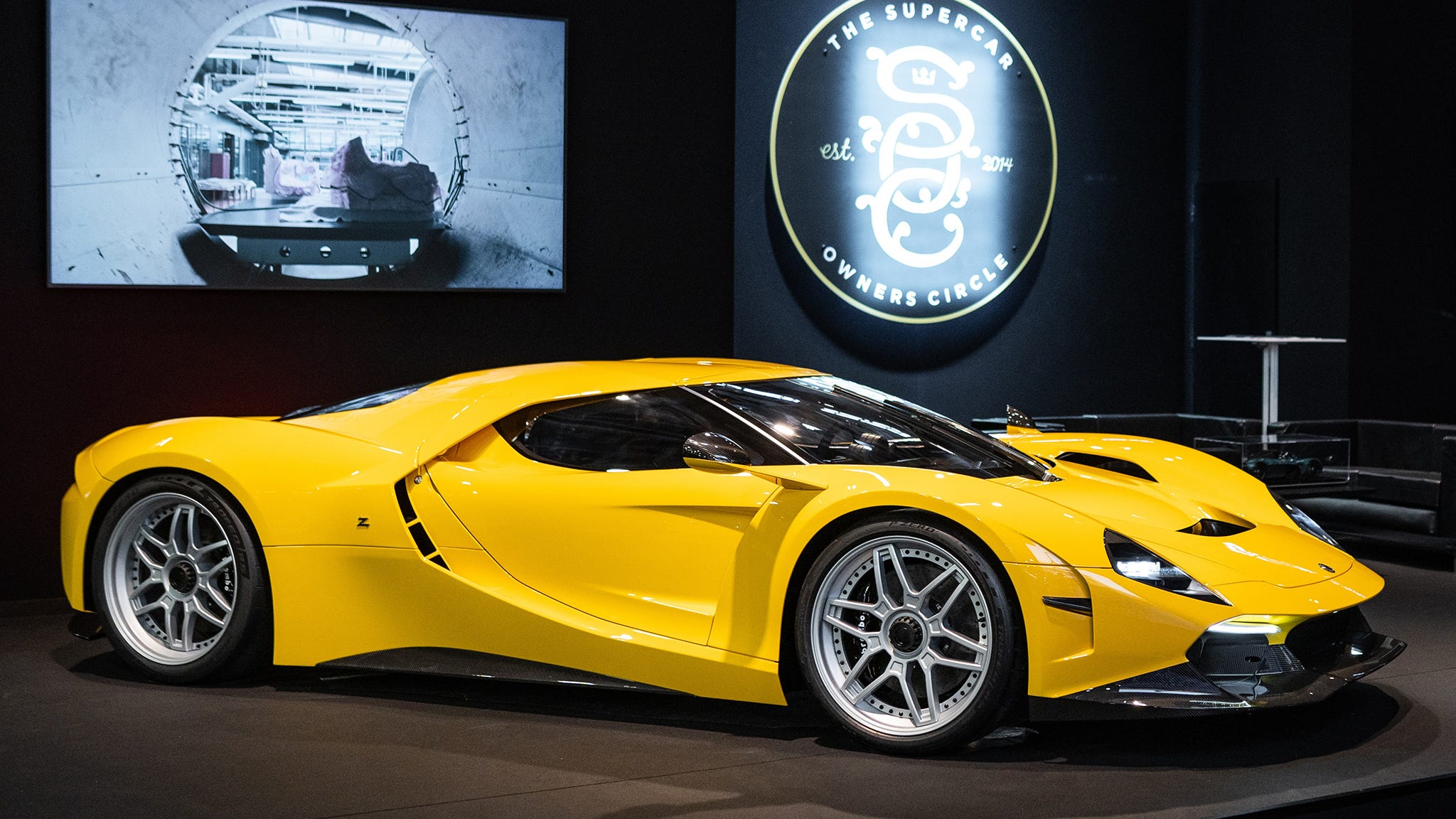
Lightweight, Clean Aero, and a Focus on Feel Over Flash
That fast top end is partly due to the absence of large, drag-inducing wings and other showy aero gewgaws. “We decided in the very beginning to have a clean car, with no flics and flaps or big spoilers because they would just disturb the design,” Hartelt said. Almost all the aero work is therefore done under the car, courtesy of a floor design that works with front and rear diffusers and a subtle rear spoiler to provide meaningful and consistent levels of downforce. “We were not aiming for a downforce monster,” Hartelt said. “We wanted a constant ratio between downforce front to rear to maintain balance, which is important for non-professional drivers. It’s no fun to drive a car where the aero changes drastically. We did not want this to be a nervous car.”
For all the race-face engineering, the Capricorn 01 Zagato will not be a penalty box to drive like the deafeningly loud and claustrophobic Aston Martin Valkyrie. The relatively roomy cabin will accommodate drivers up to 6 feet, 6 inches tall. The seats, equipped with Schroth four-point harnesses, are fixed, integrated into the carbon-fiber safety cell. To accommodate drivers of different heights and shapes, the seat cushioning is fully adjustable, as are the steering column and pedal box. Uniquely, the Capricorn Zagato’s shifter can also be moved through 3.2 inches of fore and aft travel along the center console so it’s always within ideal reach.
Although carbon fiber dominates the interior and it doesn’t come with an audio system, the Capricorn 01 Zagato features switchgear and interior parts machined from solid titanium and aluminum, Connolly leather on the seats, and Alcantara on other surfaces. The pared-back dashboard features an analog instrument cluster with a large centrally located tach, a speedo to the left, and a binnacle on the right that houses the fuel, oil temperature, and oil pressure gauges. The three-spoke steering wheel is Capricorn’s own design and is trimmed in Connolly leather. The only additions to the wheel are the engine start-stop button and the controller that allows the driver to switch between Comfort, Sport, and Track drive modes.
ADVERTISEMENT – CONTINUE READING BELOW
Capricorn plans to build just 19 of the 01 Zagato coupes, with prices starting at the equivalent of $3.5 million, plus shipping and tax. Why 19? That’s an homage to Zagato, which was founded on the 19th of April 1919. The 01 Zagato has been homologated as road legal in the E.U., U.K., Switzerland, Japan, Mexico, Canada, and the Middle East, but Hartelt says it’s already attracting considerable interest from well-heeled enthusiasts in the U.S. looking to import the car using show or display permits. “I think one-third of the cars will maybe go to the U.S.,” Hartelt said. “We did not expect that.”
What’s more intriguing is the 01 Zagato won’t be the last hypercar from Capricorn. “We’ll definitely do a new model,” Hartelt said. “It’s already in preparation. We want to share the technology of the platform we have developed.” The new car will thus be mid-engined, but Hartelt says it will have a different shape and silhouette. If the design, engineering, and craftsmanship of the Capricorn 01 Zagato is anything to go by, it should be an impressive machine.