

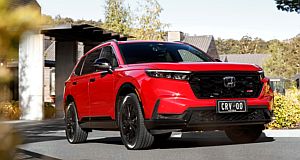

HONDA Australia says its revised CR-V medium SUV will join an incoming range of new and updated models that will drive up total sales volume for the importer by the order of 10 per cent by year’s end.
The Japanese car-maker sold 15,383 units nationally in 2025, an improvement of 9.2 per cent on the preceding year.
Honda Australia director of automobiles Robert Thorp said this will be improved again in 2026, suggesting the brand is in a phase of sustainable growth.
“When you look at year-on-year sales results to the end of March 2026 – which was build off significant improvements in the business that aren’t necessarily seen at the front-end – we are in a very solid position,” said Mr Thorp.
“We have laid great foundations on which to build additional growth into 2026, and that’s in spite of a market we are expecting to remain rather flat.
“(In hard numbers), we are looking for another 10 per cent this year … which will come largely from new product entering the portfolio.”
But for now, the focus for Honda Australia remains somewhat transfixed on growing its CR-V footprint.
Competing in the dominant sub-$65 medium SUV segment, the CR-V has found more than 244,000 Australian buyers since it debuted in 1997.
Six generations on, the CR-V remains a staple of the Honda line-up, and a vehicle that is capable of growing the brand’s segment share, despite a notable increase in the number of rivals.
“I think there is further scope for improvement with the CR-V … driven largely by the updates we have introduced today and our transition to electrification through hybrid technology,” said Mr Thorp.
While Honda is set to introduce a battery electric model to market soon, it is noteworthy that its CR-V arrives without a plug-in hybrid alternative, relying solely on petrol and petrol-electric hybrid power in its bid to draw in Australian buyers.
“While the market is shifting and changing quite rapidly, we think that is actually the right strategy for now,” Mr Thorpe said of the current CR-V’s driveline strategy.
“Hybrid (technology) in particular doesn’t require any consumer behavioural change, it is actually an easy transition for people to make. It also provides the sort of power and driving capabilities that people want.
“Honda has been in the hybrid space for a long time, and in fact were pioneers in many ways. Now, we are seeing that over half of the sales in the (sub-$65K medium SUV) segment were electrified or hybrid in nature … that is where the mass market is naturally moving.”
In meeting that demand, Mr Thrope suggested that up to 80 per cent of Honda Australia’s sales volume could come from hybrid-powered vehicles by the end of 2026, possibly driving a Toyota-style push to delete petrol-only offerings from much of its line-up.
“While I don’t have a definitive time on when that will happen, I would say it’s probably not too far away,” he told GoAuto.
“My estimation would be somewhere between 2027 and 2028. We will make that adjustment strategically when the market shifts, or as consumer preferences shift.
“But it is likely our (CR-V) line-up will become all-hybrid.”
While the forecast success of the CR-V for Honda Australia marks a turnaround of sorts, the hard data suggests sales of the once-dominant medium SUV have slipped significantly since the importer moved to an agency style sales model in July 2021.
VFACTS figures show sales of the CR-V have fallen considerably since a high of 16,107 units in 2018 to a low of 5547 units at the end of 2024.
Last year, Honda Australia sold 5595 examples of the CR-V locally, giving the model a modest 2.3 per cent segment share against a field now comprising 33 entrants – including a growing number of lower-priced electrified models from Chinese brands.
During the first quarter of this year, Honda sold 1850 examples of the CR-V in Australia, giving the model a 3.2 per cent share of the segment and placing it just outside of the segment top 10.
Year to date, the CR-V ranks eleventh in the sub-$65K medium SUV segment behind the Chery Tiggo 7 (2323 units and 4.1 per cent share), Subaru Forester (2979 units and 5.2 per cent), and Nissan X-Trail (3761 units and 6.6 per cent).
In the transition to a new-generation model, Toyota’s usually big-selling RAV4 managed just 3842 units for a 6.7 per cent share, outsold by the GWM Haval H6 (3844 units and 6.7 per cent), Kia Sportage (4322 units and 7.6 per cent), BYD Sealion 7 (4486 units and 7.8 per cent), Hyundai Tucson (5476 units and 9.6 per cent), Mazda CX-5 (6247 units and 10.9 per cent), and Mitsubishi Outlander (6363 units and 11.1 per cent).
Honda versus CR-V sales 2016-26*:
*Sales data supplied courtesy of VFACTS.
^Forecast model sales based on Honda Australia’s projections