

BMW Group, which includes BMW, BMW motorcycles, Mini, and Rolls-Royce, has a growing problem on its hands: The rich keep getting richer. Per the UBS Global Wealth Report, the number of millionaires has quadrupled since the year 2000. According to Forbes, the total amount of money the world’s billionaires had in 2000 was less than a trillion dollars. In 2025, that sum grew to over $16 trillion. What do you do when there are more people, with a lot more money, and you have about a $200,000 gap between the most expensive BMW (~$160,000) and the least expensive Rolls-Royce (~$340,000)?
Well, first you find an appropriate brand that fits this gap and buy it, which BMW did in 2022 when it announced it had acquired the rights to Alpina, the aftermarket tuning house long associated with the Roundel. Then, you announce a strategy to take Alpina upmarket as an ultraluxury brand to compete with the likes of Mercedes-Maybach and high end Porsches.
ADVERTISEMENT – CONTINUE READING BELOW
And lastly, you give the automotive enthusiasts and the BMW faithful something to send them spinning, gasping, and drooling over until your first production BMW Alpina vehicle hits the market, in late 2027.
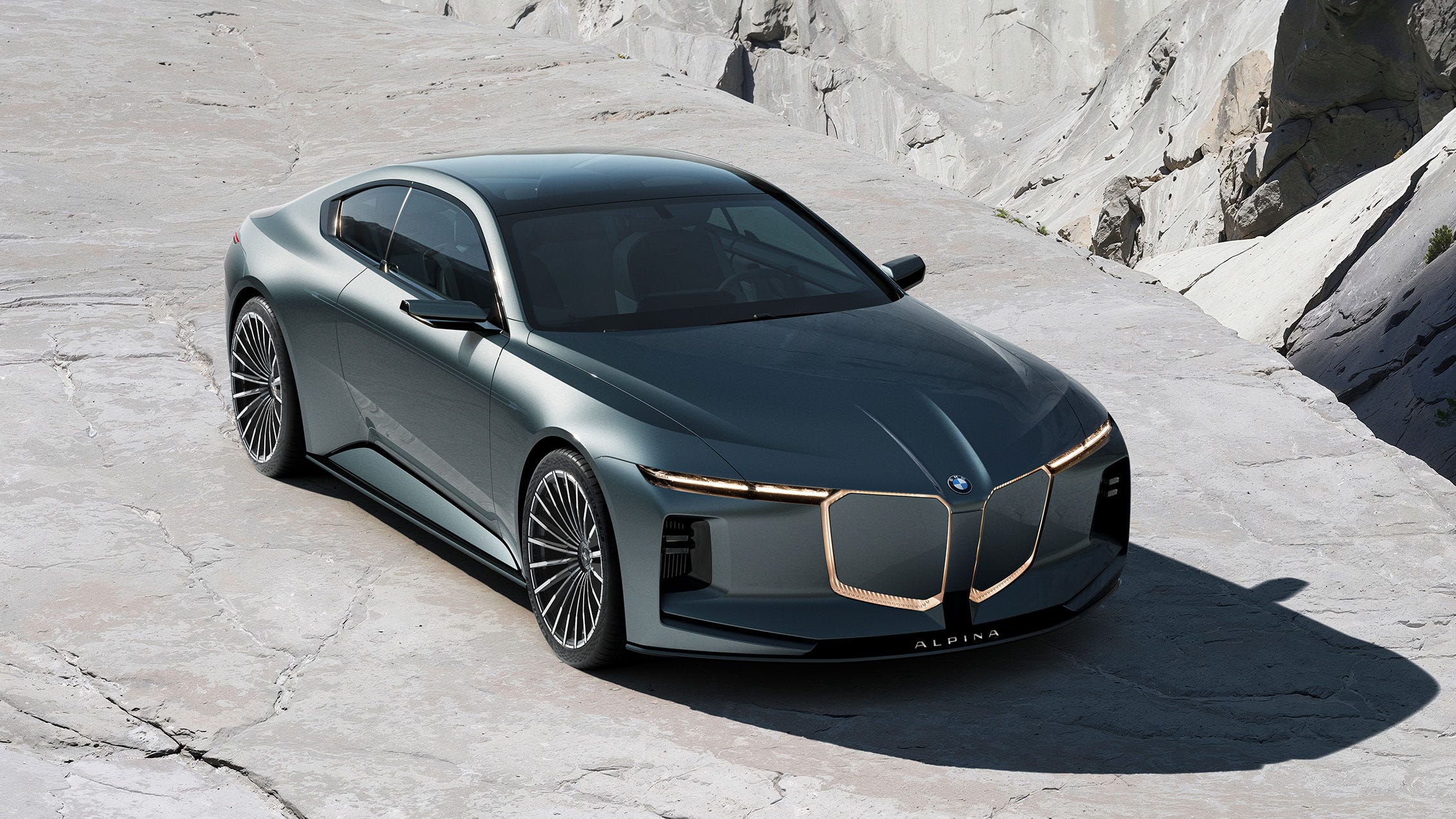
BMW used the 2026 Concorso d’Eleganza Villa d’Este for the trifecta, by unveiling the Vision BMW Alpina, a one-off design study previewing the future direction of the newly integrated BMW Alpina brand. As the first concept car since the acquisition, Vision BMW Alpina signals how BMW intends to preserve Alpina’s long-standing identity and credibility, while repositioning it within the BMW Group’s luxury hierarchy.
ADVERTISEMENT – CONTINUE READING BELOW
Classic GT Shape and Sound
At 204.7 inches long, the four-seat coupe carries familiar Alpina themes into a more restrained and contemporary form. The proportions are classic grand tourer: long hood, low roofline, wide stance, and a cabin designed to accommodate four adults in comfort. BMW says the concept is powered by a V-8 engine, with an exhaust tuned to deliver the subdued but distinctive character long associated with Alpina road cars. We also expect gobs of torque available on demand for effortless acceleration and high-speed cruising.
Shark Nose and Speed Line
The exterior design centers around what BMW calls the “speed feature line,” a character line that begins at the front fascia and runs the length of the body, rising by six degrees as it does, before wrapping around the rear. The front end itself revives Alpina’s historical shark nose treatment and forward-leaning stance, first seen prominently on cars like the Alpina B7 Coupe of the late 1970s. Here, BMW’s kidney grille becomes a three-dimensional sculptural element integrated into the nose rather than a separate graphic feature.
ADVERTISEMENT – CONTINUE READING BELOW
Many of the details are intentionally understated. Alpina’s deco-lines, the brand’s signature pinstripes, are now painted beneath the clear coat for a cleaner appearance. Dark metallic finishes appear on recessed surfaces, while hidden lighting elements and subtle graphics inside the grille reinforce what BMW designers describe as a “Second Read” philosophy—details intended to reveal themselves gradually rather than dominate at first glance.
Other traditional Alpina cues on the concept include elliptical quad exhaust outlets and familiar 20-spoke wheels measuring 22 inches in front and 23 inches in the rear.