


Overview
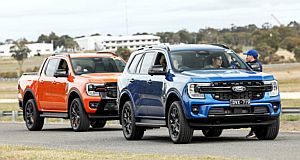
IF IT ain’t broke, don’t fix it, or so the saying goes. Yet late last year, Ford announced a significant shake-up for its winning Ranger ute and Everest SUV line-ups for MY2026.5, the former being Australia’s best-selling model for three consecutive years.
The 2.0-litre Bi-Turbo diesel engine choice was discontinued globally, with the six-speed automatic transmission joining it on the chopping block.
Save for the petrol twin-turbo V6 beneath the bonnet of the Ranger Raptor and the Hybrid model’s PHEV powertrain, this leaves two engine choices for the main Ranger and Everest line-ups for 2026 and beyond, with all variants of both models now equipped with a 10-speed automatic transmission.
Now with an upgraded timing chain and fuel injection system, the 2.0-litre single-turbo diesel four cylinder – which still produces 125kW and 405Nm – has become the base engine option for the Everest, while being available in both 4×2 and 4×4 configurations in the Ranger.
The 3.0-litre turbo-diesel V6 – which is now available in a wider range of variants including the base trim levels of both the Ranger and Everest – meanwhile continues to make 184kW and 600Nm.
But the removal of the Bi-Turbo isn’t the only change made to each line-up for 2026…
As mentioned, there’s now greater V6 availability, but plethora changes also include new variants and revised trim levels.
For instance, the Ranger XL and XLT cab-chassis models’ list of standard safety features has been updated and includes a digital reversing camera, reverse brake assist, rear parking sensors, a blind-spot information system with rear cross-traffic alert, and a lane change warning aid.
Meanwhile, the XL receives dual-zone climate control as standard, XLT Double Cab Chassis models benefit from heavy duty suspension as standard, while the Wildtrak receives a 10-speaker sound system, and Matrix LED headlights.
The off-road-focused Tremor model has also returned for a limited time, now available in 3.0-litre V6 guise as opposed to the Bi-Turbo engine offered previously.
Another limited edition model, the Wolftrak, has also joined the line-up, positioned below the aforementioned Tremor, arriving with 17-inch black alloy wheels with all-terrain tyres, two front tow hooks, green exterior accents and decals, a honeycomb grille, pro-trailer backup assist, a 360-degree camera with trailer guidance, Mud/Ruts and Sand off-road driving modes, and vinyl seats with ‘Wolftrak’ embroidery, while also being available in a unique ‘Traction Green’ paint colour.
Meanwhile, for the Ford Everest, a new entry-level Active model has replaced the Ambient and Trend variants, with standard features including 18-inch alloy wheels, leather accented seats, privacy glass, tyre pressure monitoring, seating for five (with seven seats available as a $1350 optional extra), and LED headlights.
A 360-degree camera is now available for the Sport and Tremor models, while the latter offers buyers the option to remove the third row of seats at no additional cost.
All variants of both the Ranger and the Everest come equipped with a 12.0-inch touchscreen, compared to the 10.1-inch unit previously used for lower-spec model grades.
For the 2026 Ranger, prices span from $37,130 plus on-road costs for the entry-level 4×2 Single Cab-Chassis model, all the way to $90,690 + ORCs for the Raptor variant.
The cheapest V6 Ranger is available in 4×4 XL Single Cab-Chassis guise, priced at $52,100 plus on-road costs, compared with the equivalent outgoing Bi-Turbo model’s $48,230 + ORC asking price.
Previously, the cheapest V6 Ranger available was the XLT Double Cab, priced at $67,190 + ORCs.
Everest prices meanwhile range from $58,990 + ORCs for the entry-level Active in 2.0-litre guise, while the flagship Platinum V6 comes in at $83,490 + ORCs.
Compared with the outgoing entry-level Bi-Turbo, the new base model Everest is $500 cheaper, while the Platinum V6 is some $500 more expensive than before. However, if you want a base-model V6, you’ll be paying $66,990 + ORCs.
The previous cheapest Everest V6 model was the Sport variant, wearing a price tag of $75,990 + ORCS.
For more specifics on the full list of changes made to the Ranger and Everest you can visit our full pricing and specifications piece here.
A full-size spare is standard across the Everest and non-hybrid Ranger line-up. For the PHEV Ranger variants, it is available as a no-cost optional extra for all variants.
Servicing pricing and intervals for the updated Ranger and Everest is yet to be officially published by the brand.
Both the Ranger and Everest are offered with 12 months of roadside assist, extended for another year with general service completed at a participating dealer for up until the vehicle reaches seven years of age.
Both models are backed by a five-year/unlimited kilometre warranty.
Driving Impressions
At the Australian media launch of the updated Ranger and Everest, GoAuto drove the Everest Active 2.0-litre and the Everest Sport V6 on the road, while also having the opportunity to sample several additional variants of both the Ranger and Everest at the Blue Oval’s You Yangs Proving Ground.
The 2.0-litre Active model largely delivers what we’ve come to expect from the Everest’s driving experience.
Its ride is comfortable and surprisingly refined, especially for a ute-based SUV and despite its size and weight, its body control is solid too. The steering isn’t brimming with feedback, but it’s appropriate weighting makes up for this.
The 12.0-inch infotainment touchscreen – which is now standard on all variants of both the Everest and Ranger – is slick and easy to navigate, and does particularly well to not overload its users with too many options and sub-menus.
Combined with the cabin’s physical controls – including those for the HVAC, media volume and, and four-wheel drive modes – make the Everest (and indeed the Ranger) easy to interact with.
However, the standard 8.0-inch digital instrument cluster looks a little dated. The 12.4-inch unit found in Platinum variants of the Ranger and Everest appears much more modern.
When it comes to interior trim, the base-model Everest’s cabin feels more utilitarian than up-market. The cabin plastics feel a bit scratchy. If it’s a premium interior you’re after, the Platinum models have you covered, abound with plush leather, and wood-looking and metal touchpoints.
The base model Everest feels like quite the solid package, right up until the moment you put your foot down. As 125kW/405Nm attempts to shift a vehicle weighing in at over 2200kg, the entry-level Everest feels sluggish.
The V6 is simply a much better engine for a car of this type. It accelerates the Everest quicker and – in situations like overtaking – it provides ample grunt in a timely fashion.
Our road drives in the Everest Active 2.0-litre and the Sport differed in nature, both in terms of length and the roads on which we were driving.
We drove the Active model from Essendon Fields in Melbourne to a truck-stop just outside Rockbank, a journey which comprised stop/start urban traffic with a short motorway stint, during which it returned 8.9 litres per 100km.
Our journey from the You Yangs Proving Ground to Melbourne airport – much of which was motorway driving – saw the Sport V6 return a fuel number of 8.3L/100km.
As for the Ranger, a quick spin over a bumpy You Yangs testing track in the Platinum V6 revealed confirmed that Ford’s ute best-seller has retained the exceptional ride quality we’re come to expect from the current generation model.
We also had the opportunity to try the new Wolftrak model on You Yang’s off-road course. While lacking some of the off-road kit of the Tremor – such as the Trail Control feature, General Grabber AT3 Tyres, and Rock Crawl mode – the Wolftrak proved itself immensely capable when the going gets tough, tackling the course with no undue issues to report.
The Wolftrak’s unique aesthetic attributes and Mud/Ruts and Sand driving modes also allow buyers to get into something with off-road, rugged appeal without necessarily needing to splash the extra cash for the Tremor.
Ultimately, the Ranger and Everest update brings with it more standard equipment, greater V6 availability, and new variants such as the Ranger Wolftrak, all of which will likely appeal to many buyers.
However, the 2.0-litre single turbo doesn’t quite feel up to scratch for the Everest, undoubtedly leaving a sour taste in the mouths of buyers who may previously have sought after a Bi-Turbo example.
In the case of the Everest at least, the V6 is almost unquestionably the one to have if you splash the extra cash.
It’s important to note that we’re yet to witness the full extent of the Everest and Ranger’s changes in the real world. For instance, we’re yet to test a non-Super Duty V6 Ranger in cab-chassis form…
Overall, however, the post-update Ranger and Everest (in the case of the V6 models anyway) continues to deliver what buyers have come to expect from these two, highly popular models, proving Ford’s ladder frame duo has what it takes to compete with Australia’s top sellers.