

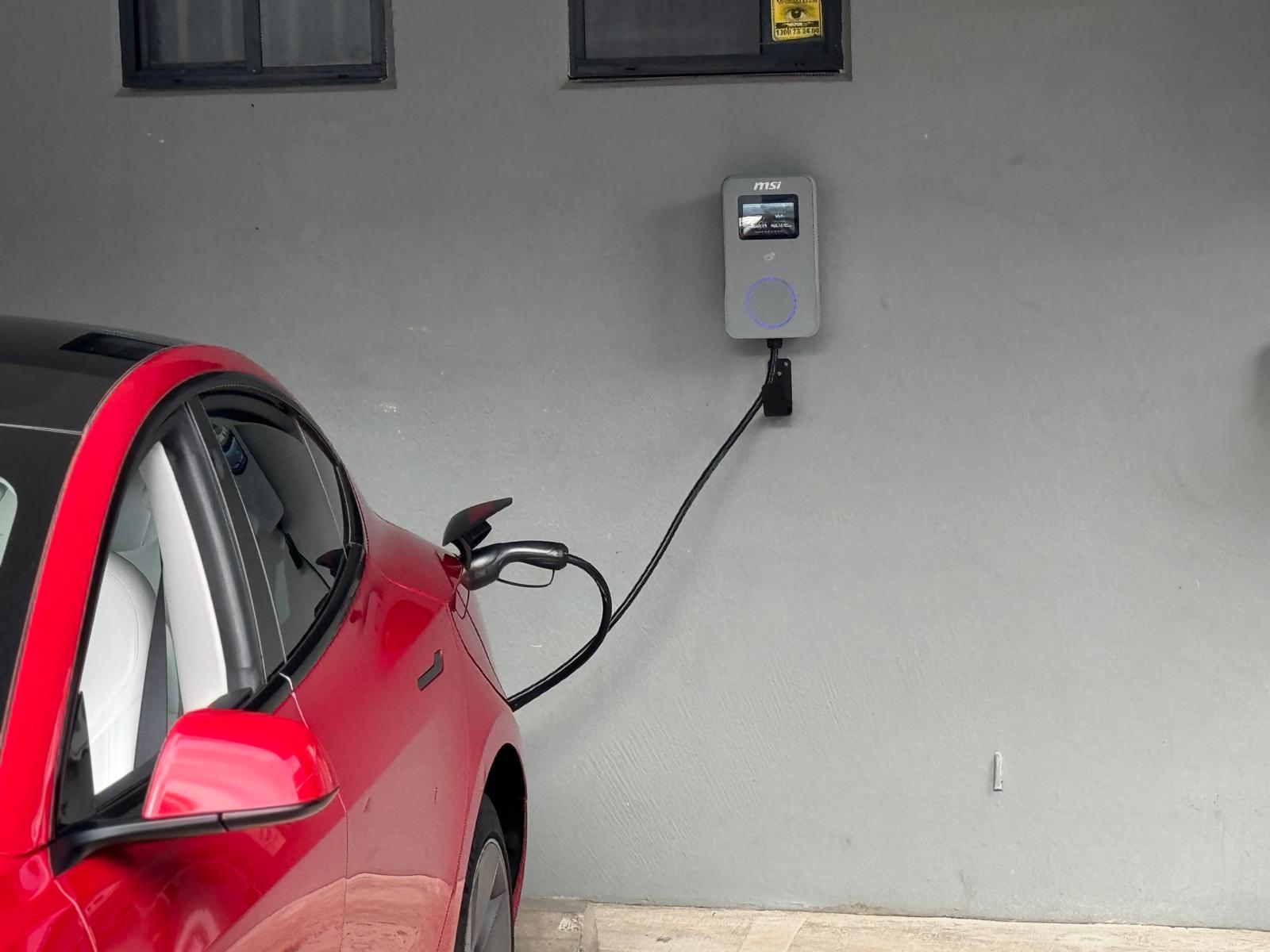
For most EV owners, home charging should quickly become one of those things you stop thinking about. You arrive home, plug the car in, and expect it to be ready again in a few hours or the next morning.
That means a good home charger arguably needs to do two things: offer enough intelligence to work with solar, charging schedules and changing electricity tariffs, while remaining simple enough that none of those features get in the way of simply plugging the car in.
MSI is better known for its computer hardware, but its Eco Series EV chargers bring the company’s electronics background into a rather different part of the home.
The Eco Series can operate on either single or three-phase power, delivering up to 7kW on a typical single-phase connection or as much as 22kW when connected to three-phase power. Both use a tethered Type 2 cable measuring a generous 7.5 metres.
There are plenty of EV chargers with slick apps and smart-energy claims. But the physical installation can matter just as much.
A 7.5-metre cable gives considerably more flexibility over where the wallbox is installed and where the car needs to be parked. This is particularly useful for households with two cars, awkward driveways or vehicles whose charging ports are on opposite sides.
MSI has also allowed the electrical supply to enter the charger from the top, bottom or rear, giving the electrician more flexibility to produce a clean installation rather than designing the installation around the charger.
The charger itself is reasonably compact at 351mm tall, 204mm wide and 113mm deep, and weighs 3.5kg excluding the charging cable. It can be wall-mounted, with a pedestal installation also available.
There are two main versions. The simpler Eco Life uses MSI’s circular LED indicator to communicate charging status, while the Eco Premium adds a five-inch display that can show information including voltage, current, energy delivered and charging time.
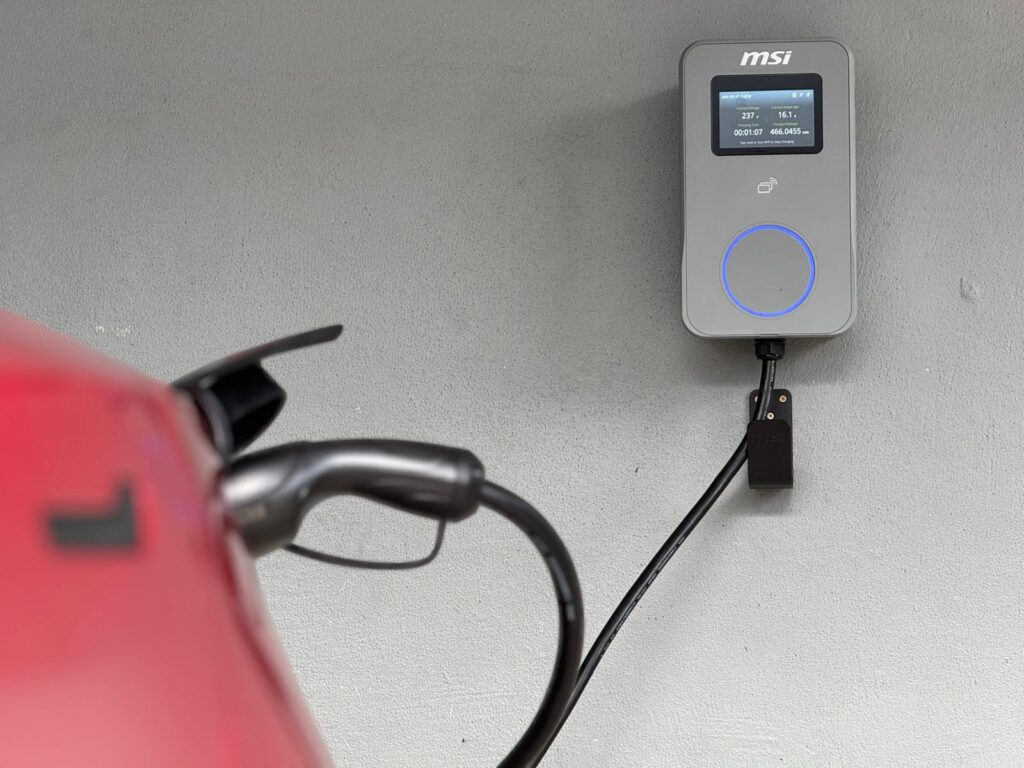
The display is nice to have, but it isn’t necessarily something every home user needs. Once an EV charger is configured correctly, the amount of time most owners spend standing in front of it checking the screen is probably measured in seconds rather than hours.
The headline charging rate is up to 22kW, although there is an important caveat with any AC charger carrying that number.
You will need a three-phase electrical connection and an EV capable of accepting 22kW AC charging to actually get 22kW into the battery. Plenty of EVs are limited to 11kW or even 7kW AC charging regardless of what the wallbox can provide.
For a typical Australian home with single-phase electricity, the Eco will instead deliver up to 7kW. That is still substantially quicker than charging from an ordinary power point and, for most drivers, enough to replenish a typical day’s driving comfortably overnight or for a few hours during the day.
The Eco Series can be managed through MSI’s aConnect app, which lets the owner monitor charging, change the charging current and create charging schedules. RFID cards can also be authorised through the app.
Scheduling is becoming increasingly important as electricity plans become more complicated. An EV charging at 7kW is potentially one of the largest electrical loads in a house, so shifting that load into cheaper overnight periods, or into the middle of the day when rooftop solar is abundant, can make a meaningful difference to running costs.
MSI includes an automatic charging mode designed to recognise an authorised vehicle and begin charging when it is connected. For a household charger, being able to configure it once and then mostly forget about it is the ideal setup.
For homes where access needs to be controlled, such as an apartment car park or a charger accessible from the street, RFID authentication provides another option.
MSI labels the Eco Series “solar ready”, with the more advanced versions supporting OCPP integration. It’s an increasingly important capability in Australia, where charging an EV directly from excess rooftop solar can be one of the cheapest ways to run a car.
It’s worth noting that “Solar ready” doesn’t by itself mean the wallbox magically knows how much excess solar is available at your house. The actual functionality will depend on the model, the energy-management or OCPP platform it is connected to, and other hardware installed at the property.
The Eco Life Commercial and Eco Premium versions support OCPP 1.6J, with optional over-the-air migration to OCPP 2.0.1 listed by MSI. The home version of Eco Life does not list OCPP support, which is something worth noting particularly if solar integration or participation in a broader smart-charging system is part of the plan.
The Eco Series carries an IP65 rating for the charger itself and IP67 for the charging cable, along with an IK08 impact rating. MSI specifies an operating range from -30°C to 55°C and says the unit has also undergone salt-spray testing to IEC 60068-2-11.
That makes it suitable for exposed outdoor installations, including the sort of hot, wet and coastal environments that aren’t difficult to find in Australia.
MSI has also put considerable emphasis on electrical protection. The Eco includes built-in residual-current monitoring along with protection for surges, ground faults, under- and over-voltage, over-current and over-temperature events, plus relay-welding detection.
The charger is RCM certified for Australia, while MSI says it is EESS certified and registered. The company provides a standard three-year warranty and says the product is covered by up to US$5 million in product-liability insurance, an important reassurance for a device permanently connected to a home’s electrical system and regularly shifting several kilowatts for hours at a time
The MSI Eco doesn’t reinvent home EV charging, rather its appeal is instead in covering most of the things owners are likely to want without making the charger unnecessarily complicated.
The 7.5-metre cable and flexible cable entry make installation easier. The choice of 7kW single-phase or up to 22kW three-phase gives it room to suit different homes. While scheduling, remote control and RFID access add genuinely useful smart features.
For more sophisticated installations, the OCPP-equipped versions are also potentially more interesting than a wallbox locked permanently into one manufacturer’s ecosystem.
There are still a few things buyers should establish before choosing a model. In particular, anyone wanting solar-surplus charging should check exactly what additional energy-management hardware or software is required, while buyers attracted by the 22kW figure should first confirm both their household supply and their EV can make use of it.
The best EV charger isn’t necessarily the one with the longest feature sheet. It’s the one that works with your electrical supply, your solar system, your car and the way you actually park it.
On those practical measures, MSI’s Eco Series looks to have concentrated on the right things.
The MSI Eco Premium will be available from mid-October 2026.
This article is produced in partnership with MSI.