

From the July 1970 issue of Car and Driver.
OK, readers, cinch up your seat belts, stub out your cigarettes, and grab onto your grab handles. We’ve spent the last couple of months honing and massaging what was once a mildly underprivileged Opel GT, and now we’re ready. The revs are up for an end run around the insurance cartel and the government and all the other loose-talking dissidents who would have you believe that driving a car and enjoying it is just slightly less anti-social than genocide.
Why do they think a fun car has to be hostile to the environment? It doesn’t. In fact, after spending an hour or two on the choked Long Island Expressway, followed by a tearful session with the family car insurance agent, we are of the opinion that the hostilities flow the other way. The world of fun cars and car fun has changed. And like the price of draft beer, it will never again be like it was. But just as none of us has given any thought to sacrificing the brew, we aren’t fixing to abandon the car thing either. Instead, we’re going to try a different tack. If big cars won’t slip through the holes in traffic any more, we’ll try something smaller, and if the white-collared chart readers at State Farm and Allstate insist on putting a bounty on horsepower instead of on the drunken and accident-prone driver where it belongs, we’ll feed our driving appetites on something more sophisticated—and something they won’t understand for another 15 years. And while we’re at it, since we all have to breathe the air we drive in, we will make use of every exhaust emission control device available. And do you know what? A car like that can be as electrifying as any you’ve ever driven. We’ve got the prototype almost finished, and already the Publisher wants it for the weekend.
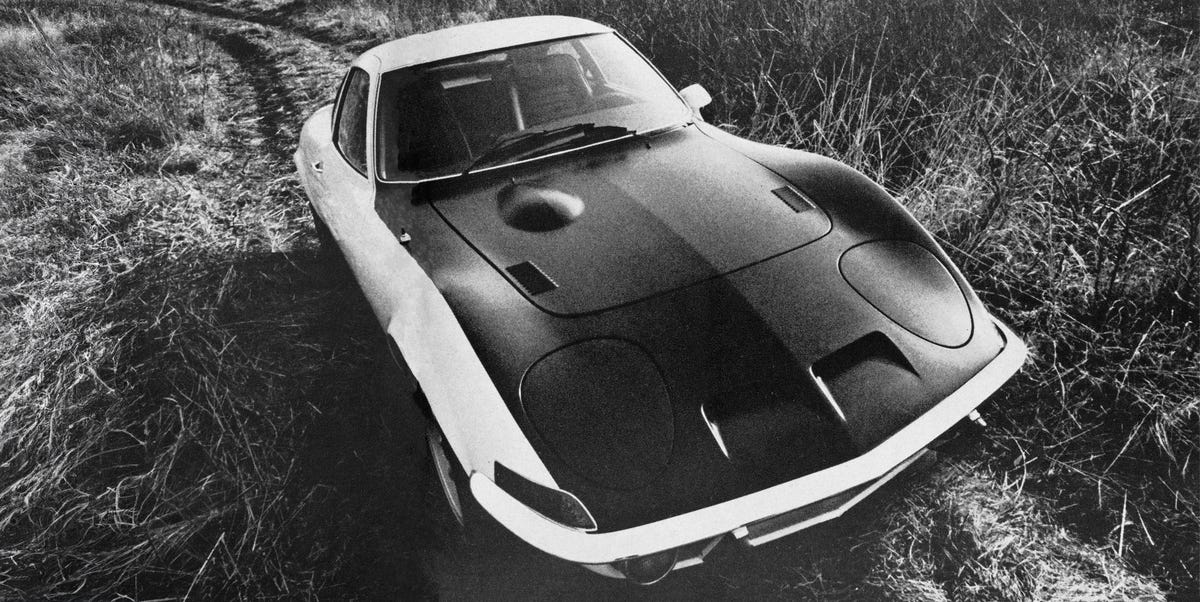
Unless you haven’t guessed, you’re about to meet our new project car. It used to be an Opel GT, but that was so far back we can hardly remember it. You might be asking why we picked an Opel after all the unkind things we’ve said about them (C/D, September, 1969). It wasn’t hard. We settled on an Opel GT because we like the looks of it. There was a little more. We wanted a small, 2-passenger coupe, something that didn’t cost too much and yet had potential.
The Opel GT has potential. You know it the minute you snuggle into the cockpit, reach out for the racecar-size steering wheel, and snick through a couple of gears. Right on. Who needs an Aston Martin when you can have an Opel GT? But then, when you take it around the block, you can see why Buick is willing to part with them for $3324 a copy. The engine sets up a ruckus that a Farmall tractor can’t match, and the car corners like the tires were bagels on a road covered with cream cheese. Who needs it? The delivery boy from the corner deli, maybe. But that brings up a very important point about project cars—if you start with one that’s perfect, it can only get worse. On the other hand, if you start with one that could use a little help, with only average luck and an engineering degree you can be a real hero. As a project car, the Opel is magnificent.

Of course, there’s more to this scheme than just shaping up a car. It gives the staff a chance to let it happen with a car that the accounting department has to pay for. Knowing that, the art department was not to be denied its chance at designing a trick paint job, and the frustrated Bruce McLarens from every corner of the office had to have a chance to play with the Opel’s innards and satisfy a few accumulated curiosities. And we do have curiosities. Next to “Who’s up for lunch?” the question most often heard within the C/D walls is “What happens if…?” What happens if you put on fat tires? What happens if you add a rear antiroll bar? What happens if you stick on a spoiler? What happens if you blueprint an engine? Does all of that stuff do enough so that an average driver could feel it on their own car, or do you have to be Sam Posey at Lime Rock to tell the difference? We’re finding out.
When we are all done, we may not have a handle on your Riley Elf or your Delmont 88, but we’ll sure know what it takes to make an Opel GT work. At this point, we should admit that all of this mechanical mayhem isn’t happening in the editor’s office. We’ve enlisted an outside contractor, selected from the multitude of racecar shops based on equal parts “what we think they know” and nepotism. About a year ago, Jack Cowell—a one-finger typist who kept C/D’s Sport and FYI pages full—gave up his vocation in journalism to become manager of the newly formed Competition Research in Blauvelt, New York. And because of great native ability, he has already transformed himself into the car parts equivalent of a Snake Oil salesman. But while Cowell was emerging in his new role, the other partners in the back room who make the cars go were turning loose some hard-running Formula Fords and Vees. And that is the interesting part. If they could squeeze horsepower out of Fords and Vees, both tight rules classes, then perhaps they could summon a few extra horsepower from within our Opel without violating the emission control system.
It would seem that the search for power is always the same. No sooner was the Opel in the shop than they had the engine unplugged and scattered piece by piece from one end of the shop to the other. And after much honing, turning, grinding, and polishing, the word came down that it was finally “blueprinted” and ready for the dynamometer. The head had been ported (Competition Research is very big on porting heads), the compression ratio had been lowered fractionally with a thought toward lead-free gas, and an exhaust header had been fabricated in the manner that works well on Formula Fords. Of course, because the project car must conform to emission regulations, the original carburetor, distributor, and associated valves and diaphragms were not changed. This kind of restriction on an engine is like making a boxer wear a straitjacket, but even so, the little Opel four-cylinder still managed to generate exactly 100 horsepower—only two less than what is advertised. We haven’t taken the car to the test track yet, but it feels strong on the street and speaks with an irreverent buzz from its exhaust. And best of all, no insurance agent or bureaucrat, no matter how well-meaning, will go into a conniption fit over a 100-hp Opel.

However fruitful the labors on the engine are, they will be overshadowed by the improvement in handling. We have already mentioned that the standard Opel has a long way to go before you can consider it agile, but this one has come a long way. And it hasn’t been difficult—chiefly because the needed improvements are obvious. Look at the tires on a normal Opel GT—miniature 165HR-13s. And Buick demonstrates a lack of concern for handling when it imports all of the GTs into this country without anti-roll bars. European models are available with both front and rear bars and a limited-slip differential as well, but nobody at Buick seems to know, or wants to know, anything about that. And even though we had an order code number, no one could be persuaded to follow it up. But there are other ways. There is a West Coast company, with the unlikely name of Super-O, that makes Opel anti-roll bars—they are a little crude, but for the price, you probably couldn’t make better ones in your basement.
And when you get the suspension to work, you finish off the job by gluing the car to the pavement with a set of man-size tires. There is no doubt that tires can do more for handling than any other bolt-on suspension part or adjustment. With the Opel, we’re following a hunch. Goodyear’s 60-series Polyglas tires do a remarkable job on heavy, high-powered Detroit performance cars, and we wonder if the effect would be so dramatic on a European sports car. To find out, we’ve chosen the smallest of the available 60-series tires, E60-15, and mounted them on 15 x 7-inch Minilite wheels. The overall tire diameter is indeed somewhat larger than is convenient on the Opel but, because of the extreme low profile design, the diameter is actually less than that of a 14-in. 70-series tires of the same load-carrying capacity. And the 15-inch rim size is advantageous because it allows the wheels and tires to clear the Opel’s front suspension control arms and steering linkage without using an outrageous wheel offset—something that would not have been possible with a 13-inch wheel/tire combination of the same width. The most incredible part of this whole story is that it is not necessary to reform the Opel’s outside sheetmetal to use the big tires. The inner panels in the front needed some heavy hammer work, but not the fender itself. As you might expect, some lowering of the suspension and a change of axle ratio were necessary to compensate for the tall tires, and this has been done—all in the spirit of ”What happens if …. “
And after driving the car, we like what has happened. It’s now a zippy little machine that corners with a combination of grip and balance that will worry Porsches to death. Of course, like all project cars, it’s not really finished yet. We’re still testing and adjusting and looking for ways to make it even better. Right now, we’re experimenting with different seats and kicking around the pros and cons of a roll bar. But all of this tinkering will end soon, and next month we’ll have a full report on the trials, tribulations, and bountiful rewards of escaping the hostile bureaucrats in Washington and points west in our 100-hp coupe. And, as a final step to discourage the kind of harassment that the whole car community has had to endure lately, we’re thinking of naming it J. Edgar Opel.