

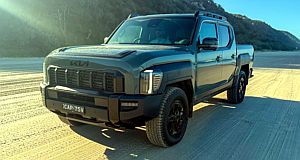

Long-Term Tests
GOAUTO’S reviews aim to make your choice of vehicle easier, whether it’s a passenger car, an SUV, or a light commercial utility like the Kia Tasman.
Our long-term tests offer a particularly valuable insight into vehicle ownership, diving deeper into the individual elements owners come to love – or hate.
Over the course of three months, we live with the vehicle as an owner would, paying for fuel and servicing, and experiencing both day-to-day driving and the qualities a specific model seeks to offer.
We believe long-term tests are a terrific way to understand a vehicle more completely, helping buyers decide whether a model is right for them, and just how well it will serve them in the long haul.
Overview
The Kia Tasman has echoes of the original Volkswagen Amarok. Both came out swinging as their respective brands’ first one-tonne ute, both took a go-it-alone approach in a segment where badge engineering is the norm, and both raised the bar in terms of thoughtful design touches and interior quality.
When the Amarok launched Down Under in 2011, it scored a number of firsts including electronic stability control, a five-star ANCAP rating, and official fuel economy figures that dipped below 8.0L/100km, not to mention ride and handling that eclipsed many contemporary SUVs.
Once the eight-speed automatic transmission option was added to the previously manual-only Amarok, packing three more ratios than most of its contemporaries, GoAuto’s early reviews highlighted how daring it was for VW to come out of nowhere with its first dual-cab ute and show everyone how it was done.
Then Wolfsburg brought out a V6 version of its ute and raised the bar yet again.
In contrast to the Tasman, the Amarok came as a bit of a surprise. Kia has been talking about a ute since time immemorial, so it’s had plenty of time to dream up the many quality-of-life features for its debut ute, not to mention a box-ticking exercise of payload, towing and off-road tech credentials.
The gap widens further when considering if the Tasman represents an Amarok-like reset in terms of how it drives. It doesn’t. And the conventionally handsome Amarok – which has aged fairly gracefully – stands in stark contrast to the polarising looks of the Kia.
So why do we find a top-spec Tasman X-Pro in the GoAuto garage for a multi-month long-term test?
To find out if the wow factor of its interior wears off. Whether the looks can grow or grate on us. If its 2.2-litre engine has the chops to do the job despite misgivings over its outputs and passenger car origins (a concern shared with the original Amarok’s four-cylinder engines). Or whether those thoughtful touches are a novelty to be used once and then forgotten.
What we won’t know for some time is whether Kia continues to invest in the Tasman platform as Volkswagen did the Amarok until, that is, it followed the herd with a Ford-built, platform-shared follow-up.
Kia, of course, is part of the Hyundai Motor Group conglomerate, which has the option to produce a Hyundai equivalent to the Tasman – as much as it denies it has intention to.
For now, all we can do is share our experiences from the first full month of life with a Tasman X-Pro.
Topping the Tasman price ladder at a punchy $74,990 plus on-road costs (which is purely theoretical come transaction time given slower-than-expected sales and EOFY deals at $65K drive-away), on paper the X-Pro is pocket change cheaper than a V6-powered Ford Ranger Tremor, two grand pricier than a Toyota HiLux Rugged X and, as we’re talking Amaroks, part way between VW’s V6-powered Style and PanAmericana versions.
While not the value play it once was, the Mitsubishi Triton tops out around $10K south of our top-tier Tasman with its Nissan Navara platform pal also more affordable than the Kia.
On the subject of platform pals, Isuzu’s D-Max X-Terrain is two grand less than a Tasman X-Pro and, at a grand-and-a-half less than a Tasman X-Pro is the Mazda BT-50 SP, which we had time to benchmark against the Kia during our first month of this long-term test. More on that later…
As well as the most expensive Tasman to buy, the X-Pro is the costliest to fuel, the official combined-cycle 8.1L/100km being between half a litre thirstier than most 4×4 variants and using 0.3L/100km more than the next-from-top X-Line.
Collecting the ute from Brisbane as death, destruction, and disruption in the Middle East translated into the first-world problem of high diesel prices Down Under, we noticed the four-cylinder was devouring more than the official combined-cycle as we cruised, unladen, northbound on the Bruce Highway.
On paper, the X-Pro uses 7.3L/100km on the test cycle and 9.4L/100km on the urban cycle. So far, country and motorway driving yields fuel use close to the published urban figure, with urban and suburban errands pushing comfortably into the double digits.
After a month, we’re just below 10L/100km on average.
A lot of the X-Pro’s extra thirst compared with other Tasmans is down to the X-Pro’s 17-inch alloy wheels with Kumho all-terrain tyres, as well as the higher ground clearance and additional weight of its expanded standard equipment list that includes a rear differential lock, harman/kardon premium audio bundle, a fuel tank protection plate, heated steering wheel, heated second-row outboard seats, and power-adjustable front passenger seat.
However, straying so far from the official figures makes the big Kia seem like a gannet next to the Mitsubishi Triton, which we have found to be one of the most economical diesel dual-cabs, and the 3.0-litre versions of the D-Max/BT-50 twins, which, unless towing, seem to vary little in their appetite for fuel regardless of how they are driven.
For those with an aversion to the bowser, it’s not looking good for the Tasman at the end of month one.
Aside from full-size American pick-ups and some recent utes emanating from China, the Kia Tasman X-Pro has the most bespoke-feeling, luxurious, and comprehensively equipped light commercial vehicle interior on the Australian market.
In a market where the Navara is a Triton, the BT-50 is a D-Max and an Amarok is a Ranger, the Tasman hides parts commonality with other Kias – let alone any other brands – exceptionally well. Which is probably why it has to be so expensive.
Around the premium-feeling cab of this X-Pro is a decent level of storage, including upper and lower gloveboxes common to the segment but absent are dash-end cup holders, while the door bins do a bad job of holding drinks bottles. So, you and your front passenger have to fight over two cup holders in the centre console.
Both of you do have a wireless phone charging pad, although the rubber coating in our test vehicle seemed to warp a bit from the heat generated from powering a device that is being worked hard by the wireless Apple CarPlay connection.
One of Kia’s thoughtful touches is the central armrest, which can flip over to create a kind of charcuterie board complete with a recess for dips. Or a desk with somewhere to put your reading glasses.
Second-row occupants are faced by unique large zip-up storage pouches with room for tablets, books and magazines plus a thin upper pocket for smaller items and the shape of the backrests enables a coat or bag to be hung neatly.
This is one of the most spacious one-tonne dual-cabs, including the broad centre console separating front passengers and the roomy second-row bench where elbow, head and legroom are generous.
A reclining rear bench (with storage space beneath) eliminates the typically too-upright dual-cab backrest, which also provides a better angle for our youngest’s child seat.
Dual-cabs are a royal pain for installing child seats but the Tasman is one of the least worst. There would be room for three child seats in here, but it is increasingly rare to find a ute that has the requisite anchorages in the central position.
The X-Pro interior has been subjected to abuse by children and off-road use during the past month, and we know this particular Tasman has lived a hard life in the 11,000km it covered before we took custody, but the quilted upholstery, plush surfaces, knurled everything, fancy stitching, tasteful finishes and tactile switchgear seem to be holding up remarkably well.
And, thankfully, is easy to clean.
We’ve spent many kilometres in the back, both on- and off-road, and the Tasman X-Pro impresses with the amount of room and comfort for tall rear occupants.
For interior, the Tasman is a winner in numerous regards.
We managed to get a 6x3m gazebo and two double swags into the back of the X-Pro plus an Esky, and sufficient clothes and provisions for a long weekend of camping.
The Tasman has just that bit more room in the tub than most dual-cab utes to make all the difference and wheelarch intrusion is also comparatively minimal. We’ve struggled to get this much stuff into most of the Kia’s competitors.
Given there’s no tonneau cover on this example, we stuffed bedding into an outboard rear seat of the cab, meaning an adult passenger was consigned to the middle position at the back beside the child seat in the other outer position.
In most utes this would be hell but in the Tasman it was tolerable enough to manage a nap.
Anyway, back to the tub, which also has a 240-volt power outlet (an engine-on affair as this isn’t a hybrid) and lights on both sides, the steps on the rear bumper make a big difference when climbing in to arrange loads and the tailgate (which is secured by the central locking) is damped just enough to open promptly but gracefully.
Similarly well-judged is the tub liner surface, which is grippy enough but not so grippy that is makes sliding loads in and out difficult. It also seems to be holding up well to abrasions.
Whether using all the available tub space for camping or just some beach gear for a day of sand driving, the Tasman’s well-designed tie down points have been a constant source of delight.
Some are movable on rails along the upper edges, the others mid-way down the corners with loops for straps and windings for rope. We’re yet to fail to find a workable combination.
Another feature that we use regularly is the little storage area in the rear driver’s side wheel arch trim, again secured by central locking and with enough space for ropes, straps and tent pegs plus the fold-down cover provides a handy surface for refreshments.
During our stint in the back while the tub was loaded with bulky but not super-heavy camping equipment (plus another adult, a 10-year-old and a five-year-old onboard), we couldn’t help but sense that the rear suspension was bottoming out over bigger hits.
It was more of a soft thud than a slam but given even this top-spec X-Pro is rated at more than a tonne of payload, it seemed odd that we’d be getting that much sag. Is it NP300 Navara all over again?
Our next instalment will include towing for an off-grid long weekend, so watch this space.
Compared to many of its competitors, the Tasman goes about things in its own unique way but arrives at essentially the same result.
This conclusion was hammered home when driving it back-to-back with a Mazda BT-50 SP that felt eerily similar in many ways despite having two fewer cogs in its transmission and 800cc more displacement under the bonnet.
Both make fairly smooth, fuss-free progress with decent throttle response and control weights.
Kia’s relatively small 2.2-litre engine is down on power and torque against all-comers beside a handful of Chinese utes but, so far, it seems to be a case of ‘not about size but what you do with it’ as the Tasman is surprisingly responsive and even sprightly on request.
It does the sprightly bit without as much audible fuss as the Mazda’s Isuzu-sourced driveline, which comes into its own when challenged by off-road obstacles or towing but would never be described as quiet or refined.
The Tasman doesn’t mind being hurried, the BT-50 responds better to more deliberate inputs. But drive the Kia like you would the Mazda and it will feel eerily similar from behind the wheel. The Tasman just seems to have more bandwidth.
Where many diesel utes hesitate – sometimes dangerously – during rolling starts, such as the Sunshine Coast’s many roundabouts, the Tasman already seems ready with prompt acceleration. This has been one of its most endearing qualities so far.
The engine’s passenger car origins (Sorento, Carnival) are felt with its relatively rattle-free cold start and subdued shutdown shudder and its eight-speed auto is both smart and swift-shifting, particularly when using the paddle-shifters.
Refinement on the move is also impressive, although Kia has clearly deployed a lot of sound deadening as the Tasman’s rather whiny engine note is quite noisy for bystanders.
In contrast to the cabin experience, where it is not obviously a diesel vehicle, on the outside there is a cacophony of compression ignition. By comparison the Mazda’s idle is fairly quiet once the engine has warmed up.
Fanging a up a mountain pass is far from the point of this vehicle but the Tasman again holds its own with predictable, well-weighted steering that is not too slowly geared for road use but not over-sensitive on gravel.
A firm but not uncomfortable ride keeps pitch and roll in check without introducing much separate chassis shudder, even when unladen. The Mazda doesn’t cope quite as well here, the difference between laden and unladen being far more obvious than with the Kia.
The Kia’s overall on-road feel lacks the easy-going fluidity of a Ranger but there is a sense of solidity about how it connects with the road and the X-Pro’s all-terrain Hankooks provide a decent all-weather experience on bitumen with only occasionally detectable additional road noise.
Again, the phrase well-judged comes to mind.
As well as the all-terrain tyres on 17-inch alloys, the X-Pro has a respectable 252mm of ground clearance, which is a healthy uplift over the Tasman X-Line (224mm) and lesser variants (206mm) while matching the recently launched Mitsubishi Triton Raider.
Ford’s Ranger Tremor has it beat with 261mm and the HiLux Rugged X has 265mm.
Still, the side-step-free Tasman has plenty of daylight passing under it, which along with its chunky tyre treads, gives you confidence even before reducing the tyre pressures and going bush.
At this stage of our test, we haven’t tried the only-for-X-Pro five-stage ‘X-Trek’ crawl control system, low range or Rock terrain mode.
It took us a while to realise the terrain selector was on the bottom of the steering wheel beside the main drive mode control, while the X-Trek toggle lives in the centre console opposite the four-wheel drive mode switch.
Like an increasing number of utes and pioneered by Mitsubishi’s Super Select system, this Tasman has an all-wheel drive mode to provide additional traction on bitumen without destroying your driveline by leaving it in 4H.
It’s easy to use and fuss-free to engage each mode, although like the Ranger, Sand mode is calibrated for soft stuff so its tendency to select low ratios can feel like overkill if the surface is firm. Happily, the snappy paddle-shifters enable manual override with satisfyingly swift results.
By contrast, the BT-50 we had along for the ride is a much simpler affair. Select 4H, turn off traction control (for sand in particular) and use the manual gate to get the revs where you want them.
Ground clearance notwithstanding (the Mazda has 240mm), on the beach and bush tracks with a few rocky water crossings, nothing really challenged these utes.
We separately crested some steep dunes in the Tasman, which has a relatively long wheelbase, but these were overcome without drama or fuss (other than the reaction of our younger passengers).
In these environments both utes felt remarkably well-matched and even more remarkably similar to drive. In fact, the Mazda’s relative simplicity felt less overwhelming to use and overall better-suited when away from the beaten path.
This simplicity came to the fore during that camping trip where the Tasman ably carted our family and gear to the top of a mountain. Having not driven it for several days, when it came time to leave the Kia would not start.
Roadside assistance eventually made it to the summit where our stricken Tasman awaited, when it was discovered that the battery voltage had dropped to just four volts.
The technician who attended said it was the first Tasman they had encountered but that several other diesel Kias had presented the same four-volt issue. After a surprisingly short time with the engine running, our Tasman’s battery was restored enough to start up again.
Given how utterly crippled the tech-packed Tasman was without its 12-volt energy source, even unable to select a gear from its shift-by-wire stalk, we lost a fair bit of confidence in taking such sophisticated vehicles too far from civilisation.
We’d have had fewer qualms about that Mazda.
But that concern aside, the Tasman has really grown on us, and we’ve used it as designed – to our satisfaction – quite a lot just a month in.