

According to the Grattan Institute, 80-90% of detached homes have off-street parking and it may come as a surprise to some, but many Australians don’t realise they can charge at home with just a regular power point. This isn’t their fault. There’s been very little public education about how to charge an EV or just to normalise it, just as hybrids have become a normal choice of vehicle to buy.
“The provision of off-street parking is significantly higher in suburban and regional areas, where properties are mandated by local councils to include at least one or two off-street spaces,” says Grattan.
“Even in dense capital city apartment markets, off-street parking is heavily oversupplied. For example, off-street spaces account for 13% of the total built floor space of apartments in Sydney and Melbourne.”
So it appears most Australians are perfectly primed for EV ownership, and public charging shouldn’t be as big an issue as we’ve been led to believe.
That’s not to say there’s no issue at all – sure, we’ll need more chargers as adoption grows, and yes, it is an issue for people without a driveway (I’m one of them), but perhaps it’s a smaller issue than we think.
Maybe we have a messaging problem.
The Federal Chamber of Automotive Industries consistently states that “the lack of public recharging and total cost of EV ownership remain major hurdles”, and comments like those from Sean Hanley, the vice-president of sales at Toyota Australia stating that EVs “make sense right now in places like Norway where most energy is renewable and incomes are high,” but Australia is not Europe.
In countries like Australia, our data suggests that hybrids can have a greater impact than full electrification in getting carbon off the road” have spread FUD (fear, uncertainty, doubt) across the industry and into people’s homes and it’s been going on for years.
However, the May, June and July EV delivery numbers have crushed this narrative, and the August numbers have mashed it underfoot like a cockroach. It’s time it stopped.
Despite the consistent lo-fi fear mongering, most potential EV owners do understand they can charge at home. They often walk into a showroom knowing more about the car than the salesman.
They’ve crunched the numbers, they’ve done the research, they know what they want and they’re merely whittling down their options. Before the oil crisis, anecdotal accounts of salesmen attempting to talk people out of EVs and pushing hybrids instead were a common occurrence. Hopefully the Strait of Hormuz has stymied that somewhat.
So, no biggie, most people will charge at home most of the time, and many new EV owners have told me time and again, they were worried about range and charging until they bought their EV, and after only a few weeks, that fear evaporated.
But I do want to dig into the charging situation.
Much work has already been done to increase EV fast charging along our major highways; a trip from Sydney to Melbourne, for example, has many choices, especially the excellent Tesla Supercharger network, which is now largely open to all EVs.
Rhetoric online often points to outdated information or highlights the few times a year that queuing actually happens: Christmas, Easter or a long weekend. All we need to do is increase the number of chargers as demand grows. And educate new owners about DC charging etiquette – charging to only 80% especially during busy periods.
Here are the two areas that do need work: regional towns and inner-city suburbs.
It’s in regional towns where an investment in EV chargers can have a real economic benefit. People in an EV will make a beeline for a town with a charger, they’ll likely go for a wander while the car charges, they might eat lunch, buy a coffee, they may even choose to stay in a particular motel just because it has dedicated EV charging. This is great for regional economies, so an investment there would be a real boon.
On the inner-city front, we’ve dropped the ball. While focusing on journeys between our cities we’ve forgotten the inner suburbs that were designed before the invention of the car.
Yes one could argue we need to encourage less car use, more investment in active and public transport, of which I am a huge proponent, but being pragmatic, some people need to drive at least some of the time. According to Sydney’s Inner West Council, 67% of households do not have access to off-street parking. This is where the real work needs to happen.
Pollution alone costs Australians billions every year in health costs, according to Dr Clare Walter from the University of Melbourne: emissions from diesel trucks and buses cost us $6.2 billion annually. That’s a few quid saved right there we could invest in EV charging, PT and active transport.
35kW to 50kW DC chargers at destinations where people linger like the supermarket, cinema, gym or at sporting fields are a great start, but we don’t need an abundance of them. A handful of faster 150-350kW DC chargers will help too. 7kW and 22kW AC charging on street poles are a crucial piece of the inner-city puzzle, as a charger on every pole would send a message that charging is easy and not something to worry about.
They’re also much more affordable, however this does highlight a problem: the inequity of EV charging. The cheapest EV charger I could find in the inner west was a 22kW AGL pole charger, which was 0.38c per kWh. DC charging costs double that, with Tesla chargers running as high as 0.96c per kWh (for non-Tesla EVs).
Still cheaper than petrol, sure, but it’s getting up there, and this is the great divide: if you have off-street parking you could be charging for free from solar or for as little as 0.8c per kWh on an EV plan or on the wholesale market with Amber. And because of that financial inequity, people start taking risks like throwing cables over tree branches to charge their car on the street.
We need to balance that inequity.

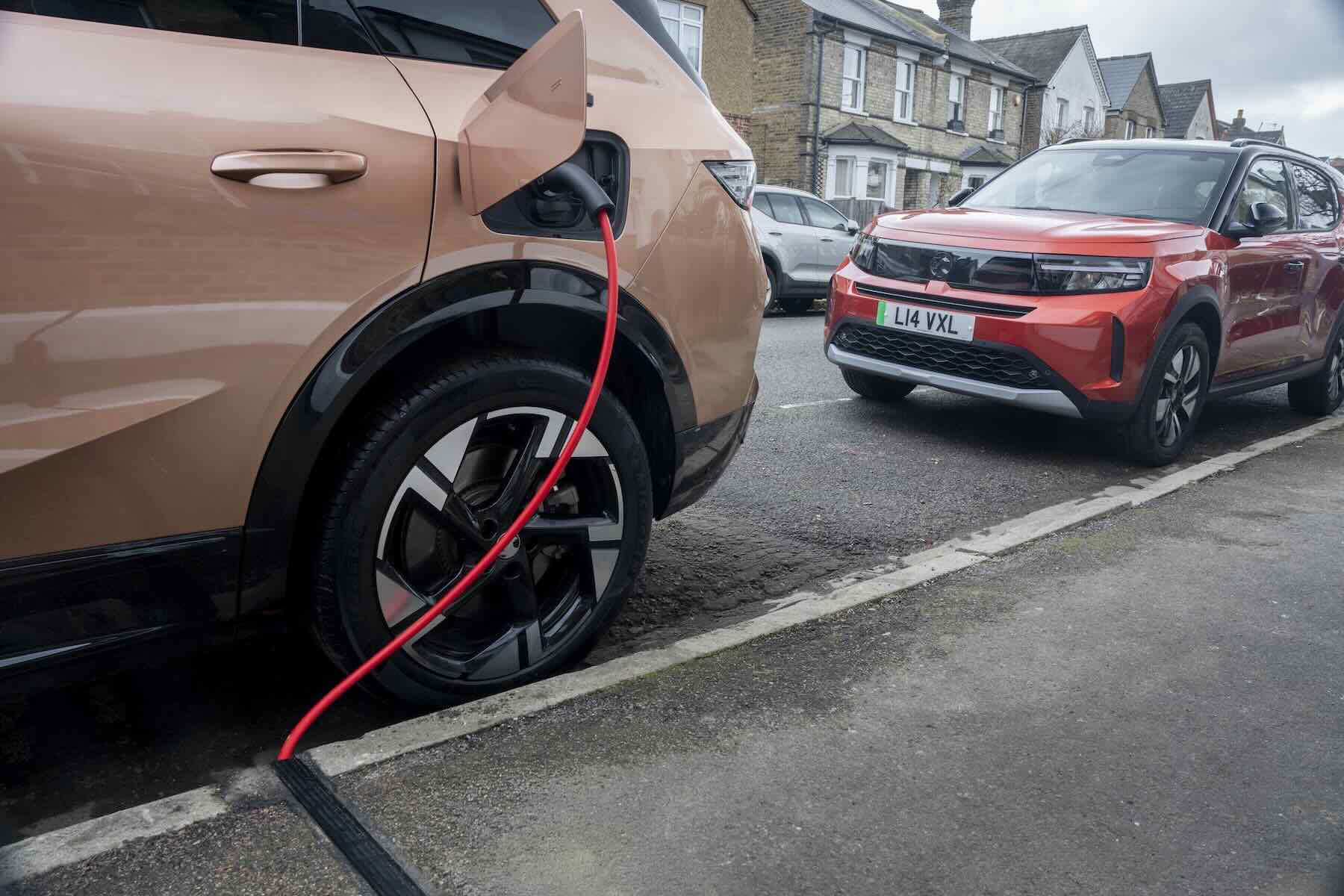
The truth is, there will never be enough public EV chargers in areas like the inner west, so we need more options, like those being adopted in the UK. We’re lucky to be behind their adoption curve as they’ve had the chance to trial some of these solutions; flat cables, boom arms, and gully charging.
Flat cables are a clever solution but still pose a small trip hazard.
Boom arms, while a nice idea, are just adding to visual clutter – they’re also very large and cumbersome, which is why they haven’t really taken off elsewhere.
After many trials, gully charging appears to be the clear winner and better still it’s the least complained about and most affordable option.
So what is it and how do I get it?
Gully charging allows residents without a driveway to safely charge their electric vehicles at home. It involves installing a shallow, flush-mounted channel across the public footpath to run a charging cable from a home to a parked car on the street, preventing trip hazards and avoiding messy cable runs over the pavement.

The gully and its lid are flush with the footpath, avoiding potential accidents for the elderly, disabled or children.
In many ways this is an elegant solution to a privatisation of public street parking. When someone installs a driveway, that public parking spot is effectively privatised — certainly lost to everyone else. With gully charging, because you have no claim to the parking spot, it’s still available to everyone else, but it does go a long way to making owning an EV fairer, and more sustainable if you want to utilise your own rooftop solar.
I just want to give a shout out to Sydney’s Inner West Council who have been a leader in this space by trialling an EV footpath license for a few years now. With well over 100 participants, the program has never been advertised – proof of the hunger for a solution.
The license allows homeowners to run a cable out to the street to charge their car; they must have public liability insurance, a cable cover and display their license while charging.

Once finished you must take your cable cover and cable back inside your property and you have no claim to the parking spot. It’s been wildly successful and I hope the next step is a more permanent and safer solution like gully charging.
I have a dedicated Level 2 charger, so I can add 40km of range in one hour. I also have a longer cable giving me access to three potential parking spots.
So there you have it, the solution as EV adoption continues to grow: AC street pole chargers, DC chargers and most importantly gully charging for inner-city homeowners, are just some of the solutions that all levels of government in Australia will hopefully embrace. Lessons from the UK are the perfect road map; we just need to keep up with demand.
Sign up for The Driven’s free daily newsletter and get the latest EV news and analysis delivered straight to your inbox.