

A new analysis of the European Union’s decision to weaken CO₂ emissions standards for cars by replacing its original 2035 zero-emissions target with a 90 per cent reduction will introduce high levels of uncertainty that could see battery electric vehicle (BEV) sales slip by as much as 50 per cent.
The European Commission, the primary executive branch of the European Union, announced in December a proposed revision to the bloc’s CO₂ emissions standards for cars and vans.
While the Commission claimed that its revisions were “ambitious” and designed to “ensure 2050 climate neutrality and strategic independence”, the fact that they no longer call for a complete phaseout of internal combustion engines mean that they are a downgrade on previous legislation under the guise of being “pragmatic policy… while providing more flexibility to manufacturers.”
In the Commission’s own words, in place of actual zero-emission policies, the new proposal maintains only “a strong market signal for zero-emission vehicles (ZEV) while giving the industry more flexibility to achieve CO2 targets.”
The revision came after intense lobbying from European automotive and fuel industries and fly in the face of evidence that the electric vehicle (EV) transition was working.
And according to a new analysis published this week by leading European advocacy group for clean transport and energy, Transport & Environment (T&E), the revisions will serve only to create huge uncertainty in the region’s EV market, potentially cutting the EV market share from 85 per cent in 2035 to as low as 50 per cent.
“It’s like hedging your bets when there’s only one horse in the race,” said Lucien Mathieu, cars director at T&E.
“The world is going electric, but the EU proposal would divert investment into other technologies that won’t deliver for the climate or the economy. The current 2035 target provides the investment certainty Europe needs to scale up EV production and compete globally.
“The proposed changes would mean keeping the combustion engine and hybrid alive and rewarding the laggards.”
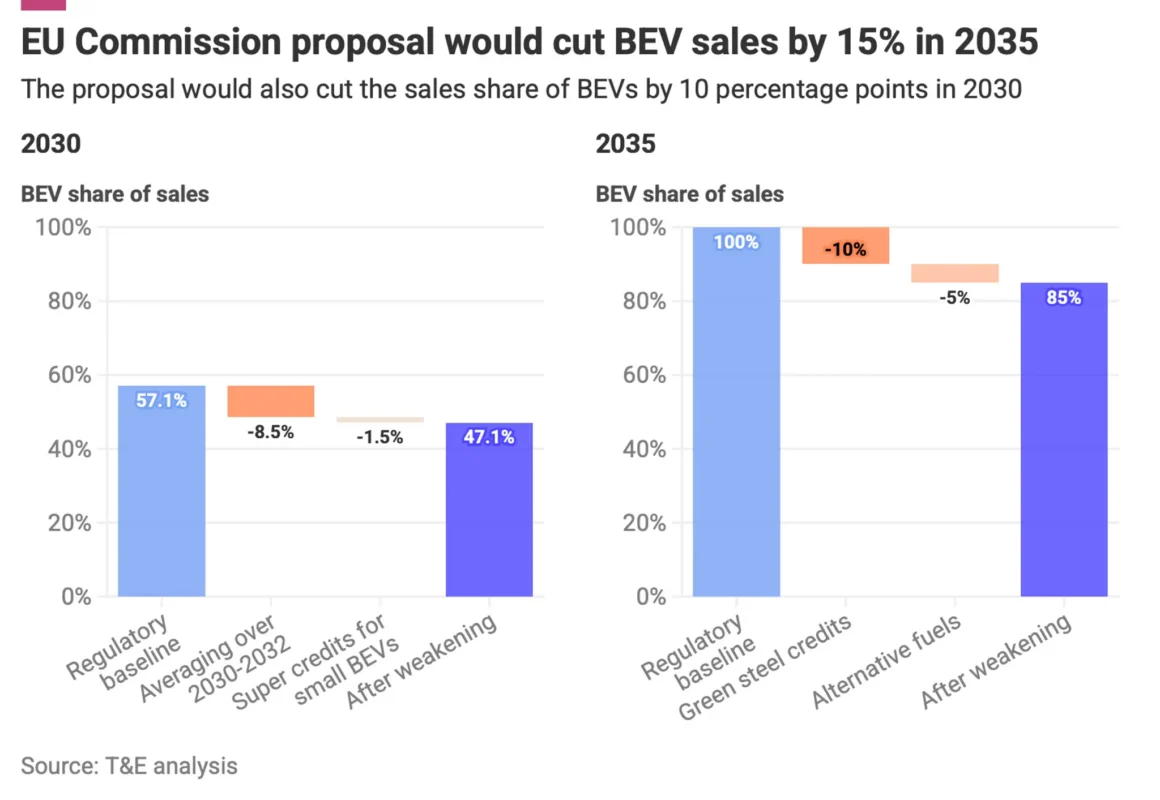
The European Commission’s revisions include replacing the original zero-emissions target in 2035 with a 90 per cent reduction target, with the remaining 10 per cent supposedly being compensated through the use of locally made low-carbon steel or from the use of e-fuels and biofuels.
Specifically, that remaining 10 per cent in a carmaker’s output has to be compensated by up to 3 per cent in alternative fuels and up to 7 per cent with low-carbon steel.
But as T&E explain, this will allow carmakers to sell any powertrain they like after 2035, including hybrids or straight-up internal combustion engine (ICE) vehicles.
Weakening the 2035 CO2 reduction target from 100 per cent to 90 per cent is expected to therefore reduce the share of BEVs by 15 per cent – from 100 percent to only 85 per cent.
However, according to T&E, scrapping a complete transition to net-zero emissions opens the door for carmakers to sell whatever they want – it would just mean they are limited in the number of cars they can sell. Depending on the sales mix, carmakers could sell anywhere from 5 per cent to 50 per cent non-BEVs by 2035, depending on their average CO2 emissions.
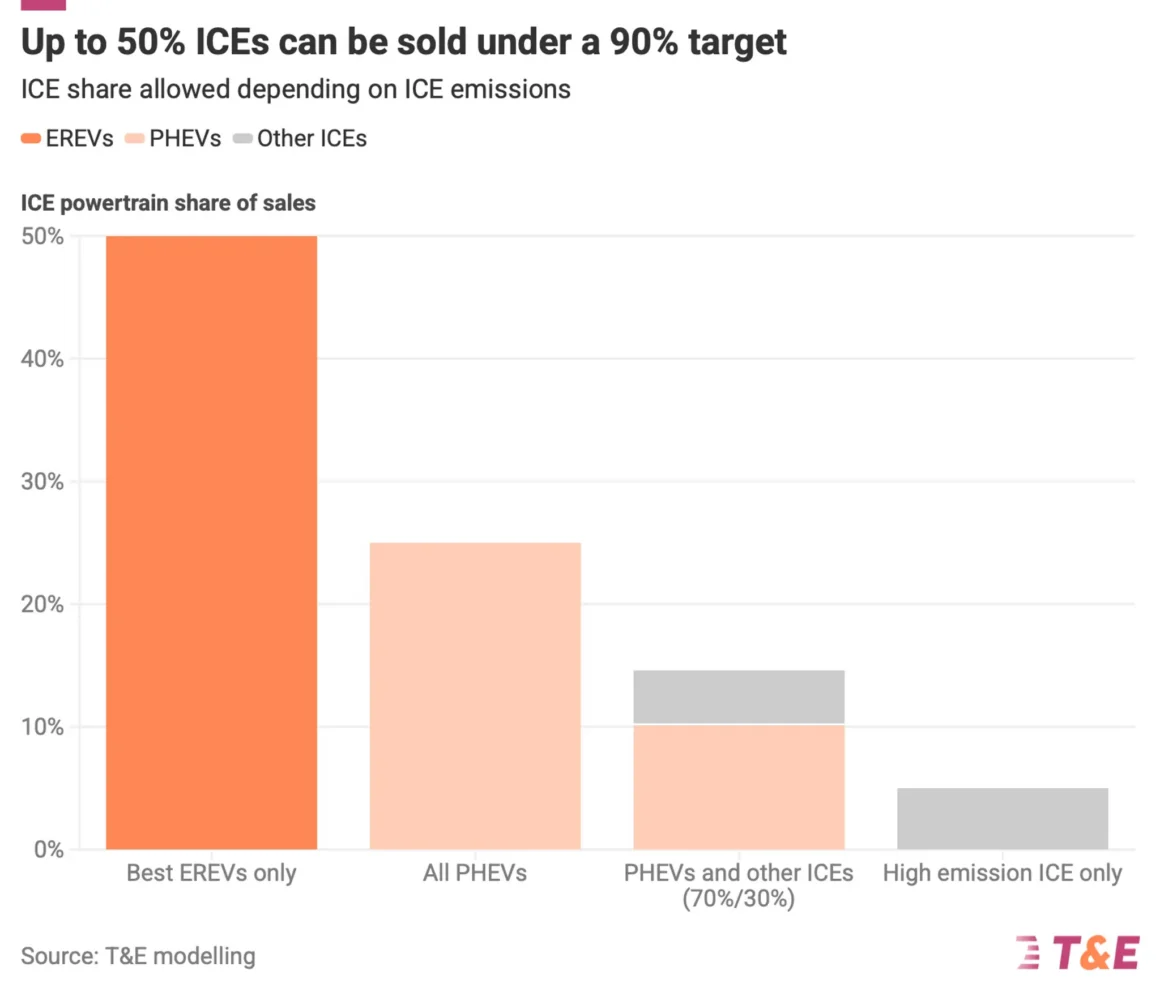
BEV sales might arguably rise to 95 per cent, but could also fall to only 50 per cent, creating huge uncertainty for carmakers and the transition in general, and undermining the certainty Europe needs to invest heavily in electrification and strengthen its competition with China.
Among the other proposals offered up by the Commission, the 2030 targets for cars and vans have also been weakened, reducing the target for vans by 10 percentage points and averaging the 2030 target for cars over a three-year period from 2030 to 2032, instead of meeting the 2030 target in 2030.
All told, T&E expects to see car emissions increase by 720 MtCO2e between 2025 and 2050, or around 10 per cent.
There is also the chance that the European Commission may further weaken its 2035 targets in the face of ongoing pressure from automakers and the fuel industry.
Any further weakening of the EU’s targets would only further slow BEV sales, potentially seeing sales in 2030 slump to a market share of only 32 per cent, instead of the 57 per cent intended under existing legislation, and 70 per cent in 2035 instead of 100 per cent.
T&E’s full analysis can be found here.