

In a sea of big, long, technologically-advanced cars full of screens and AI and LiDAR and self-driving tech, one car stood out. With brown matte paint, this car was wedge-shaped and stylistically chic. Sure, there are plenty of classy, well-finished, and well-styled manufacturers from China’s domestic manufacturers, but this felt new. It felt fresh, and most importantly, it wasn’t a time-wasting concept meant to gauge opinion or preview a new model, but an actual production car with specifications and plans to enter China’s market within the next few weeks.
Imagine my suprise for me to walk to the front of the stand and saw a round grey “H” on the front of the car. It was a Hyundai, the new Ioniq V. “It’s a striking car, that’s for damn sure,” I said to myself, walking from Xiaomi’s stand to Geely’s stand at this year’s Beijing Auto Show. For once, I didn’t feel so pessimistic when it came to non-Chinese automakers in China. Based on vibes alone, it felt like at least one non-Chinese automaker understood where it went wrong and wanted to right the ship, so to speak.

Photo by: Kevin Williams/InsideEVs
Two Years Ago, Legacy Brands Were Asleep At The Wheel
This was a marked improvement from the first time I had come to China, in 2024. That was one of the first shows China had after removing its COVID-19 contact tracing and quarantine requirements, allowing for significantly easier entry and exit to the country. At the time, I only knew what I had read about, mostly in Western media and via translated versions of Auto Sina or Autohome, and digital conversations with executives and other on-the-ground Chinese automotive enthusiasts.
It was safe to say that there was a lot of riff-raff about China’s New Energy Vehicle market (NEV), with many in the West insisting that China’s car market was mostly fake, and that the reasons as to why so-called “Western” brands were losing against China’s homegrown car industry were largely due to unfairly low prices from China’s home brands. Seemingly every other news piece before I had gone to China had been automakers complaining about their sales and profitability woes in China, with news of retreat. Some hawks tried to blame it all on IP theft, trying to justify where their profit had gone.
It took me all of 15 minutes at the 2024 Beijing Auto Show to realize that what I was told here in the West wasn’t the full story. Sure, perhaps the incentives from China’s federal, provincial, and municipal governments definitely helped its EV industry develop probably faster than it would have otherwise, but once again, that ain’t the point. What I saw on the ground was that by and large, cars with “Western” badges were crap. They were old designs, with not-great interiors, basic infotainment, and none of the high-tech stuff that China’s car buyers had come to expect from its home-grown brands.
China’s own brands had clearly innovated and created cars that were tailor-made for what its people wanted, and they had done so very quickly. By comparison, the non-Chinese competition felt low-rent, basic, and sometimes poorly made, for prices that were much higher than China’s homegrown brands.
In 2026, They Came Back Swinging
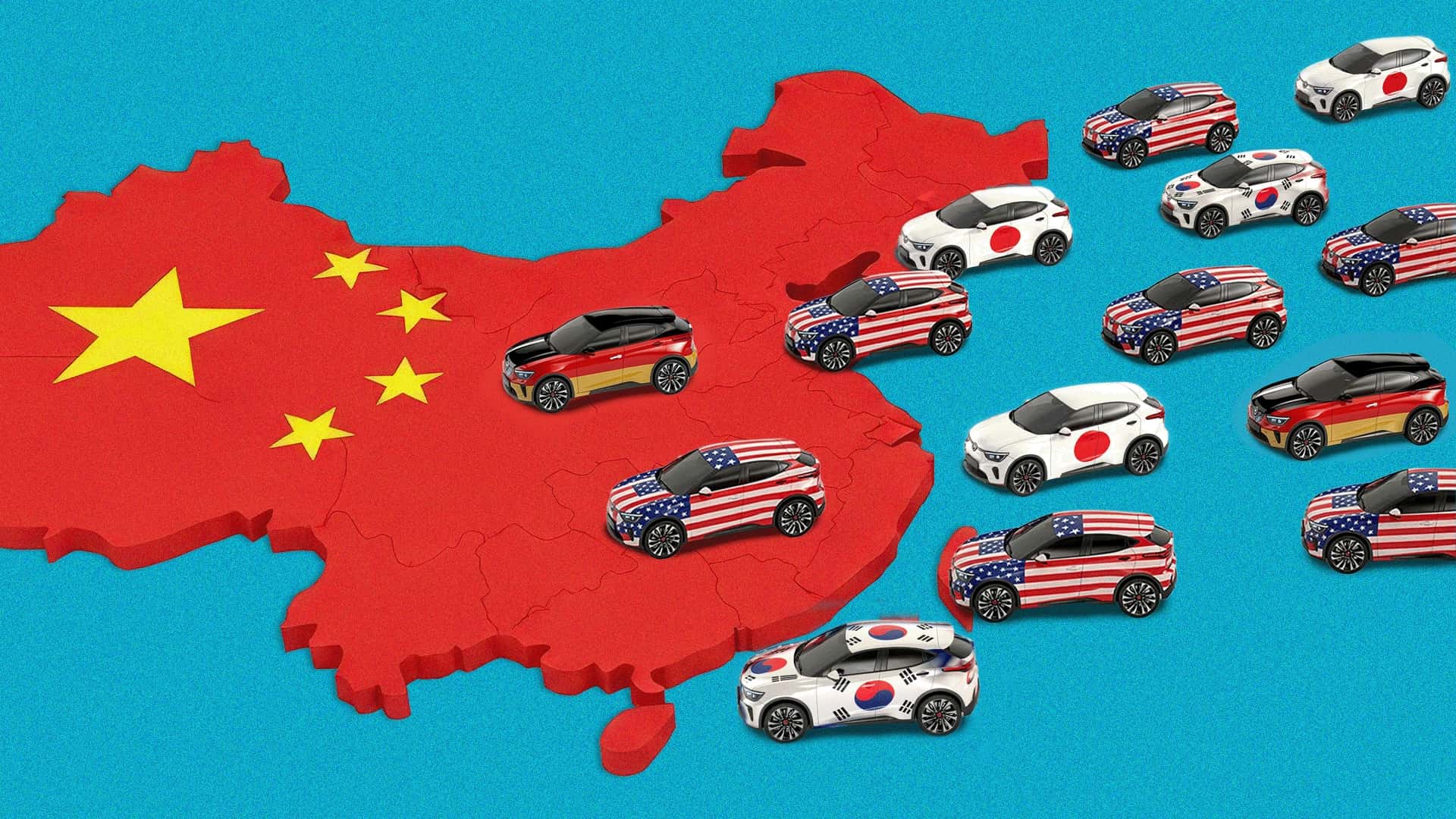
But this time around, at the 2026 Beijing Auto Show, it felt like legacy automotive brands had learned their lesson. The Hyundai Ioniq V is one of the most visible examples of a true renaissance from non-Chinese automakers to fight back in the country. The design felt fresh, but more importantly, it seems like Hyundai had taken its time to really listen and craft out a product that’s correct for China. The ADAS system came from Momenta, one of China’s autonomous-driving pioneers, and could end up being on par with the ones we’ve seen from China’s leaders, like Xpeng. For once, it felt like the car wasn’t lacking when it came to the rest of China’s very competitive market.
Photo by: Kevin Williams/InsideEVs
I’ve been using the Ioniq V as an example, but it wasn’t the only brand that came out in full force. Volkswagen showed off a series of near-production level models and concepts, like the ID Aura, T6, ID. ERA 9X and ID UNYX 08. Buick is back with a recently launched version of the GL8 Encasa and Electra E7, both available in extended range EV (EREV) and full EV form. Mazda has leaned into its EZ-60 crossover with a full EV to supplement its EREV. Even in the concept realm, Peugeot and Citroen reaffirmed their commitment to China with swanky concepts that are refreshingly eye-catching compared to the low-effort slop it currently sells in China.
By China, For China, with China’s Speed
Whatever the case, China is now an unignorable part of the global automotive landscape. It is the largest car market for both car sales overall and for EV sales specifically; it’s a trendsetter, point blank. Although many Western brands are rethinking their China strategy, some think that retreating from China won’t solve any brand’s issues. Inevitably, the trends that China has started will spread across the globe.
Like it or not, the rest of the world will have to keep up with China and how quickly it moves. That’ll likely require working in close quarters with China’s homegrown automakers. “The only path forward for legacy auto in China is to partner with Chinese tech companies,” wrote Tu Le, of Sino Auto Insights.
“Even still, the companies that currently seem to be in retreat feel deep down in their hearts that eventually, by continuing to refine and pump future products designed and developed locally full of ‘local’ features, they can eventually launch products that can compete in the Chinese domestic market. And then they’ll recapture some past glory,” he continued.
Photo by: Volkswagen
That was the trend at this year’s auto show. Perhaps the taglines are a little cliché, but VW and Hyundai both used the same “China Speed” and “By China, For China” buzzwords, with the goals of reversing the collapse of sales in China. The Hyundai Ioniq V is said to be developed in partnership with BAIC (Beijing Automotive Group), using local Chinese suppliers and tech companies for its infotainment and ADAS software. Similarly, Volkswagen made a big deal about speeding up its development and relying more on its local partnerships. It’s ID. Era, ID. Aura, and ID. Unyx (and AUDI) models are developed in conjunction with Xpeng and SAIC, and made by its local joint ventures. These partnerships are meant to jumpstart sales and get these big brands back on track in China. Hyundai said its Ioniq V is part of a push to grow sales to 500,000 units per year in China by 2030.
Will it Work?
Still, just because you try again doesn’t mean it’ll succeed. “Even with these local partnerships, there’s no guarantee for future growth and success. It just helps them survive the moment,” wrote Le.
Author of Driving The Dragon, and Chinese car market expert, Mark Andrews, also seconds Le’s assessment, insisting that legacy automakers are trying to do better in China’s car market by aligning themselves closer with Chinese automakers. Still, Andrews isn’t convinced that it is necessarily a winning proposition.“Whether they’ll actually be successful is debatable. Wang Chuanfu, BYD’s CEO, in 2024 predicted that the JVs’ share of the market would fall to just 10% in 3-5 years,” he wrote via e-mail. Andrews said that there are new headwinds in China’s car market and the economy as a whole. China’s economy is slowing, and there is evidence that consumers are becoming less willing to buy new cars. Also, the car market’s growth is stagnating, with a lot of Chinese automakers’ growth coming from overseas markets. It doesn’t do too much good to foreign manufacturers trying to rekindle sales in China if China as a whole is less able to buy its own cars.
Photo by: Kevin Williams/InsideEVs
Still, we’ve already seen some modest successes from brands that have gone all-in with cooperation with China’s homegrown EV makers. The Kia EV5, based on Hyundai’s E-GMP platform but developed for China, has helped the brand increase its sales by nearly 50% between 2023 and 2024. The Dongfeng-based Nissan N7 and NX8 sedan and crossover EVs have both had healthy preorders and sales. Buick’s GL8 Encasa and Electra cars, based on its Xiao Yao platform (developed with SAIC), have both received warm critical reception in China. Toyota’s GAC-based bZ3x is the best-selling SUV made by a joint venture in China, moving 80,000 units in its first year on the market.
To me, those promising numbers say that success is very much possible, and that at the end of the day, the collapse of non-Chinese brands in China had much to do with the quality and execution of the cars themselves. And if China gets better cars, I think it bodes well for the rest of the world, because a rising tide lifts all ships. Even if those “ships” never make it to American shores.
Contact the author: kevin.williams@insideevs.com