


Overview
MAZDA offered a taste-test of its third-generation CX-5 in March this year, but the brand has now launched the next-gen line-up locally and GoAuto was given a drive of the petrol-only midsize SUV to see if it can take the fight to a growing field of hybridised competitors.
The biggest change is that Mazda has dropped the petrol 2.0-litre four-cylinder and turbocharged 2.5-litre four-cylinder engines from the range, offering the CX-5 with just one powertrain option until a second plug-in hybrid variant launches in 2027.
Mazda’s well-proven 2.5-litre ‘G25’ Skyactiv petrol engine has been detuned slightly for the new model, in order to squeeze more fuel efficiency from the atmo’ runner, producing 132kW (down 8kW) and 242Nm (down 10Nm) of torque, mated to a six-speed automatic.
According to Mazda, the simple (by 2026 standards, at least) powertrain returns a claimed combined fuel use of 7.4l/100km and emits 173 grams of CO2 per km.
The elephant in the room is the lack of a hybrid option for the first 12 months of the CX-5’s product lifecycle, especially since the mild-hybrid variant offered in Europe was considered but ultimately turned down by Mazda Australia, as it battles electrified competitors like the Toyota RAV4, Nissan X-Trail e-POWER, Honda CR-V Hybrid, and Mitsubishi Outlander PHEV.
This makes the CX-5 somewhat of an outlier, particularly amongst its Japanese peers, but the brand defended its decision to wait until 2027 for hybrid power, suggesting the mild-hybrid model – which produces 104kW/238Nm – wasn’t powerful enough for its Australian customers.
“There’s a cost but we also looked at the performance, and we think this (petrol variant) better reflects the Australian consumer profile in terms of power outputs,” Mazda Australia director of sales and marketing, Jarrod Gieschen told GoAuto.
What the new CX-5 does deliver on is an improved array of standard inclusions across the line-up, including more technology, improved safety and all-wheel drive as standard, somewhat offsetting modest price increases of between $1000 and $2750 across the board.
The range kicks off with the Pure at $39,990 (+$2750), steps up to the Evolve at $42,990 (+$2030), Touring at $47,490 (+$1000), GT SP at $51,990 (+$1030), and tops out with the flagship Akera at $54,990 (+$1840) – all before on-road costs.
For the extra dosh, the Pure – which replaces the outgoing Maxx grade – gets a 12.9-inch infotainment screen (up from 10.25-inch), 10.25 digital instrument cluster (up from 7.0-inch), cruising and traffic support, front cross traffic braking, dual-zone climate control, rain-sensing wipers, and eight speaker sound system (up from six speakers).
It also rides on 17-inch wheels, scores LED headlights with auto on/off and high-beam control, and features black cloth trim.
The Evolve adds heated front seats, a frameless rear-view mirror with auto-dimming, auto folding side mirrors, heated front seats, keyless entry, wireless charging and rear air vents. It too rides on 17s, with a similar cloth interior treatment.
Moving up to the Touring, it scores a windscreen de-icer, larger 19-inch machined alloys, black Maztex trim with cloth inserts, powered driver’s seat with memory function, heated steering wheel, roof racks and a heated windscreen.
The GT SP adds a 360-degree camera view, power lift tailgate, power front seats, Bose 12-speaker audio, ambient lighting, as well as a blacked-out exterior treatment that includes the 19-inch alloys and gloss black bumper and wheel arch finishes.
At the top of the model tree, the Akera gets a panoramic sunroof (over the sliding unit in the outgoing model), an even larger 15.6-inch infotainment display, remote operated tailgate, paddle shifters and front seat ventilation.
The new model has a longer wheelbase (+115mm) to offer improved second-row space, and it’s wider (+15mm) and taller (+15-20mm) too, but despite the inflated dimensions Mazda has reduced the total weight of the new model by around 10 per cent.
Cargo volume is up too, demonstrated to us by Mazda Program Manager, Koichiro Yamaguchi who used a stroller to emphasise the point, with a boot that is both lower and deeper to offer an additional 43 litres over the old model.
The rear also transforms into a quirky bed arrangement, whereby the headrests are flipped and the second row folded forward to reveal a lay-flat surface that’ll accommodate two adults. It feels like a modern-day shaggin’ wagon, but really it’s probably just Mazda’s answer to the camping-focused features a lot of SUVs now get.
Standard safety is up across all models with an expanded suite of ADAS functions and Mazda Australia confirmed the new CX-5 will soon be ANCAP tested. It currently holds a five-star Euro NCAP rating.
Mazda offers the new CX-5 in seven colours, which include Aero Grey Metallic, Jet Black Mica, Machine Grey Metallic, Polymetal Grey Metallic, Rhodium White Metallic, Soul Red Crystal Metallic and the new Navy Blue Mica.
All models are covered by a five-year/unlimited kilometre warranty and visits to the dealer will roll around every 15,000km or 12 months.
Driving impressions
Led by the always friendly Karl Reindler, who drives the Formula 1 medical car when he isn’t chaperoning motoring media, we took the fleet of CX-5s out for a brief, but relatively spirited drive through Northern New South Wales.
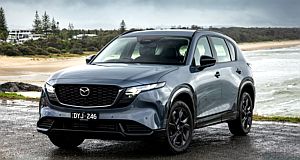
At first glance, the exterior is sleek, well proportioned and plays on Mazda’s longstanding (and brilliantly attractive) shape despite being mostly new metal. If it ain’t broke, right?
Once inside, the interior is clean, simple and logically laid out, keeping analogue buttons in play while also introducing a massive centre display (particularly in the Akera) for a best-of-both feel.
Buttons, however, have been relegated to the steering wheel, which is a busy affair until you wrap your head around all of the functions. This does, however, make for an uncluttered dash that is virtually free of switches or buttons.
Unfortunately, HVAC is controlled via the touchscreen, but Mazda positioned the climate control interface on the bottom right side of the display, closest to the steering wheel, so it’s at least close to hand.
My only other gripe is that if you by chance don’t own a smartphone, be prepared to crack open a paper map as there’s no native navigation on board. A sign of the times, more than a criticism, really.
In a refreshing deviation from the appliance-on-wheels approach to car design that’s becoming the norm, Mazda maintains that it wants to focus on the way its customers feel. I felt it almost immediately in the CX-5.
And, importantly, it doesn’t feel slapdash like certain other recent models (particularly the CX-60, which Mazda admitted was rushed to market), marking a return to form for the brand in Australia.
Mazda focused on improving the handling of the CX-5, which was admittedly never a flaw of the last-generation model, opting for lower spring rates and high-response damping as opposed to the high spring rates and low response damping used previously.
The thinking is that the softer springs allow for a smoother low-speed ride, while the damping compensates at higher speeds, and the logic stands up. The improved setup is noticeable, although a back-to-back test would best ascertain just how much better the ride is.
We were on pretty average B-roads for part of the drive loop, and the car soaked up big hits with aplomb (a few unavoidable potholes being the ultimate test).
Mazda’s revised suspension tune also provided sure-footed handling through the more spirited mountain section of our drive, allowing for fairly aggressive turn-in and mid-corner composure that had us pushing the tyres to the point of squealing without getting too much roll.
Genuinely rewarding dynamics are hardly a requirement in a midsize family SUV, but as the segment grows heavier – largely due to cumbersome hybrid systems – the sharp handling is a pleasant treat. Interestingly, the lower-spec models with 17-inch wheels felt more agile, perhaps the result of less unsprung mass.
What makes the CX-5 so impressive on the whole, though, is how well-sorted every element of its design feels.
The steering is satisfyingly weighty and direct, the brakes are strong and progressive, and the engine and transmission work well together to keep the atmo’ four-pot singing (and fairly fuel-efficient while doing so).
This is what Japanese automakers have historically excelled at, taking a meticulous approach to the entire vehicle. I’d even argue that the simplicity of the CX5’s driveline may have allowed Mazda to focus more intently on getting every part of this car right, rather than getting bogged down in hybridisation that, ultimately, complicates everything from the packaging to suspension tune.
The fuel figures were certainly not hybrid-beating, though. In saying that, we weren’t exactly driving for economy.
We recorded 11.7L/100km in the top-spec Akera on the drive from Burleigh Heads to Tumbulgum, though that figure dropped to 10.8L/100km on the way back in the mid-spec Touring. A more sedate commute would undoubtedly have dipped us into single figures, but a longer test will be needed to properly assess fuel use.
On the safety front, the ADAS intervention is mild in its sensitivity, taking more of an ‘alert passenger’ approach, rather than the ‘overbearing backseat driver’ so many systems feel like.
This is a good thing. It was actually so unobtrusive across a day of driving that I had to ask Mazda executives whether they’d turned certain features off. They confirmed that no fettling had taken place, and that the system is just “well tuned”.
While the powertrain is simple, with no electrification whatsoever, I’d argue that in a family-focused midsize SUV like this one that isn’t necessarily a bad thing.
There’s an almost nostalgic simplicity to the CX-5, which manages to squeeze pretty respectable fuel efficiency out of the tried-and-tested combination of an atmo’ combustion engine and slush box.
If you’re into the idea of a no-nonsense SUV, this may be one of the last chances you’ll have to get into one. It’ll probably outlive many of its more advanced competitors, too.