

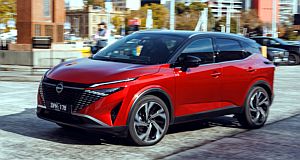

NISSAN has again proved the real-world efficiency credentials of its hybridised Qashqai e-Power SUV, this time a lot closer to home.
Last August, the Nissan team drove from one end of the UK to the other to demonstrate the efficiency of the Qashqai e-Power on the open road.
Now, Nissan Australia has replicated the performance on local soil, covering a 1303km lap of the island state with an average fuel consumption figure of just 4.5 litres per 100km.
The journey began in Geelong, Victoria, where Nissan Australia team members topped up the Qashqai e-Power’s 55-litre fuel tank before boarding the Spirit of Tasmania ferry service.
Upon arrival in Devonport, Tasmania, the crew charted a clockwise route of the Apple Isle, circumnavigating the state with the goal of not visiting a Tasmanian petrol station.
The lap was completed at the posted speed limits, across varied terrain including freeways, urban roads, and several challenging hill climbs.
Travelling through Launceston, Freycinet, the Bay of Fires, Hobart, the Huon Valley and Tasmania’s rugged west coast, the vehicle’s trip meter showed 1209.2km upon returning to the ferry, ultimately recording 1303km when the fuel flap was reopened.
“This trip isn’t laboratory testing, this is the real world and real conditions, completing a dream lap of Tasmania that so many Australians have either done, or would love to do,” said Nissan Oceania managing director Steve Milette.
“Now more than ever, Australian drivers are looking for fuel efficiency that doesn’t compromise driving enjoyment, and this 1300km real-world journey shows that the Nissan Qashqai e-Power delivers.”
The recently updated 2026 Nissan Qashqai e-Power introduces an revised hybrid powertrain with a reduced combined cycle fuel consumption figure of 4.1 litres per 100km and CO2 emissions of 92 grams per kilometre.
Central to the update is a new ‘5-in-1’ powertrain architecture integrating the electric motor, generator, inverter, increaser, and reducer into in a single unit, further reducing, Nissan says, both weight and complexity while improving energy transfer.
The revised system is paired with a redesigned turbocharged 1.5-litre three-cylinder petrol engine featuring Nissan’s proprietary STARC combustion technology, helping deliver thermal efficiency of up to 42 per cent by converting more fuel energy into usable power and reducing energy losses through heat.
To read GoAuto’s review of the latest 2026 Nissan Qashqai e-Power click here. For more information on the pricing and equipment details of the model, click here.