

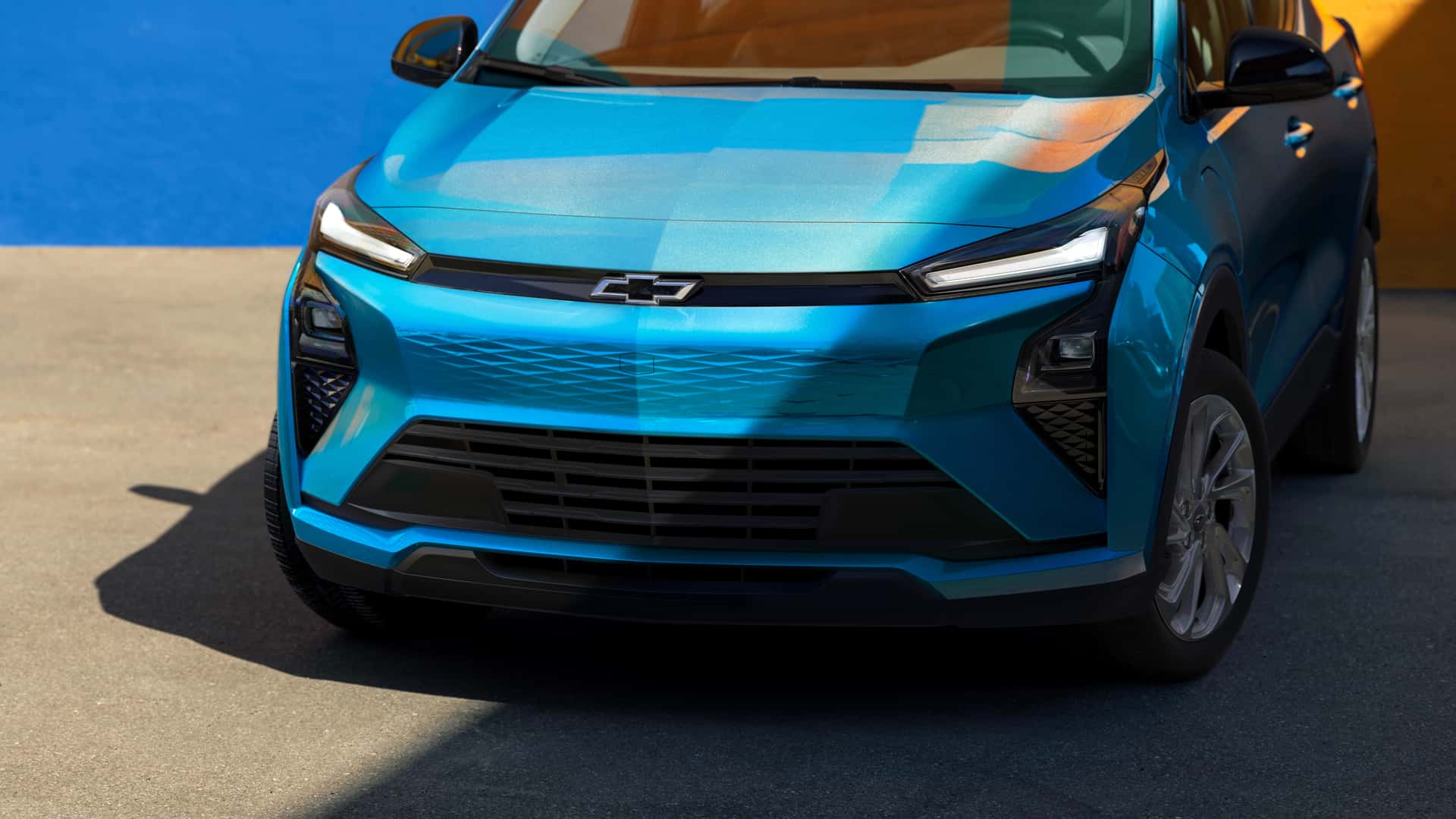
There’s a clever choice at the heart of every “Ultium”-powered General Motors EV. Whether it’s a big honkin’ GMC Hummer EV or an affordable, base-model Chevy Equinox EV, all of the General’s electric products rely on the same foundational pillar: The same basic cells, arranged into 24-cell modules. All of them, that is, except the new Bolt. And it’s also the one with the best 10-80% charge time.
Coincidence? Not quite. The explanation requires some basic knowledge of battery packs, a little bit of chemistry, and a dash of geopolitics.
Let’s get into it.
The Module Approach
There’s a key reason why many EVs are expensive. Economies of scale just haven’t kicked in as they have for gas cars. Over 100-plus years of building dino-burners, we’ve gotten pretty good at every individual part. There are plenty of firms that can build fuel pumps, turbochargers, alternators, and radiators at scale, leveraging hundreds of thousand-unit volumes to drive per-unit costs down.

Photo by: General Motors
With EVs, automakers are having to build that whole supply chain for scratch. It’s a lot harder to find a supplier to build an automotive-grade DC-to-DC converter than it is to find a fuel pump supplier, because only one of those technologies was in demand a decade ago. For most of these components, it’s not an issue, as the supply base has built up. But the biggest cost and the biggest challenge is the battery.
Automotive-grade batteries are highly specialized, and they’re not one-size fits all. But at the same time, the more of any one single product you build, the more you can drive down costs with economies of scale. So if you can’t use the same pack for every car, as different vehicles have different range demands, and you still want to offer a variety of models, you’re in a pinch. How do you build a variety of batteries without decimating your economies of scale?
For GM, the answer was to make everything common on the sub-pack level. Each pack is built from the same core components: A 103 amp-hour cell, arranged into 24-cell modules that run at 29 volts. Using that core building block, GM can build a variety of packs. The ones in the Chevy Equinox EV, Blazer EV LT, and Optiq are 10-module, 85 kilowatt-hour packs, while the Cadillac Lyriq and Blazer EV SS get 12-module, 102 kWh packs. Step up to the big-dog trims of the Hummer EV and Chevy Silverado EV and you get 24 modules, or 205 kWh of power.
Photo by: GMC
The Voltage Problem
If you know how batteries work, though, you can already see the problem. The core cells that make up large automotive batteries don’t run at 400 volts or 800 volts. They run, in this case, at between 3.6 and 4.2 volts, as Motor1 explained in an excellent deep dive. Getting higher voltages requires wiring all of these batteries together to raise the pack’s overall peak voltage.
But do the back-of-the-napkin math yourself: With cars like the Equinox EV and Blazer EV getting 10 modules, each with a nominal voltage of 29 volts, that puts the overall pack voltage at around 290 volts. This explains why both vehicles have a pretty excruciating charge curve. While both peak at 150 kW, to get 150 kW out of such a low voltage requires over 500 amps—because charging power (kW) equals voltage times current (amps). Since existing 150-kW charger designs can’t actually output that much current, you need to find a 250- or 350-kW charger to get the peak number.
Photo by: Suvrat Kothari
Even if you do, the 10-80% sprint takes a lethargic 40 minutes in a best-case scenario. And while larger GM packs can peak at higher rates—the Silverado EV can charge at up to 350 kW—their gargantuan size slows the process. That means the little Bolt, with its 65 kWh battery, is the charging champ. It charges from 10-80% in 26 minutes.
So why doesn’t the Bolt have this problem?
A New LFP Pack, Straight From China
Because despite using the broader Ultium architecture and software stack, the Bolt doesn’t use an Ultium battery. Instead it gets GM’s first lithium-iron-phosphate (LFP) pack. LFP batteries are cheaper, more durable, and last longer than nickel-mangnanese-cobalt batteries, which power all other Ultium cars. And because this pack didn’t have to use GM’s modular approach, the Chinese supplier was able to give it a nominal voltage that’s a lot closer to 400.
That means it can peak at 150 kilowatts from a relatively low state of charge and hold high charge speeds for a long time. It’s got a big, meaty charge curve that allows it to fill up quicker than other cheap EVs, like the base-model Ford Mustang Mach-E and Volkswagen ID.4.
20
Source: Mack Hogan/InsideEVs
With that, GM turned the Bolt’s greatest weakness into a major strength. While the old one had painful, hourlong charging stops on road trips, the new one will get you back on the road faster than even a Tesla Model Y or Rivian R2—at least when it comes to going from 10-80%.
It’s a huge improvement. But there’s one major catch to the new Bolt. To learn what it is, check out my full first drive here.
Contact the author: Mack.Hogan@insideevs.com