

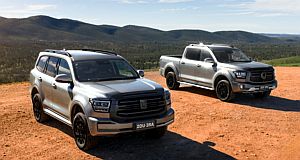

FAST growing Chinese car giant GWM has unleashed its most serious attack yet on the heartland of the Aussie bush: the large off-road SUV and workhorse ute.
A new 3.0-litre four-cylinder turbo diesel engine for the Tank 500 and Cannon Alpha arrives with V6-like grunt and does without the need for AdBlue fuel additive, providing adventurers and off-roaders with an additional incentive over the Toyota Prado/Hilux and Ford Ranger/Everest that make up around half of the off-road market Down Under.
A dual fuel tank in the flagship variant of the Tank 500 has GWM claiming it can drive from Sydney to Melbourne and back without refuelling.
The Tank 500 also picks up an extra row of seats – for seven in total – as a result of the new engine.
Throw in serious off-road hardware, a healthy list of tech and standard gear and a price tag to shake the 4WD establishment and it’s easy to see why GWM is talking a big game for the new arrivals that deliberately buck the electrified trend.
The newcomer is a 3.0-litre four-cylinder developed with a heavy focus on Australia.
GWM Australia head of marketing and communications, Steve Maciver, says the brand’s rapid local growth was a key factor in the engine being developed.
“It’s clear from where Australia is at, and has been at, that diesel and large-capacity diesel has a role. So that was a big factor in them developing that engine,” he says.
“I would say that without Australia being in the picture, I reckon it would have been quite difficult for this engine to have been possible. So we’ve been a huge part of making it happen (globally).”
Maciver says GWM’s head office leaned heavily on Australia over the past year to finish development, with “many, many thousands of kays” of durability testing across a variety of local road conditions.
Other markets, including South Africa and Brazil, will also get the engine.
In the Tank 500, the new diesel replaces the regular hybrid previously sold locally, while the Tank 500 Ultra plug-in hybrid continues at $79,990 drive-away.
In the Cannon Alpha, it replaces the previous 2.4-litre turbo diesel.
The new engine makes 170kW and 620Nm, a gain of 35kW and 140Nm over the old 2.4-litre turbo diesel.
That’s more torque than any rival four-cylinder diesel, including the Toyota HiLux (500Nm), Mitsubishi Triton (470Nm) and Isuzu D-Max (450Nm). It also beats the 600Nm of Ford’s 3.0-litre V6, although the Ford retains a power advantage with 184kW.
Drive goes through a nine-speed automatic, and GWM claims an official average fuel figure of 7.1L/100km for the Tank 500 and 7.3L/100km for the Cannon Alpha, both better than the Ranger/Everest V6’s 8.4L/100km and 8.5L/100km.
The lack of AdBlue is a notable win for remote-area travellers, removing both an extra running cost and the hassle of topping up on an adventure.
Both models can tow 3500kg and get serious off-road hardware, including low-range gearing and front and rear locking differentials.
However, they miss out on the 4A on-road four-wheel drive system some off-roaders have, including the V6 Everest and Ranger.
As with other Cannon Alphas and Tank 500s, the 3.0-litre models also get a healthy list of equipment, with heated and ventilated front seats, a head-up display, a panoramic sunroof and a 360-degree camera available.
Maciver says the combination of capability and equipment is what sets GWM apart from established 4WD brands.
“Four-by-four and off-road has got a huge following in Australia – it’s part of lifestyle,” he says.
“For us, we’ve got these incredible products in Cannon and Tank that we want to lean in heavily to because we think we deliver exactly what those type of buyers are looking for. Not just the off-road capability, but the tech, the value, the comfort. All the stuff that perhaps some of the more traditional competitors in that space haven’t been able to offer.”
Pricing is clearly designed to rattle the 4WD establishment.
The Cannon Alpha starts at $58,990 drive-away for the Lux and $63,990 for the Vanta.
The Tank 500, now a seven-seater in diesel form, is $65,990 for the Lux and $71,990 for the Vanta.
The Tank 500 Lux undercuts the cheapest V6 Everest by $1000, while the Vanta is $5000 cheaper than the mid-spec Everest Sport V6.
The Vanta also gets a dual fuel tank setup, with 131 litres of capacity split across main and auxiliary tanks.
GWM claims that’s enough to travel from Sydney to Melbourne and back without refuelling.
It’s a seriously big tank for an SUV, and it bucks a trend: Toyota’s fuel tanks have shrunk with each new generation of Prado and LandCruiser. The current Prado carries 110 litres, down from 150 litres in the previous model and 180 litres before that.
The LandCruiser 300 Series has 110 litres, down from 138 litres in the 200 Series diesel.
The Ford Everest and Ranger have 80 litres, although the Super Duty version of the Ranger – the hardcore off-road workhorse – gets a 130-litre tank.
GWM is offering a $2000 cash bonus or $2000 fuel card on vehicles ordered before October 30.
While large-capacity diesels are under pressure from the New Vehicle Efficiency Standard (NVES), GWM appears better placed than many traditional brands to absorb the impact.
Its growing range of plug-in hybrids and EVs, including PHEV versions of the Tank 500 and Cannon Alpha and more Ora EV models on the way, helps offset the emissions of its diesels.
Maciver says the brand’s powertrain breadth is a key advantage.
“The fact that we’re developing petrol, diesel, hybrid, plug-in hybrid, EV across on-road and off-road vehicles gives us breadth that most other OEMs probably can’t compete with,” he says.
He acknowledges the diesel market is declining but says there’s still plenty of volume to chase.
“We’ve got to be where the market is, and … (while) different parts of the market declining, other parts of the market growing. Ultimately, we are where the volume is right now.”
Maciver says reliability and durability are critical to winning over off-road buyers, and that GWM has no shortcut to building the kind of reputation Toyota enjoys.
He points to GWM’s network of more than 130 dealers and a new parts distribution centre in Perth, its third, which he says means parts can generally reach anywhere in Australia within 24 hours.
While the new 3.0-litre engine is starting life in the Cannon Alpha and Tank 500, it’s eventually expected to be fitted to the regular Cannon and other versions of the Tank; they include the Tank 700 and 800 that have not yet been confirmed for the Australian market, but at least one of which is expected.
2026 GWM 3.0-litre turbo diesel pricing*
|
Cannon Alpha Lux 3.0 turbo diesel (a) |
$58,990 |
New |
|
Cannon Alpha Vanta turbo diesel (a) |
$63,990 |
New |
|
Tank 500 Lux turbo diesel (a) |
$65,990 |
New |
|
Tank 500 Vanta turbo diesel (a) |
$71,990 |
New |
*National driveaway pricing