

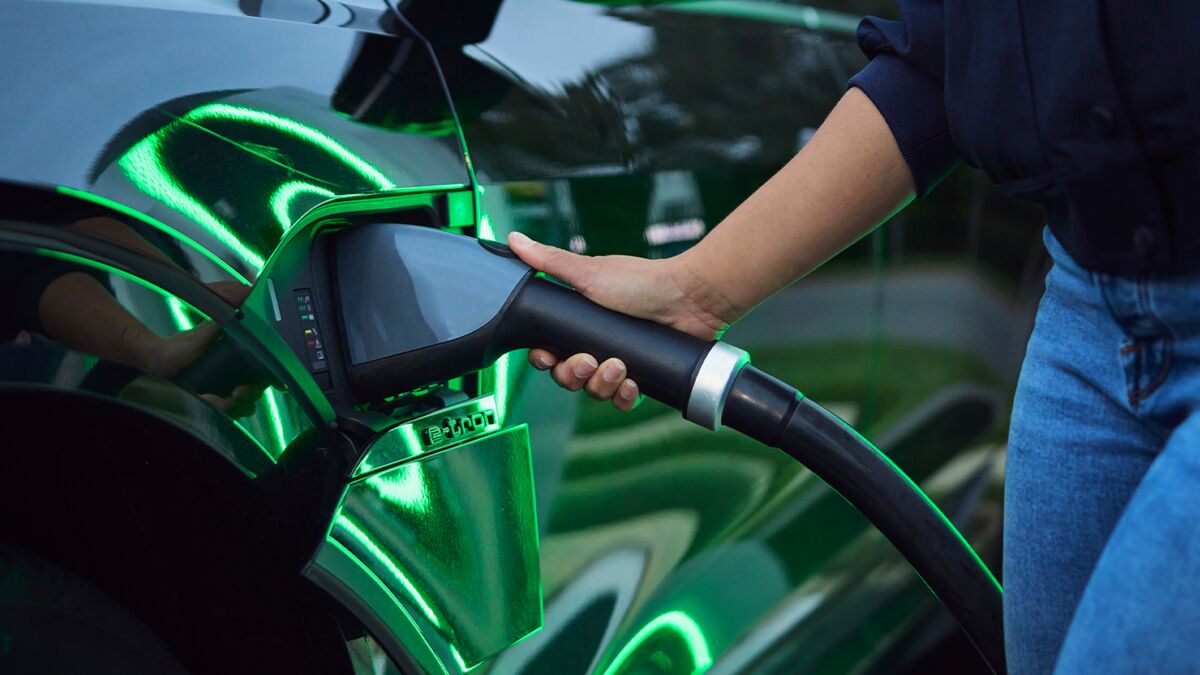
- Charging an electric vehicle (EV) battery overnight at home is usually the least expensive option.
- Gas prices fluctuate, and electricity rates vary regionally, but in most cases, it costs less per month to charge an EV than to buy gas for a traditional vehicle.
- While free options are available, public charging stations typically charge higher fees than home charging.
Many people ask the single biggest question about electric cars: What will I spend to charge the EV?
If you’re looking at an electric car versus a gas car, doing some upfront research on charging compared with gas costs will help you make an informed decision. Remember that some new EVs come with a limited number of free charging at public stations, and charging networks typically offer subscription plans that help reduce charging fees for EV drivers who frequently use them.
To address the cost question, we enlisted the help of John Voelcker, a longtime automotive journalist and industry analyst specializing in electric vehicles. He’s heard every argument made for (and against) electric vehicle ownership, including recharging costs compared to traditional refueling.
You Need to Do Some Math
Don’t sweat it. The math involved is pretty simple. It helps to have a recent electric bill for the most accurate estimate. You’ll want to calculate the amount you pay for electricity each month. Then we’ll provide examples so you can determine how much you spend per kilowatt-hour (kWh) of electricity.
“For home charging, find your electric bill, then divide the [number] of kilowatt-hours you used by the bottom-line dollar total. That’ll give you the price you paid per kWh,” Voelcker explains.
According to the United States Energy Information Administration, U.S. households paid an average of 18.34 cents per kWh in June 2026, the most recent figures available at the time of this writing.
Let’s apply this rate to a typical electric car. This example does not account for any discounts offered by your utility.
RELATED: Electric Cars 101: What You Need to Know About EVs
What Is the Cost to Charge an EV in kWh?
“A conservative rule of thumb is that an electric car gets three to four miles per kWh,” Voelcker says. “So divide the total miles you drive each month by three to get the kWh you would use monthly. Multiply that number by your cost per kWh. The dollar amount you get will most likely be lower than what you pay each month to buy gasoline.”
To put this into perspective, let’s give an example. Suppose you drive about 1,015 miles per month (Americans go an average of about 12,200 miles annually). For an EV, you will use about 338 kWh in that time frame. Using the most recent U.S. household average estimate of 18.34 cents per kWh, charging an electric car at home would cost about $61.98 per month. Using a DC fast charger at a public charging station when away from home, an EV driver might pay 50 cents per kWh, or $169 for that much energy.
RELATED: How Long Does It Take To Charge an Electric Car?
Is EV Charging Cheaper Than Gas?
According to AAA, the average price of gas currently hovers around $4.10 per gallon in late August 2026 (a dollar more than the cost in February 2026). So, filling a 12-gallon gas tank currently costs about $49.20. Things get a little tricky because, as we all know, cars and trucks use vastly different amounts of fuel.
Let’s say you’re driving a car that averages 30 mpg across a mix of city and highway driving. Using that same 12-gallon tank as a reference point, you’ll have 360 miles of driving range for each fill-up. If you’re driving the national average of 1,015 miles per month, you’ll need to refuel about three times each month and spend about $147.60 ($49.20 x 3) for gas, compared to $61.98 for charging an EV at home in the example above.
In the table below, we’ve compiled a few examples to demonstrate some real-world costs of charging your EV. We’ve selected three of Kelley Blue Book’s 2026 Best Buy Award winners: The Nissan Leaf (Best New Model; Best EV Under $35,000), the Hyundai Ioniq 5 (Best EV), and the Kia EV9 (Best 3-Row EV). These three EVs represent a good cross-section of the available EVs right now, from a subcompact SUV (the Leaf) to a compact SUV (the Ioniq 5) to a midsize 3-row SUV (the EV9).
Sample Charging Times and Costs
Again, this is only an estimate since gas prices and fuel efficiency vary. Few cars and SUVs come close to delivering a 30 mpg combined average, so our fairly conservative number-crunching in this scenario makes it clear that recharging will cost less than refueling a car. The financial gap narrows with a more fuel-efficient vehicle, but it remains.
[Editor’s Note: I drive a lot of EVs and often need to charge when I’m away from home. Since charging at home is so much more affordable, I limit my charging at pay stations to the bare minimum. I calculate how far I’ll need to drive before I can park at home again and charge to just that level, plus 10% for safety, rather than charging to 80% or higher. Every little bit of savings helps. — Jason Fogelson, managing editor]
Costs of Charging an EV at Home
Electricity rates are influenced by many factors, including the region you live in, the time of year, and even the time of day when peak charges apply. For the most part, electricity use and costs are lowest late at night. That’s good news for anyone considering an EV, according to Voelcker.
“While shoppers worry about access to public charging stations, they need to know that as much as 90% of electric car charging is done overnight at home,” Voelcker said. “The cheapest way to charge your electric car is almost always at home, overnight. Some utilities have special low rates for the overnight period when their demand is lightest.”
Where you live directly impacts your electric bill. People in New Hampshire pay an average of 27.01 cents per kWh in June 2026, about twice the cost as in Louisiana (13.49 cents per kWh in June 2026).
EV Charging Cost by State
Associated Charging Costs Beyond Electricity
Electricity rates are only one part of the total cost of keeping an EV charged. Drivers may also need to factor in expenses such as installing a faster Level 2 home charging setup, which can cost $2,000 or more.
Costs for fast-charging at public charging stations can vary by network, location, membership plan, vehicle compatibility, and time of day, making tools like the PlugShare app helpful for finding stations and checking user tips. At some charging networks, charging rates during peak times are nearly twice those during non-peak times.
Visit our Car Powertrains Information Center for curated articles on electric vehicle (EV) and hybrid fundamentals, performance, and range insights, as well as battery technology and how powertrains deliver efficiency.
Editor’s Note: We have updated this article since its initial publication. Chris Hardesty and Chris Teague contributed to the report.