


RAM Trucks Australia has given its clearest indication yet that it is in no hurry to electrify its local full-size pick-up range, instead embracing V8, six-cylinder petrol and diesel power as Detroit’s truck giants reconsider how quickly customers are prepared to move away from combustion engines.
The position follows the return of Hemi V8 power to the Australian Ram range in the new 2500 Warlock, ahead of the supercharged 1500 TRX SRT arriving next year, while the 3.0-litre twin-turbo Hurricane six-cylinder remains central to the regular 1500 line-up.
Ram Trucks Australia also continues to offer the 6.7-litre Cummins turbo-diesel in its 2500 and 3500 Heavy Duty models and is negotiating with its US parent for one or more versions of the recently revealed V8-powered Rumble Bee’.
Speaking at the Australian launch of the 2500 Warlock, Ram Trucks Australia general manager Jeff Barber said replacing the previous 5.7-litre Hemi with the more modern Hurricane six was not itself the problem.
Removing customer choice was.
“The mistake was that it should have been a choice for consumers,” he said.
“I think the US saw that, they brought it back to the US, and now we’ve brought it back here as well, to give people a choice of either the heritage and the sound of the Hemi V8, or the new technology that’s in the Hurricane.
“So, it’s important to have it back in our range and to have both those engines on offer.”
Mr Barber stressed Ram’s renewed enthusiasm for the Hemi does not come at the expense of its newer six-cylinder engine.
“In fact, in the US, where consumers have the choice of a Hurricane or a Hemi, 60 per cent of those people choose the Hurricane,” he said.
“The Hurricane absolutely remains part of our future. Now we have the best of both worlds, with both the Hemi and the Hurricane in our petrol line-up, and the upcoming diesel in our 2500 Ram and 3500 Ram.”
The returning Hemi strategy will initially concentrate on specialised models.
Australia’s new 2500 Warlock uses a naturally aspirated 6.4-litre V8 producing 306kW and 582Nm, while the forthcoming TRX SRT brings back the supercharged 6.2-litre Hemi at the performance end of the 1500 range.
Mr Barber said Ram presently sees no requirement to reinstall a Hemi across mainstream 1500 grades, particularly given the performance and popularity of the Hurricane.
The company is, however, working to add the Rumble Bee, potentially providing Australian buyers with a third route into Hemi V8 ownership.
The strategy also reflects strong North American demand for petrol Heavy Duty models.
Ram Trucks International product and sales head Amy Augustine told Australian media the 2500 Warlock was moving from US dealerships 60 per cent faster than the overall Ram 2500 range.
“We also are seeing a strong momentum for our gasoline-powered models as well,” she said.
“So, believe it or not, our gasoline trucks sell 35 per cent faster than our diesel models, and in some North American markets, gas outsells diesel, and other markets it’s a 50:50 split.”
No rush to hybrid
What is considerably less apparent in Ram’s Australian plans is any immediate push towards hybrid or battery-electric propulsion.
Asked specifically whether full-size trucks would increasingly move towards hybrid technology, Ms Augustine acknowledged there was a role for electrification but stopped short of discussing future product.
“Hybrid is a solution out there (but that) is something that we’re not ready to talk about right now,” she said.
“But, you know, we know that customers do like hybrid.”
Ms Augustine added that hybrids were proving successful in other US vehicle segments but said Ram was “just trying to find, for trucks, what’s the right solution”.
When asked whether Australian Ram customers were requesting hybrid power, Mr Barber was considerably more succinct.
“Not really, not (for) this segment,” he noted.
That position is noteworthy given how aggressively Ram once promoted its electric future…
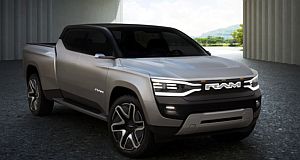
At CES in January 2023, the company unveiled the dramatic 1500 Revolution BEV Concept, based on Stellantis’ STLA Frame electric architecture and equipped with dual electric drive modules, four-wheel steering, an 800-volt electrical system and DC charging capability of up to 350kW.
At the time, Ram described it as a “road map” to its electrified future and at the time said its entire line-up would ultimately offer electrified solutions.
The concept led to plans for a production Ram 1500 REV battery-electric pick-up, but Stellantis progressively changed direction as demand for full-size electric trucks slowed.
By December 2024 it had brought the range-extender Ramcharger program forward ahead of the BEV, explicitly citing stronger customer interest and slowing industry demand for half-tonne battery-electric pick-ups.
Stellantis eventually cancelled development of the battery-only Ram 1500 in September 2025 and transferred the REV name to its range-extended model.
The latter uses electric motors to propel the vehicle while a 3.6-litre Pentastar petrol V6 operates as an onboard generator, with Ram targeting a total range of around 690 miles – approximately 1110km.
Australian availability remains unconfirmed.
Ford changes course
Ram is hardly alone in reassessing the merits of a battery-only full-size pick-up.
Ford moved earlier and considerably further with the F-150 Lightning, putting an electric version of America’s biggest-selling vehicle into series production while Ram’s rival remained on the drawing board.
But Lightning volume never approached that of conventional F-Series.
US sales peaked at 33,510 units in 2024 before falling 18.5 per cent to 27,307 in 2025, against total F-Series volume of 828,832 vehicles.
More tellingly, Ford sold a record 84,934 F-150 hybrids in the same year – more than three times the Lightning volume – with hybrid sales increasing 15 per cent.
Ford has since discontinued the existing Lightning and changed direction for its successor.
The next-generation model will use an extended-range electric drivetrain in which electric motors continue to drive the wheels, but a combustion engine provides generator-backed range.
Ford is targeting more than 700 miles (1125km) between refuelling/recharging stops, with the company specifically highlighting long-distance towing as one of the applications the EREV system is designed to address.
For Australia, the Lightning story has an additional chapter…
Ford Australia never officially imported the battery-electric F-150, but Queensland-based AusEV established a business importing US-market Lightnings and remanufacturing them locally to right-hand drive.
AusEV parent Bosscap Group was placed into receivership on March 17 this year, suspending operations.
Importantly, Bosscap did not attribute its predicament simply to weak Australian customer demand. It said a “sudden change in global production strategy from Ford” materially affected availability of the underlying vehicle platform on which the Australian program depended.
The episode therefore does not demonstrate that Australians rejected the Lightning, but it does underline the difficulties of building a local conversion and sales operation around an electric pick-up whose overseas production strategy was changing rapidly.
The repercussions continued after AusEV entered receivership…
A federal recall issued on March 24 covers 146 AusEV-converted F-150 Lightnings built from 2022 to 2025 over a CCS2 charging-port fault that could cause the internal charging pins to overheat during high-power DC charging.
Because AusEV was in receivership, fellow Australian conversion specialist Performax International offered to inspect and rectify affected vehicles, despite having neither designed nor originally supplied them.
A stock of previously converted Lightnings subsequently resurfaced through Eagers-owned easyauto123 dealerships, backed by dealer-provided vehicle and battery warranties.
For Ford Australia itself, however, full-size pick-up propulsion remains conventional.
The locally remanufactured F-150 is sold exclusively with a 298kW/678Nm 3.5-litre EcoBoost twin-turbo petrol V6. Neither the US-market PowerBoost hybrid nor an electrified F-150 is presently offered here.
GM goes bigger on V8s
General Motors has taken a different path again…
Rather than introducing a hybrid to its redesigned Chevrolet Silverado 1500 and GMC Sierra 1500, GM has developed two entirely new sixth-generation naturally aspirated small-block V8 engines.
The new 5.7-litre L76 develops 402hp (300kW) and 428lb-ft (580Nm), while the larger 6.6-litre L78 delivers 481hp (359kW) and 501lb-ft (679Nm).
GM says the latter is the most powerful naturally aspirated V8 in the light-duty pick-up segment.
Both feature greater displacement than the outgoing 5.3- and 6.2-litre engines, along with higher compression, increased airflow, redesigned intake manifolds, combined direct and port fuel injection, and a new variable-output lubrication system.
They will sit alongside an enhanced 2.7-litre TurboMax four-cylinder and continuing 3.0-litre Duramax turbo-diesel, all paired with 10-speed automatic transmissions.
“It’s not one engine for everybody,” said GM president Mark Reuss in a recent statement.
“It’s the freedom to choose the engine that fits your work, lifestyle and priorities.”
The philosophy closely mirrors Mr Barber’s explanation of why Ram believes Hemi and Hurricane should coexist.
GM is also defending diesel against hybrid alternatives, pointing to its combination of towing performance, efficiency, and range.
With an available 34-gallon (129-litre) fuel tank, the 3.0-litre Duramax is claimed to provide more than 900 miles (1450km) of highway range.
Nor is GM’s combustion-engine investment insignificant.
It has committed $US888 million ($A1.32b) to its Tonawanda Propulsion facility in New York to support sixth-generation V8 production, while $C691 million ($A760m) is being invested in St Catharines, Canada.
The engines will also be produced at Flint Engine Operations in Michigan and are expected to have accumulated more than 1.5 million miles (2.4 million kilometres) of real-world validation before the new trucks reach dealerships.
Australian availability of the new Silverado and its sixth-generation V8s has not yet been announced by GMSV.
Toyota takes a different hybrid route
Toyota is currently the exception among Australia’s factory-backed full-size American pick-up operations, offering the US-built Tundra exclusively with hybrid propulsion.
But its i-Force Max system is overwhelmingly performance- and capability-focused rather than designed around the large fuel-economy or electric-driving gains associated with Toyota’s passenger-car hybrids.
The Tundra combines a 3.5-litre twin-turbo petrol V6 with a 36kW/250Nm electric motor integrated into its 10-speed automatic transmission, producing combined outputs of 326kW and 790Nm.
Toyota itself says the system provides “extra punch” for stronger acceleration, particularly when towing heavy loads.
Its nickel-metal hydride battery is comparatively small, and the system is not intended to provide meaningful electric-only driving.
Instead, motor assistance boosts response, pulling power and performance, supporting a braked towing capacity of up to 4500kg.
It is therefore better characterised as an electrically assisted high-output petrol powertrain than an economy-led hybrid equivalent to Toyota’s smaller passenger vehicles.
Even so, Tundra remains the only one of the four main factory-backed US full-size pick-up propositions available locally – Ford F-150, Ram 1500, Chevrolet Silverado 1500, and Toyota Tundra – to presently offer hybrid propulsion.
NVES complicates local equation
Australia’s New Vehicle Efficiency Standard (NVES) adds another dimension to the divergent powertrain strategies.
The NVES has applied to eligible vehicles since July 1, 2025, with manufacturers and importers assessed against fleet-average CO2 targets and able to generate, bank or trade units where their performance beats those targets.
However, current full-size pick-ups are treated differently depending largely on GVM.
Ford’s F-150 carries a GVM of between 3315kg and 3360kg depending on specification, placing it inside the present NVES framework. Its 3.5-litre EcoBoost also carries a quoted CO2 figure of approximately 306g/km.
Ram’s current 1500, meanwhile, has a 3505kg GVM, putting it just five kilograms beyond the present 3500kg boundary.
GMSV has taken its Silverado 1500 to exactly the same 3505kg GVM for MY26i, up from 3300kg, simultaneously raising payload and moving it from NA light-goods to NB1 medium-goods classification.
Toyota’s Tundra is similarly rated at 3536kg GVM.
The exclusion may prove temporary…
The Federal Government has proposed removing NVES exempt status for qualifying passenger-style vehicles between 3500kg and 3855kg GVM from July 1, 2027, now that Australia has introduced an applicable CO2 test procedure.
If adopted as proposed, that would potentially draw the Ram 1500, Silverado 1500, and Tundra into the scheme alongside Ford’s F-150.
Vehicles above 3855kg remain a different proposition because a suitable CO2 testing procedure has not yet been specified.
That is particularly relevant to Ram 2500 and Chevrolet Silverado HD, which sit comfortably beyond the immediate proposed expansion.
Results from the first six months of NVES operation also demonstrate the importance of portfolio mix.
Ford Motor Company of Australia generated a negative interim emissions value – meaning it beat its fleet target and earned units – while General Motors Australia and New Zealand finished with a positive interim value.
FCA USA LLC also recorded a positive figure, although that entity should not be treated as a direct proxy for Ram Trucks Australia alone given Stellantis’ multiple Australian regulatory entities and Ram’s distribution structure.
Ford’s much broader Australian range – increasingly including hybrids and BEVs – gives it greater scope to balance a high-emitting vehicle such as F-150 against lower-emissions models elsewhere in its portfolio.
GMSV and Ram face a rather different equation should more of their core full-size pick-ups ultimately fall inside NVES.
Choice returns to centre stage
A few years ago, Detroit’s three truck giants appeared to be travelling broadly towards the same destination.
Ford had committed heavily to Lightning, Ram was promising the REV, and GM was spending billions on electric trucks including Silverado EV.
The route now looks far less linear.
Ford has retained hybridisation, abandoned a conventional battery-only replacement for the current Lightning and turned to range-extender technology for its next generation.
GM continues to develop EVs but has simultaneously committed major investment to two entirely new V8s, an enhanced four-cylinder and its existing diesel – without a hybrid Silverado or Sierra in its core combustion range.
Toyota has hybridised the Tundra but uses electricity principally to enhance torque, response and capability rather than providing substantial zero-emissions running.
And Ram, having once positioned the Revolution concept as the starting point for an electric future, has reinstated the Hemi while retaining Hurricane and Cummins power and shifted its planned electrified half-tonne towards range-extender technology.
None of that means Detroit has abandoned electrification.
Rather, the experience of the past several years appears to have pushed choice, towing ability, long-distance range and customer demand back towards the centre of full-size pick-up product planning.
For Ram Trucks Australia, Mr Barber’s assessment of the immediate local appetite for hybridisation remains considerably simpler.
“Not really, not (for) this segment.”