


Overview
WHILE the relevance of the classic ‘win on Sunday, sell on Monday’ slogan is up for debate, Skoda’s RS moniker – which was first used in 1974 for its 180RS and 200 RS rally cars – forms a significant part of the Czech’s brand’s still-ongoing 125-year motorsport history.
In any case, when applied to its road cars, the RS badge indicates the vehicle it’s applied to is the performance variant of that particular model, with Kodiaq family SUV and the facelifted Enyaq mid-size electric SUV being the latest pair of Skodas to receive the Rally Sport treatment in Australia.
Out of the two, the Kodiaq RS – now in its second generation – arrived first, launching Down Under in late-2025.
Priced at $70,590 before on-road costs, the RS sits atop Skoda Kodiaq line-up above the Plug-In Hybrid model we tested earlier this year ($63,490 + ORCs) as well as the Sportline variant ($58,990 + ORCs).
This pricing puts the Kodiaq RS in competition with the Mazda CX-80 G40e Azami ($75,300 before on-road costs), the Hyundai Santa Fe petrol and hybrid Calligraphy variants ($73,900 and $77,150 + ORCs respectively), and even its closely-related Volkswagen Tayron 195TSI R-Line 4Motion ($74,550 + ORCs) cousin in the three-row, large family SUV segment.
However, the RS variant isn’t just another Kodiaq trim level, packing meaningful performance gains over the Sportline model grade.
It’s powered by the Volkswagen group’s EA888 2.0-litre turbocharged four-cylinder engine – which you’ll also find beneath the bonnets of several vehicles including the Volkswagen Golf GTI, the Skoda Octavia RS, and the Audi S3 – in this instance producing 195kW and 400Nm. Compared to the Sportline grade, this represents a 55kW and 80Nm increase.
Mated to a seven-speed dual clutch transmission and all-wheel drive, the Kodiaq RS accelerates from 0-100km/h in 6.3 seconds, completing the dash 1.6 second quicker than the Sportline model.
Exterior changes distinguishing the RS from the Sportline model include a different 20-inch wheel design, satin chrome dual exhaust tips, RS exterior badging, and RS front and rear sports bumpers.
Inside, the RS has leather upholstery (as opposed to Suedia), heated rear outboard seats (as standard), ventilated front seats as well as optional features from the Sportline – including power adjustable driver and front passenger seats with pneumatically adjustable lumbar, a heads-up display, and a 13-speaker Canton premium sound system – included as standard.
It also gains hill descent control, drive mode selections, an eco function, progressive steering and the Volkswagen group’s dynamic chassis control adaptive suspension system as standard, all of which are optional for the Sportline.
The RS also retains several features found throughout the rest of the Kodiaq line-up, including, a heated windscreen, a 13-inch infotainment touchscreen (compatible with Apple CarPlay and Android Auto), a 10-inch digital instrument cluster, interior ambient lighting, multi-function smart dials (which can be used to adjust air conditioning, media volume, drive modes, etc), and seating for seven (in the case of the non-PHEV variants).
As for boot space, the Kodiaq RS has 289 litres with all rows upright, 794 litres with the third row folded and 2035 litres with all rows folded.
Safety features on the Kodiaq RS include nine airbags, tyre pressure monitoring, adaptive cruise control with stop and go, predictive adaptive cruise control, traffic sign recognition, an intelligent speed limiter, a rear and an area view camera, front and rear parking sensors, intelligent park assist, advanced driver fatigue detection, front assist, side assist, lane assist with adaptive lane guidance, front and rear manoeuvre braking assist, crew protect assist, collision avoidance assist, crossroad assist, emergency assist, emergency steering assist, an exit warning system, traffic jam assist, travel assist, and turn assist. The RS – along with the rest of its stablemates – holds a five-star ANCAP rating
The Kodiaq RS is offered with a seven-year/unlimited km warranty and 12 months of roadside assist (with another 12 months added with each scheduled service at an authorised Skoda dealership).
It is also offered with either a five-year/75,000km or a seven-year/105,000km servicing program priced at $3190 and $4290 respectively.
The Kodiaq RS comes with a space saver spare wheel.
Meanwhile, the facelifted Enyaq RS is the latest Skoda performance model to arrive in Australia, but like its Kodiaq RS stablemate this is not the first time the nameplate has appeared in the Australian market.
When the pre-facelift Enyaq first arrived in Australia in 2024, it launched in both Sportline and RS guises, both in the Coupe body style.
The facelifted Enyaq arrived in late-2025, but the RS model didn’t rejoin the line-up until this year.
With its return, the Enyaq RS assumes its position as the flagship of Skoda’s electric mid-size SUV range above the Sportline 85 model.
Priced at $76,590 + ORCs for the SUV body style and $77,590 + ORCs for the Coupe, the Enyaq RS rivals such vehicles as the Tesla Model Y Performance ($89,400 + ORCs), Polestar 4 Dual Motor AWD ($86,350 + ORCs), the BYD Sealion 7 Performance AWD ($63,990 + ORC), and its Volkswagen ID.5 GTX AWD ($72,990 + ORCs) relative.
Over the 85 Sportline, the Enyaq RS crucially receives a front-mounted electric motor, giving it dual-motor all-wheel drive a combined system output of 250kW with torque figures quoted at 134Nm from the front motor and 545Nm from the rear, good for a 0-100km time of 5.4 seconds.
Electricity is sourced from an 82/77kWh (gross/net) NMC battery, providing a combined WLTP range of 546km for the SUV and 557km for the Coupe.
The RS model is distinguished visually from the Sportline model by a different 21-inch wheel design and RS exterior badging as well as an illuminated ‘tech deck’ face for both the SUV and Coupe body styles (for the Sportline SUV it is available as an optional extra while being standard on the Coupe).
Its interior additions over the Sportline include leather seats (as opposed to Suedia), a 12-speaker Canton sound system as standard across both the SUV and Coupe (its an optional feature on the Sportline SUV), and ventilated front seats, while the SUV RS gets an opening and closing panoramic glass sunroof as standard (it’s optional on the Sportline 85 SUV while the Coupe Sportline and RS models get a fixed glass roof as standard).
Furthermore, both Enyaq RS body styles get dynamic chassis control as standard (the Coupe Sportline gets this as standard while it’s an option for the SUV).
The RS retains several features from the rest of its Enyaq stablemates, including metallic paint, an electric tailgate with hands-free opening, a 13-inch infotainment touchscreen with Apple CarPlay and Android Auto, a five-inch digital instrument cluster, and interior ambient lighting.
It also benefits from several changes made to both the Enyaq and the smaller Elroq for the 2027 model year including an upgraded area view camera with dynamic parking lines, a new ‘half-light’ lighting function, traffic sign recognition, predictive adaptive cruise control, a predictive speed limiter, one pedal driving, advanced driver monitoring, a 21-litre frunk, crossroad assist, side and rear detection for the crew protect assist system, more ‘Simply Clever’ practicality features, 25W MagSafe wireless phone charging, and an updated, Android-based infotainment system.
However, it should be noted that the vehicles tested in this review were model year 2026 specification vehicles, and therefore did not benefit from these changes.
The Enyaq RS SUV’s boot space is quoted at 585 litres with the rear seats up and 1710 litres with the rear seats down, while the Coupe’s is quoted at 570L/1610L.
On top of the safety features added for 2027, the Enyaq RS’ safety features include nine airbags, tyre pressure monitoring, front and rear parking sensors, intelligent park assist, emergency assist, emergency steering assist, an exit warning system, front assist, side assist, lane assist, manoeuvre braking assist, rear traffic alert, front cross traffic assist, traffic jam assist, travel assist, and turn assist. Like the Kodiaq, the Skoda Enyaq also holds a five-star ANCAP safety rating.
The Enyaq is offered with a seven-year/unlimited km warranty, an eight-year/160,000km battery warranty, as well as 24 months of roadside assist with each scheduled service completed at an authorised dealership.
Service intervals for the Enyaq arrive every 30,000km or 24 months, with services priced at $569.
Customers can also choose an eight-year/120,000km or a 10-year/150,000km service pack coming to a total cost of $1750 and $1990 respectively.
But have these two SUVs been able to capture any of Skoda’s prized rally magic? GoAuto headed to a snow-covered proving ground in New Zealand to test the latest RS duo’s performance pedigree…
Driving Impressions
Admittedly, spending a day sliding around in the snow on slalom courses, figure-of-eight tracks and on other exercises probably isn’t a frequent use case for either the Kodiaq or Enyaq RS. However, we were still able to learn a few things about both cars in the process.
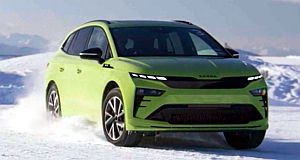
The Enyaq RS – equipped with winter tyres – responds well to a snowy slalom, exhibiting surprising agility – especially for a mid-size electric SUV – and composed body control.
When initiating slides, the immediate responsiveness of the electric powertrain allows for quick adjustments to be made with your right foot, making it very controllable.
Also wearing winter tyres, the Kodiaq RS surprised us with how quickly it could put its power down and accelerate on snow.
We’ve already come to expect solid driving dynamics from other current-generation Kodiaq variants we’ve tested, and the RS seems to be no exception. Like its electric stablemate, the Kodiaq RS was also very approachable on snow, being both easy to slide around and have fun in while also proving controllable.
It also sounds pretty good both inside and outside the cabin. While we understand that the sound system has some impact on what its 2.0-litre turbocharged four-cylinder engine sounds like in the cockpit, stand next to it while it’s idling and it burbles away like a muscle car.
While certain modes do reset when both the Kodiaq and the Enyaq RS are switched off, such as the ESC mode – which needed to be set to ‘Sport’ in order to facilitate the day’s snow-centric antics – the customisable driving experiences of both vehicles is something we appreciate.
In this environment, the luxury features of both these cars were also welcome, particularly the heated seats and steering wheels of both the Kodiaq and Enyaq RS.
What dawned on us during the snow driving day is that we weren’t doing all of this in some purpose built sports car, but instead, sensible SUVs (albeit performance variants of them), one of them capable of ferrying seven people.
The Kodiaq and Enyaq RS are sensible and practical with a performance edge, and the day’s activities proved that when the time is right, they can put a smile on your face.
The Kodiaq RS isn’t immune to some of the issues we’ve mentioned previously with its stablemates, including the odd iffy touchpoint and a slightly cramped third row.
We’ll also have to wait until we’ve tested the Enyaq RS in the ‘real world’ to see if it’s truly worth the $15,600 price jump from the Sportline in the case of the SUV and $10,600 jump for the Coupe models. Skoda seems to think it is, having forecasted a 50 per cent take rate for the RS among Enyaq buyers.
However, if you need a car with space, or you want to go to the snow, and you also want your vehicle of choice to have some performance chops, the Enyaq RS – especially with its MY27 changes adding features like a frunk and one-pedal driving – and the Kodiaq RS are two differing yet compelling takes on the fast SUV formula.