


DESPITE being the first mainstream brand to bring a mass-market battery electric vehicle to the world in the form of the frog-eyed Leaf, Nissan – at least in Australia – is hesitant to put all of its eco-eggs into the BEV basket.
Nissan Oceania MD Steve Milette is still fresh behind the desk, having recently transferred here from Nissan North America – which included five years as president of Nissan Canada – and takes the reins at a challenging time.
With Nissan’s global struggle to return to profitability hanging overhead, Nissan Oceania also needs to navigate a pathway to get its New Vehicle Efficiency Standard ledger back in the black.
In parallel, the fuel shock of March and April has also thrown a spanner in the works by dramatically crimping demand for diesel and petrol models across the board.
With a portfolio of one slow-selling BEV (the Ariya medium SUV with just 104 sales in the first four months of 2026) and no plug-in hybrids, Nissan’s Australian operation is truly behind the eight-ball when it comes to offering combustion-independent options.
But while some brands are hedging their bets when it comes to powertrain strategy, Mr Milette appears to be leaning in the direction of PHEVs.
“I think it (PHEV) is a huge opportunity,” Mr Milette said at a recent media roundtable in Sydney.
“This market, similar to the one I came from, has huge geography, people travel long distances, you’ve got the topography of the land, you’ve got off-road enthusiasts, and also the need for utility.
“People pull stuff and they love to play, and so I certainly see the need for something that has that capability and plug-in hybrid seems to be what’s going to work best in the short-term and mid-term.”
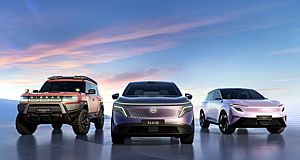
Top of the list of Nissan’s PHEV prospects for Australia are the Frontier Pro pickup, official confirmation of which is believed to be close, and the Terrano SUV, which was previewed as a concept at the Auto China 2026 show in April.
Both are products of the Nissan-Dongfeng joint-venture, and both pair a petrol-electric powertrain with rugged off-roader underpinnings.
“Terrano as an example, a fantastic vehicle. We saw it – it’s badass,” Mr Milette said.
“The Terrano concept vehicle, to me that would be something we seriously need to look at, and there would be demand for that in this country.”
“You would have (also) seen Frontier Pro or Navara Pro, whatever it’s going to be called in the future – these are all products that we’re looking at. There’s nothing confirmed yet, but we are looking at them because obviously they would resonate extremely well for our market.”
PHEV utes are beginning to find favour in Australia. The BYD Shark 6 spearheaded the charge, followed by the Ford Ranger PHEV and GWM Cannon Alpha PHEV, with the JAC Hunter PHEV and Chery’s upcoming plug-in diesel-electric ute (provisionally named the KP31) just around the corner.
With the diesel price shock decimating ute sales in April, the Frontier Pro could capitalise on a shift in buyer sentiment away from diesel.
None of this means Nissan is turning its back on BEVs entirely, but the emphasis is likely to be more on PHEVs for the remainder of the 2020s.
The next-generation Leaf – no longer a C-segment hatch and now a small SUV – has had its business case deemed unsustainable for Australia, and the retro-futuristic Nissan Micra, based on the Renault 5 and a commercial hit in Europe, is a non-starter due to its high acquisition cost.
The NX8 SUV and N7 sedan – also products of the Nissan-Dongfeng JV – may come our way to help provide some BEV diversity in local Nissan showrooms, but an over-reliance on BEV product is something Mr Milette is wary of:
“If I rely on my Canadian experience, when there were government subsidies, EVS went up. When government subsidies were removed, EV sales went down. There was a 1:1 correlation, but that being said, I think with legislation like NVES, as a company, we need to make sure we meet those standards,” Mr Milette explained.
“Through portfolio management, BEV has to play a role, E-Power hybrid has to play a role – the future evolution of our product will have to make sure it respects what NVES requires.”
Nissan needs all the help it can get with NVES right now. The brand accumulated 215,261 NVES liabilities in 2025, making it one of the least-compliant OEMs under the New Vehicle Efficiency Standard, outdone only by Mazda.
The addition of the Frontier Pro and Terrano as PHEV options in the LCV and large SUV categories, two segments that provide a significant chunk of Nissan’s sales volume, would enable the company to scrub a significant amount of emissions from its carbon ledger.