

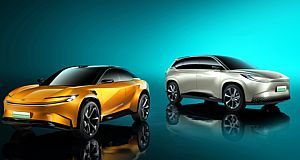

TOYOTA will make an unprecedented shift in its vehicle development strategy by putting a next-generation Lexus electric vehicle into production in China before Japan.
The as-yet unnamed electric SUV is expected to enter production at Toyota’s new Shanghai manufacturing facility in the second half of 2027, according to reports out of Japan.
Significantly, the model will also introduce Toyota’s gigacasting technology to series production, making China the proving ground for one of the Japanese giant’s most important new manufacturing processes.
It represents a notable departure for Toyota, which has traditionally introduced its latest vehicle and manufacturing technology in Japan before rolling it out elsewhere.
The Shanghai operation will be Toyota’s first wholly owned EV manufacturing facility in China, rather than a joint venture with a domestic manufacturer, and will produce Lexus battery-electric vehicles and batteries.
Toyota is investing around 14.6 billion yuan ($A3.0b) in the facility, located in Shanghai’s Jinshan district.
Initial production of the new Lexus EV is reportedly expected to run at about 1000 units per month during its first year, before climbing to tens of thousands annually from 2028.
The decision to introduce the model in China reflects the increasing influence of the world’s largest EV market on Toyota’s product development.
China accounted for about 8.57 million battery-electric vehicle sales in 2025, representing around 60 per cent of global BEV volume and more than three times that of Europe.
It was also more than 100 times Japan’s BEV volume.
Toyota has come under increasing pressure from Chinese manufacturers able to develop new models more quickly while competing aggressively on technology and price.
The Japanese manufacturer is already adapting its Chinese-market products accordingly, including incorporating locally developed technology into some models.
Its new Lexus EV will take that strategy a step further by introducing gigacasting, a production method pioneered at scale by Tesla and subsequently adopted or investigated by a growing number of manufacturers.
Instead of constructing major sections of a vehicle body from numerous stamped components that are then welded together, gigacasting uses large die-casting equipment to produce substantial structural sections as single pieces.
Toyota says the process can reduce the weight of affected body structures by around 20 per cent while increasing rigidity and cutting the number of components and manufacturing processes required.
Lower structural weight could also deliver a several-per-cent improvement in EV driving range.
Toyota publicly demonstrated its work on gigacasting in 2023, including equipment capable of producing a major vehicle body section in approximately three minutes.
Putting the technology into production in Shanghai could allow Toyota to develop the process alongside China’s extensive EV, battery and electronics supply chain before applying what it learns to vehicles produced elsewhere.
That could ultimately make the Shanghai operation more important to Toyota than its initial production volumes suggest.
Toyota already produces EVs in China, including the bZ3X SUV, but these are manufactured through joint ventures with Chinese partners including GAC and FAW.
The new Shanghai operation gives Toyota direct control over development and manufacturing at a time when established global car-makers are under pressure to match the considerably shorter product-development cycles of their Chinese rivals.
Lexus itself remains a sizeable player in China, recording 182,458 sales there during 2025, although the United States remained considerably larger at 370,260 units.
No name or detailed specifications have been confirmed for the new electric SUV and Toyota has not indicated whether it will be exported from China.
There is likewise no indication that the Shanghai-built model is under consideration for Australia.
Toyota has not previously sourced Australian-market vehicles from its Chinese manufacturing operations, although that distinction is becoming less unusual among Japanese manufacturers as China develops into an export base as well as the world’s biggest new-car and EV market.
Mazda, for example, has turned to China for its latest generation of electric models, while Nissan is also looking to Chinese-developed products for overseas markets.
In Toyota’s case the more significant development may be where the technology behind its future vehicles is being industrialised.
Rather than developing its newest EV manufacturing processes in Japan and subsequently taking them to China, Toyota is preparing to do the reverse.