At launch, the Electric Car Discount was expected to help about 5000 Australians get behind the wheel of a quiet, low-emissions, battery-powered vehicle.
The policy, introduced in 2022, removed the fringe benefits tax from some electric cars, potentially cutting thousands of dollars from their price.
But rather than helping a few thousand motorists, the policy has been embraced by more than 105,000 people, tripling the adoption rate of electric cars and fuelling a second-hand market.
Its runway success may be its undoing, however, with Treasury forecasts blowing out to a cost of $1.35 billion a year and a statutory review into whether the policy is efficient and still required.
Automotive experts say maintaining the discount will give Australia some chance of meeting its 2035 environmental targets, and removing or reducing it could stall progress in the transport market as overseas examples have shown.
The tax break for electric cars initially discounted the price of plug-in hybrid electric vehicles as well as battery electric models.
Vehicles qualify for the discount if priced under the current luxury car tax threshold of $91,387 and are purchased in a salary package through their employer.
The policy has proven popular with workers in outer suburban areas, National Automotive Leasing and Salary Packaging Association chief executive Rohan Martin says, as they have long commutes to fund.
Mr Martin cites the example of a Sydney accountant with 100km daily drive who chose an electric car to save $3000 to $4000 a year on petrol but could only afford it with the tax discount.
“This is an extremely successful policy and government doesn’t always get policies right,” he says.
“It’s delivered strong uptake, it’s reducing emissions, providing cost-of-living relief and it uses an effective private sector delivery channel.”
The cost of electric cars in Australia has fallen over the past three years, with BYD recently releasing the first model priced at less than $24,000.
But the cars still have far to go before they reach price parity with their fuel rivals, Electric Vehicle Council policy head Aman Gaur says, and consumers need help to bridge the gap.
“For the top 10 best-selling EVs last year … there’s still an average 25 per cent price premium that needs to be addressed in order to bring more Australians into EVs,” he tells AAP.
“You’re going to be saving heaps of money per year by driving an EV and doing a great thing for your country in terms of air pollution and noise pollution (but) those benefits are difficult to understand when somebody is looking at the sticker price.”
Discounting the price of EVs on novated leases also has an added benefit, Mr Gaur says, as the vehicles are often sold second-hand after three years.
Used electric car sales in January jumped 20 per cent, according to figures from the Australian Automotive Dealers Association and AutoGrab, outpacing other vehicle types.
“We are now finally starting to see an emerging EV market in second-hand sales,” Mr Gaur says.
“That really is the biggest reason we need to see the Electric Car Discount continue.”
Other financial rebates and discounts for electric car purchases have already been removed in Australia, including those offered by state governments in Victoria, NSW and Queensland.
Withdrawing this final discount could put the brakes on electric car sales, Swinburne University future urban mobility professor Hussein Dia says, just as similar moves had slowed adoption overseas.
“There are countries like Germany, the Netherlands, New Zealand and even the US that have had drastic declines in EV sales when incentives were reduced or removed,” he says.
“The international experience shows sustained EV uptake is closely linked to the availability of consumer incentives.”
In New Zealand, for example, electric car purchases dropped from 27 per cent to 11 per cent after the government dropped its Clean Car Discount in December 2023.
The tax exemption’s possible removal is a concern shared by Federal Chamber of Automotive Industries that represents 68 car brands.
While the peak body has clashed with electric car groups in the past, chief executive Tony Weber says both agree financial incentives should be offered to consumers to boost the fledgling market.
The New Vehicle Efficiency Standard encouraged car makers to bring low-emission cars into the country under the threat of penalties, he says, and these changes will be wasted if there is no support for demand.
“We now have more than 100 EVs, 50 plug-in hybrids,” he says.
“Without consumer demand, we can bring as many cars into the country and as many models as you like but it’s not going to achieve the policy objective.”
Submissions into the Electric Car Discount review closed on February 6 but a report into the policy is not expected until 2027.
Driving can be many things – from a hobby to a professon – but for the majority, it’s also a necessity; getting to work or school, traveling to family, running errands… driving is essential. And we all had to start somewhere. While there are many driving schools out there, and many of us were privileged to have been taught the basics of how to operate a car by an adult in our lives, some may need a reference guide to look back on. This is a very simple guide for first-time drivers who are learning the interior and controls of their car. We cover everything from the gauge cluster and the pedals to the steering wheel and stalks. We’ll also clarify some of the more advanced features and give you some guidance on warning signs you might need to react to in the future as a driver.
This is meant to serve as a general guide for the interior to most vehicles, and while some specific models will be mentioned, your own car may vary in some way or other.
The Basics: The Controls You Will Need To Operate a Vehicle Safely
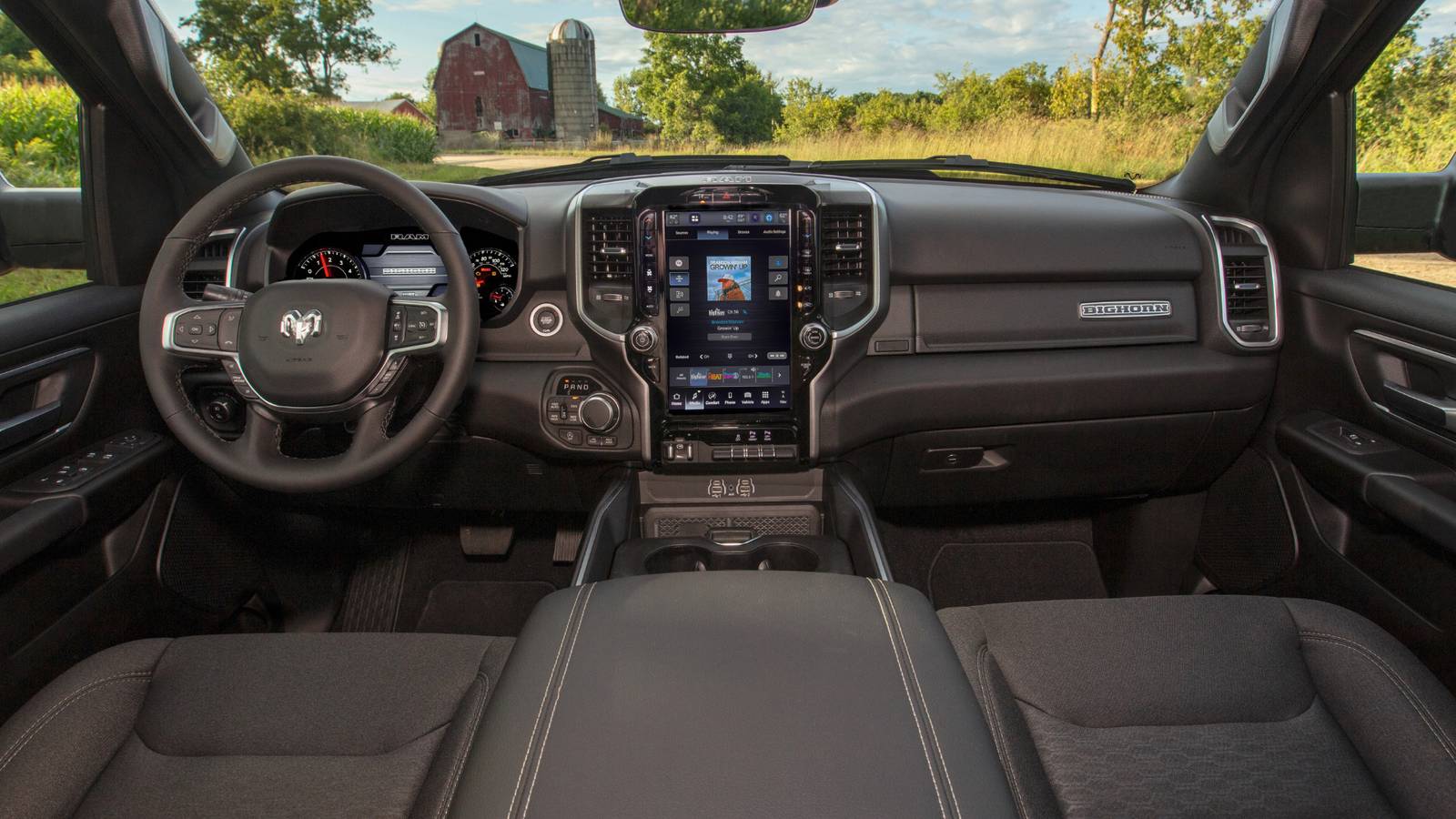
Interior detail shot of the 2025 Ram 1500 REVRam
To get the car going and driving safely, you will need to know the very basics. In this section we will look at the controls and equipment you will need to use.
The Ignition
2011 Audi S5 Coupe stop start system ignitionAudi UK
To activate the car, its electronics, and engine, you will need to start the car. Most modern vehicles use push-to-start systems, with you simply needing to have the key fob on your person in the car. You then put your foot on the brake for an automatic, or the clutch with the car in neutral in a manual car. Lastly, you press the start button and the car should fire up.
In older cars, you’ll need to put the key into the ignition and twist to turn the car on. To be safe, you should always have the clutch fully depressed in a manual car when you are starting it, even if your car is not in gear. There were a few years when manufacturers were figuring out push-to-start technology, meaning that some late 2000s and early 2010s models may require you to put the key fob in a slot in the dashboard, and then press the start button, or soemething similar.
The Pedals
The 2024 Subaru BRZ with 3 pedalsSubaru
The pedals from left to right are the clutch, brake, and accelerator. If you have an automatic, you will not have a clutch pedal. The clutch is used to engage the gearbox to the engine, and you will have to master it to be able to drive smoothly with a stick shift. The brake pedal is used to stop the car – regardless of whether you drive an EV, a gas-only car, or any type of transmission – the pedal will be there. The way you use it may vary, however. The accelerator pedal is last and is used to increase the speed of the vehicle. In the image above, you’ll see a foot rest on the far left, too.
Some steering wheels are more complicated than others, offering alot of buttons from which your multimedia and even cruise control is operated. Some steering wheels are more simple, and some are fancy and come with heating for those icy days when you can barely grip the wheel. You also get some interesting shapes, like the oval shape of the 2024 Subaru Solterra or the flat-bottomed wheels of performance-focused cars.
It’s important to know that some steering wheels are much lighter (or easier) to turn, while others are more heavily weighted. Old cars may also not have power steering, which impacts how it feels to turn the wheel, too. You should familiarize yourself with your car’s steering ratio so that you don’t get caught off guard.
Modern steering wheels will usually feature controls for things like audio, cruise control, and, if applicable, buttons to change how the gauge cluster displays. You can adjust your steering wheel position by unlocking the column by pulling a paddle or level; more upmarket cars will have electronic controls to adjust the tilt and position of the wheel.
Your steering wheel also contains your car horn – this is supposed to be used for warning other drivers, drawing attention, and the like. Some people use it to greet people they may know – we hope you never use it in a fit of road rage.
The Stalks
Mitsubishi Galant VR-4 front cruise control stalk rearBring a Trailer
Stalks are where you will find indicators (blinkers), along with some of your lighting controls. This is also where you will control windscreen wiper activation and speed, and window sprayer controls. Some models that are going back to having the gear selector on the column are now putting all controls on one large stalk, too. Some manufacturers also use a second stalk for the cruise control module.
The Gear Shifter Or Gear Selector
2013 Audi SQ5 TDI shifterAudi
Traditionally, cars have an easy-to-recognize gear shifter. Manual cars have a stick shift with some of patterned layout indicating which gear is located where. For automatic cars, the shifter looks a litle different, and has fewer directions of movement: The most basic set-up will be the classic PRND set-up with some transmission levers allowing you to force the car into a low gear, such as PRND12. Hybrids and electric cars can also have a slightly different layout in the form of PRNDB or PRNDL, with the B/L meaning the drivetrain will more actively slow the car down when coasting to harness the energy for the battery.
Some modern cars have changed up on this conventional set up, with buttons for the different shifter modes, a rotary dial, or a column shifter being used. Jaguar had the famously shaped J-gate automatic, Mercedes-Benz used the column shifter for years and Lincoln and Aston Martin have used button-style shifters for a while now. They all have the common ground of a light or icon that shows which gear the car is currently in.
It’s worth noting that if you have an off-road focused car with 4WD, you may have additional shifters for low-range gearing – although all of this is changing too, as technology advances.
The Parking Brake, AKA Handbrake
Electronic parking brake button on a HyundaiHyundai Motor Group
The parking brake is used to hold the car at a stop and should be engaged any time you are leaving the driver’s seat of the vehicle. There are three main types: Some cars that are based on older platforms use foot-mounted parking brakes. There will be a pedal on the left of your clutch or brake pedal that you press down to engage, then press again to disengage. The second type is the old-fashioned handbrake: a lever you pull up to engage and lock in place, and then push a button in to disengage and lower. The last type is the electronic hand brake. These are activated and deactivated by pressing or pulling on a switch-type button.
Cars with electronic parking brakes are the norm now, and have extra safety features that help stop the car rolling. Some may include auto-hold, a feature that will automatically hold the car when it detects the car has stopped moving. This allows you to take your foot off the brake pedal, with the system disengaging when it detects the accelerator being pressed or enough pressure from the clutch, allowing you to pull away. Another safety system is that the car will automatically turn on the parking brake if a door is opened in the car, and will have to be manually disengaged by pressing the parking brake button.
The Next Level: The Dashboard, Cluster, Mirrors, And Safety.
The Dashboard Gauge Cluster
2012 Nissan Altima dashboard close-upAutoTempest
The most critical visual aid in your car is the driver’s gauge cluster – or instrument cluster – in the dashboard. It contains your tachometer, speedometer, fuel/EV percentage gauge and temperature gauge, as well as an odometer. The tachometer shows you theRPM of the vehicle to help understand when you should change gear or just so you are aware of your engine speed in an automatic. The speedometer shows your speed, and is important to ensure you’re not going over the limit.
You can also expect to see other information like fuel consumption, driving time or distance traveled, and fuel range. In more modern or up-market vehicles, you may have a customizable digital gauge cluster that can show you a map, what is playing on the radio, or settings for your radar cruise control.
In the gauge cluster you will also find a temperature indicator which is vital to knowing if your car is overheating, as well as various dashboard warning lights that may illuminate to show you any current problems with your car. Some cars, such as the Tesla Model 3 and Model Y, don’t have a cluster like this, instead putting that information on the right side of their huge infotainment screen.
The Seat Belts
2009 Mercedes-AMG S63 – Back seat, seat belt and clipMercedes
One of the most important safety aids in your car, the seat belt, is to be used every time you drive your car. Some modern cars require the seat belt to be used to disengage the parking brake. For rear seat occupants, the middle seat belt is generally not compatible with the two outer belts, meaning you will have to be sure you are using the right buckle, or it won’t click in and engage. With seat belt pretensioners now coming to the most modern of cars, don’t be alarmed if a 2024 or 2025 car automatically pulls the seat belts tighter when driving spiritedly or if the car thinks that an accident or impact is imminent.
You may also hear an annoying warning tone or see an illuminated warning light on your gauge cluster if you aren’t buckled up. Safety first!
The Rearview Mirror
2025 Land Rover Discovery Sport Rear View MirrorLand Rover
The rearview mirror is key to being aware of your surroundings while driving and parking. They were rather straight forward up until the last few years, but nowadays these can look remarkably different. The most basic type will be a regular rearview mirror you can manually adjust; you should position this for the clearest view through the rear window. There will be a small tab underneath the glass that you can pull or push. This is the mirror dimmer, and is used if you are driving in the dark and want to lessen the glare from the headlights of other vehicles behind you. Most modern cars now have an automatic dimmer that will detect the glare and adjust as such.
These days, you also get a mirror camera, which is becomign more and more popular. This type of mirror not only show you a view out of the back, but can also show a backup camera view for when you are needing to reverse. In fact, some cars these days don’t have traditional mirrors at all, using just a camera – and that’s because some cars don’t even have a rear windscreen. Have a look at the Polestar 4 and 5 if you want an example.
Basic Safety Controls
A shot of the 2011 Lotus Elise hazard light switchLotus
There are some other basic safety systems and controls we need to look at inside your car. Your hazard lights, used to highlight your vehicle if parked in a dangerous place, or signal that the car is in trouble in some way (such as being broken down or crashed), are usually located in the center console. It’s marked clearly in red with a triangle design in white; it may also be illuminated for ease of use.
Another safety control you may need to use, especially when towing, is your headlight leveling dial. Some cars will do this automatically, but if yours doesn’t, you will see a small dial to the left of the steering wheel. You move this dial to the desired position to point the headlights to where you want, making sure not to blind oncoming drivers by raising them too high.
Convenience Features And Infotainment
2026 Aston Martin Vantage Roadster center console and main touchscreenAston Martin
So you are all ready to drive. In this next section, we will look at the things that make your journey more pleasant and the infotainment system and its controls.
We do not recommend using these controls while driving, unless you are an experienced driver and familiar with your car. Distracted driving is extremely dangerous.
The HVAC Controls
2025 Hyundai Santa Cruz XRT HVAC ControlsHyundai
Also known as the heater, temperature, or A/C controls, the HVAC controls are not only used to control the temperature of the cabin, but also de-ice or de-fog your windows. Some cars use buttons, some cars incorporate the HVAC controls into the screen, but all follow a basic formula. The three main controls will be temperature, placement and speed. Temperature is first and will either be a blue-to-red dial on more basic cars, showing a general idea of the temperature you are setting it too, or a digital setting with numbers. In more advanced models with single or dual zone climate control, you will have one or two actual temperature gauges to help you get the exact temperature you or your passenger want.
Most cars with this more advanced gauge will have an “Auto” button, where you set the temperature you want, press Auto and the car will automatically keep the cabin at the desired degrees. It is important to point out that older or less expensive cars may not feature air conditioning, meaning they will blow no colder than the outside temperature. The car will usually activate the A/C automatically if trying to get to a cold enough temperature, but A/C can also be activated with a button push.
Next is the placement or direction of airflow, with a choice between upward (toward your head), feet, and the windscreen. Most cars will let you choose multiple or all at one time. The windscreen option is key as it allows you to de-mist or de-ice your windscreen and front door windows. Setting it to the window option may also activate the wing mirror de-misters.
Lastly, there is the speed gauge. Here, you can control how much air you want traveling through the vents. Other HVAC controls you will see include the recirculation button/slider. This is used to keep cabin air circulating through the vents, instead of outside air and is useful for heating up or cooling down the cabin quickly (or preventing smoke or smells from outside coming in). Lastly, you may have a rear window de-fogger button. This button turns on a heating element inside the rear window, clearing it from mist.
The Center Console
A detail shot of the 2025 Audi S7 Sportback’s center consoleAudi
What is the middle compartment in a car called these days? The center console is something you will use every time you drive as it contains the shifter (or gear selector), parking brake, and sometimes cupholders and an armrest. Modern cupholders now have more functionality than ever, with some cars imbuing them with heating or cooling. Depending on the vehicle and its infotainment setup, the center console may also contain a trackpad or wheel/dial to scroll and select things on your infotainment screen.
Infotainment System Or Multimedia Screen
2019 Hyundai Santa Fe finished in blue with black interiorHyundai
More commonly referred to as the infotainment display or multimedia screen, your car’s infotainment system is where you will control your vehicle’s audio and navigation systems, and depending on your vehicle, some or all of your climate controls. Some infotainment systems are now becoming almost the entire dashboards, with brands like Lincoln, Cadillac and Mercedes-Benz selling cars with full-width screens that go from one side of the car to the other.
Most infotainment systems have a user interface that is made by the manufacturer. Depending on the vehicle and options, the infotainment system will be your main touchpoint in the car, other than the steering wheel. Most will have a home screen, displaying basic information along with a small view of a map for navigation. These are usually customizable to better suit your preferences. On some more premium cars, the climate control will also be displayed here at the bottom of the screen, or by pressing a shortcut button on the screen, or center stack.
Similarly, your audio and phone controls will also be built into your infotainment system. You can connect your phone via Bluetooth or use a USB-C/USB-A cable to stream audio and phone calls through the vehicle’s speakers. Most modern cars, depending on options, will also have access to features like Android Auto and Apple CarPlay. These act as a more generic, user-friendly system to stream your phone screen and certain apps, such as Waze and Spotify to your car in a consistent and uniform way. It must be noted that some makes and models may not have access to these features, or require the phone to be connected via a wire to access Android Auto or Apple CarPlay.
Some systems will have built-in navigation, and can be set to take you to whatever destination you require. For older luxury cars, SD cards or discs may be required for other regions or for other parts of the US, due to the limitations of older infotainment systems. Your audio/speaker customization may also be found in your information, with users able to control the bass, treble and mids, along with the placement of the sound in the car. We recommend that you get used to your car’s infotainment system before driving, not only for your convenience but also for safety, as some confusing or poorly made systems have been criticized for how much they take drivers’ eyes off the road. In fact, some modern systems may sense that you’re furiously tapping around and not looking at where you’re going, locking you out of the screen for a few seconds.
Lastly, your ADAS and driver assist technology will be embedded in your center screen, allowing you to turn off or on the systems you want. One thing of note, due to regulations, you may need to turn systems like speed limit warning noises off every time you start the car, with it being set to on by default until turned off every time the car is started.
Storage And Other Features
Lastly, we will look at storage and other small features inside your car that help to make your driving experience a bit more livable.
Door Cards
2026 Mercedes-AMG GT 53 Door PanelMercedes-AMG
The door card/door panal also has some form of storage and not just the door latch/armrest. In most mainstream cars, there is a bin at the bottom of the door for storage, along with a bottle holder. Further up your door card you will find your electric window controls and door handle – unless you’re driving a classic car that requires you to manually open windows. The driver’s door will have access to more features than the passengers, like window lockouts, electric mirror controls and a door unlock button.
The Armrest
A detail shot of the 2025 GMC Yukon Denali Ultimate’s center armrestGMC
While not every car has one, the armrest and armrest storage area is getting ever more multipurpose. Almost all are adjustable, sliding back and forth, but some may also have the ability to adjust height. The modern arm rest is alot more complicated than that, with split levels, USB points to connect and charge your phone and even heating and cooling, both on the armrest surface and in the storage area.
Some brands, like Genesis, even offer a feature that clears bacteria off of any object placed inside using UV technology. On more utilitarian vehicles like pick-ups and vans, the center armrest can also have a measurement table like in Ram models built into the armrest, or in the case of the newest Ford F150, fold out to become an actual table for writing and typing on.
The Trunk Release And Hood Opener
A studio shot of the 2026 Mercedes-AMG S63 Sedan with its trunk openMercedes-Benz
Some cars may have a trunk release button by the door or on the left of the steering wheel. These will either pop the trunk release, allowing for the people outside to open it, or electronically open it and/or close it with the button. Some sedans, like the base Audi A6, have a sort of halfway house, using the pressure from the trunk struts to pop open the trunk, but needing to be manually closed.
Similarly, you’ll often find the latch to pop your hood near underneath the steering wheel or in the footwell somewhere within reach.
Other Features Inside Your Car You Might Need To Know About:
Seats: Depending on the make and model you’re driving – and the age – your seat may have electronic controls along the side to adjust the backrest, boslters, height, and distance from the pedals. In older cars, this is done with manual levers. Always familiarize yourself with how these work.
Sun visors: With the exception of a few cars, all cars have sun visors that can flip down to help shade your eyes from glare. They’re actually a safety feature, and can swivel to eliminate harsh light from the side, too. They may also contain mirrors – the driver should never use these while driving.
Glovebox: Likely your main point of storage, the glovebox comes in various shapes and sizes – and in some trucks and SUVs, you may even have two! Some can lock to keep your valuable safely stowed, but these are a great place to keep some emergency supplies like phone chargers and a small first aid kit.
FAQs:
What are the parts called inside a car?
There are a huge number of different parts of the inside of the car which we call the cabin. The steering wheel, pedals, dashboard, infotainment and center console all make up the cockpit, too, which is the space the driver pilots the car from.
Which SUV has the nicest interior?
The SUV’s with the nicest interiors come from luxury brands, such as Rolls-Royce, Range Rover or Bentley. However, brands like Genesis, Lincoln, Mercedes, and BMW also offer some truly refined cabins.
What car brand has the nicest interior?
That depends on what you define as “nice”. Brands like Audi and Genesis offer understated and elegant interiors, while Mercedes-Benz goes all in on technology. Rolls-Royce and Bentley are completely ultra-luxurious.
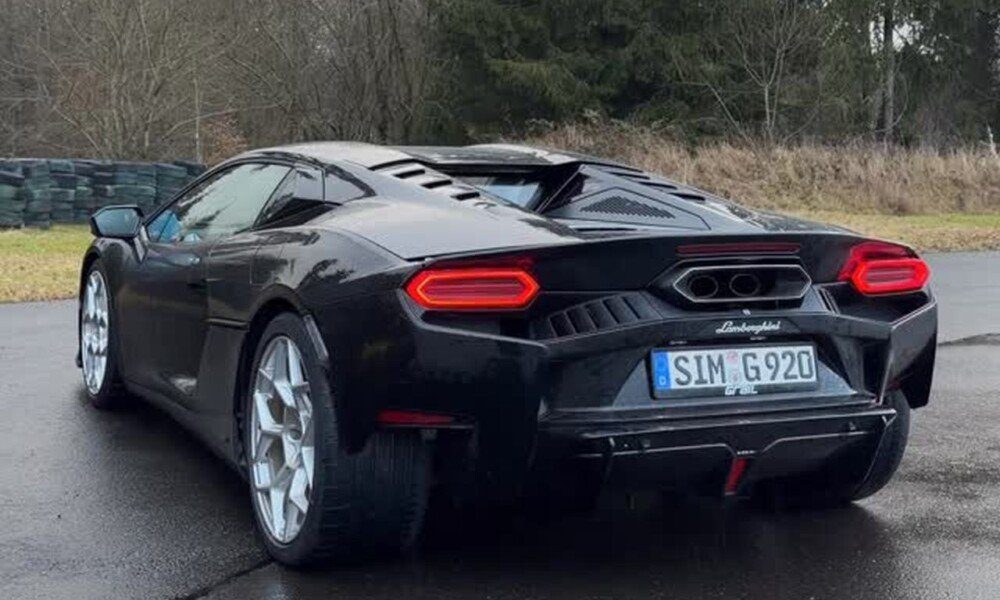
When Lamborghini decided to switch to a twin-turbo V8 for the new Temerario, everyone feared that it wouldn’t sound as visceral as the old naturally aspirated V10 engine. And they were right; the new turbocharged hybrid powertrain may be superior in terms of performance, but it lacks the theatre of a V10.
However, this opened up an opportunity for aftermarket exhaust brands like Grail Automotive. The company has developed a straight-pipe exhaust for the Temerario, which completely transforms the driving experience.
The car was recently featured on their social media, where they stripped it down to replace the exhaust with the aftermarket unit. The results are quite impressive.
The engine definitely sounds a lot louder with the catless system. You still get the throaty bass of the V8, but the pops and bangs make up for the lack of spice.
Grail claims that it’s the first straight-piped Lamborghini Temerario in the world. If you want one, get in touch with Grail Automotive now.
Subaru is known for its dependability, ruggedness, and capability. All of these were honed over the years as the brand competed in the Rallying scene, where it was even dominant. That relationship with racing showed that it’s an enthusiasts’ brand through and through.
Times have, of course, changed, but Subaru has been one of the few automakers that has tried to stick to its core beliefs as much as possible. A recent survey circulating among US owners is generating significant excitement within the enthusiast community.
Related: Subaru Hints at Pickup Comeback After 20 Years
Reddit/Macgyver452
Stick Shift SUV
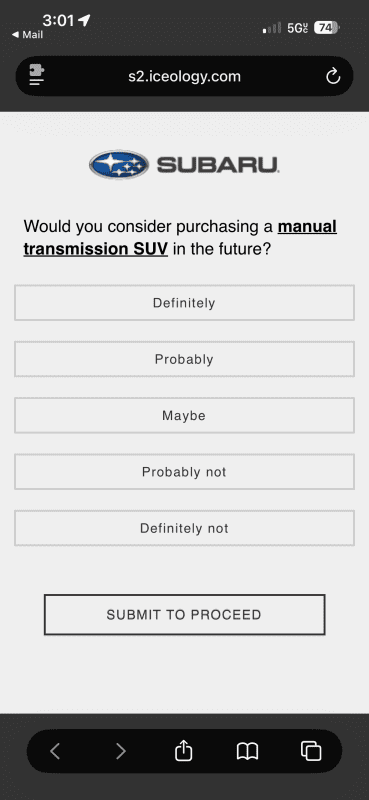
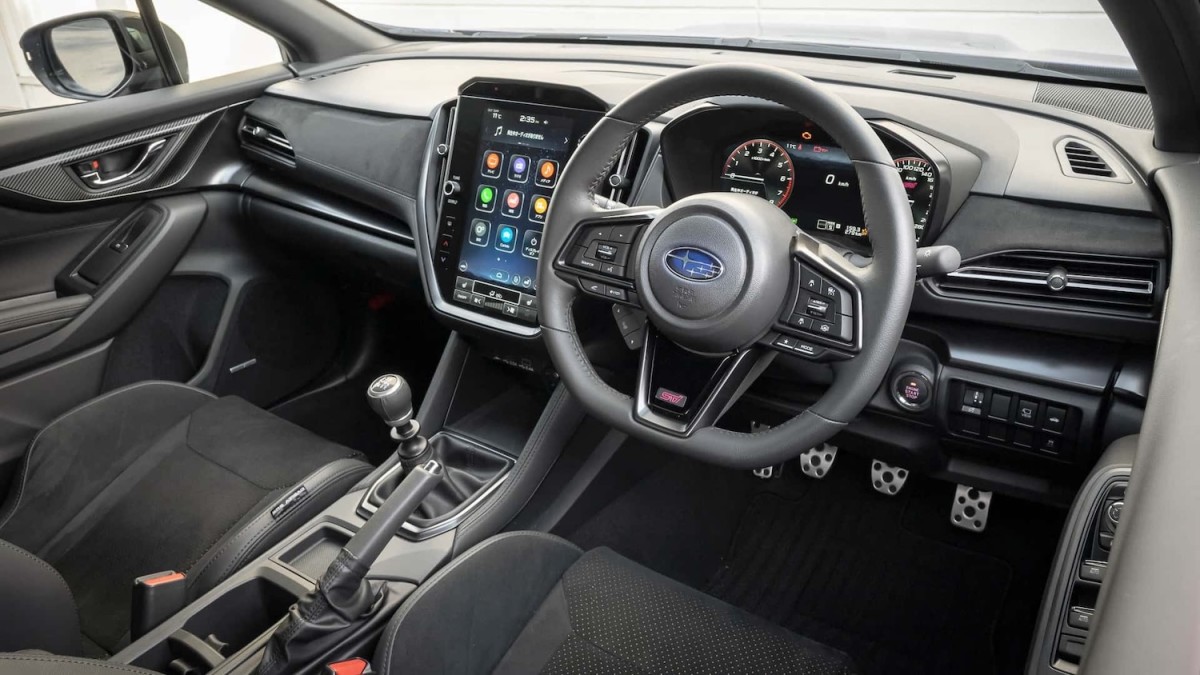
Reddit is a platform where content goes viral quickly, and Redditor Macgyver452 posted a screenshot of the survey in question. It was even posted on the Subaru subreddit, their community. The post’s photos show the Subaru logo and the question, “Would you consider buying a manual transmission SUV in the future?” What follows is a litany of choices to answer the question, ranging from Definitely Not to Definitely. We think we know which option the Subaru owners are likely to choose.
Surveys are generally private matters, not just sent to the public; in this case, only a select few owners received the survey prompt via email. Also, no indication was given which model would receive the treatment, but based on the current lineup, everything appears to be a candidate except the EV Solterra.
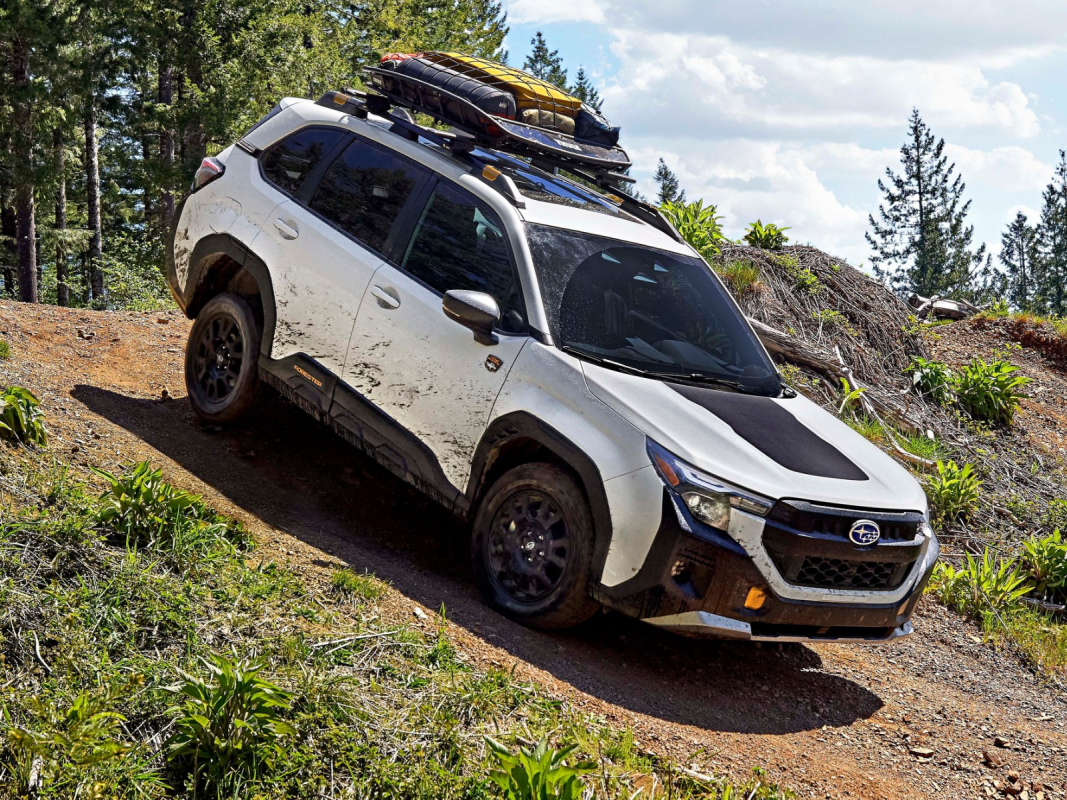
If we were to hazard a guess, though, we could narrow down the possibilities to the models that have a Wilderness variant like the Crosstrek, Forester, or Outback. Given that the Wilderness line is for hardcore enthusiasts, the manual transmission makes the most sense here, as opposed to the highway cruising Ascent or the more tame variants of the aforementioned three models.
Subaru
Hoping On The Trend
For reference, the last Subaru to offer a manual was the 2023 Crosstrek; the Forester lost it after 2018, and the Outback went fully automatic after 2015. At the time, it seemed the days of manuals were numbered, and we all played our small violins as we saw brand after brand cut down on third pedal shifting.
Recently, though, the enthusiast market has picked up, with multiple marques reinstating manuals on their performance models. We’ve seen the numbers increase over time. In 2025, there were still around 32 models offering a manual, but the vast majority were performance cars.
Granted, the numbers don’t lie – the average percentages of manual car sales in the US fluctuate from 1% – 2% annually. Profits for these models won’t be volume-driven, but Subaru will be doing itself a huge favor branding-wise if they actually do it.
Pickup trucks are the backbone of America, and the sales figures prove that year after year. That’s why a lot of automakers naturally thought of electrifying their pickups to ride the demand wave. The problem is that things never really took off, and we’re now seeing companies like Ram and Ford canceling their all-electric trucks.
There are several reasons for this shift, but one of the biggest factors is the price. A Tesla Cybertruck, which had appalling sales in 2025, starts at $80,000. The now-dead Ford F-150 Lightning had a starting price of around $57,000, while the fancier Rivian R1T kicks off from $75,000.
But there’s light at the end of the tunnel. Slate Auto, a brand new American car company backed by Amazon founder Jeff Bezos, is betting on simplicity and a low price tag to attract customers who just want a basic, no-frills pickup. The startup made quite a stir when it debuted its two-door truck last April, and it has racked up at least 150,000 refundable preorders to date.
With production scheduled to begin by the end of this year, we thought we’d bring you a comprehensive roundup with everything we know so far about the 2027 Slate EV truck.
Photo by: Slate
Slate Truck: The Basics
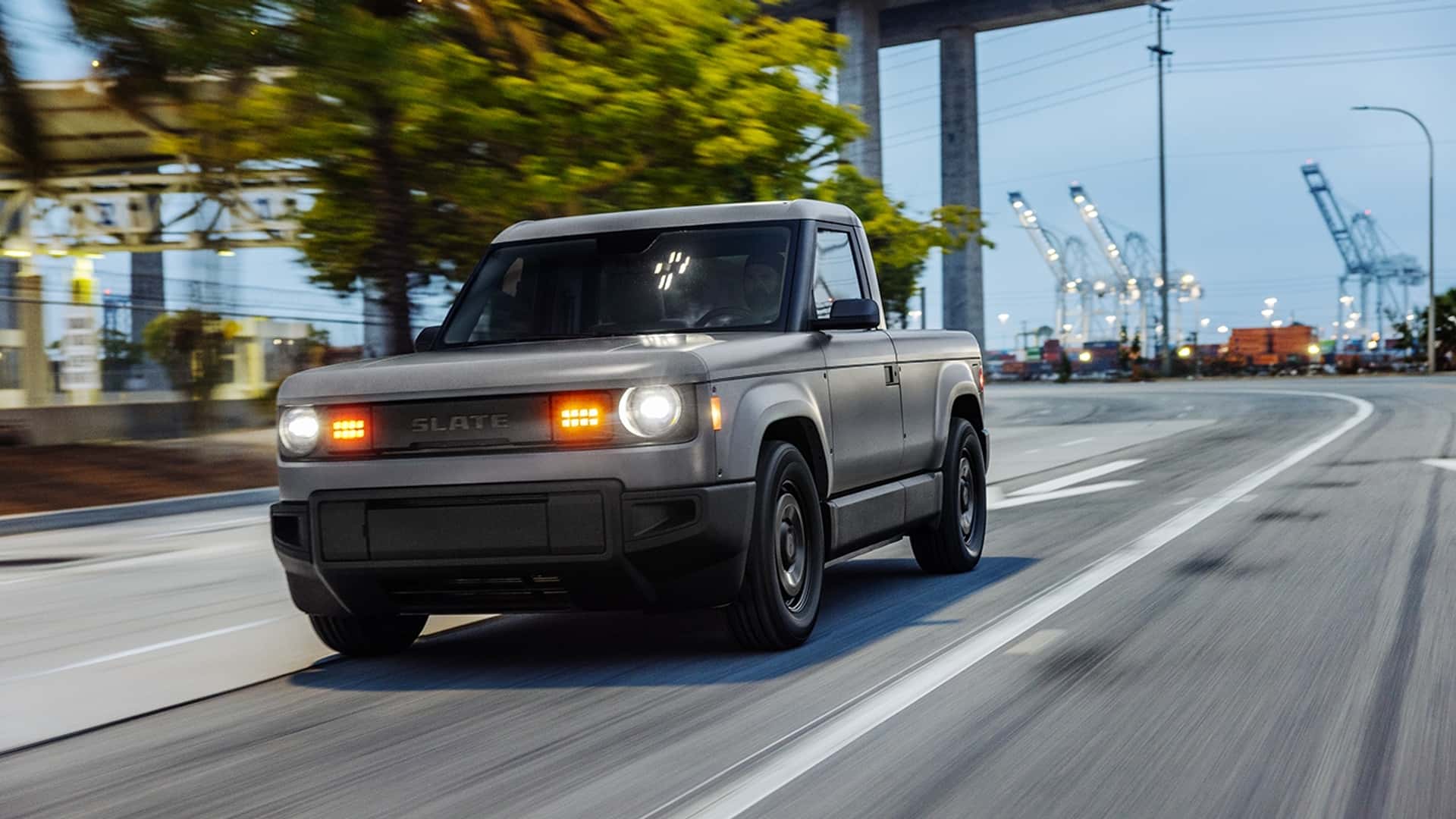
The Slate is a compact all-electric pickup truck designed, engineered and manufactured in the United States. Its main selling point is the low starting price, which is expected to be in the mid-$20,000 range, but there’s an asterisk attached to that promise. (Slate still hasn’t announced a final price tag.)
To keep costs low, the base truck is… well… very basic. There are no power windows, no infotainment screen, no speakers, and even the composite body panels are unpainted. According to the company, this means production costs can be kept at a minimum because there’s just one configuration that needs to roll off the assembly line.
The Slate truck will offer creature comforts, but they’re all add-ons that will be installed by the owner or at a partnering garage.
Photo by: Slate
Every Slate comes to life as a two-door pickup with two-wheel drive, crank windows and a Tesla-style NACS port. No fancy electronics, no flashy paint—just a basic work truck. A single rear electric motor that makes 201 horsepower (150 kilowatts) is the only motivation option, so extreme off-roading is out of the question.
Even with the available accessories installed, drivers are still expected to use their smartphone or tablet in place of an infotainment screen. There is a small digital instrument cluster that also displays the feed from the backup camera.
Despite the downsizing and cost-cutting, Slate said that its truck was designed to achieve a five-star US NCAP crash rating, thanks to standard features like traction control, electronic stability control, forward collision warning and at least four airbags.
Battery capacity, charging and driving range
Slate plans on offering two battery versions, both using U.S.-made SK On nickel manganese cobalt (NMC) cells. The base model will come with a 52.7-kilowatt-hour pack, enabling an estimated range of 150 miles. Meanwhile, the 84.3-kWh extended-range battery will boost the estimated range to 240 miles. The two battery sizes will be the only Slate options that get installed at the factory.
Photo by: Slate
The company chose NMC cells over more affordable lithium iron phosphate (LFP) ones for two main reasons, executives told InsideEVs. NMC offers better energy density, which is important in such a small vehicle with limited packaging space. Plus, the NMC supply chain is more mature in the U.S., whereas LFP production is largely based in China.
That decision was made before the $7,500 federal tax credit, which required U.S.-sourced batteries, went out the window. So it will be interesting to see if Slate will offer an LFP version in the future.
Charging is managed through a Tesla-style NACS port on the left rear of the vehicle and tops out at 120 kW. Slate says that a top-up from 20% to 80% will take 30 minutes when connected to a DC fast charger.
How Big Is The Slate Truck?
The Slate truck is 174.6 inches long, 70.6 inches wide and 69.3 inches tall, with a wheelbase of 108.9 inches. In other words, it’s about 7 inches shorter and roughly the same width as a Toyota Corolla. It’s also 25 inches shorter than the Ford Maverick.
In the standard two-door configuration, the bed is 5 feet long and has a 35.1 cubic feet volume. Meanwhile, the front trunk can accommodate 7 cu ft of stuff. That’s better than the Ford Maverick, which has a 4’5” bed length and a total cargo volume of 33.3 cu ft, but it also has four doors.
Photo by: Slate
Towing and payload
For a compact vehicle, the Slate truck has decent payload and towing specs. According to the company, the two-wheel drive EV can tow around 1,000 pounds and has a maximum payload of approximately 1,400 pounds. That’s on par with the Ford Maverick, which can carry between 1,400 and 1,500 lbs, but falls short in the towing department, as the Maverick has a maximum capacity of 4,000 lbs.
Slate Accessories
The 2027 Slate truck will roll off the assembly line as a very basic vehicle. It’s actually appropriately called the “Blank Slate,” seeing how it doesn’t have painted body panels and very little in the way of creature comforts. The Slate will have heating and air conditioning, but everything else will be available as add-on accessories to keep the production costs as low as possible.
Over 100 accessories will be available, which can be installed by the owner or at third-party shops. That’s because Slate will not have dealers–instead, it will rely on independent shops to handle repairs.
Photo by: Tim Levin/InsideEVs
Among the accessories are colored wraps, decals, chunky wheels, a suspension lift or a suspension lowering kit, power windows and even an SUV conversion kit. This last one is pretty interesting because it will add a bench seat and a couple of airbags, all for the price of around $5,000.
Where Will The Slate Be Made?
Slate’s truck was designed in California and Michigan, and it was engineered in Michigan. Production will take place at a repurposed printing plant in Warsaw, Indiana.
Slate EV Truck Pricing and Availability
The first production-ready Slate EV trucks are scheduled to roll off the assembly line in Indiana by the end of 2026. Pricing is still not set in stone, though.
When the pickup first debuted, it was marketed as a sub-$20,000 EV, but that was only possible with the help of the $7,500 tax credit. Now that the incentive is gone, Slate is touting a starting price in the mid-$20,000 range.
When asked about the price, Slate CEO Chris Barman said there’s still some work to do on this front. “We’re still having discussions on that,” she said on the sidelines of the BloombergNEF Summit in San Francisco in January 2025. “We’re still working really closely with our suppliers to see what opportunities we have to continue to bring costs down, to see what we can do to pass along to the customer before we announce final pricing.”
42
Source: Slate
Click here to see all articles with lists of the best EVs
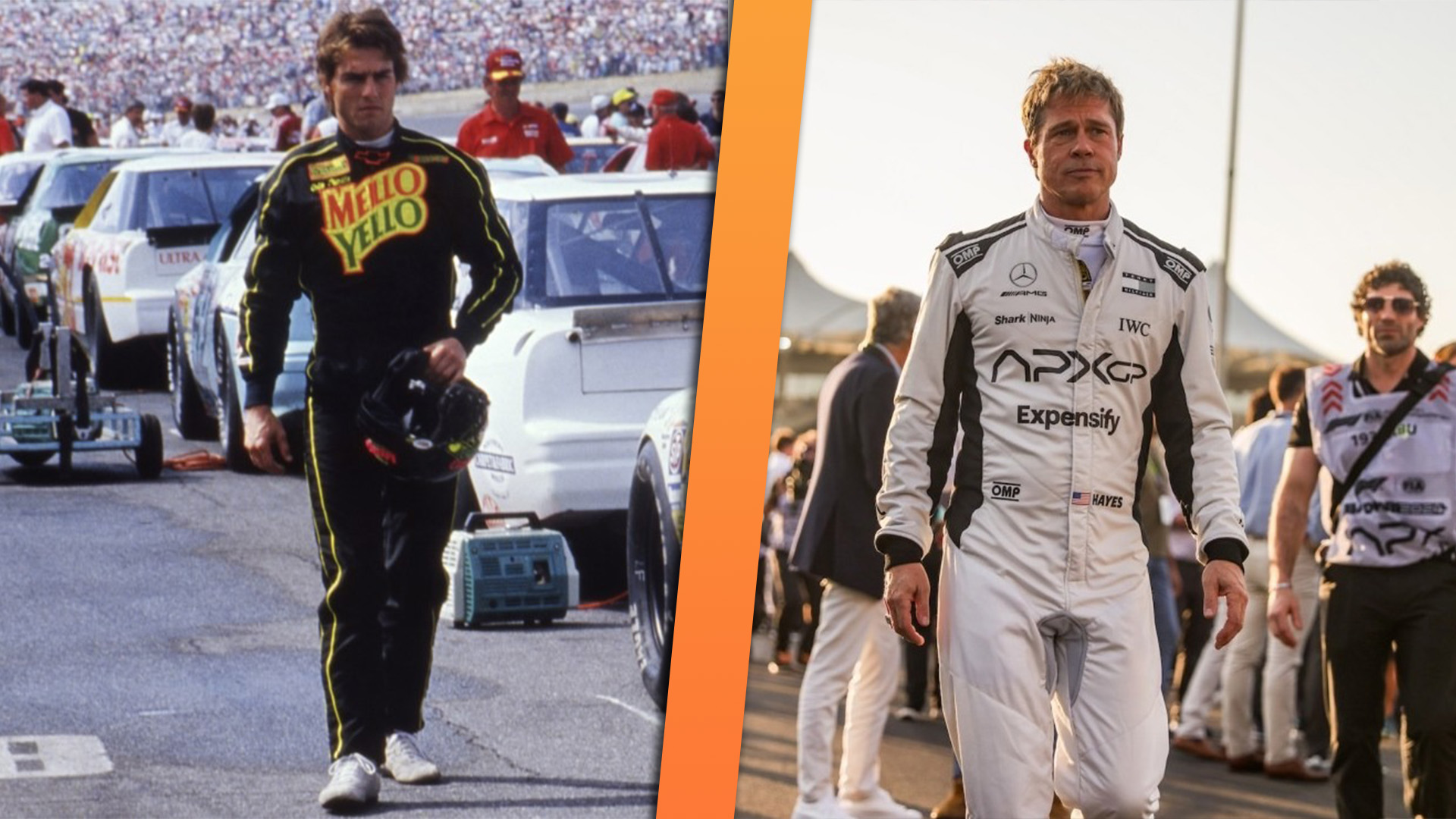
Two motorsports blockbusters are getting sequels: One is a quick follow-up to a recent release, the other has been decades in the making. But will the sequel to “F1” or “Days of Thunder”cross the finish line first?
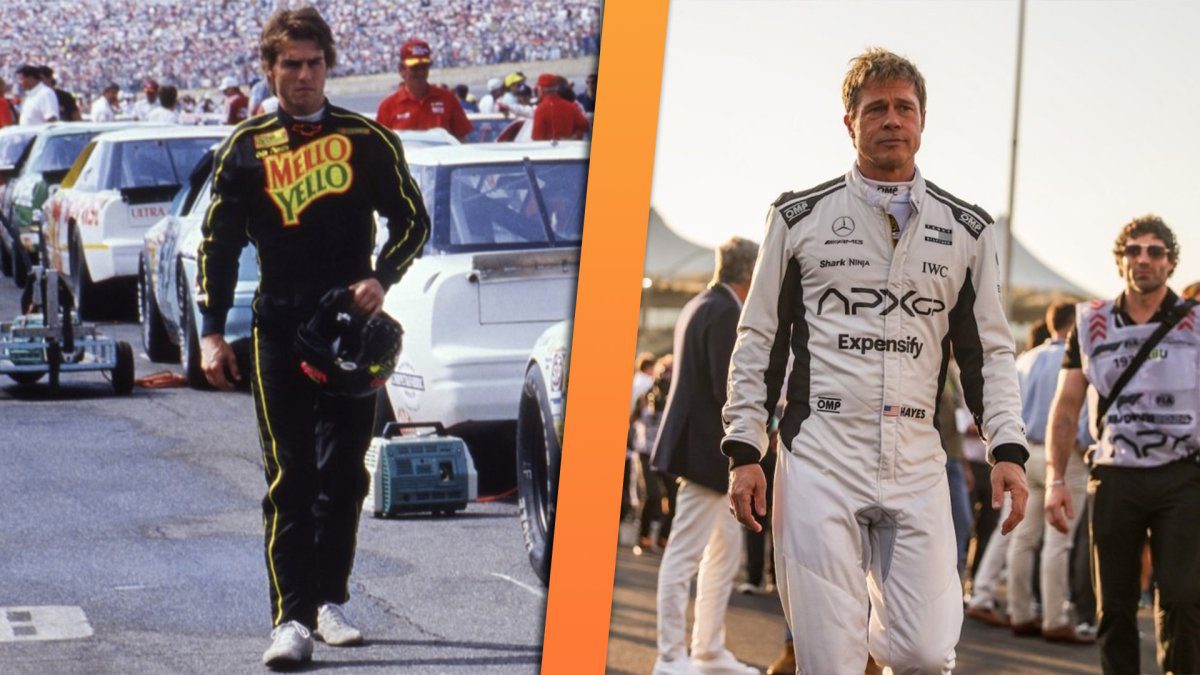
Producer Jerry Bruckheimer confirmed the “F1” sequel in a BBC interview published earlier this week. The Brad Pitt vehicle, which was co-produced by seven-time F1 champion Lewis Hamilton and directed by Joseph Kosinski of “Top Gun: Maverick” fame, garnered four Oscar nominations this year and grossed $630 million during its release last summer, making it Apple Original Films’ most successful theatrical release to date. So a sequel getting green-lit isn’t exactly surprising.
Bruckheimer confirmed that the sequel is happening, but didn’t discuss timing or casting details. A major question mark is whether Pitt, 62, will return as driver Sonny Hayes. His real-life (and on-screen) age was one of the more implausible aspects of a movie that aimed for authenticity, aided by unprecedented access to F1 races for filming.
This comes after Bruckheimer hinted that a belated sequel to NASCAR spectacle “Days of Thunder,” which he also produced, is gaining traction. On the red carpet for the “F1” premiere last summer, Bruckheimer told an ET reporter that ideas were being discussed with that movie’s star, Tom Cruise.
“There’s always new technologies, new ways to do things, to see things,” Bruckheimer said at the time. “And Tom is such a great individual to come up with phenomenal ideas. So we’ll have something really exciting for an audience once we pull it together.”
That’s not the same as confirming that filming has begun or actors have been cast, but assuming those discussions continued, “Days of Thunder” could have an eight-month head start over the “F1” sequel. Released in 1990, the original didn’t make a big impact at the time, but it’s earned its place in the canon of racing movies.
Cruise’s return would also be somewhat more believable, both because he pulled off a similar trick in “Top Gun: Maverick” and because older drivers have historically been more common in NASCAR (although admittedly less so these days). Combining the NASCAR setting with the camera tech Kosinski used for “F1” would also be epic.
The post Which Will Come First: ‘Days of Thunder’ or ‘F1’ Sequel? appeared first on The Drive.
The latest generation of the Ford Mustang represents a bold new era for the historic sports car. The genre-defining pony car has been one of the most important nameplates in the American automotive industry for over 60 years, but recent years have seen the Mustang evolve significantly.
That evolution includes a lineup that makes it a world-class performance car with racing variants, a performance flagship that competes with some of the world’s most exclusive exotic cars, and the Dark Horse, which showcases impressive power and engineering solutions like carbon fiber wheels for the first time in Ford’s own lineup.
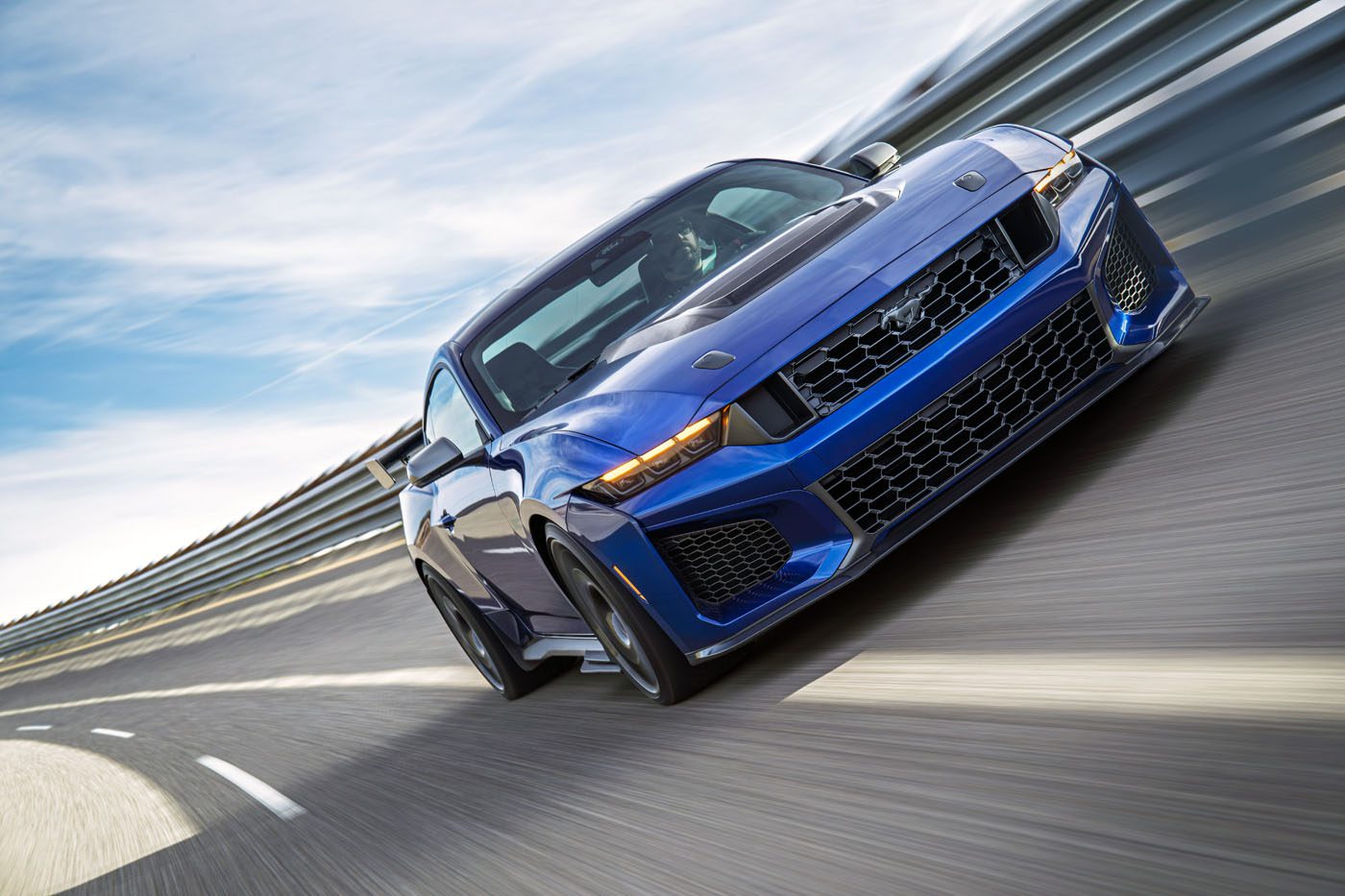
However, the 2026 model year sees Ford introducing an even more powerful version of the Mustang Dark Horse, the new Ford Mustang Dark Horse SC. Created by the newly rebranded Ford Racing, the new Dark Horse SC is made to be the most powerful and track-ready variant of the Dark Horse, and the team behind the flagship Ford Mustang GTD lent many of its racing-bred engineering solutions to the new Dark Horse SC.
Unlike the Dark Horse’s naturally aspirated 5.0-liter engine, the Dark Horse SC uses a 5.2-liter V8, and this time, it’s supercharged, hence the SC suffix to its name. Carbon fiber wheels and carbon ceramic brakes from Brembo mean that the car sheds an impressive 150 pounds of weight compared to the standard Dark Horse.
Revised aerodynamics include an aluminum hood with a vent that improves cooling and front-end dynamics, and especially with the SC’s available Track Pack, downforce is significantly improved, with solutions like a ducktail-shaped decklid that improves the rear wing’s efficiency by 10 percent without requiring a larger wing that could impact rear visibility.
Filling the gap between the Ford Mustang Dark Horse and the ultra high-performance, racing-bred Ford Mustang GTD with a price tag of over $300,000, the new Ford Mustang Dark Horse SC is an exciting new addition to a stable of Mustangs that are redefining the historic nameplate’s place in the performance car world.
GEELY Holding Group (Geely) has announced details of a five-year strategic blueprint it says will strengthen top-level coordination and global collaboration to become a leader among global auto-makers.
The parent brand of automotive manufacturers that include Benelli, Farizon, Zeekr, Geely Auto, Keeway, London EV Company, Lotus, Lynk & Co, Polestar, Proton, QJ Motor, Radar Auto, Smart, Volvo Cars – and significant stake holder of Aston Martin and Renault’s Horse Powertrain – says it aims to achieve global sales of more than 6.5 million vehicles annually by 2030, producing revenue exceeding 1 trillion RMB ($A204.5b).
With its sights on the new energy vehicle market, Geely says it aims to become a top-five player in the global market, with 75 per cent of all vehicles produced headed to export markets, and covering a broad range of vehicle types across the A- to E-model classification.
Reductions in R&D times, new platforms, and reduced costs will assist Geely in becoming more competitive at scale, its “One Geely” global brand matrix to further “strengthen the Geely corporate brand” while fully leveraging the strength of its growing list of subsidiaries and joint ventures.
“Geely Holding will fully leverage the brand advantages of Geely Auto, Geely Galaxy, Lynk & Co, and Zeekr, giving full play to their home advantage and access to localised operational capabilities of global brands such as Volvo, Polestar, and Lotus in the European and American markets,” it said in a statement.
“In addition, the Group will work with international partners such as Renault Group to create a new paradigm of open collaborative and mutually beneficial brand cooperation.”
Over the next four years, Geely will centre its efforts on what it describes as a “Seven Dimension” approach, centred upon a technological ecosystem encompassing intelligent driving, intelligent cockpit, E/E (electrical and electronic) architecture, vehicle architecture, battery, electric drive, and super hybrid powertrains suggesting a strengthened push into the new energy vehicle market.
Geely says it will develop the “world’s most advanced intelligent driving technology platform”, achieving full coverage of L2 assisted driving while “rapidly advancing” L3 and L4 capabilities.
New fuels and combustion engine technologies are also on Geely’s radar, its next generation NordThor AI hybrid engine expected to achieve a thermal efficiency figure of over 50 per cent, far exceeding current market norms.
Safety – including active, passive, and battery safety priorities will likewise be further strengthened, Geely saying it aims to “accelerate the evolution of safety from single vehicles to an entire ecosystem encompassing people, vehicles, roads, cloud, and space”.
The last point in that statement is one that has certainly piqued the attention of other global car manufacturers, no doubt including Tesla. Geely says it is working to accelerate the development of an integrated spare-air-ground ecosystem developed alongside Chinese firms Qianli Technology, Cao Cao Mobility, Aerofugia, and Geespace to offer coverage across major cities in China, providing self-driving technology and Mobility Robotaxis both at home – and eventually overseas.
The Chinese conglomerate is also working on a methanol-hydrogen electric vehicle ecosystem it says has already proved itself via a fleet of “over 50,000” vehicles already in operation. It is a fuel type Geely says can be modified to power automobiles, ships, mining machinery, construction machinery, generators, and other fields, particularly those in remote areas and across long-distance logistical routes.
The company says it has already developed a supply chain covering methanol production, transportation, refuelling, and vehicle manufacturing it hopes to intensify before the end of the current decade.
To ensure the ongoing development of future technologies, Geely says it is investing in educational projects to “cultivate” new professionals across its portfolio, ensuring both current and next-generation employees bring value to the company’s “talent pool”.
Geely says this approach will continue to deepen its “talent forest” strategy, further expanding its strategic development in those fields mentioned above. The program centres not only on current and new employees, but offers high-school level incentive programs that will allow the company to directly recruit high-school graduates, offering “targeted training” to develop employees that are “more proactive, effective, and practically innovative”.
For a company with just 40 years’ experience it seems Geely is holding nothing back in its push to become a global automotive powerhouse.
Under the “One Geely” banner, the drive to become what it says is a “globally leading intelligent electric mobility technology company” seems well within the company’s reach, investing sums of money other OEMs can’t possibly hope to match.
GoAuto and other industry observers will follow Geely’s progress with interest.
Like a sleeper agent activated late in the game, Elana Scherr didn’t know her calling at a young age. Like many girls, she planned to be a vet-astronaut-artist, and came closest to that last one by attending UCLA art school. She painted images of cars, but did not own one. Elana reluctantly got a driver’s license at age 21 and discovered that she not only loved cars and wanted to drive them, but that other people loved cars and wanted to read about them, which meant somebody had to write about them. Since receiving activation codes, Elana has written for numerous car magazines and websites, covering classics, car culture, technology, motorsports, and new-car reviews. In 2020, she received a Best Feature award from the Motor Press Guild for the C/D story “A Drive through Classic Americana in a Polestar 2.” In 2023, her Car and Driver feature story “In Washington, D.C.’s Secret Carpool Cabal, It’s a Daily Slug Fest” was awarded 1st place in the 16th Annual National Arts & Entertainment Journalism Awards by the Los Angeles Press Club.