It must be annoying to be other automakers trying to engineer an entry in the all-important compact-SUV segment to compete with the Honda CR-V, because this Honda is so good at everything. It is extremely quiet on the highway, has a huge back seat that easily accommodates large adults, and has the most cargo space of any compact crossover we’ve measured, able to fit 11 carry-on-sized suitcases behind the second row and 29 with the rear seats folded. It gets great fuel economy, especially in hybrid form—up to 40 mpg EPA combined—and it steers and handles a class above most of the field, without sacrificing ride comfort in the process. Although the CR-V faced fresh competition this year in the form of an all-new 2026 Toyota RAV4, the Honda successfully and, frankly, quite easily defended its spot on the list for the fourth year running.
Regular unleaded gas (87 octane) level is suitable for most engines, while some high-performance engines require premium gas (91-94 octane).
Using higher octane gas than required rarely improves performance or efficiency, but using lower than recommended can cause knocking and long-term engine issues.
Flex-fuel (E85) and ethanol-free gas are available for specific vehicle types; using the wrong type can harm your engine or void warranties.
Always follow your owner’s manual guidance when choosing a type of gas.
Selecting a grade of gasoline simply because it has a higher octane rating might not be the best choice for your car or your budget. While some vehicles can benefit from premium gas, most drivers can save money at the pump by using regular unleaded in their cars without sacrificing performance.
This guide explains the different octane ratings for fuel found at gas stations, why some types of gasoline cost more, and which gas you should use for the car you’re buying or currently own.
Which Gasoline or Fuel Should I Put in My Car?
The fundamental rule of car maintenance is to follow the manufacturer’s guidelines in the owner’s manual. It will show the minimum octane level for the vehicle and whether premium gas is recommended or required.
Gasoline Bottom Line: Quick Cheat Sheet
✅
Most cars
Use regular unleaded gasoline (87 octane) unless your owner’s manual says otherwise.
📘
Owner’s manual first
Always follow the fuel type and octane guidance in your owner’s manual or on the fuel-door sticker.
🔧
Performance or turbo engines
If your vehicle requires premium, always use it. If it’s only recommended, you can usually still run regular without harm.
🌽
Flex-fuel (E85)
Only use E85 in vehicles labeled as flex-fuel (often a yellow fuel cap or E85 badge).
🛢️
Diesel
Diesel is for diesel engines only. Never put diesel in a gas car or gas in a diesel vehicle.
💸
Price vs. performance
Higher octane doesn’t mean “better” gas for every car. It only pays off if your engine is designed to need it.
Recommended vs. Required Fuel Types
Cars that require premium fuel often have a warning notice at the gas cap and sometimes on the dashboard gas gauge to remind drivers to use the correct type of gas.
When your owner’s manual recommends a fuel type, you aren’t required to put it in your vehicle.
Generally, follow the manufacturer’s guidelines outlined in the owner’s manual, pay attention when filling up at the gas pump, and select the correct fuel for your car.
Higher octane fuel may be necessary for engines using a greater compression ratio or turbocharging to force more air into the cylinders. The use allows high-output engines to produce more power from the compressed air-fuel mixture. High-compression engines require high-octane fuel to prevent the mixture from igniting prematurely.
Using fuel with an octane level lower than what is required by the manufacturer can reduce engine performance. Over time, not following the octane guidelines for your car can cause damage to the engine and emissions control system.
It might also void the vehicle’s warranty.
Can You Use a Higher Octane Gas?
If your car is designed for regular-octane gas, you can safely use higher grades of gasoline. But under normal driving conditions, there is little to no benefit to buying fuel with octane levels greater than what is recommended. However, if you have an older car experiencing engine knock, filling up with premium gas for a few tanks might alleviate that problem.
There is no reason to panic if you unintentionally fill up your tank with a gasoline grade with an octane rating less than or greater than what the manufacturer recommends for the car.
However, putting diesel fuel into the tank of a gas vehicle or pumping gasoline when the car requires diesel is a definite cause for concern.
It’s difficult and uncommon, but not impossible, to put diesel fuel into a tank intended for gasoline. A diesel pump is a different color, usually green, and its nozzle is larger so it won’t fit into a gasoline tank’s opening. Accidentally putting diesel into your gasoline tank will require you to pay a dealership or local car repair shop to drain and clean the engine’s fuel line. Similarly, having gasoline in a diesel engine can cause damage to the fuel pump, filter, and injectors.
Does Premium Gas Clean Your Engine?
The persistent myth that using high-octane gas will clean your engine is false.
What Is Octane Rating?
The octane rating on different grades of gasoline is a measurement of the fuel’s stability. Higher octane numbers mean greater stability. The greater stability indicates the gasoline’s resistance to preignition and the fuel’s ability to resist “knocking” or “pinging” during combustion. These sounds come from the air-fuel mixture detonating prematurely in the engine.
Internal combustion engines compress a mixture of air and fuel and ignite it with a spark. Under certain conditions, the fuel-air mixture can ignite early, creating a knocking sound in the engine. Newer cars have sensors that prevent this preignition, so you’ll rarely hear knocks and pings unless you drive an older vehicle.
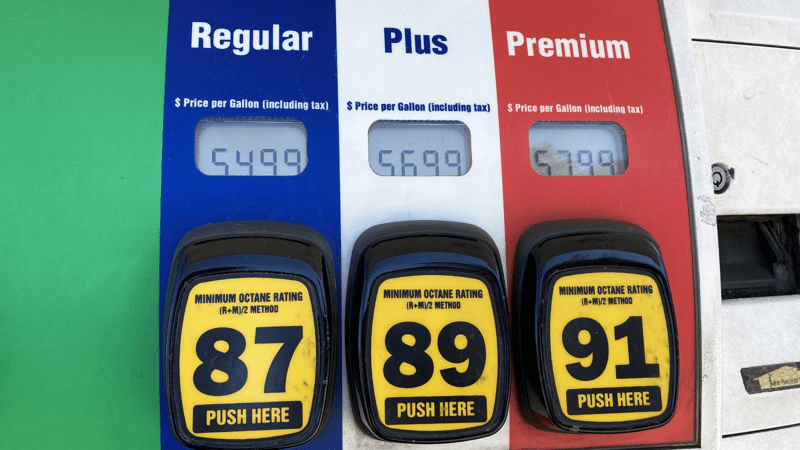
A gasoline’s octane rating averages two testing methods: the research octane number (RON) under idle conditions and the motor octane number (MON) under higher engine speed. You might have noticed this formula in smaller letters on the yellow buttons displayed on gas pumps: (R+M)/2.
The larger numbers on gas pump stickers indicate the octane rating of the different gasoline grades. Typically, gas stations sell gasoline with three octane levels. The exact levels vary from region to region, climate to climate, and by time of year.
Regular — Regular unleaded gas is the lowest-octane fuel, typically with an 87 level, and is suitable for most vehicles.
Mid-grade — Mid-grade gasoline is a middle-range fuel and typically has an octane level of 89.
Premium — Premium is the highest-octane fuel you can buy at most gas stations, with octane levels of 91-94.
Although some companies market their different grades of gas with names such as “Super Premium,” “Ultra,” or “Ultimate,” they all refer to the gasoline octane rating.
RELATED: Should You Use Premium Gas?
What Is Flex-Fuel?
E85 is a fuel designed for “flex-fuel vehicles.” It is a blend of 51% to 83% ethanol with the balance being gasoline. E85 pumps are clearly labeled at more than 4,800 gas stations across the United States. The pumps typically have yellow nozzles, and flex-fuel vehicles usually have a yellow fuel cap.
Using gasoline of any octane level in a flex-fuel vehicle is OK. However, putting E85 in a car that isn’t designed for it can be harmful if done repeatedly.
Most insurance policies don’t cover accidentally fueling up with the wrong type of gasoline. However, some insurers offer riders to cover the mishap. Check with your insurer and your policy. Pay attention at the pump, avoid distractions, and know your car’s requirements.
What About E15?
Fuel labeled as E15 is gasoline blended with up to 15% ethanol. According to the biofuel trade association Growth Energy, more than 4,300 stations in 34 states sell the fuel. It typically costs from 10 cents to 30 cents less per gallon than regular unleaded gas.
E15 was previously unavailable in warmer months because of concerns that its higher ethanol content contributed to smog in hot weather. However, the U.S. Environmental Protection Agency issued emergency waivers in 2025 and the previous three years, allowing summertime sales to combat higher prices at the pump. When the EPA issued the waivers, it said that drivers could use E15 without concern for its impact on air quality.
An EPA rule that went into effect in April 2025, allowing year-round E15 sales in eight Midwestern states that produce much of the nation’s corn crop.
Understanding Diesel Fuel
Diesel fuel is the common term for a type of petroleum distillate fuel. Gasoline and diesel engines operate differently and use different types of fuel. Vehicles that use compression-ignition engines use diesel fuel, while spark-ignited engines use gasoline. In general, diesel engines work more efficiently and provide greater torque, even though they generate less horsepower than their gasoline counterparts.
The diesel car market in the United States is relatively small. However, many heavy-duty pickups and some vans have turbodiesel engines to boost towing capacity for commercial work, off-road driving, and towing.
Diesel engines can be altered to burn biodiesel, a fuel produced from raw vegetable oil, used cooking oils, and waste animal fats.
MORE: What Happens if You Put Diesel in a Gas Car?
Off-road Diesel
Off-road diesel is a tax-exempt fuel designated for machinery and vehicles not operated on public roadways. Because it’s untaxed, this diesel costs about 25 cents less than what is commonly available at truck stops and many gas stations. However, the fuel contains a dye to help deter drivers from using it in street vehicles, making it easier for investigators to identify unauthorized use.
Penalties for using tax-exempt engine fuel can be stiff. For example, Georgia law calls for a fine of not less than $1,000 and not more than $10,000 for using non-highway fuel for highway purposes. Federal penalties are also on the books. So, typical drivers should avoid buying dyed diesel unless it’s for farming purposes or home heating use.
RELATED: What is Payload: A Complete Guide
What Is Ethanol-Free Gas?
Non-ethanol gas is gasoline that isn’t blended with ethanol. This type of gas isn’t sold at every filling station. Using pure gas can lead to better mileage. But increased fuel economy from using ethanol-free gas may be offset by its higher cost. Non-ethanol gasoline typically costs more than ethanol-blended varieties.
Using non-ethanol gas in your car won’t harm the vehicle’s engine. You can mix ethanol-free gas with ethanol-blended varieties. However, using an ethanol blend may cause damage to your outdoor power equipment. Refer to your owner’s manual to learn if ethanol-free gas is the correct fuel to use for your tools.
What Do Signs Saying “Gas Ethanol Free” Mean?
If you see “Gas Ethanol Free” on a billboard, it means the service station sells non-ethanol gas. Ethanol-free gas is a type of gas that doesn’t contain any ethanol.
What Is Recreational Fuel?
Some gas stations market ethanol-free 90-octane gasoline as “recreational fuel” or REC-90. Many consumers prefer to use non-ethanol fuel for marine equipment and small engines for lawnmowers, snowblowers, chainsaws, generators, pumps, and other non-transportation equipment.
Why Do Some Gasoline Types Cost More Than Others?
A significant difference between grades of gasoline is the cost, and motorists often wonder why higher-grade options cost more. The additives used for boosting octane are generally more expensive to produce.
At the time of this writing, the average price of regular unleaded in the United States is about $2.81 per gallon, and a gallon of midgrade costs $3.29, according to AAA. The website indicates high-octane premium gasoline costs around $3.66 per gallon, on average.
That means it costs almost $12.60 more to fill a 15-gallon tank with high-octane premium gas than it does with lower-octane regular.
Is Gas With Higher Octane Worth the Price Difference?
The price difference is only worth it if your car requires higher-octane gasoline, such as mid-grade or premium fuel. Otherwise, you are wasting money.
Some owner’s manuals indicate that fuel with a higher octane rating will make your car run better or more efficiently. Still, the increase in cost per gallon is typically higher than any reduction in gas consumption.
RELATED: Average Miles Driven Per Year: Why It Is Important
Price Factors for Gasoline
Many factors determine gasoline prices. Drivers often see higher prices in the summer driving season. Supply from refineries and demand from vacationing motorists can add up to 15 cents per gallon to gas prices in the summer months. Additionally, seasonal gasoline blends found at the pump contribute to price differences from one season to the next.
In warmer months, gasoline has a greater chance of evaporating from a car’s fuel system. To help offset smog and emissions, refiners produce a summer blend with lower volatility to reduce the chance of evaporation. Blends vary by state because of government regulations. These seasonal blends can add up to 15 cents per gallon on top of demand increases, depending on the region.
Cooler weather brings lower gas prices from September to April because the winter blend is cheaper to produce. The price at the pump can fall as much as 30 cents per gallon as gas stations switch to winter gasoline and many drivers stay closer to home.
Does Gasoline Go Bad?
The volatile compounds of gasoline naturally degrade over time, and the combustibility of old gas decreases, even when properly stored. Gasoline can go bad from contaminants such as dirt and rust. Old gas may be refreshed to usable condition by mixing it with a high ratio of fresh gasoline. Do not use contaminated gas to power any equipment because it can damage the engine’s components. Keeping the engine’s components running smoothly helps you maintain the value of your vehicle.
How Long Can You Store Gasoline?
High-quality gasoline can be stored for three to six months in an approved, tightly sealed container before it begins to degrade and loses its volatility. Using a fuel stabilizer can extend the shelf life of new gasoline. While pure gasoline can last up to six months, ethanol blends, such as E85, will last for three months. Diesel fuel can remain usable for up to one year.
How to Dispose of Gasoline
Safely dispose of old gasoline at a hazardous waste facility near you. Your local fire department can suggest options for getting rid of unwanted gasoline. Never dispose of gas in trash cans, the ground, storm drains, lakes, streams, or other bodies of water.
Bottom Line on Different Types of Gas
Choose the gasoline grade recommended in your owner’s manual for the best performance and value. Most cars are made to use regular unleaded. Premium is only required for certain engines. Using a higher octane than recommended offers little benefit, but using a lower grade can harm your engine and void your warranty. Specialized fuels like diesel, flex-fuel, and ethanol-free gas are designed for specific vehicles, so always check your car’s requirements. Fuel prices vary due to octane, additives, and seasonal blends, but higher cost doesn’t always mean better performance for your vehicle.
Editor’s Note: We have updated this article since its initial publication.
Our free daily newsletter sends the stories that really matter directly to you, every weekday.
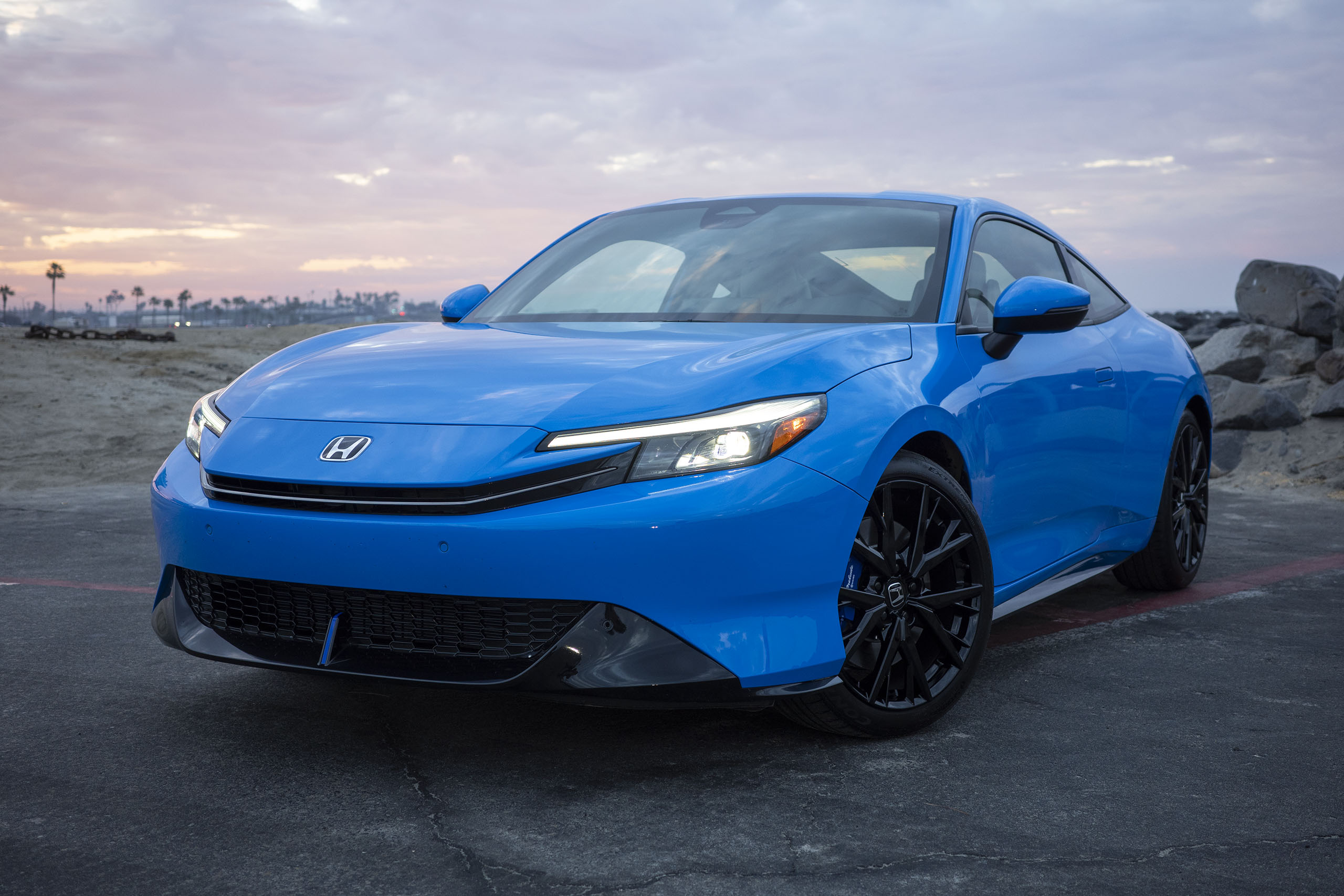
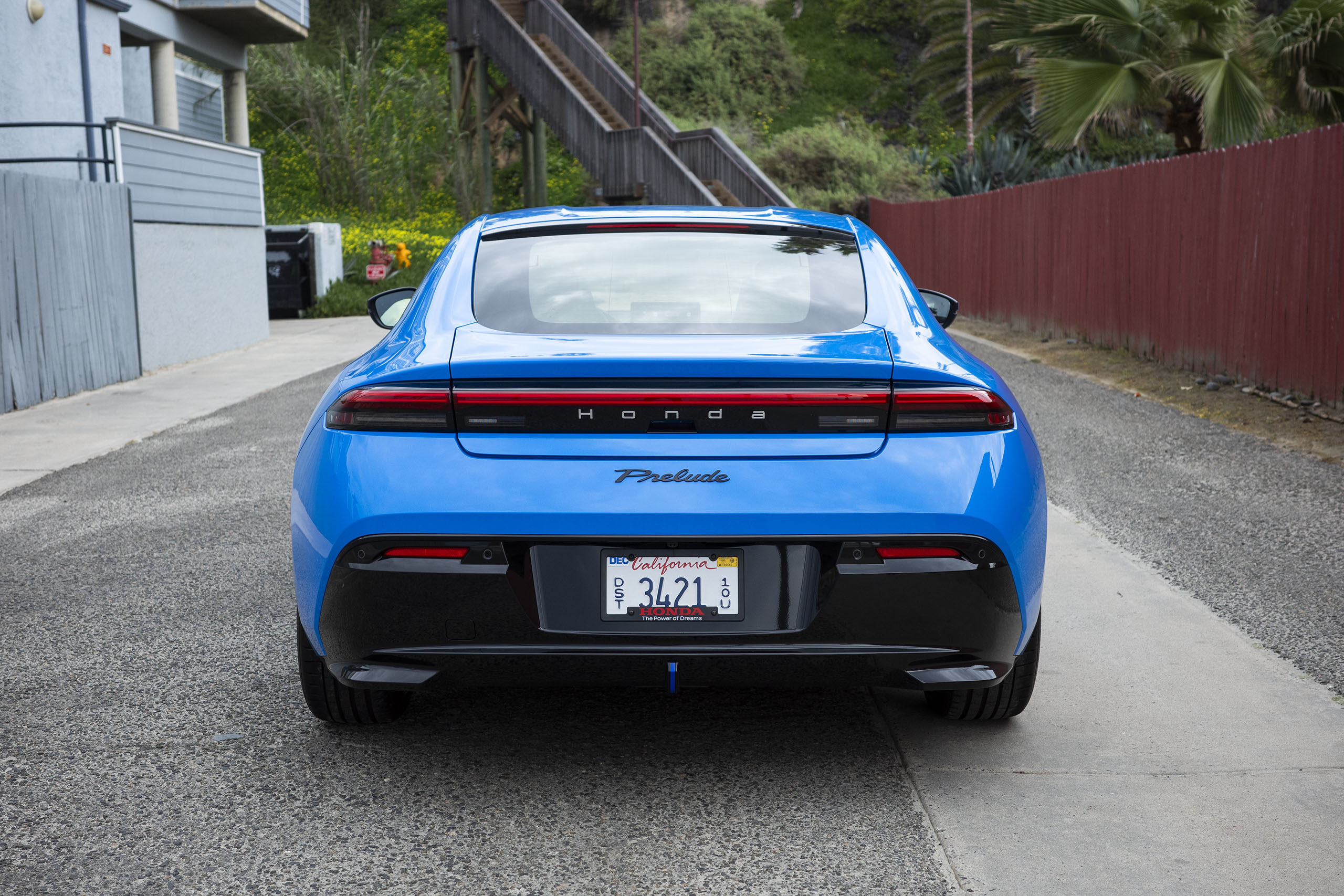
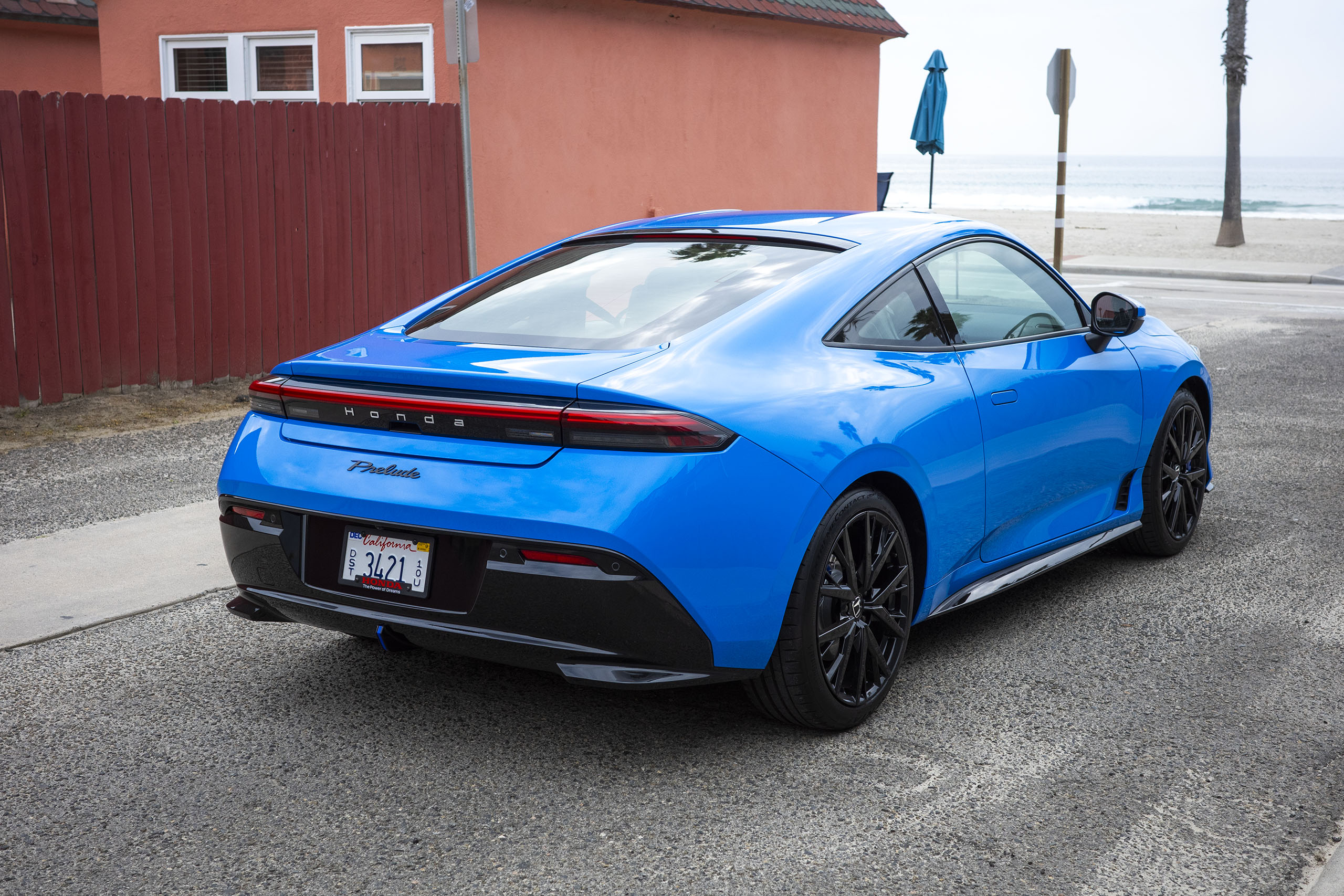
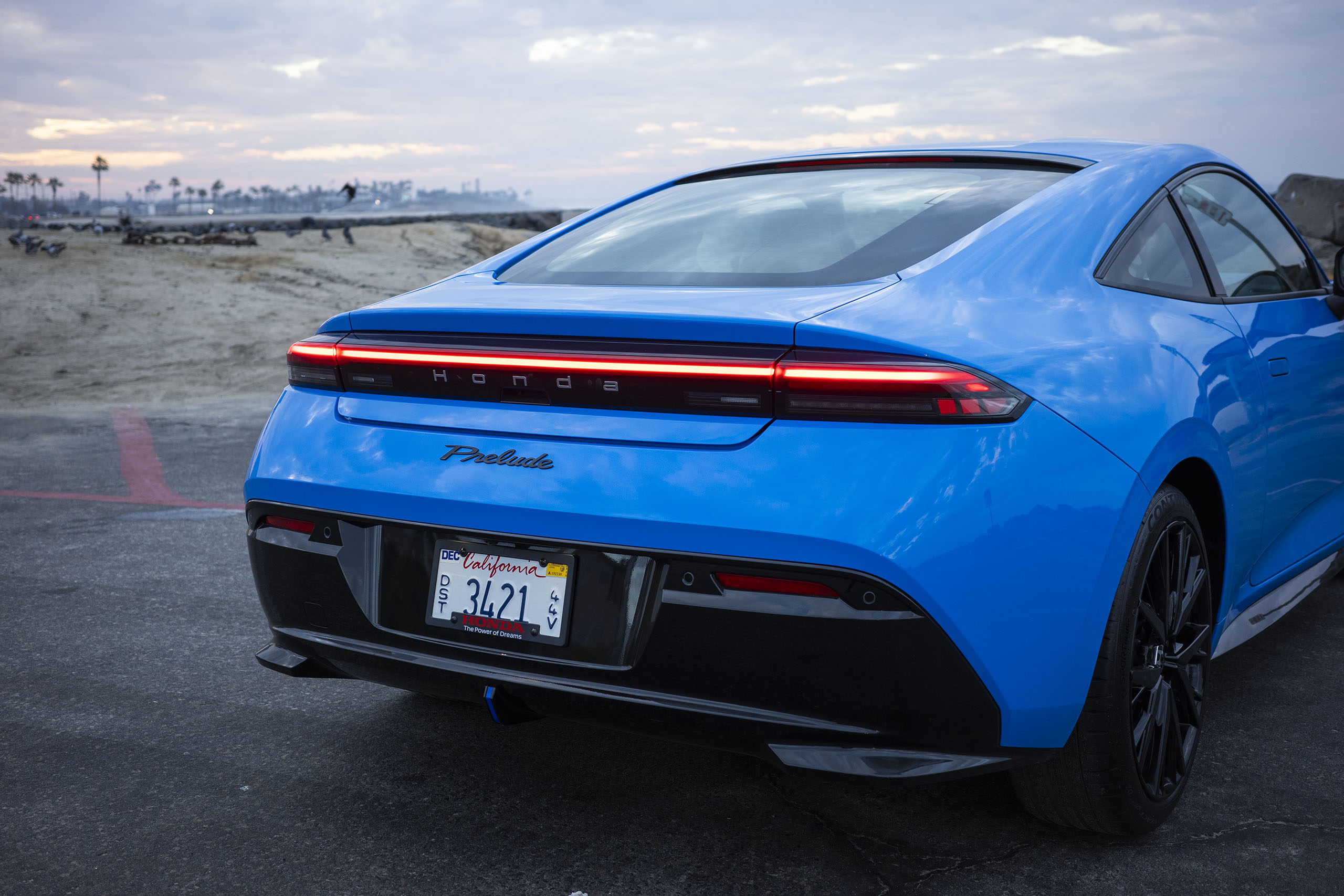
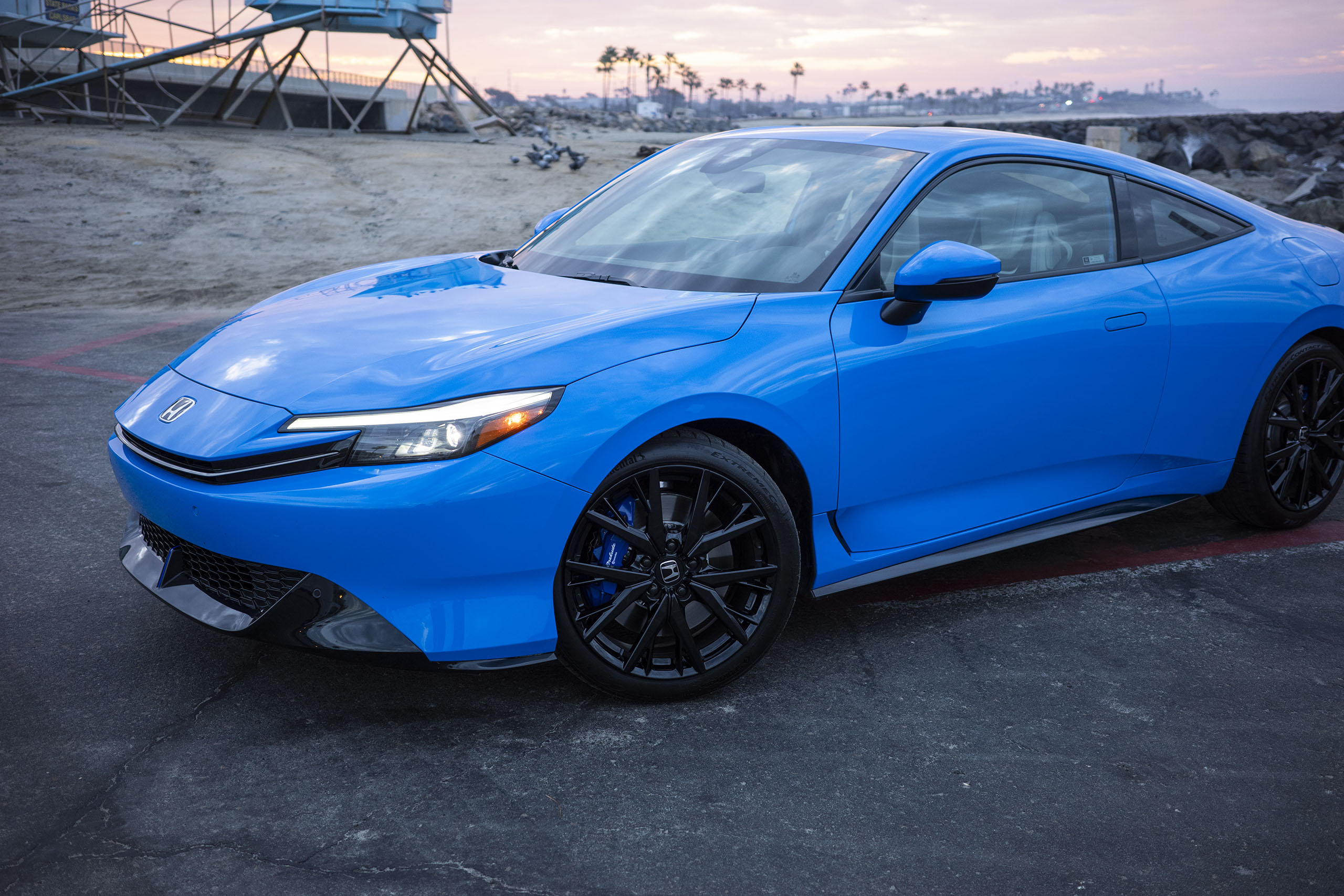
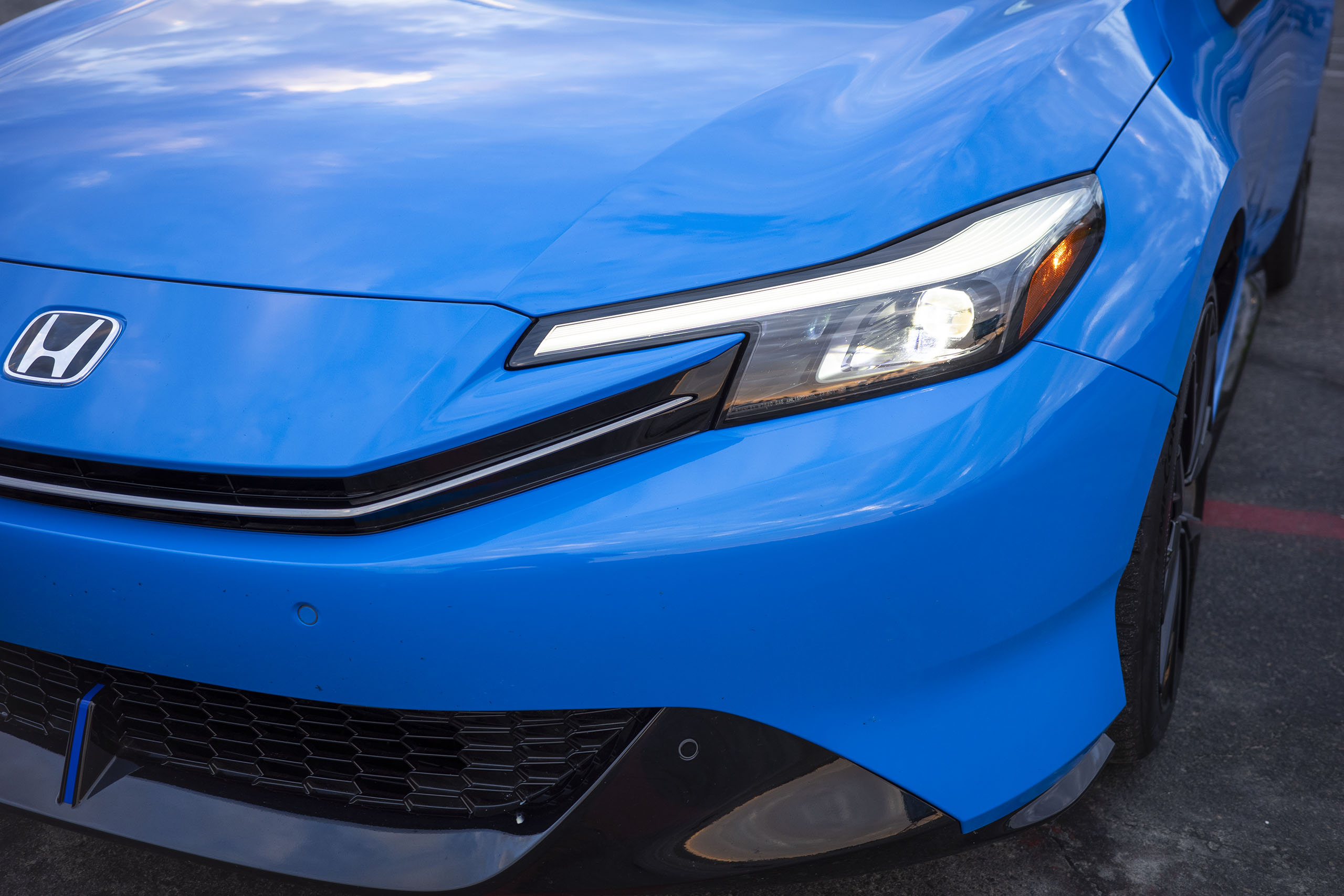
If you had a Honda Prelude revival on your Bingo card at the beginning of this decade, I am impressed, a little frightened, and have some investment questions I’d like to pick your brain about. Coupes are rare these days, and ones that aren’t out-and-out sports cars, rarer still. The 2026 Prelude may borrow its chassis from the Civic Type R, and it may look stunning, but the racetrack isn’t its natural habitat. It also costs $43,195.
You’re going to see some numbers in this review, and many of them aren’t friendly to the new Prelude. For that money, the coupe features Honda’s two-motor hybrid system, incorporating a 2.0-liter four-cylinder engine that’s good for 200 horsepower and 232 lb-ft of torque. That power figure is identical to the last Prelude’s, which exited production 25 years ago and weighed about 300 pounds less than this one.
On the other hand, electric power means the 2026 incarnation is much torquier, and also, much better on gas. Honda estimates a combined 44 miles per gallon, which may as well make the new Prelude as poisonous to the environment as a bicycle, if you dare put it up against other sporty coupes. I wouldn’t. The Prelude is better than those numbers make it look, but it is very much its own thing. I just wish it were a bit better at that thing.
Adam Ismail
The Basics
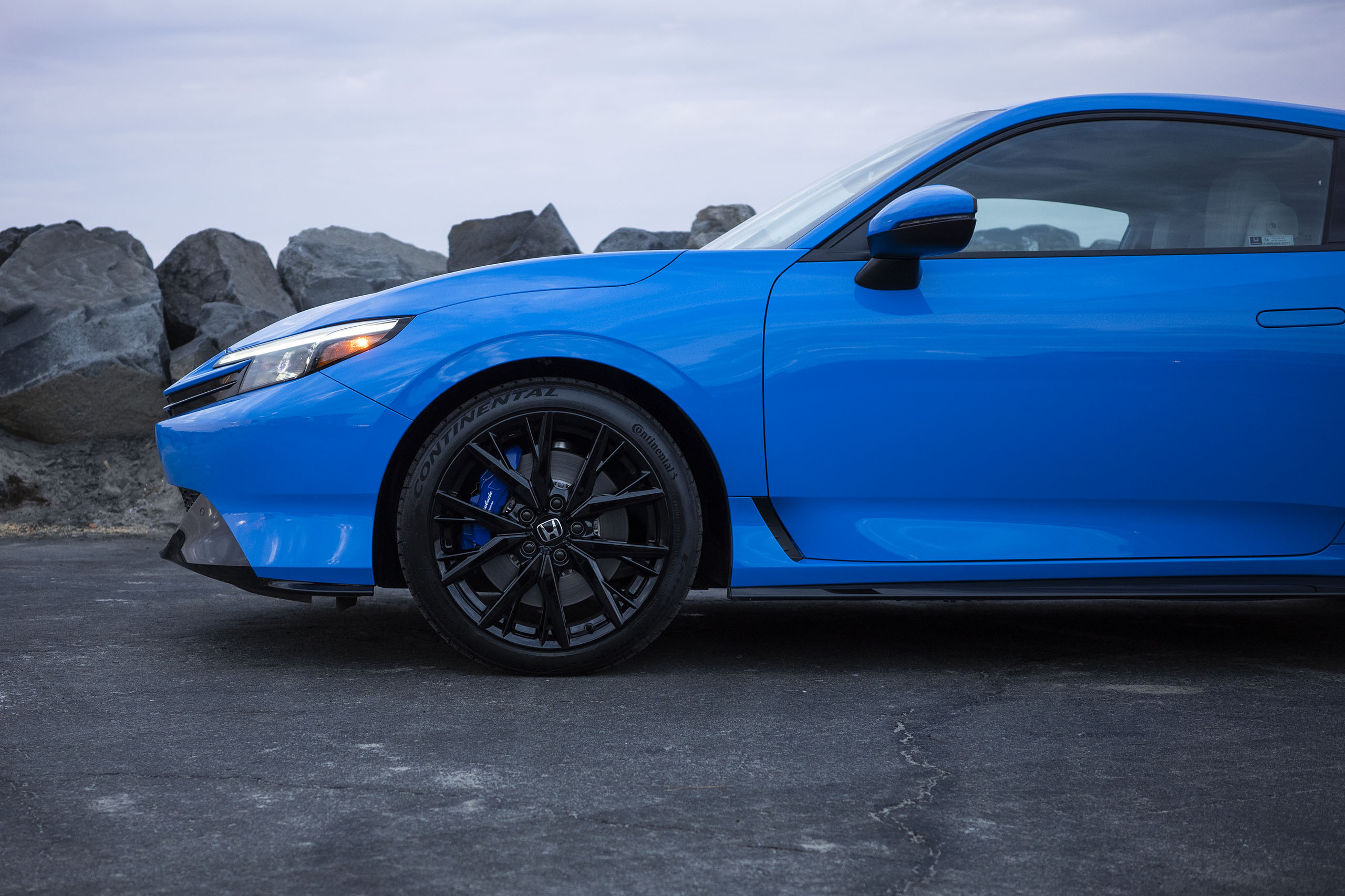
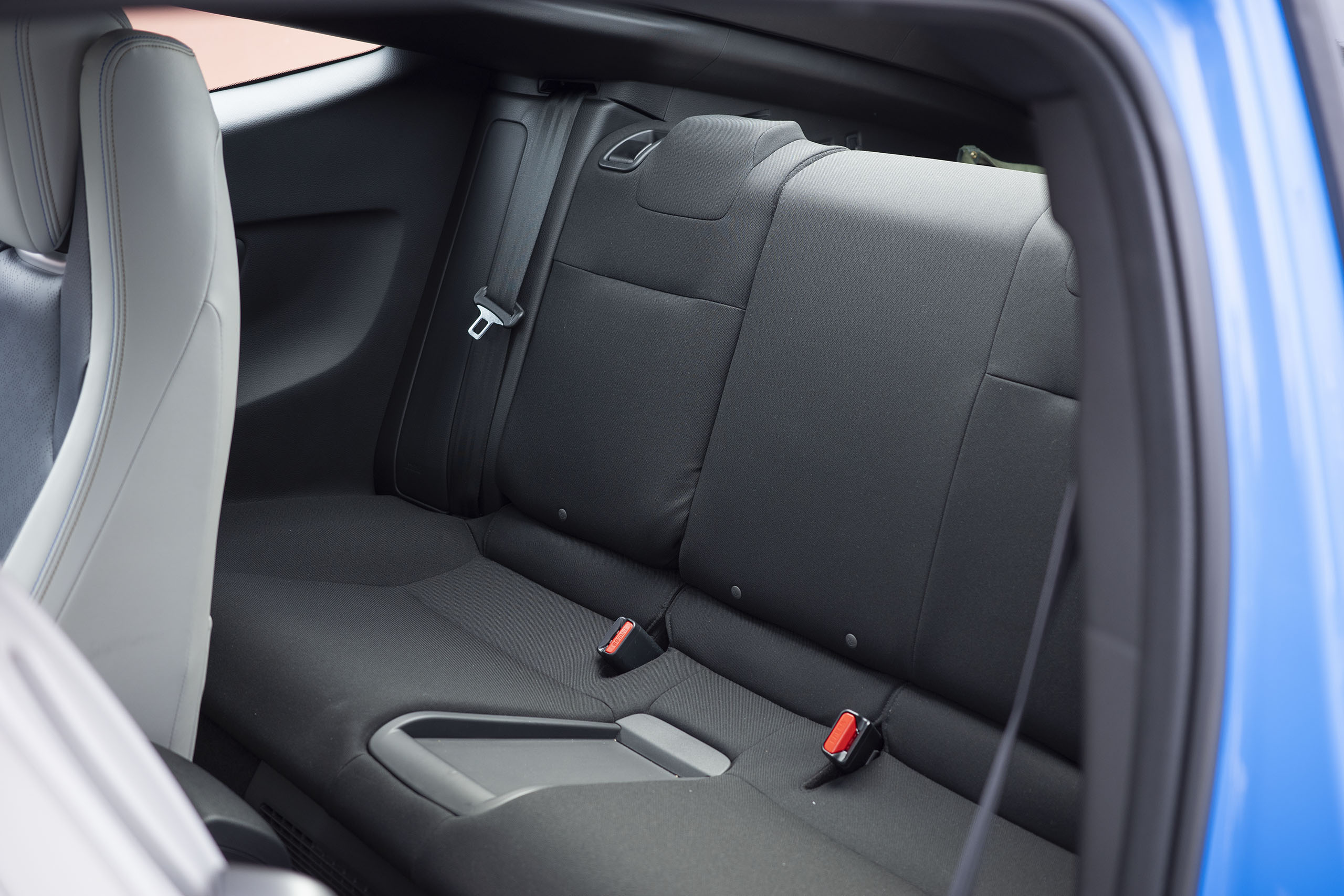
The formula for the sixth-gen Prelude is as follows: Take the Civic Hybrid’s powertrain, toss in the Type R’s dual-axis front suspension and four-piston Brembo brakes, and wrap it in a svelte body with a premium interior. Yeah, there are a few wrinkles, like Honda’s new S+ Shift system that will eventually make its way to other hybrids in the lineup, but that’s pretty much the gist. You’ve got two doors, and there is technically a backseat, but I wouldn’t call it fit for humans. My legs might’ve barely fit back there, but my head didn’t, and I’m all of five feet, 10 inches tall.
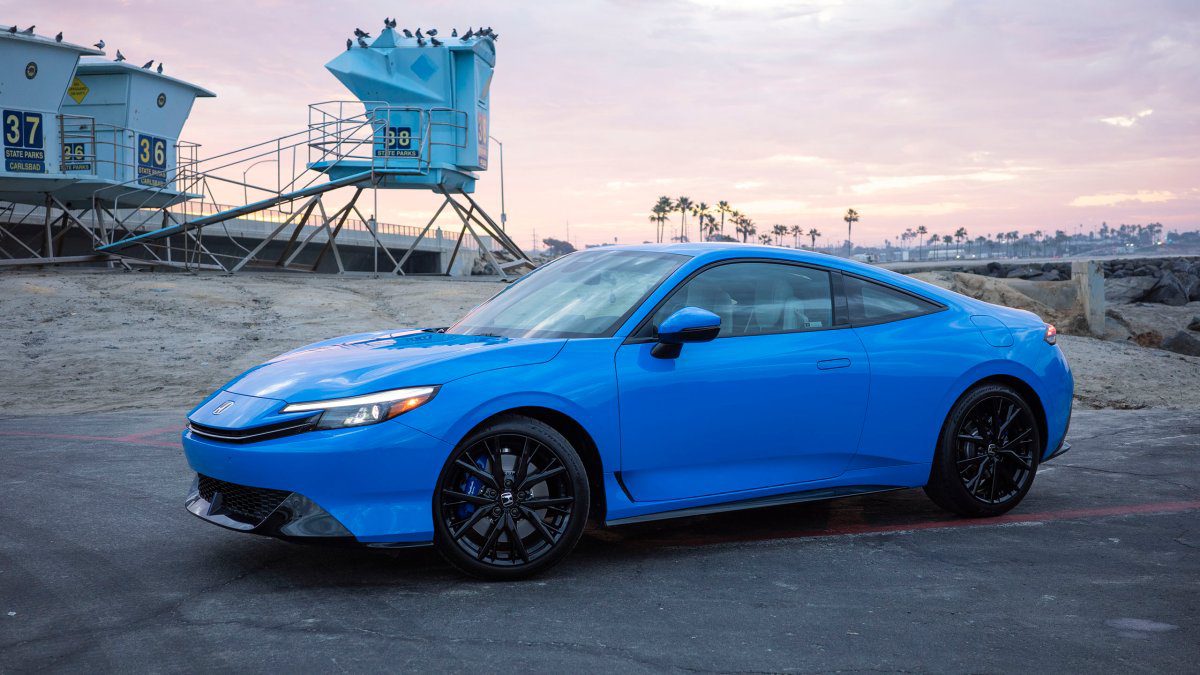
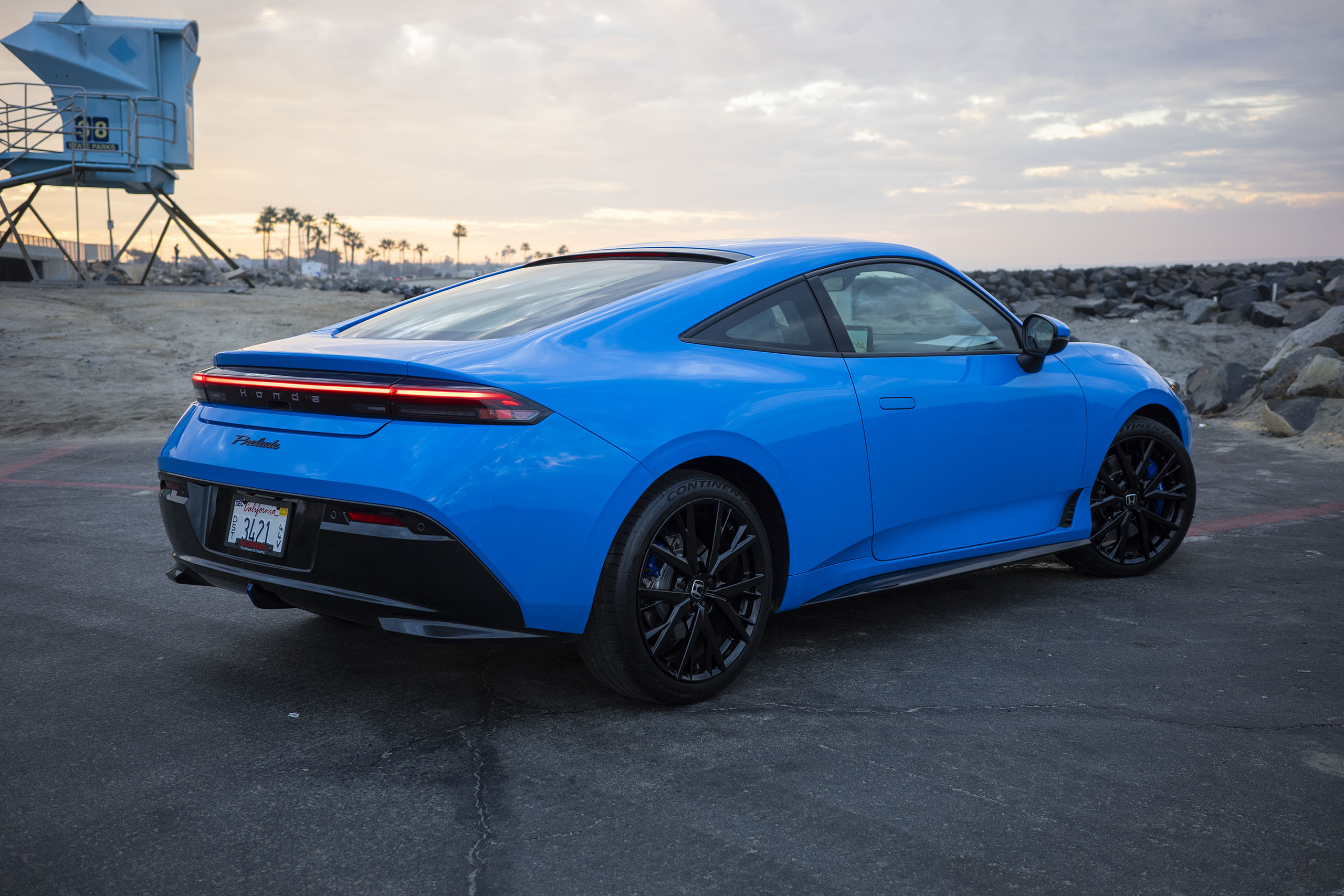
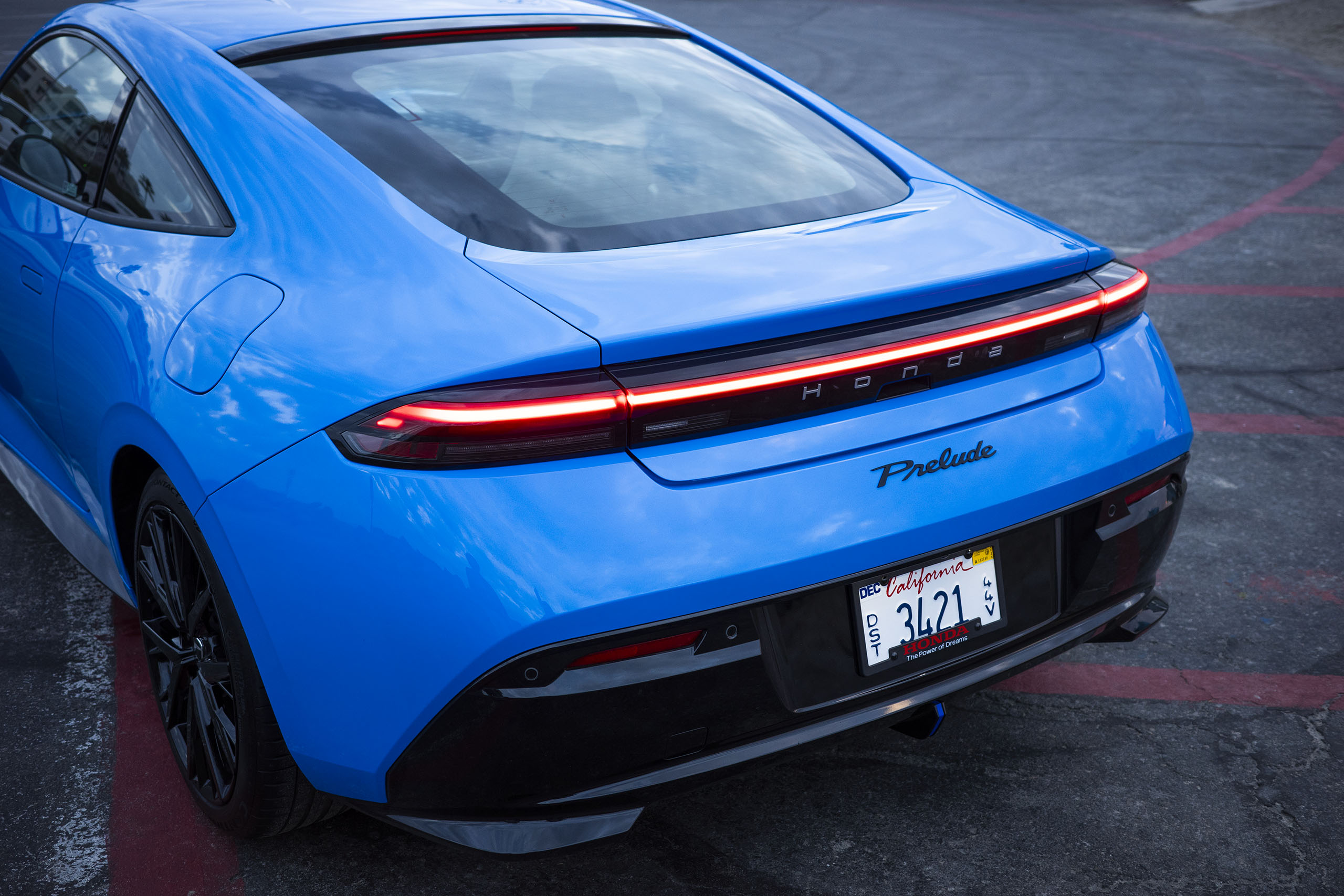
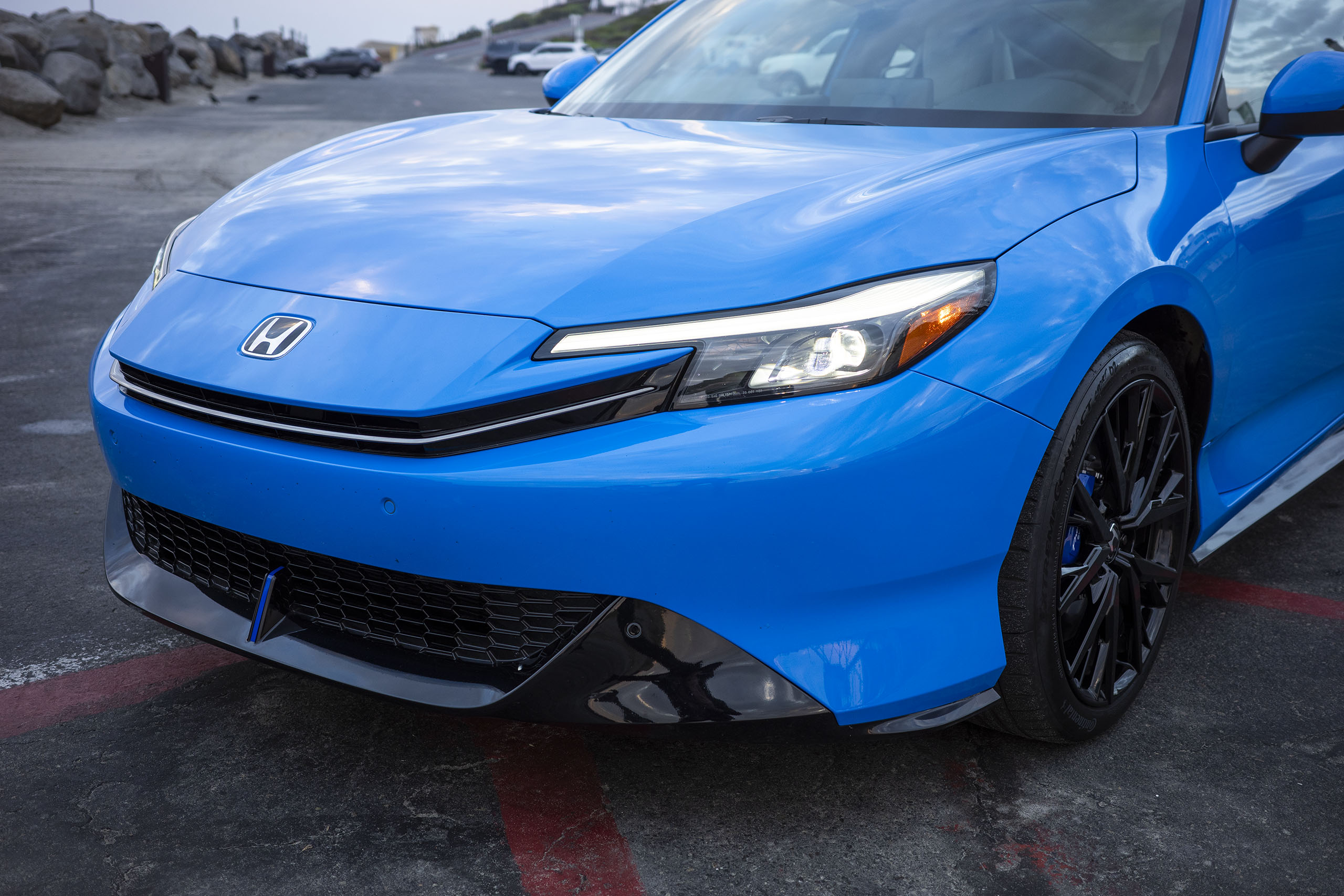
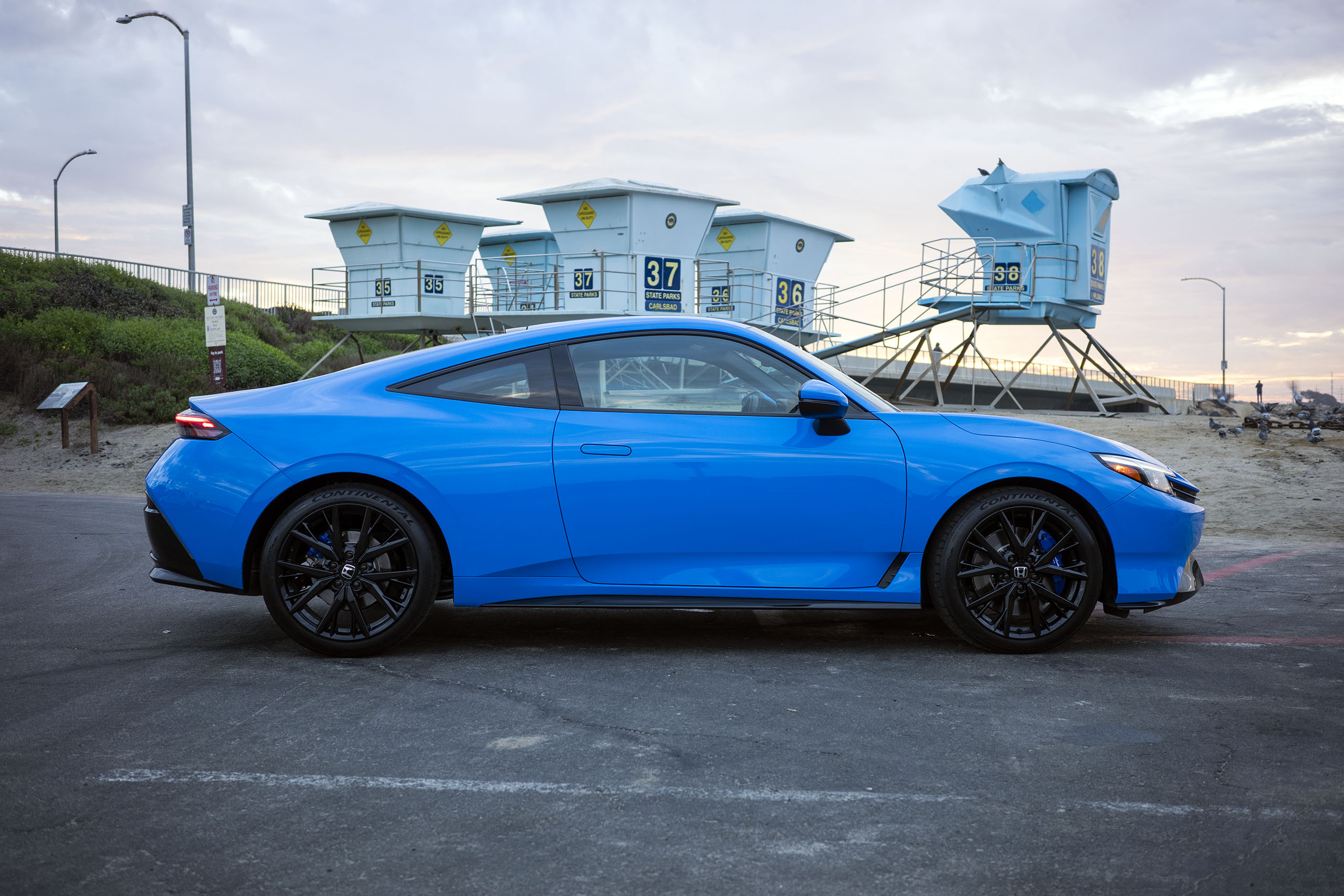
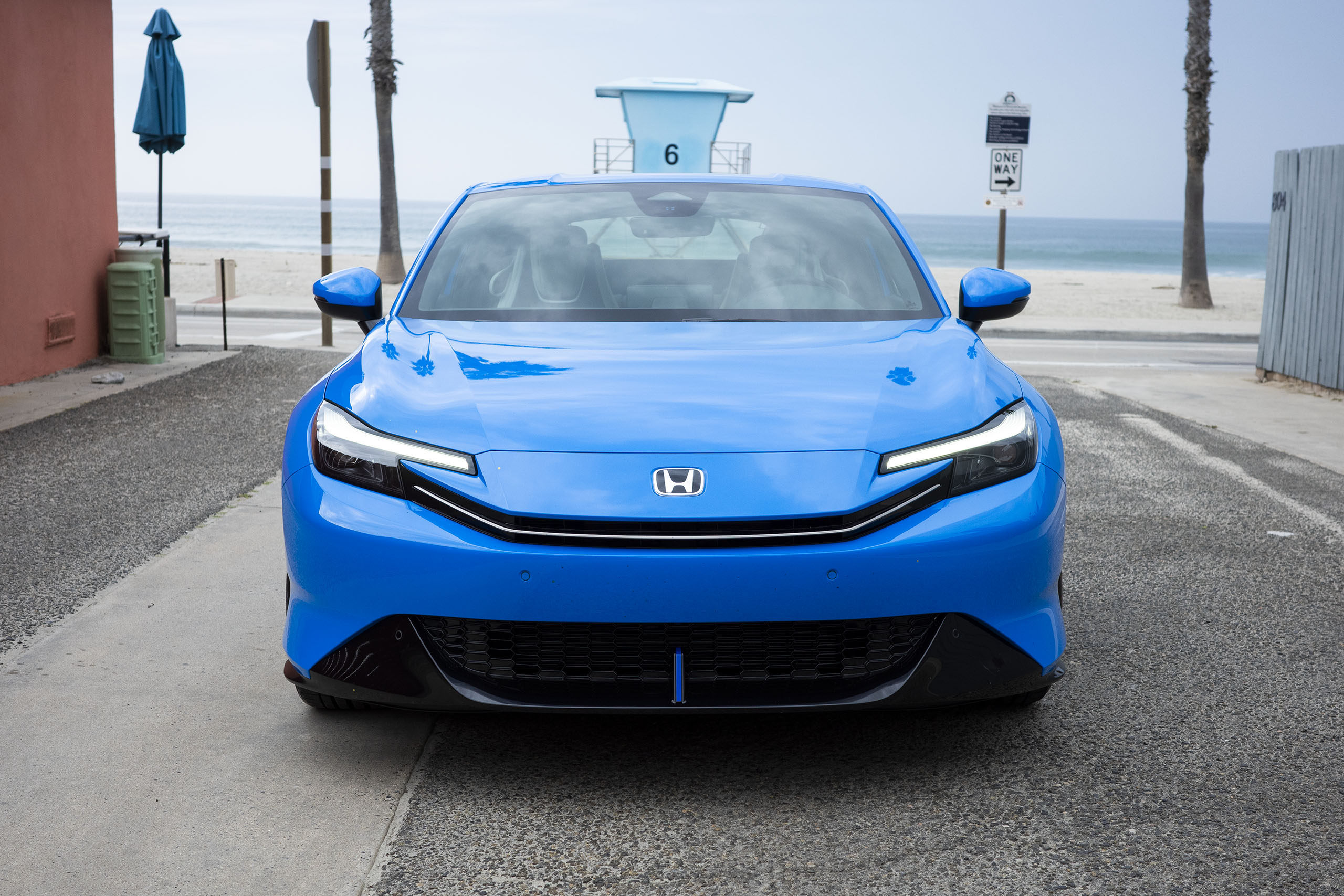
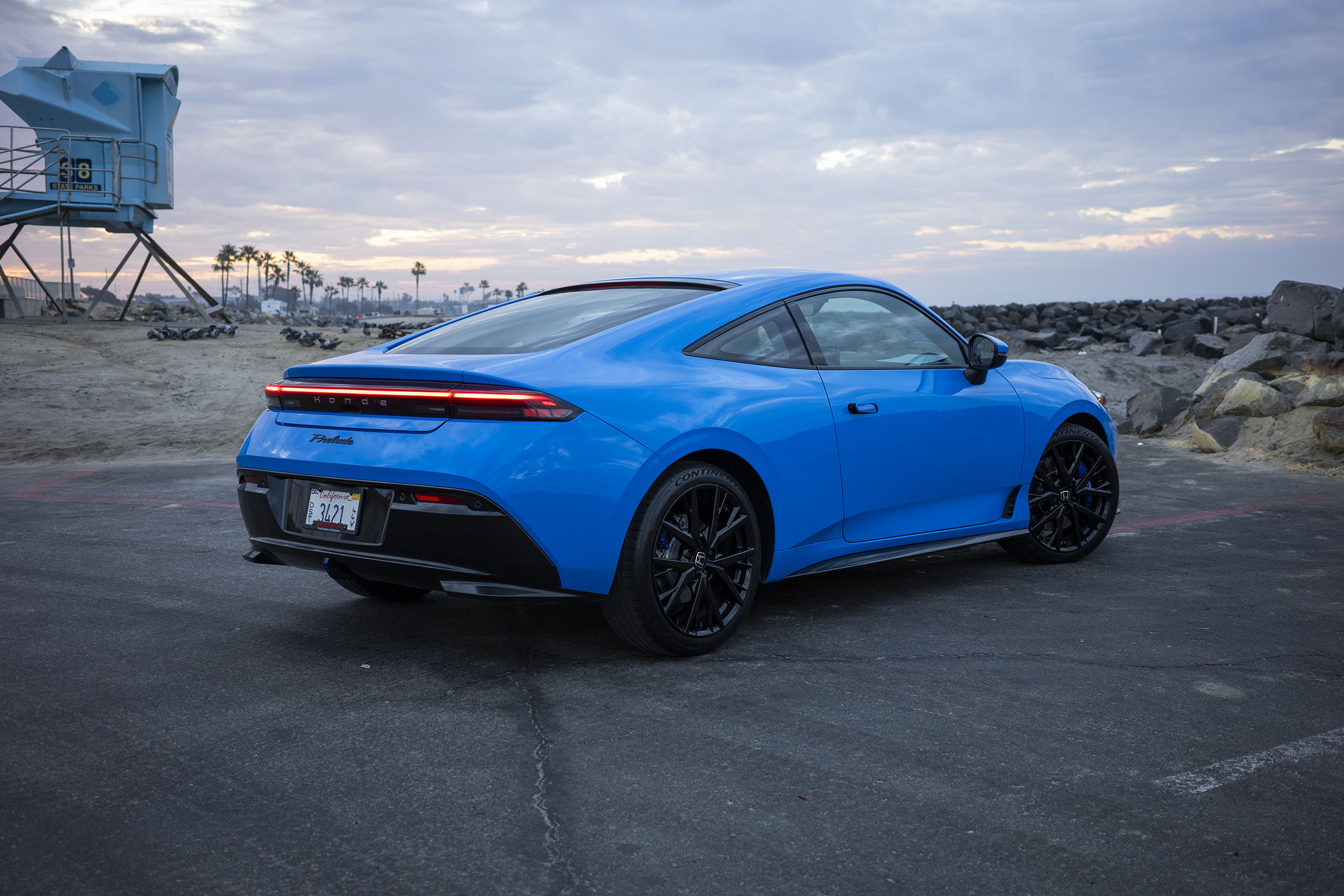
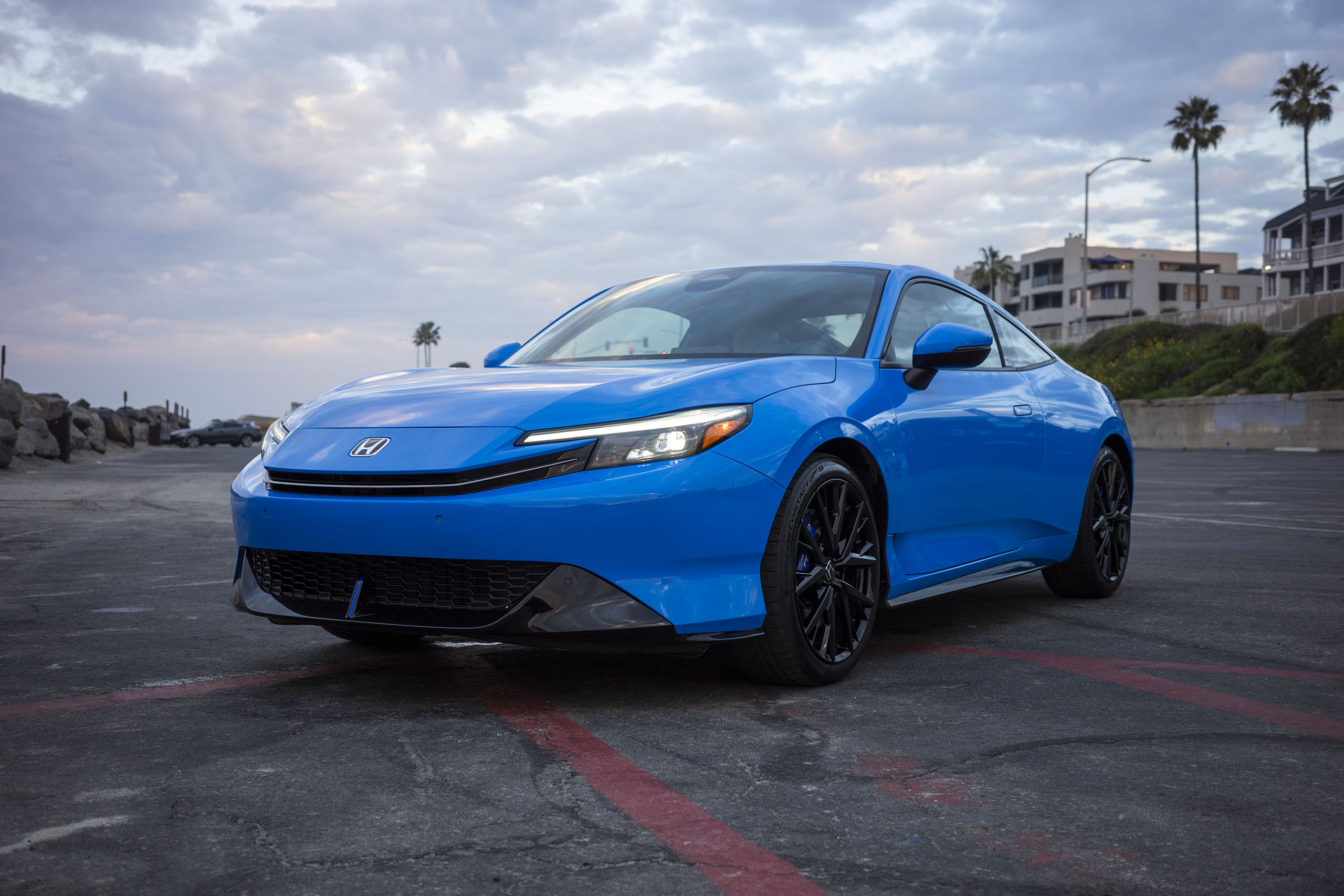
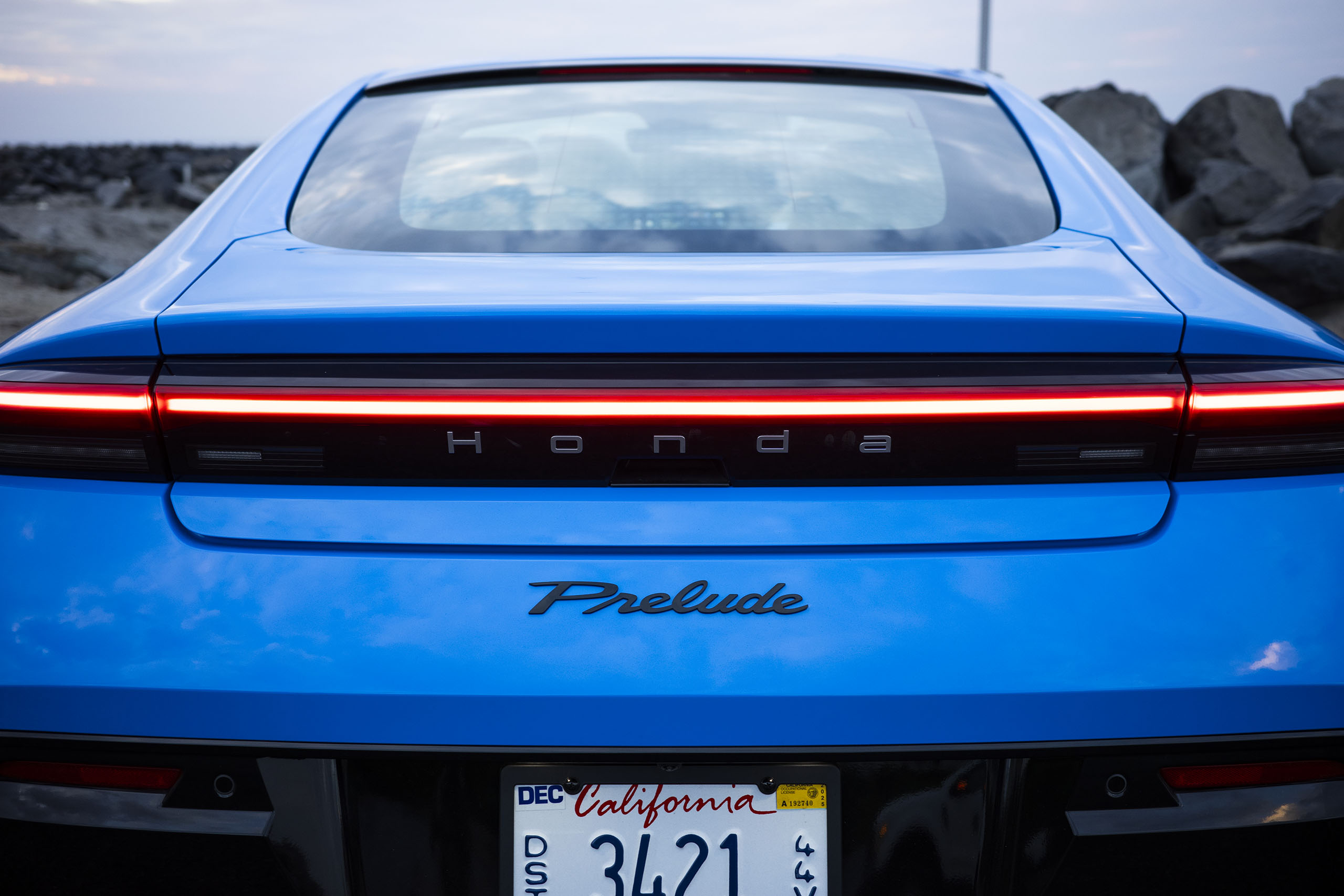
Then again, if you really wanted rear seats, you would’ve bought a Civic Hybrid and saved 10 grand. The Prelude is a coupe, unapologetically so, and the market could sure use more of those. It also looks fantastic. There’s a little Coke bottle to its wide stance and cinched midsection, and the long rake to its liftgate is pretty aggressive, especially for a $40K car. The rear-wheel-drive Toyota GR86 and Subaru BRZ might be more juvenile and exhilarating at speed, but even they don’t commit this hard to a silhouette entirely devoid of practicality.
Adam Ismail
Though the new Prelude is merely 4 tenths of an inch longer than the final model in 2001, it is 5 inches wider. In Boost Blue, which isn’t even my favorite color, it looks like a teardrop—a tribute to all those “personal luxury coupes” of the ’90s, including not only the Prelude but also the Celica, Mazda MX-6, Ford Probe, and Mitsubishi Eclipse, to name a few. Cars that may have lacked edge, but still had a certain value because they were elegant and fun enough to drive. I want to believe those kinds of vehicles can still exist, and that the new Prelude is one of them.
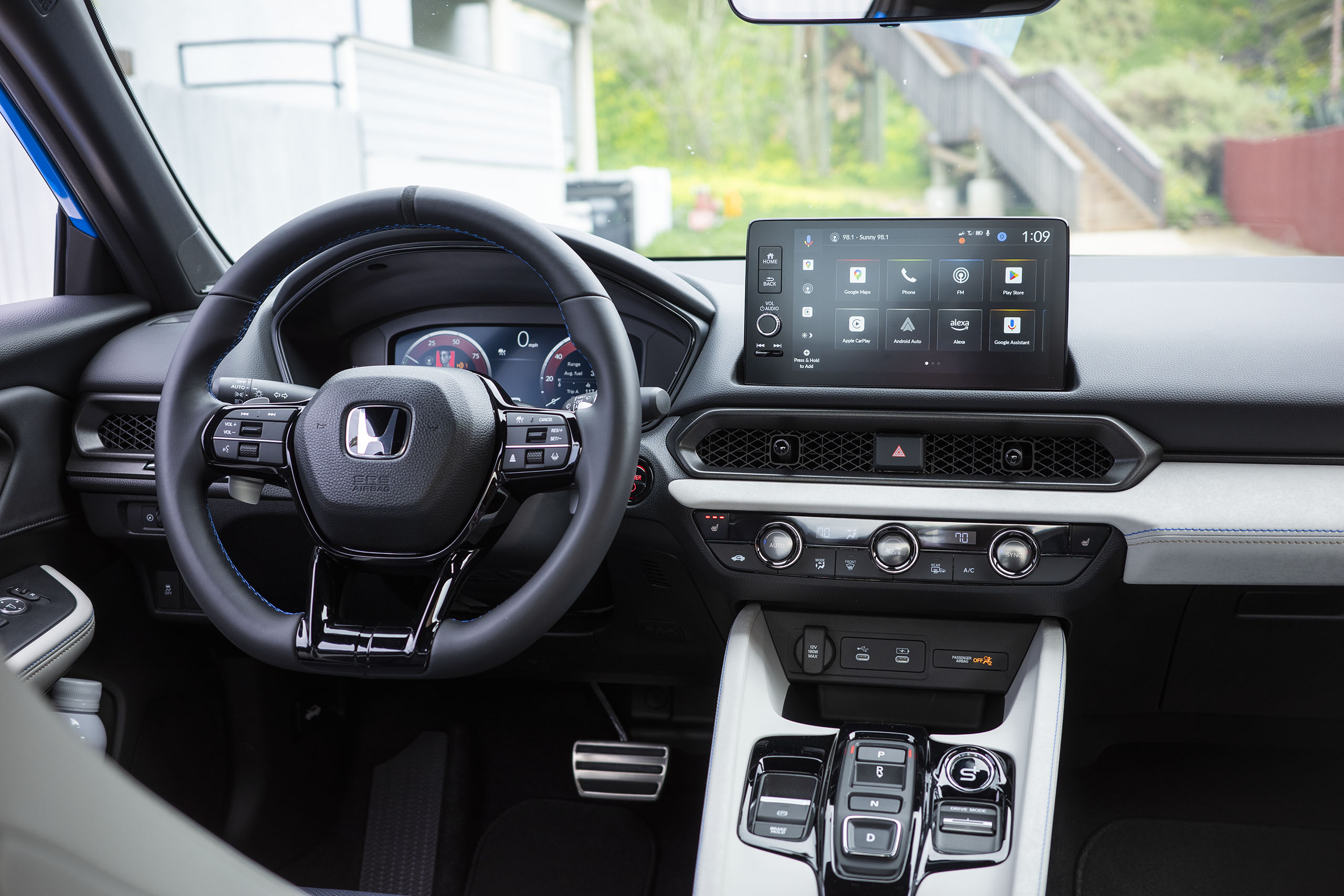
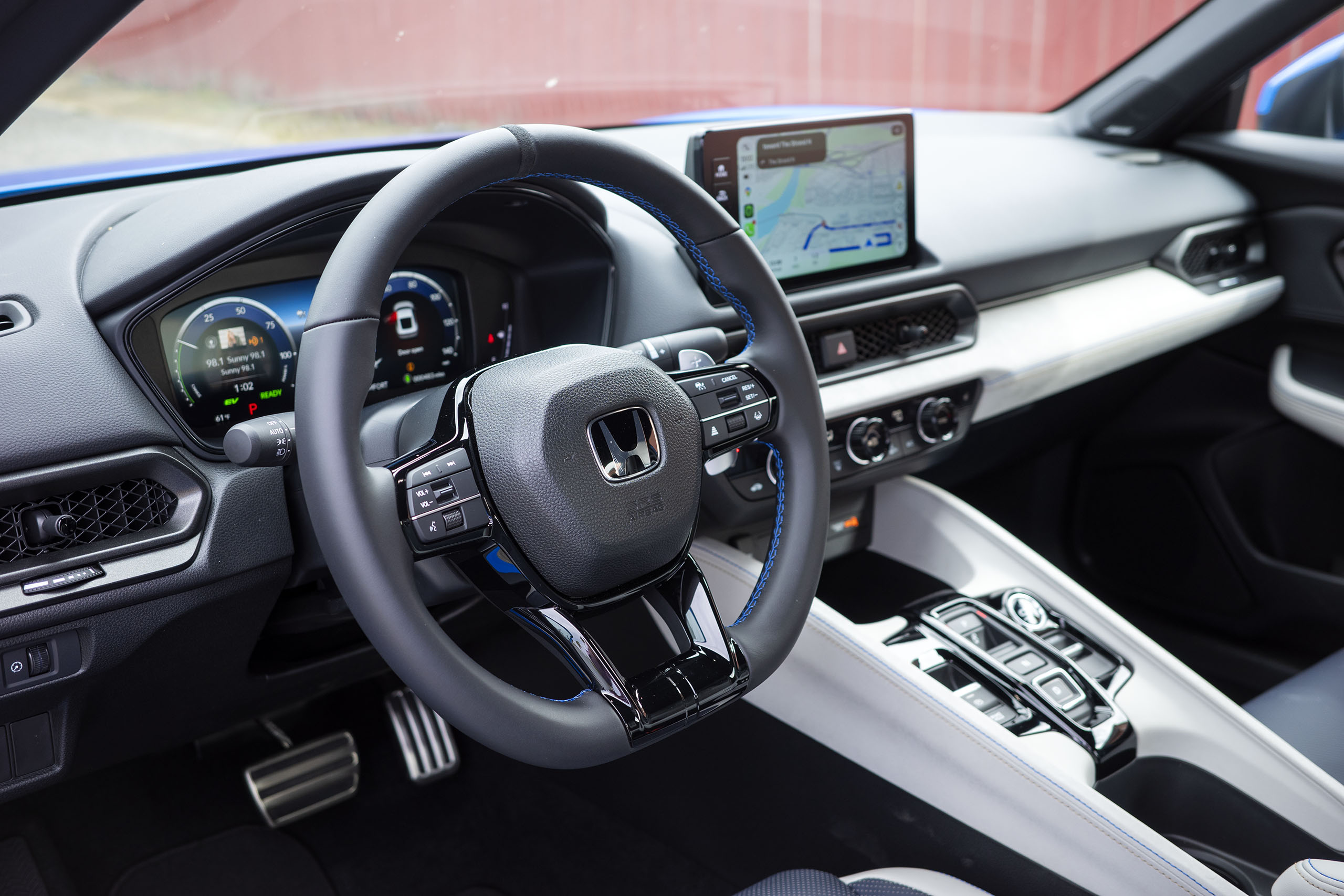
But there’s no personal luxury without luxury, and the Prelude mostly succeeds there, too. The seats are bolstered asymmetrically because the driver and passenger don’t have the same role in a car, so why should they have the same support? I love the navy and white leather colorway, and the Houndstooth-pattern perforations are a nice touch. (Side note, but I’m bummed that Honda won’t let you spec the Rallye Red exterior with anything other than a black cabin. Red, white, and blue are HRC colors!)
Adam Ismail
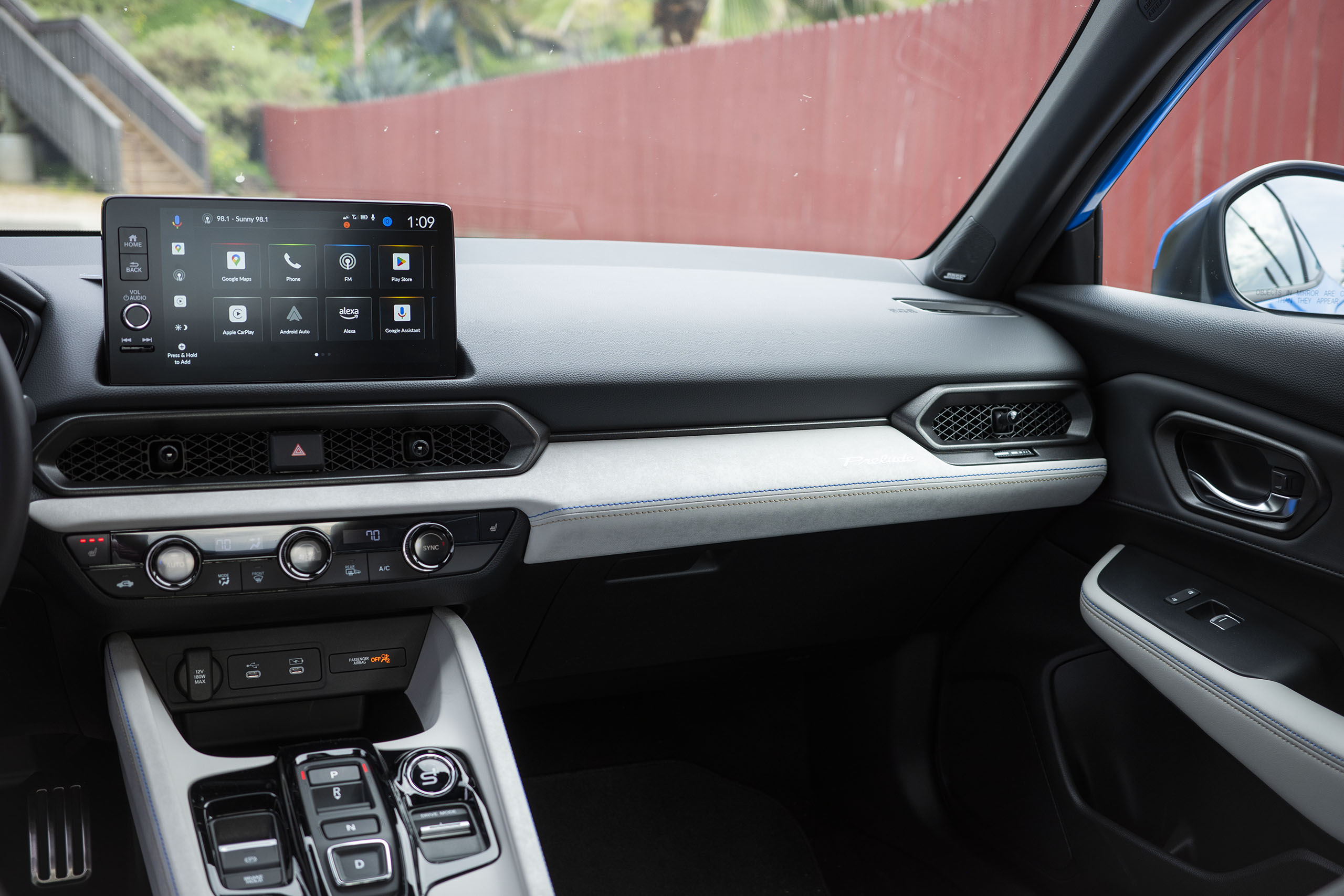
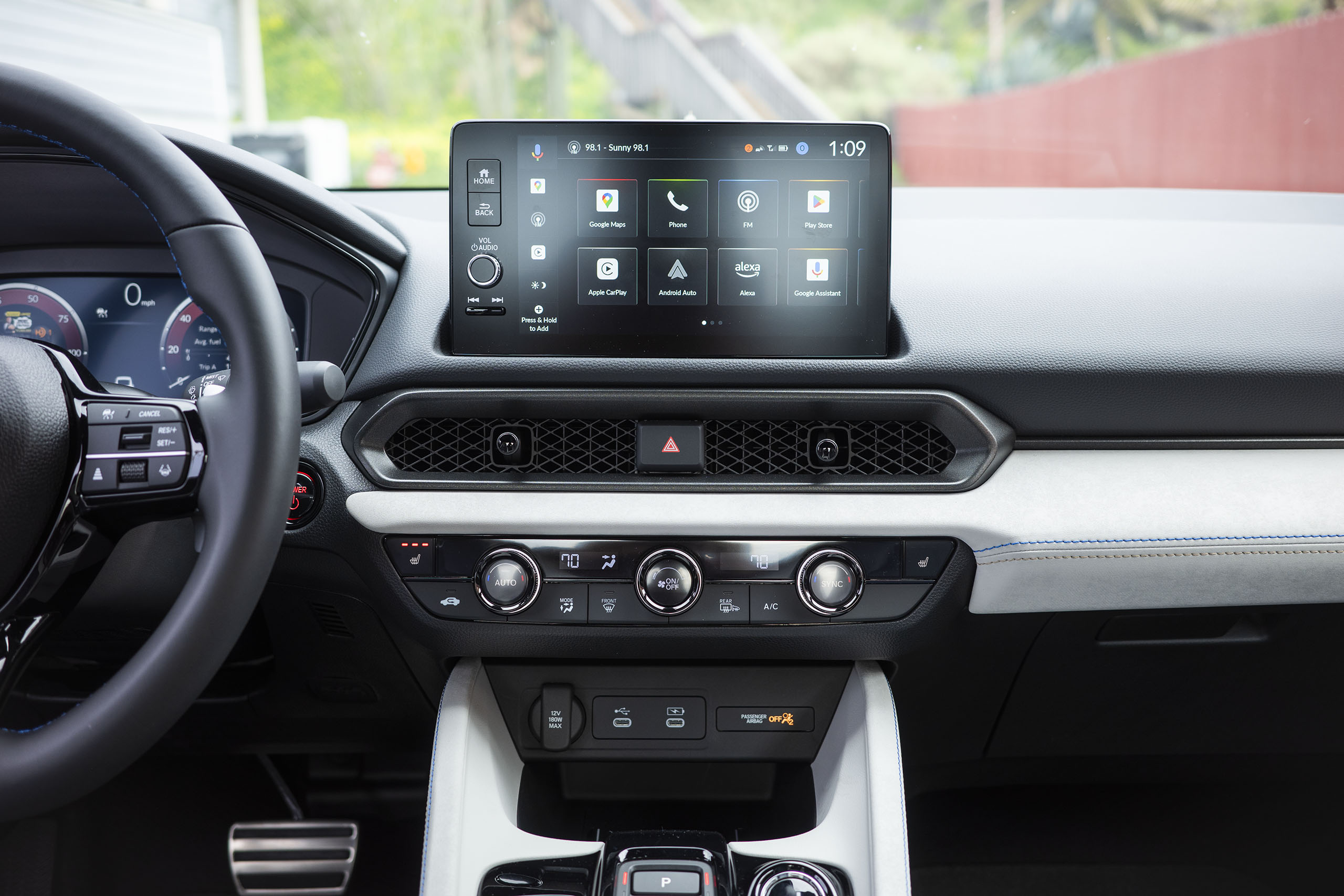
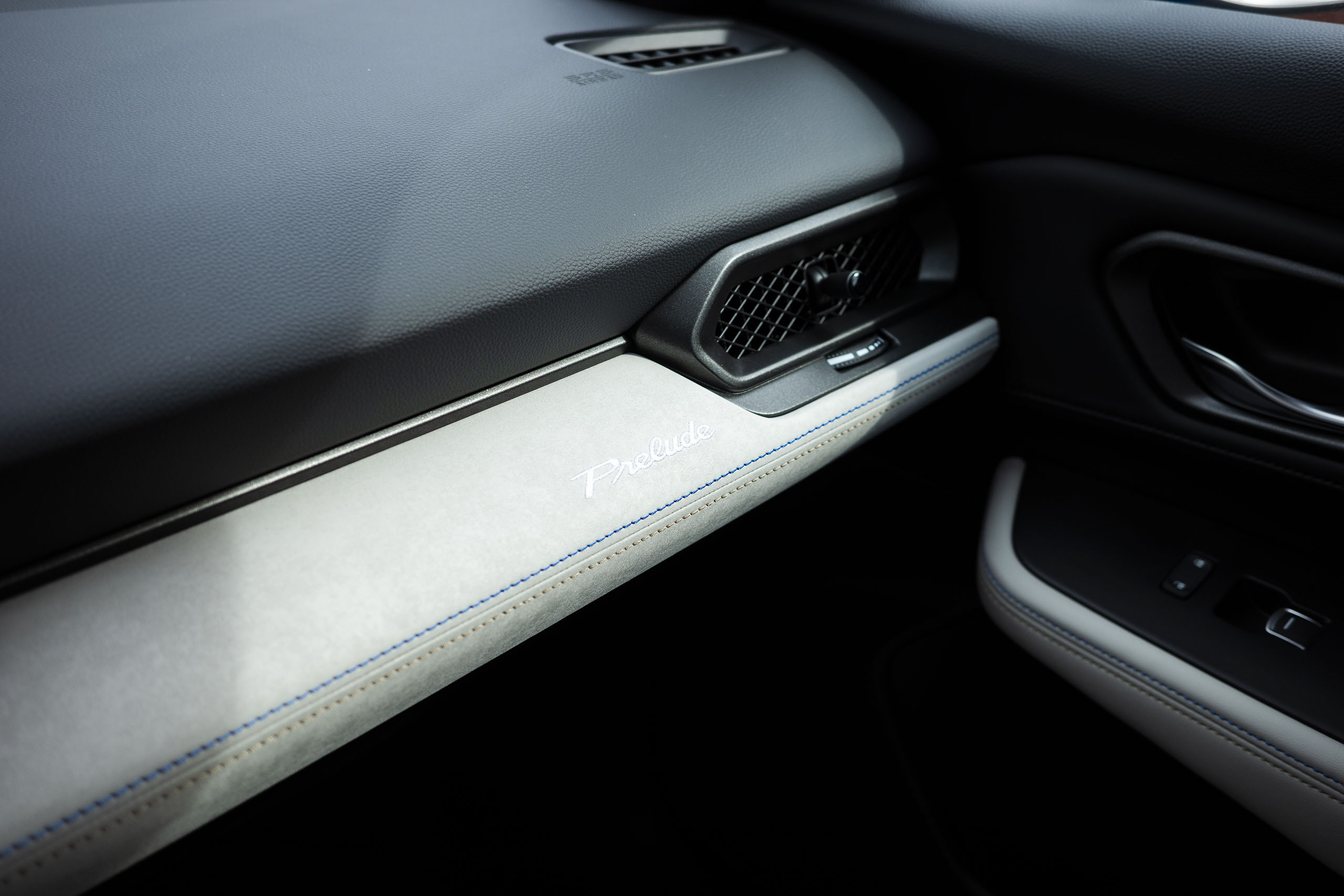
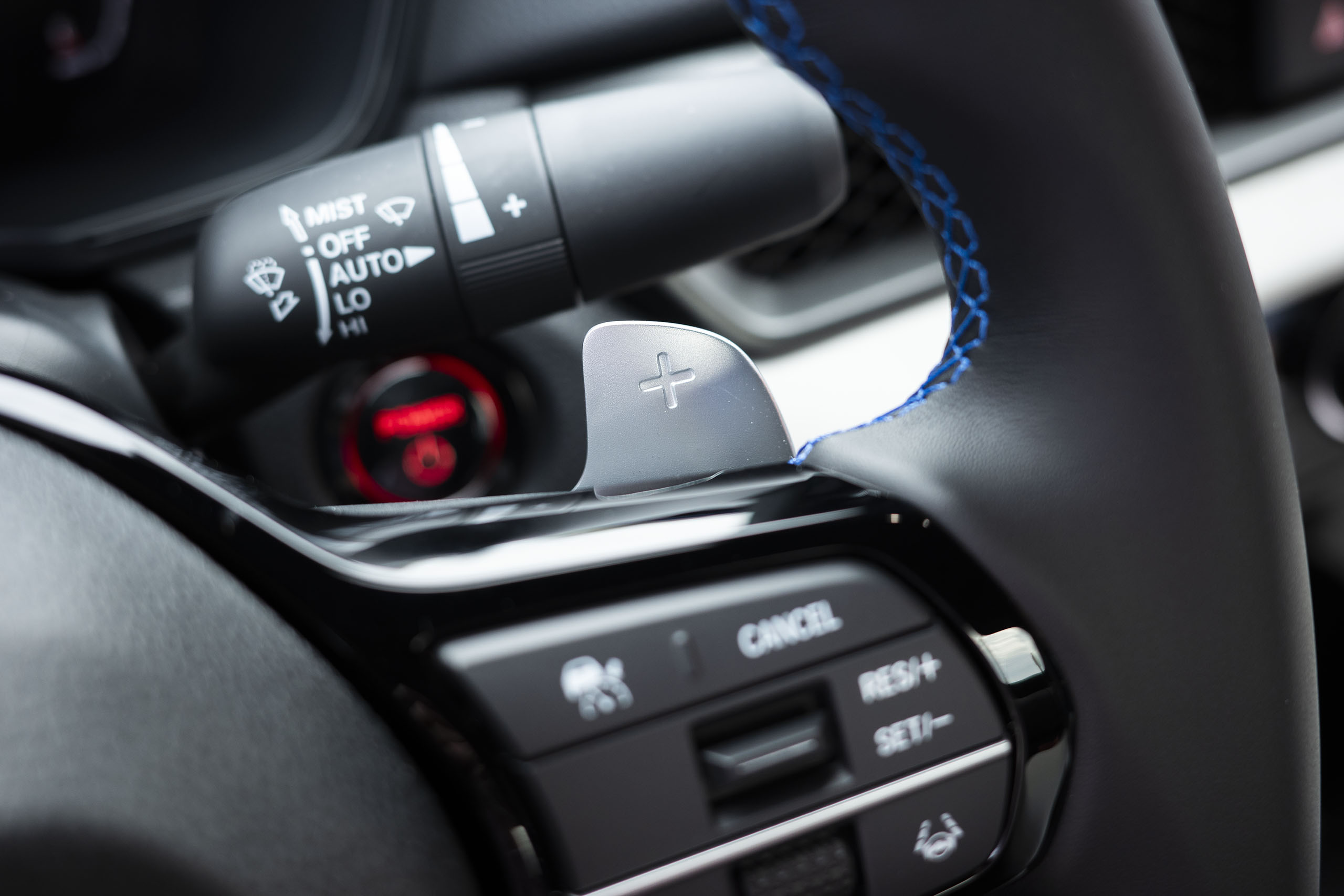
The suede-like fabric on the dash feels a little strange (it’s like a really fine-grain suede), but it looks good, as does the embroidered Prelude logo within it. And Honda deserves kudos for making the shift paddles out of metal, rather than reaching for the same plastic parts it’d use on any other model. Overall, the Civic’s interior was already a winner, and the Prelude kicks everything up with more premium materials—so long as you ignore the back not-seat, upholstered in some of the cheapest cloth you’ve ever seen in a modern car.
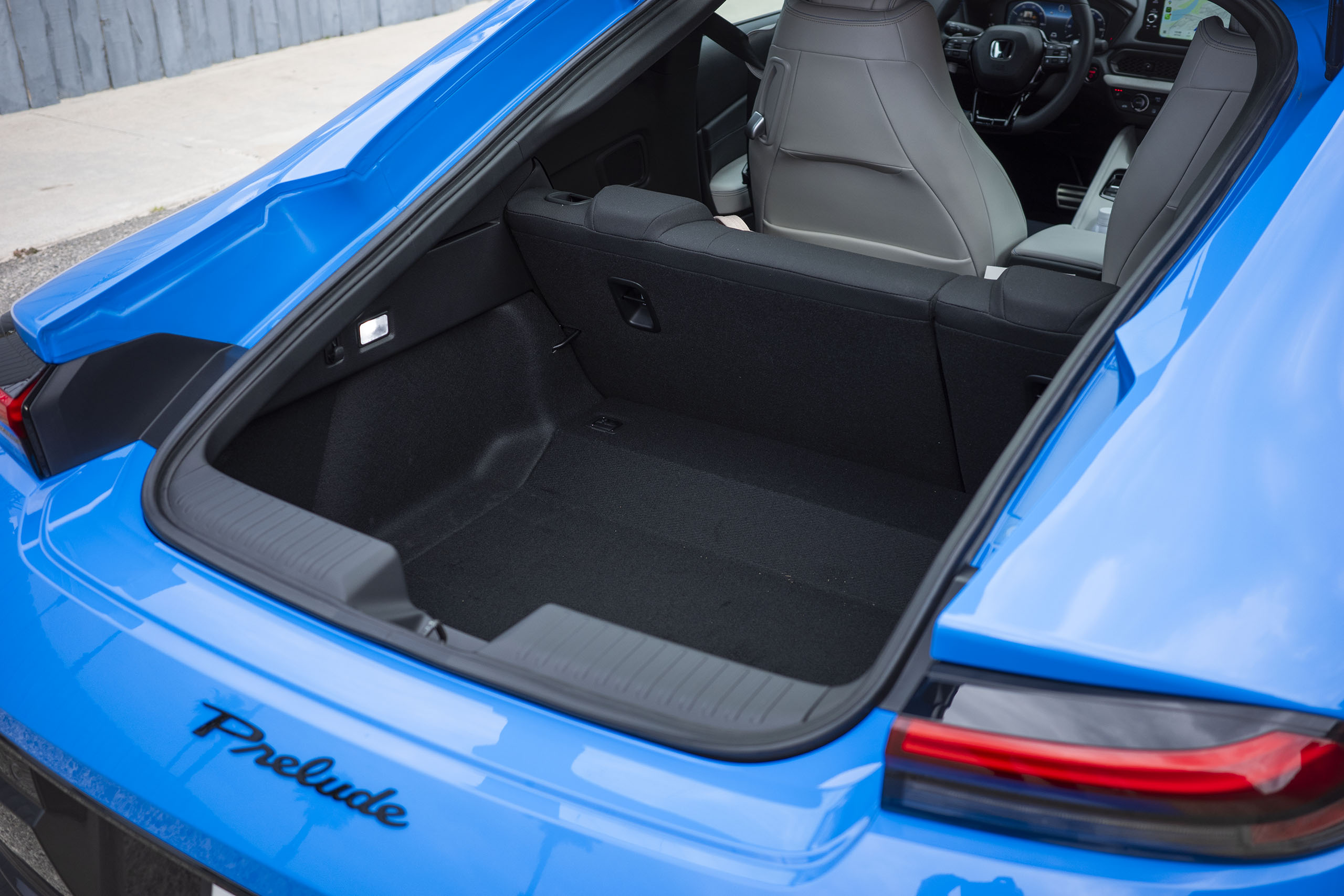
But that’s a nitpick, and this cabin is truly missing only one thing that matters. See, while the rear bench isn’t useful for people, it’s still very useful for stuff. To access it, you’re going to need to move the seats often, and a handy lever near the top of the Prelude’s thrones makes at least the act of folding them down easy. Unfortunately, returning them to the spot they were in will require some trial and error, because despite the coupe’s premium pretensions, it lacks powered seats.
Normally, I wouldn’t care about that, but this is a cramped car, and you’re going to be sliding those things back and forth a lot. Seat memory is a must, and frankly, I don’t know how Honda could overlook it at $43,000.
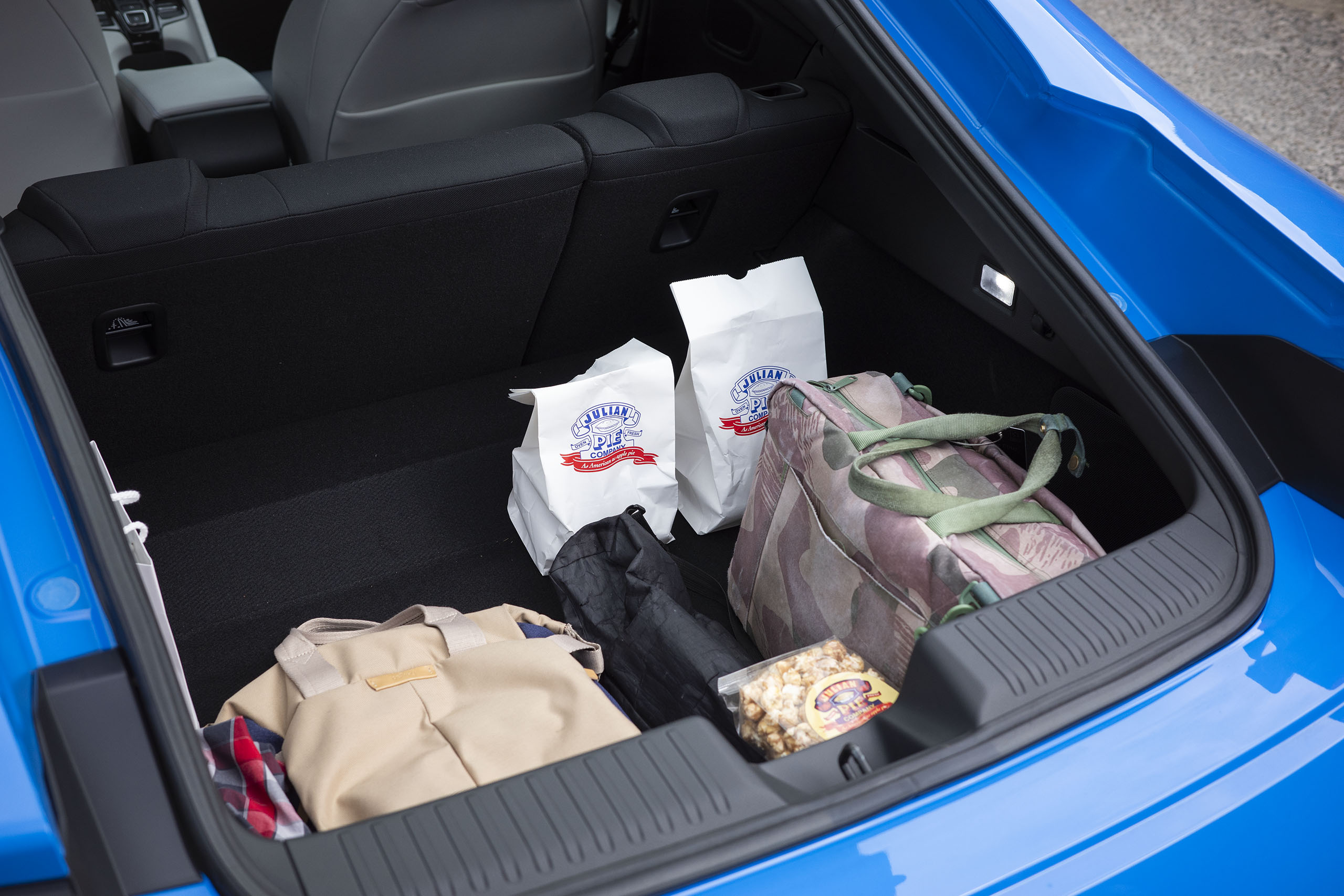
I know it looks like there’s no space in the trunk, but it’s actually not half bad. Adam Ismail
2026 Prelude Driving and S+ Shift Impressions
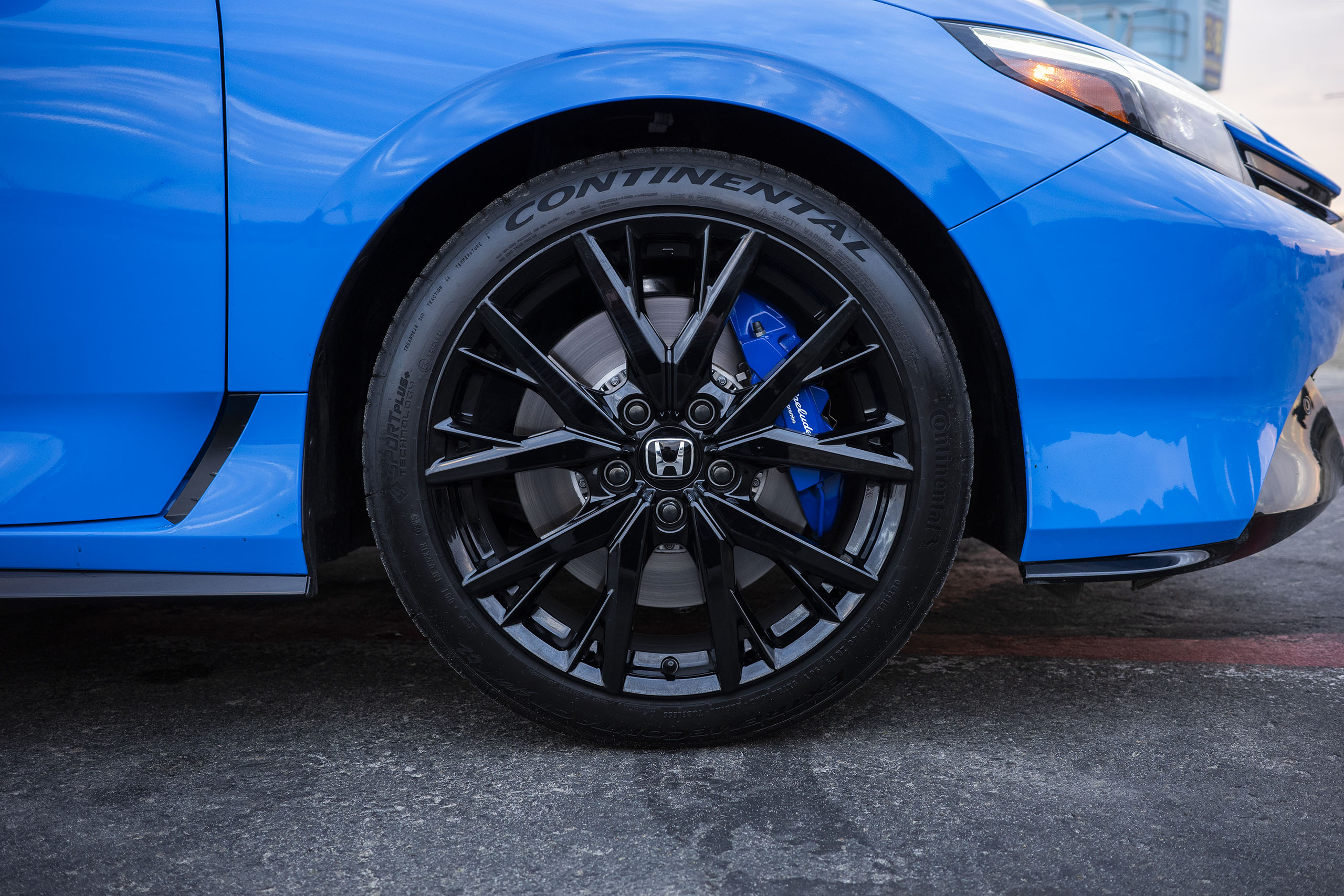
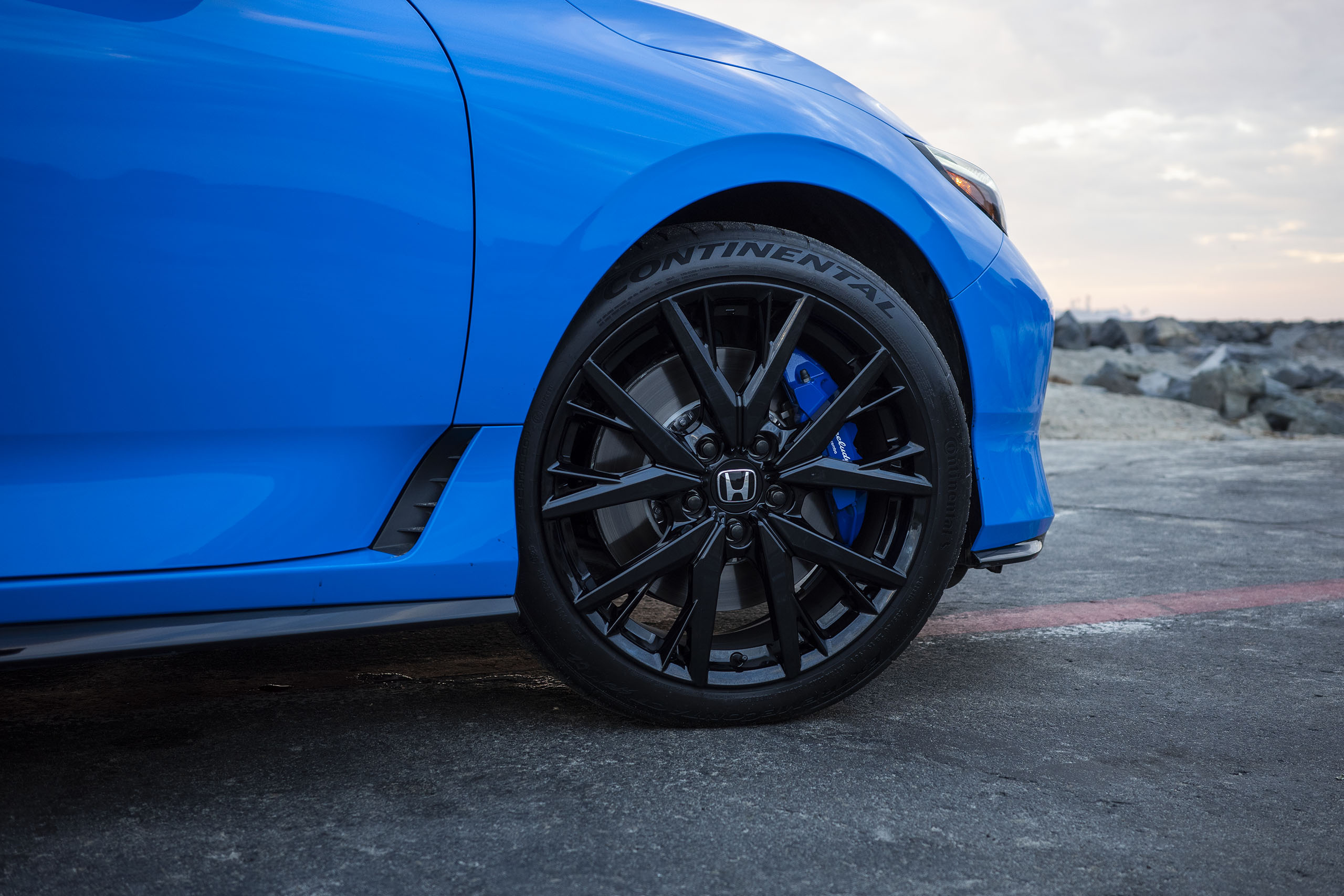
To get behind the wheel of the Prelude, Honda brought the media to sunny San Diego, which certainly fits the Prelude’s vibe better than the winter storm that swept from Texas through the Northeast last weekend. The fleet was riding on optional Continental ExtremeContact Sport 02 summer tires, but this car really doesn’t need ’em—quality all-season rubber would be fine enough.
I say that because the Prelude feels, on these canyon roads, like a zippy car, but not a fast one. A car ideal for safe-speed darting around in. Initial steering response, weight, and mid-corner composure are sublime, but then why the hell wouldn’t they be? The parts responsible came from the Civic Type R, with a little tweaking. The steering rack, for example, has been made a touch faster for Prelude duty.
Adam Ismail
Much as with the Type R, a winding road in the Prelude is a frictionless experience. Everything responds exactly as you’d expect it to, and a sense of ease comes naturally. There’s no abstraction between your hands and the tires, no hiccups in the power delivery, and the brake pedal falls with just the right amount of pressure, offering up a whole lot of stopping force when called upon. The Prelude doesn’t throw its weight around so much as it carves. It’s a joyful and drama-free drive.
Likewise, the adaptive dampers fit very well with the baby grand tourer ethos Honda is pitching this coupe with. Keep your expectations in check; Comfort mode doesn’t turn this thing into a Continental GT, but it’s definitely more compliant than my decidedly not-adaptive GR Corolla.
Electric motors mean early torque is always comfortably within reach. It’s when you get up there, and press the accelerator down into the carpet when you’re already cruising, that the Prelude begins to feel less like a CTR and more like a CR-V. I don’t know how Honda could’ve massaged another 30 or so horsepower out of that hybrid system, but if it came at the cost of those big front brakes, I’d make the trade.
Adam Ismail
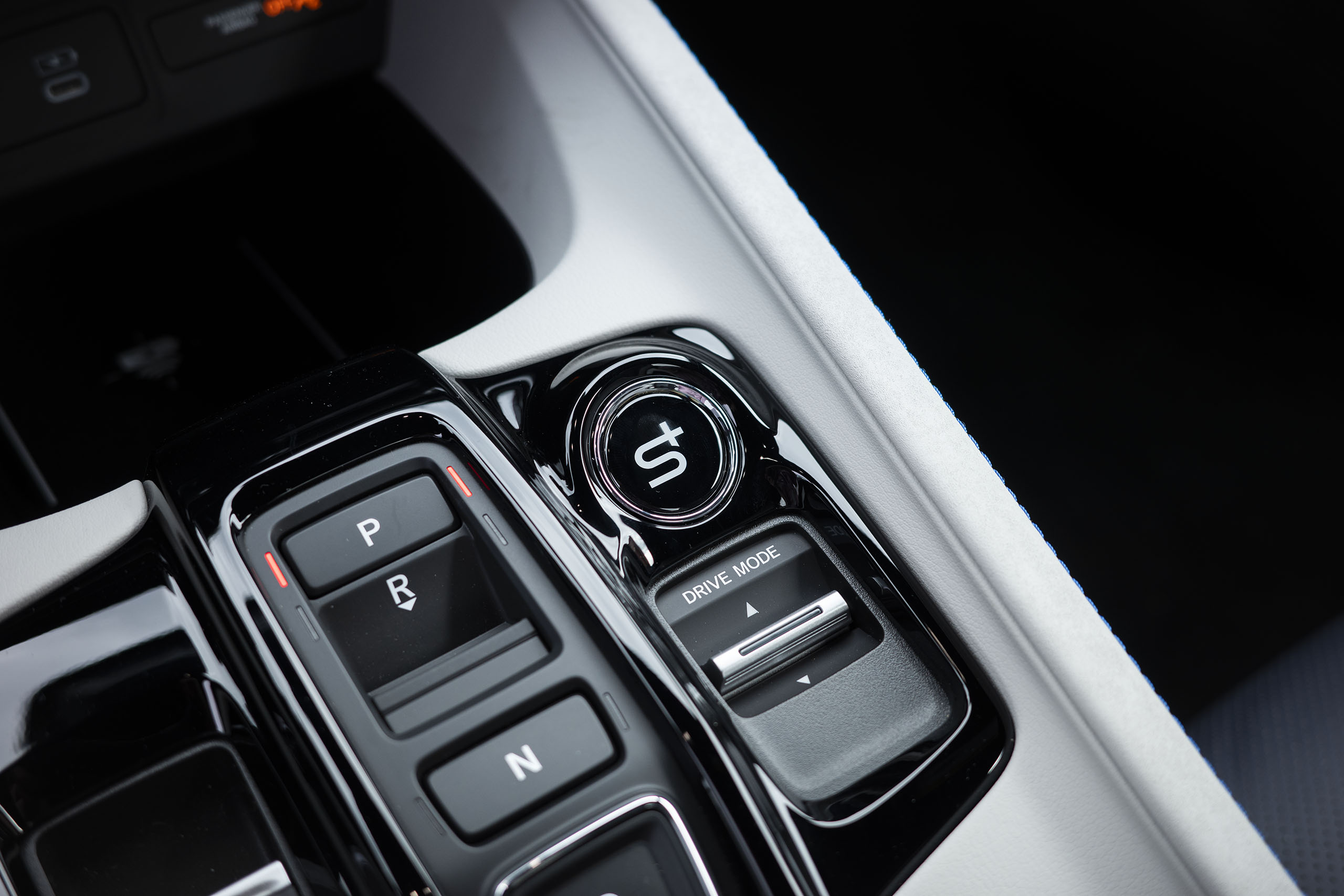
To perhaps make that aspect of the experience a little more exciting, Honda has introduced its S+ Shift system here in the new Prelude. See, these two-motor hybrids that Honda sells don’t have transmissions. Instead, the propulsion motor drives the wheels through a single-speed reduction gearset until about highway pace, when the engine takes over via a lockup clutch. S+ Shift simulates the behavior of a sequential manual transmission, specifically an eight-speed unit.
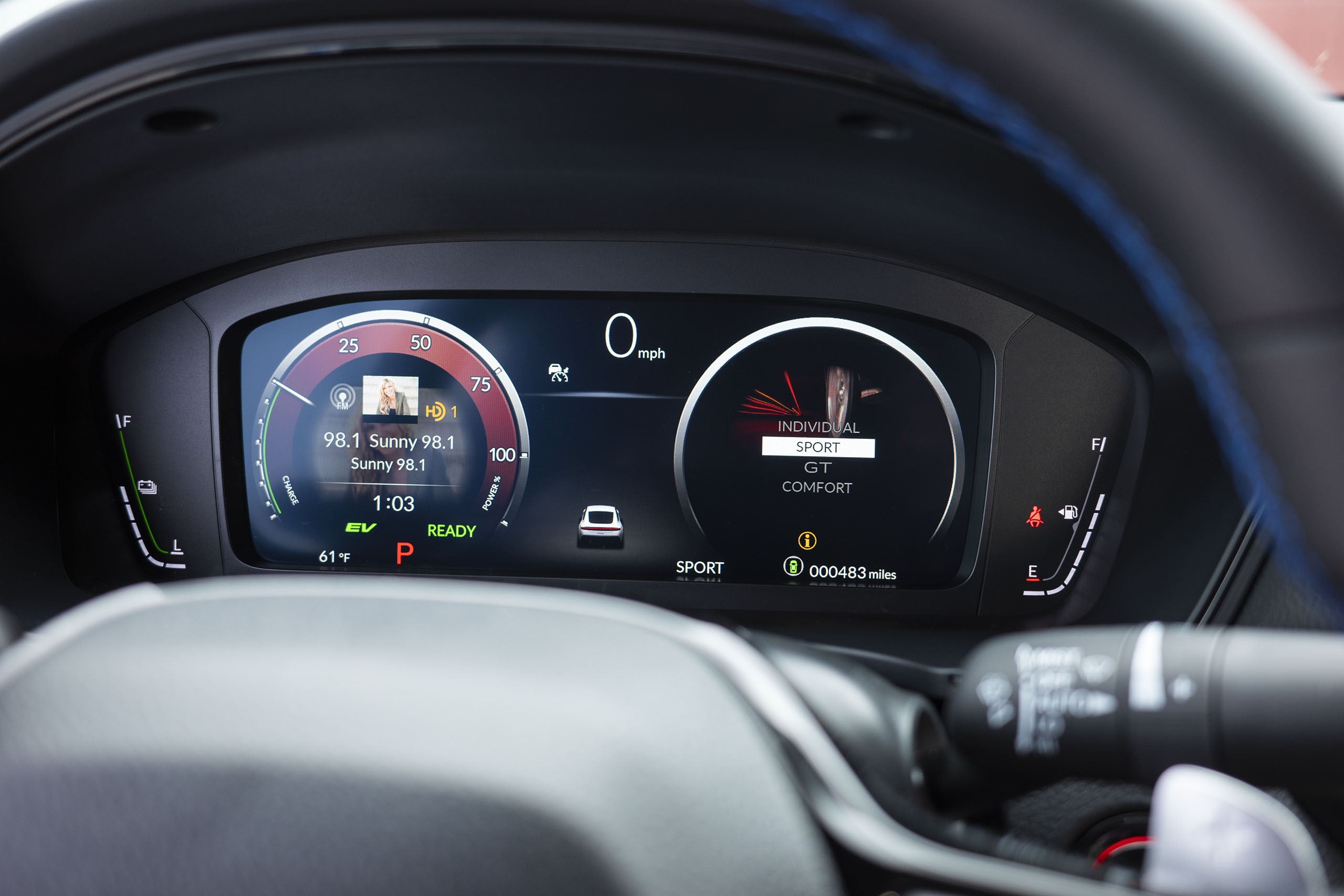
Frankly, if I could choose any number of fake gears at my disposal, eight is definitely too many and kind of a deal-breaker. But the system does a reasonable job of mimicking a manual process with software. It’s activated by a big S+ button next to the drive selector and works hand in hand with the car’s three basic drive modes—Comfort, GT, and Sport—to function differently depending on which one you’re in. For example, in Sport, the piped-in engine sound will be at its loudest, and downshifting, though “rev-matched,” will deliver more driveline shock.
The fake noise is pretty weak; it sounds like it’s coming from an engine in nearby traffic, rather than the one in your car. Also, the jolts are muted, and downshifting prematurely and redlining doesn’t elicit a sudden drop in acceleration so much as a light hitch. It’d go a long way toward a more engaging, realistic feel if Honda could amp those sensations up. Nevertheless, a lot of clever thinking has clearly gone into this feature. For example, to simulate the sludgy feeling of being engaged in way too high a gear for your speed, the generator motor actually switches into regen mode to increase friction against the engine, limiting drive power. How cool is that?
Adam Ismail
S+ Shift is neat, but it’s not compelling enough to lure anyone devoted to three pedals. That said, it would definitely stand a better chance if Honda designed it to let you handle the shifting at all times. No, really—after a period of inactivity, the fake transmission will start punching through the gears on its own, like you accidentally brushed one of the paddles in an Acura RDX.
The active drive mode dictates how much leeway the car will give you before stepping in, and I go into more detail about this in another article, featuring quotes from the Prelude’s lead planner, if you’re curious to know more. But discovering that Honda went to seemingly great lengths to engineer a fake manual mode only to prevent drivers from staying in it might just be the most bewildering thing about this car.
2026 Prelude Options, Fuel Economy, and Competition
The new Prelude only comes in one trim with practically everything you could want for $43,195, power-adjustable seats notwithstanding. The only choice you have to make before dealer add-ons is that of color. Boost Blue Pearl and Winter Frost Pearl cost an extra $455 and $655, respectively, and a Winter Frost/Black roof two-tone option is $1,155.
Honda rates the 2026 Prelude for 46 miles per gallon city, 41 mpg highway, and 44 mpg combined. That’s a smidge lower than the Civic Hybrid’s 50 city/45 highway rating or, for that matter, the 52 mpg across the board that most trims of the Toyota Prius get. And while I think it’s a little silly to stack the Prelude’s fuel economy figures against those of the Civic Type R or any other hot hatch—it trounces them all, obviously—I reckon the Civic Si makes for a fair comparison, given that it equals the Prelude in power and trails it in torque. The manual-only Si promises 27 mpg city and 37 mpg highway, but starts at $32,690, which is a $10,500 savings over the Prelude.
Adam Ismail
That brings us to price, which seems to be the hot topic surrounding this car, for good reason. When we first learned that Honda intended to sell the Prelude, many pegged it at $35K, if not a little higher. But once the coupe hit the Japanese market, it became clear that Honda didn’t envision things the same way.
$43,195 is a different territory. The GR86 starts at $32,395, and the BRZ at $37,055. An EcoBoost Mustang is $35,330, and a Nissan Z starts at just about a grand more than the Prelude. Those are just the coupes. The GR Corolla is $2,000 less; the VW GTI and Hyundai Elantra N are around $7,000 less. Even the Subaru WRX is getting significantly cheaper this year, undercutting the Prelude by five figures with the revival of its base trim.
True, those cars aren’t necessarily competition for Honda here, and they’re not going to the same demographics. But the buyer opting for a Prelude with all of that in the periphery will be choosing to pay more for, as far as I can tell, fewer doors, a smidge more comfort, and much better fuel economy. The power deficit wouldn’t even register as a consideration. Maybe they’ve only got eyes for the Prelude’s exterior, and that’s fair. I am sure these people exist, but I’m not sure how many of them there are.
Adam Ismail
The Verdict
Looking back, this has kind of always been the Prelude’s lot in life. It’s never been the fastest or the cheapest. Adjusted for inflation, the fifth-gen model cost $1,500 more than this one, back in 2001. The Prelude has a long legacy as an attractive stage for Honda’s latest technologies, like sunroofs, four-wheel steering, and VTEC. Now, the company is calling on it again to prove to the world that an unassuming hybrid powertrain can serve as the basis for a uniquely smooth and pleasurable driving experience.
That’s refreshing, especially while we bemoan everything morphing into a crossover. In spite of its powertrain, the Prelude is an anachronism in 2026—a small coupe less concerned with performance than poise. It makes some mistakes and costs too much, but it also looks fantastic, and handles just as well. Nobody makes cars like this anymore, because they don’t speak to everybody. If this one speaks to you, don’t miss your chance.
2026 Honda Prelude Specs
Base Price
$43,195
Powertrain
2.0-liter four-cylinder | two-motor hybrid system | front-wheel drive
Horsepower
200
Torque
232 lb-ft
Seating Capacity
4 (technically)
Curb Weight
3,261 pounds
Cargo Volume
15.1 cubic feet
EPA Fuel Economy
46 mpg city | 41 highway | 44 combined
Score
8/10
Quick Take
While a little more power or a lower price certainly wouldn’t hurt the Prelude, this reborn coupe is more charming than it’d seem on paper, and truly one of a kind.
Adam Ismail
Honda provided The Drive with travel and accommodations, along with the use of a vehicle for the purpose of writing this review.
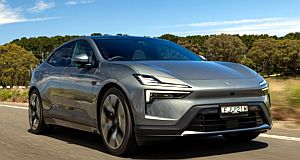
POLESTAR has been riding high on sales numbers in Australia, driven by an expanded retail presence in partnership with existing Volvo dealers and the arrival of new models, but the brand’s local leadership does not expect the “rampant” growth enjoyed in 2025 to be repeated this year.
In 2025, Polestar grew its Australian sales volume by 38.5 per cent, increasing sales from 1713 units at the end of 2024 to 2373 units at the end of 2025.
Much of this volume growth came from the Polestar 4 and Polestar 3 SUV pair that went on sale in late 2024, but with a gap now opening between the arrival of fresh metal (including the recently updated Polestar 2) and local launches for the Polestar 5 flagship and entry-level Polestar 7, a stabilisation is anticipated in 2026.
Polestar Australia managing director Scott Maynard said that although the company does expect to continue growing this year, “we don’t expect to show the kind of rampant growth that we saw when we introduced two new products (and) pulled on a whole network of retailers”.
“That really important work is done. We’ve still got a couple of retail sites to start up, so we’ll see a bit of incremental out of that, and we hope to bring news of a couple of little product enhancements and a few little bits and pieces that we can do to keep 2026 interesting.
“I’m still confident that we’re going to be in the right spot, but our expectations are a little bit more realistic for 2026.”
Mr Maynard said the arrival of the niche Polestar 5 will bolster sales to a degree when it arrives in the second half of this year, forecasting that it – and a considerable list of new models from other brands – will increase battery electric vehicle market share on the whole.
“With the number of new arrivals, the expanded choice of electric vehicles (and) the new segments that EVs are finding their way into, we should expect that the share of EVs in the Australian market will continue to grow,” he added.
“Yes, it is under threat from some of the reviews that are currently taking place in Canberra and in Treasury around the Fringe Benefits Tax that’s afforded to electric vehicles (and) we’re watching with interest to see what happens there.
“But I think that we can be confident that as it continues to become more popular among buyers, and as the choice continues to increase, it will continue to grow, and I’d love to see it logging on the high side of double-digit growth again in 2026.”
Mr Maynard said Polestar was unlikely to offer extensive discounting to inflate model sales, insisting that as a premium brand it was keen to maintain what he calls a “luxury, performance orientated” profile.
“(While) it is really great to see that there’s a broader choice and that there’s a lower entry point for electric vehicles … we operate in that premium space at the high end of the market. So, for us, it’s more about ensuring that we can demonstrate value,” he explained.
“We don’t feel compelled to descend into that volume segment that’s governed more sharply by price.
“We’d prefer to maintain realistic expectations of volume and continue to speak to a smaller audience with a product that’s more luxury, performance-oriented.”
Visit GoAuto again soon to read our Australian launch review of the 2026 Polestar 2 range.
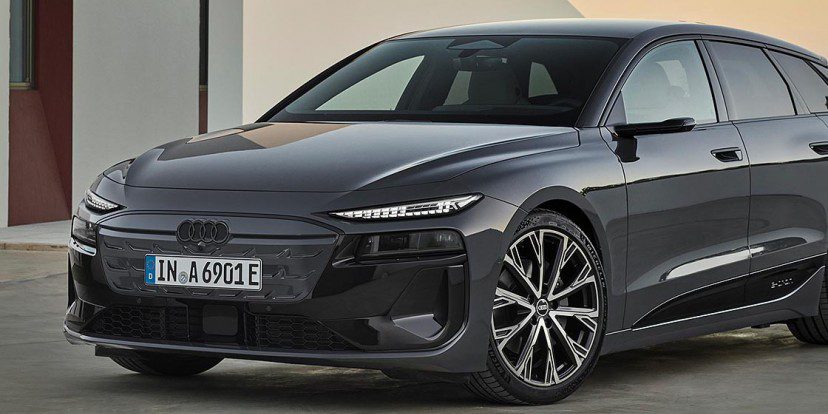
Taking a long trip in an electric car during the winter is a real test for both the vehicle and the driver. Freezing temperatures and high highway speeds are the biggest enemies of battery range. The latest study by the German automobile club ADAC put 14 popular EVs to the test to see how they would handle a 580-km journey in zero-degree weather. The results were a wake-up call for the industry. Out of the entire group, only the Audi A6 e-tron and the Smart #5 managed to finish the trip with just one 20-minute stop to charge.
The Audi A6 Avant e-tron was the clear winner of the group. It stayed remarkably efficient, using only 23.2 kWh of electricity for every 62 miles. Thanks to its advanced 800V system, it could add 186 miles of range in a single 20-minute charging session. This efficiency helped it to drive for nearly four hours at an average speed of 72 mph before needing a break. In contrast, the BMW i5 Touring struggled in the cold. It used more energy and only added 114 miles during its charge, forcing the driver to stop more often.
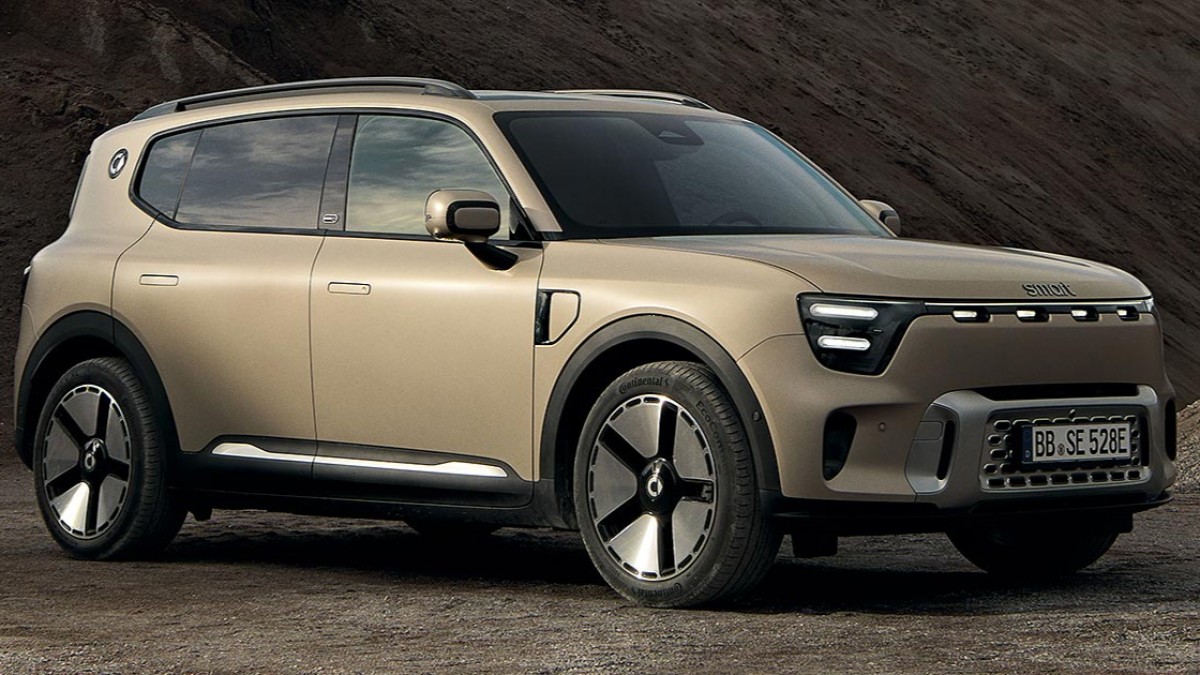
Smart #5
The Smart #5 also performed well, though it took a different path to success. This SUV is quite large, measuring about 15.4 ft long and 5.6 ft tall. Because of its boxy shape, it was not very efficient, consuming 28.9 kWh per 62 miles. But it made up for this by charging incredibly fast. In the test, it added 164 miles of range in just 20 minutes, proving that if a car can gulp down electricity fast enough, it can still be a great choice for long trips even if it uses a lot of energy.
On the other end of the scale, some famous brands fell short. The Volvo EX90 and the BYD Sealion 7 received the lowest ratings in the test. The Volvo EX90 is a large SUV with a massive 107 kWh battery, but its weight and poor aerodynamics made it “thirsty” for power. It consumed 31.6 kWh per 62 miles. The BYD Sealion 7 was the least efficient of all, using 35.3 kWh per 62 miles. These high numbers mean that a trip in a BYD would cost 60% more in electricity than a trip in a more efficient car.
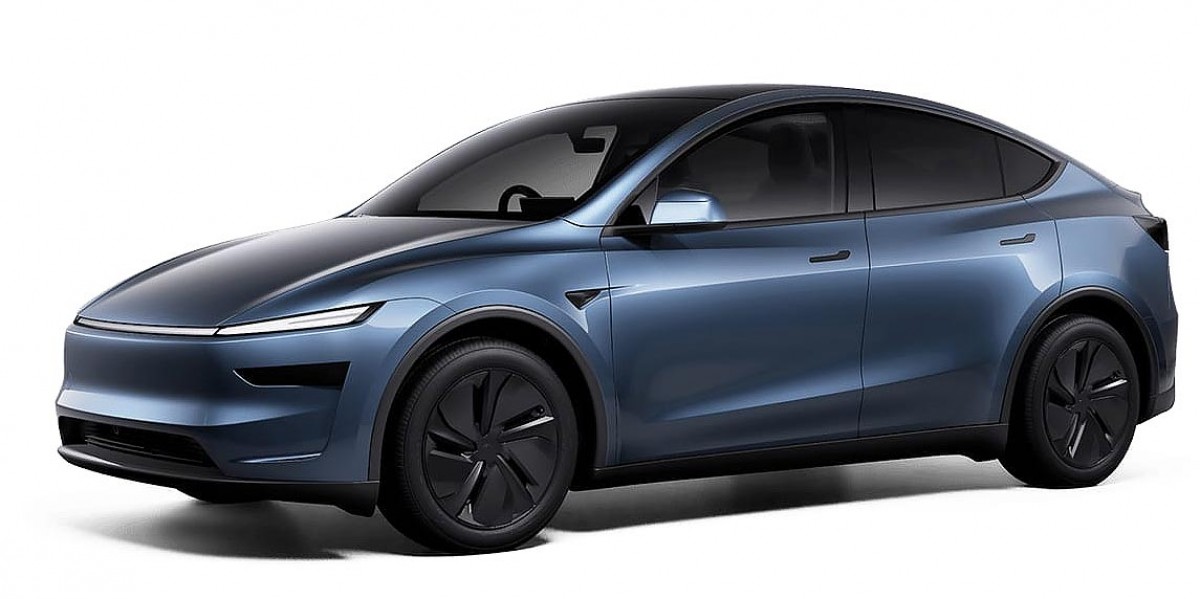
Tesla Model Y
The Tesla Model Y showed that a smart design can save a lot of money and time. Even with its all-wheel-drive system, it was the most efficient car in the test, using only 22.2 kWh per 62 miles. Its smooth, teardrop shape helps it slice through the cold air much better than the taller SUVs. While it did not charge as fast as the Audi, ADAC noted that if the charging stop had been just five minutes longer, the Tesla would have easily finished the trip with only one stop. At a price of $62,080, it is still a benchmark for value.
For families who want to save money, the Skoda Elroq was a pleasant surprise. It costs $51,400 in Germany, which is nearly half the price of the $94,500 Porsche Macan Electric. Despite the huge price difference, the Skoda performed almost as well as the Porsche on the highway. It used 25.5 kWh per 62 miles and offered a stable range of over 186 miles, showing that you do not always have to spend a fortune to get a capable family EV that can handle a winter vacation.
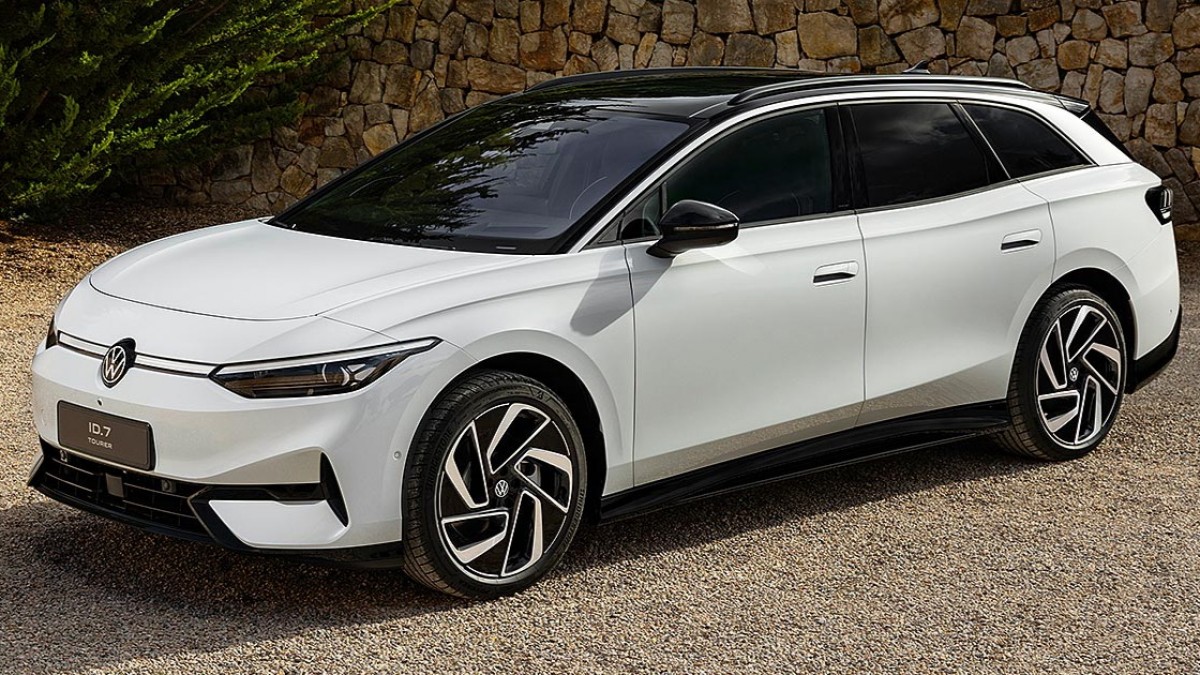
Volkswagen ID.7 Tourer
Other cars like the Volkswagen ID.7 Tourer also proved their worth. The ID.7 is a long station wagon that costs about $64,400. It was the only car in the test with a standard 400V system that could add more than 124 miles of range in 20 minutes. This is impressive because most 400V cars charge much slower than the 800V models from Audi or Hyundai. The ID.7’s sleek shape also helped it keep energy use low, matching the range of the much more expensive Volvo but using a smaller battery.
In the end, no car in the test was perfect, and none received a “very good” rating from ADAC. The winter cold simply takes too much of a toll on current battery technology. The test highlights a clear trend: cars that are lower to the ground and have fast-charging systems are much better for road trips. Whether you choose a high-end Audi A6 e-tron or a budget-friendly Skoda Elroq, knowing how much energy the car “drinks” in the cold is the key to a stress-free winter drive.
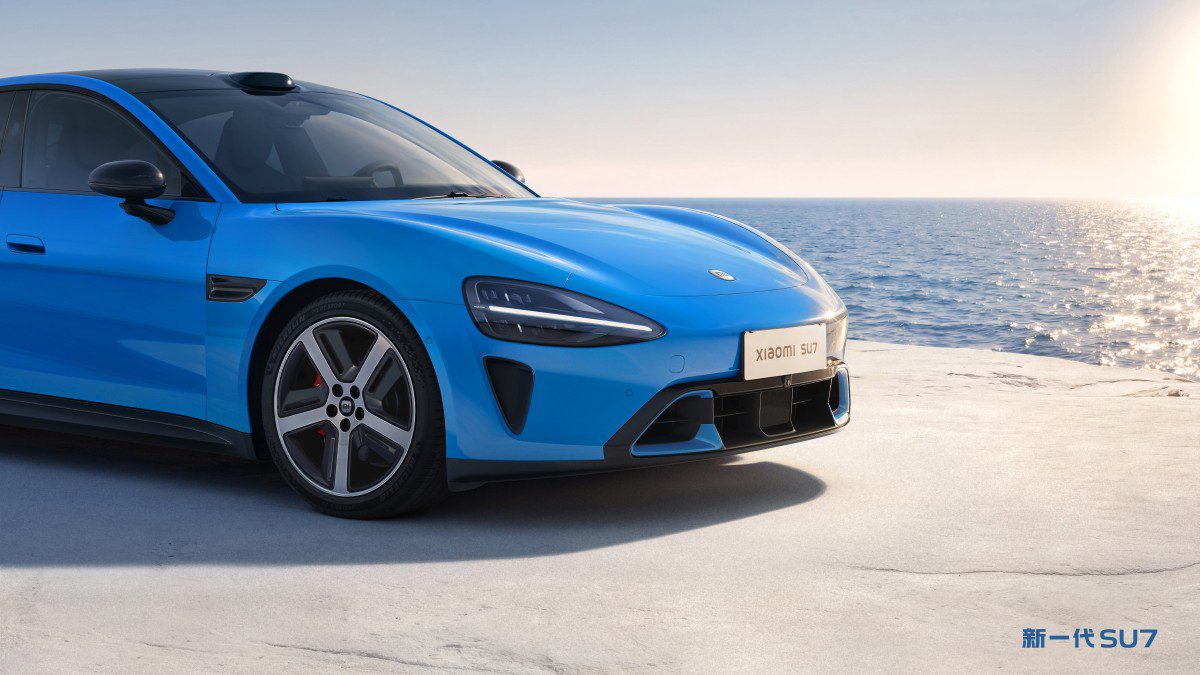
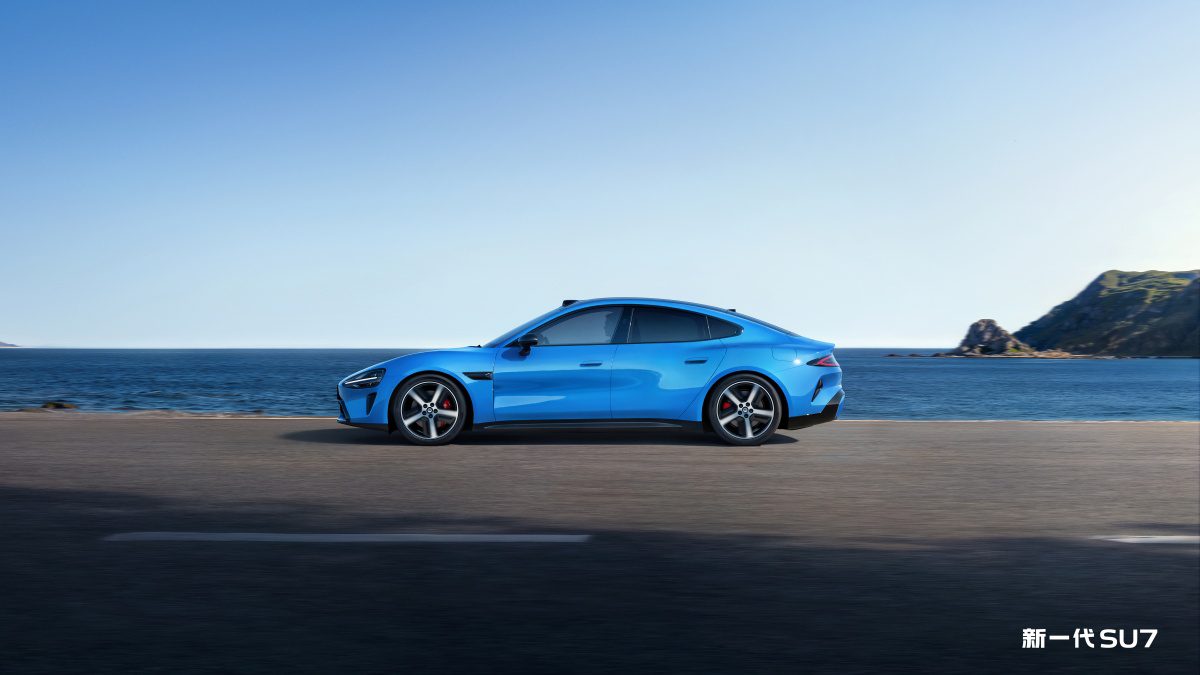
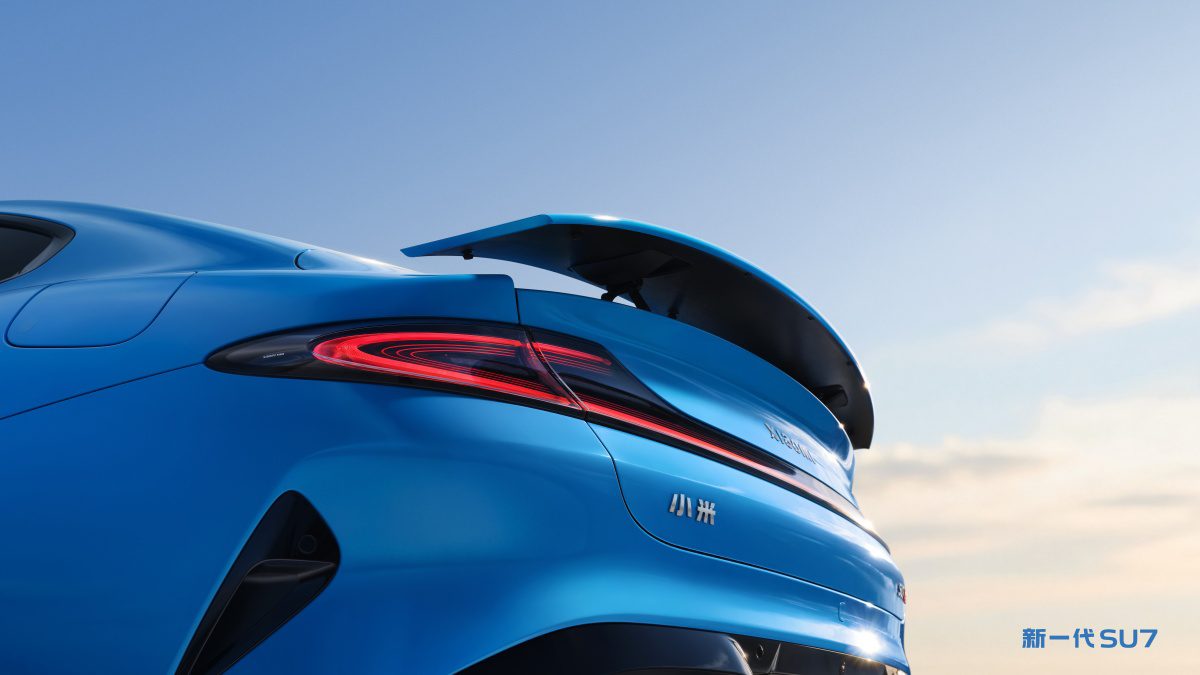
Xiaomi, one of the world’s leading smartphone companies and now also one of the hottest EV makers in China, has revealed that its upgraded SU7, the company’s first EV, has received more than 100,000 orders within 15 days of pre-sales starting.
With prices of the upgraded model starting at the equivalent of $A47,800, it is higher than the original model, which started deliveries less than two years ago.
According to reports from CNC, Xiaomi stores across China are seeing strong order volumes even though it’s a sedan in an SUV-dominated market.
Key improvements to the upcoming 2026 model include an upgraded battery and range, with the new battery delivering up to 902 km of CLTC range, which is expected to be over 750 km of WLTP range.
The upgraded battery uses CATL’s second-gen Qilin battery with a capacity for 101 kWh and can be charged from 10-80% in around 11 minutes and can add 670 km of CLTC range n just 15 minutes.
BYD is also supplying Lithium-Iron-Phosphate (LFP) battery packs for entry-level models, delivering good performance for everyday driving of the sports sedan.
On the Performance front, all models come with an upgraded V6s Plus motor which in the Max variant produces 508 kW.
When it comes to safety, Xiaomi has improved the chassis which now uses 2,200 MPa high-strength steel and has upped the number of airbags to nine.
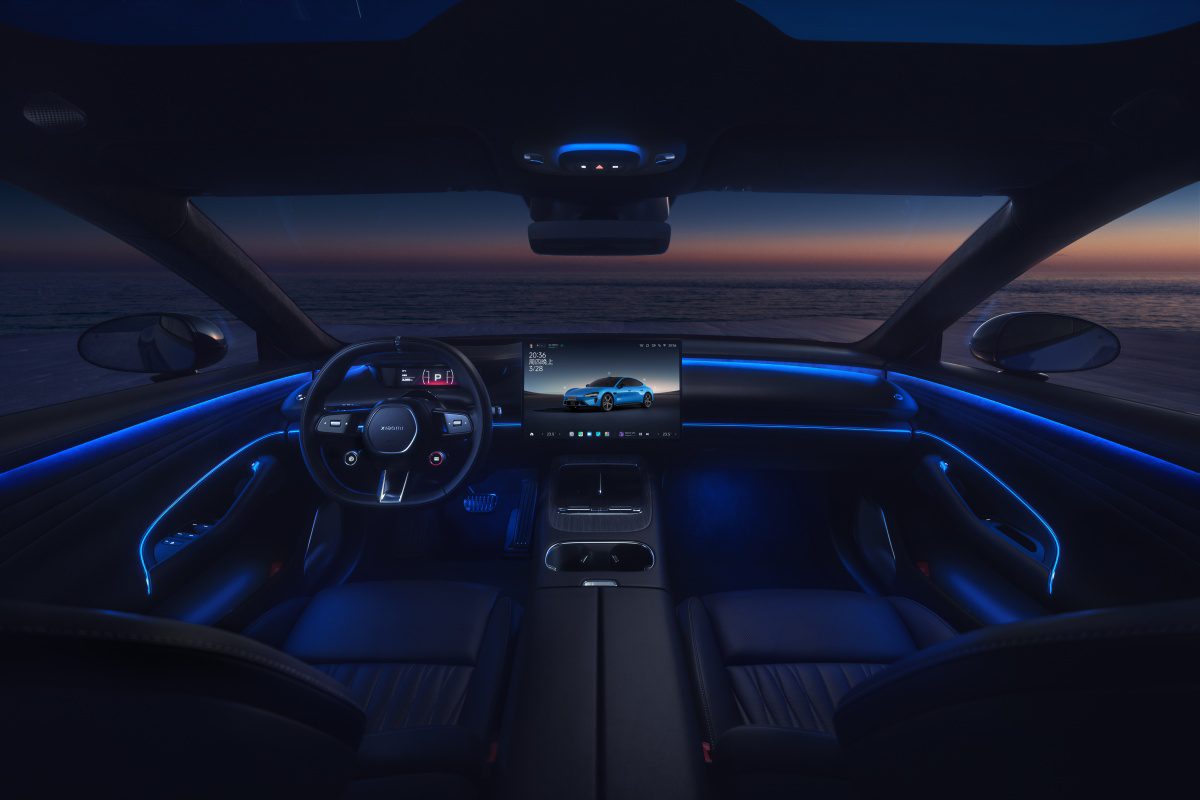
Autonomous driving tech has also been upgraded, with all models now coming with LiDAR units and a high-end computing chip with 700 TOPS (Trillion Operations Per Second).
On styling, there is a new blue colour and updates to the styling of the wheels. Inside, there is a black theme available with more comfort-focused seats.
Image: Xiaomi via Weibo
Xiaomi started deliveries of its four-door electric sedan, the SU7 in April 2024, shortly after the vehicle was unveiled.
Having seen Xiaomi’s cars up and close on recent trips to China, it’s clear that the brand has much bigger ambitions than just being one of the top 3 phone manufacturers in the world.
In November 2024, the 100,000 delivery milestone was reached, which was its original target for the entire year. It finished the year with sales of 143,000 and a 2025 target of more than 300,000.
Then in 2025, it hit 411,800 sales thanks to both the SU7 Sedan and the YU7 SUV, which has seen the brand’s popularity surge.
Image: Xiaomi via Weibo
Previously, the brand has hinted as 2027 the year for global expansion but it could even be sooner in some Western markets.
With the new SU7 already seeing stronger-than-expected order numbers, it’s clear that the product is exceeding the expectations of hundreds of thousands of customers in China, ahead of global expansion over the next 12 months or so.
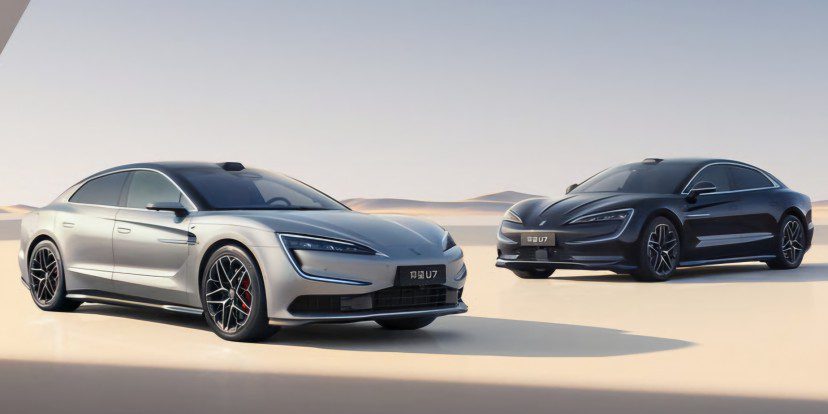
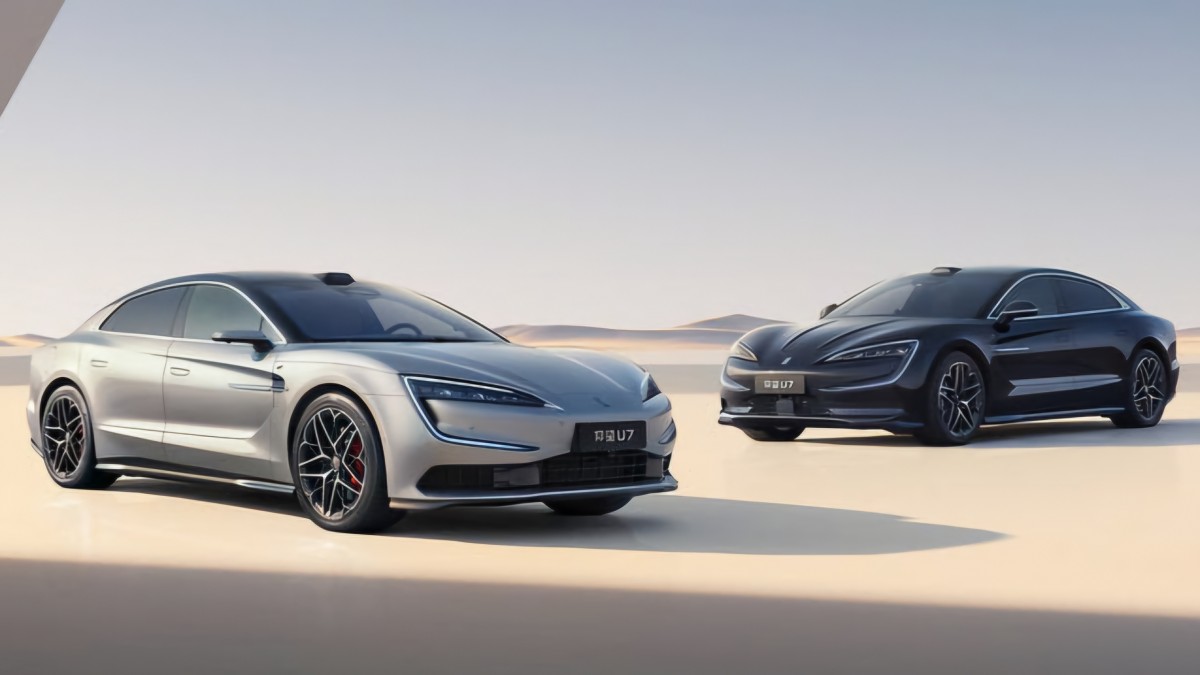
BYD is planning to refresh its luxury Yangwang U7 sedan, which comes in fully-electric and PHEV variants. Regulatory filings reveal the updated BEV version sports a massive 150 kWh LFP battery and 17.7 kWh per 62 miles consumption.
The Yangwang U7 EV model year 2026 will be offered in two powertrain versions – 1,287 hp and 1,341 hp, both of which will adopt the 150-kWh LFP battery. That’s a significant upgrade over the previous 135 kWh battery.
According to CLTC, the top-tier variant’s range on a single charge is 534 miles, while the regular 1,287-hp iteration can run 625 miles before requiring a recharge. The documents also reveal an impressive 17.7 kWh per 100 km consumption, a 10% improvement over the previous Yangwang U7 generation with the 135 kWh pack. What makes it even more impressive is the fact that the newer version is 220 lb heavier.
The car is expected to hit the market very soon, likely in the next few months.
BYD has announced that the company plans to ramp up its international expansion efforts in 2026 with a sales target of 1.3 million cars.
Reports from the company’s leadership team were shared by cnevpost ,where BYD’s GM of branding and PR shared that the company would see a growth of 24% in international sales this year, over its 2025 sales of 1.046 million in markets outside of China.
This was a growth of over 150% in sales in 2024, where the company exported 417,000 cars across the globe.
Australia made up over 50,000 of those sales in 2025, making it one of the major single markets for the brand in its international efforts.
In 2025, BYD also overtook Tesla for global EV sales and is expected to continue that trends in the years to come, with Tesla shifting its focus to autonomous vehicles and its FSD software rollout.
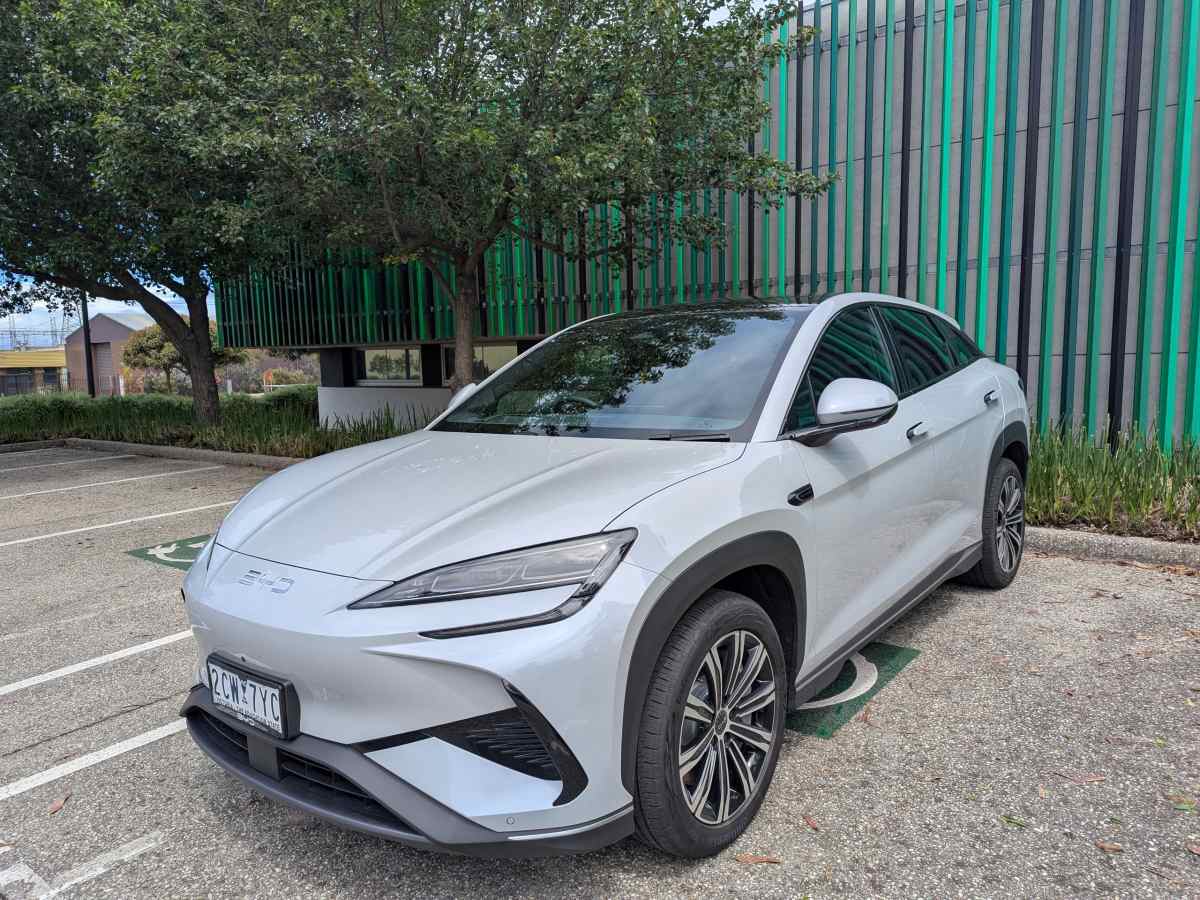
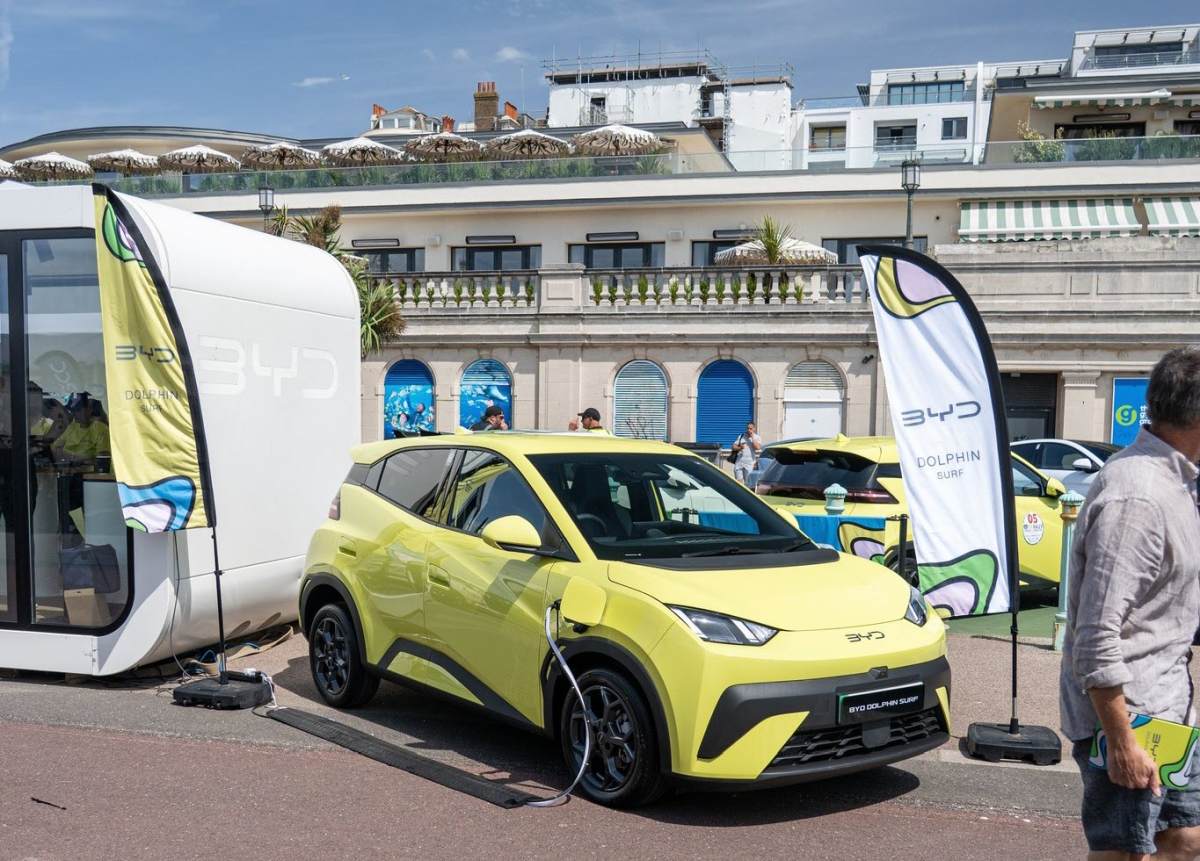
BYD has grown rapidly in our market with the original Atto 3 electric SUV being launched in 2022. At that time, it was the most affordable ground-up electric SUV and over $20,000 cheaper than the locally delivered Model Y SUV.
Image: BYD UK
Post the Atto 3, the company launched one of Australia’s cheapest electric cars, the BYD Dolphin hatchback, followed by the Seal electric sedan’s launch to close 2023 off.
By the middle of 2024, BYD unveiled its first PHEV model to the Australian market in the form of the Sealion 6, followed by the Shark 6 PHEV ute in the second half of the year.
Both models racked up thousands of pre-orders and sales, helping the brand enter into early mainstream, particularly with the ute offering.
In 2025, BYD offered what was at that time Australia’s lowest-cost EV, starting at $29,990 with its BYD Dolphin hatchback and the Essentials variant.
It also launched the Sealion 7 SUV, which has already climbed the sales charts into the top 2 best-selling EVs in the country in 2025, overtaking the Tesla Model 3 sedan, which has been in the top two electric vehicle sales for years.
In November, BYD dropped another bombshell, launching Australia’s cheapest EV, the Atto 1, as well as the country’s most affordable SUV, the Atto 2. Both these models are entering mass deliveries, with December seeing over 500 Atto 2 sales.
December also saw the company produce its 15 millionth car, 31 years after the inception of this battery cell-making company.
With global markets the key target for years to come as the brand looks to overtake Toyota in the next decade, it’d need to further expand in existing and new international markets.
1.3 million could be the lowest annual international sales target it sets, with millions to be added in years to come if it’s to achieve that feat.
Riz is the founder of carloop based in Melbourne, specialising in Australian EV data, insight reports and trends. He is a mechanical engineer who spent the first 7 years of his career building transport infrastructure before starting carloop. He has a passion for cars, particularly EVs and wants to help reduce transport emissions in Australia. He currently drives a red Tesla Model 3.
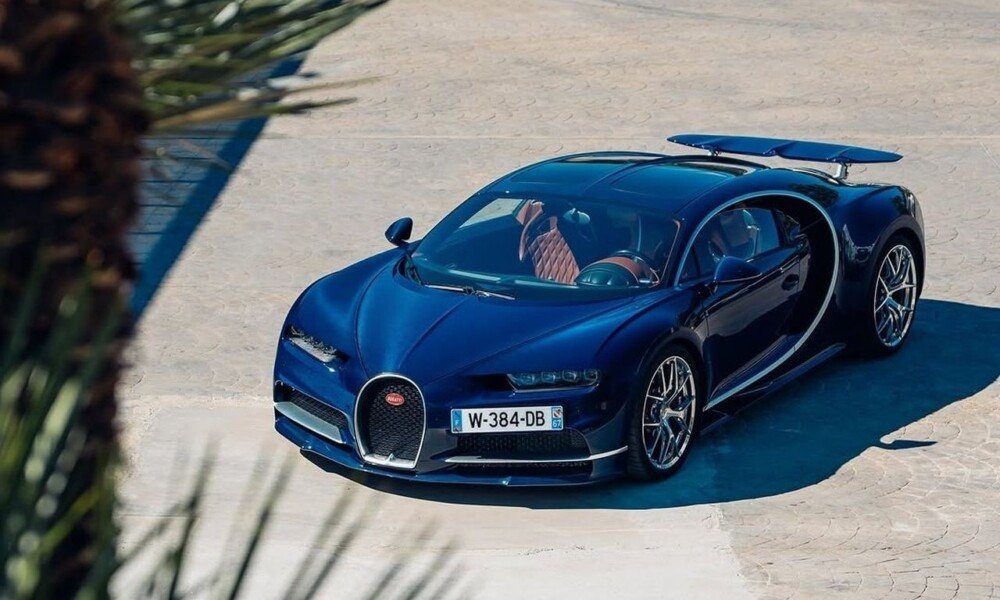
A Bugatti is not a car you drive to work in daily or run errands in. Hypercars like the Chiron are purchased as an investment and spend most of their time tucked away in a garage. However, there are a few exceptions.
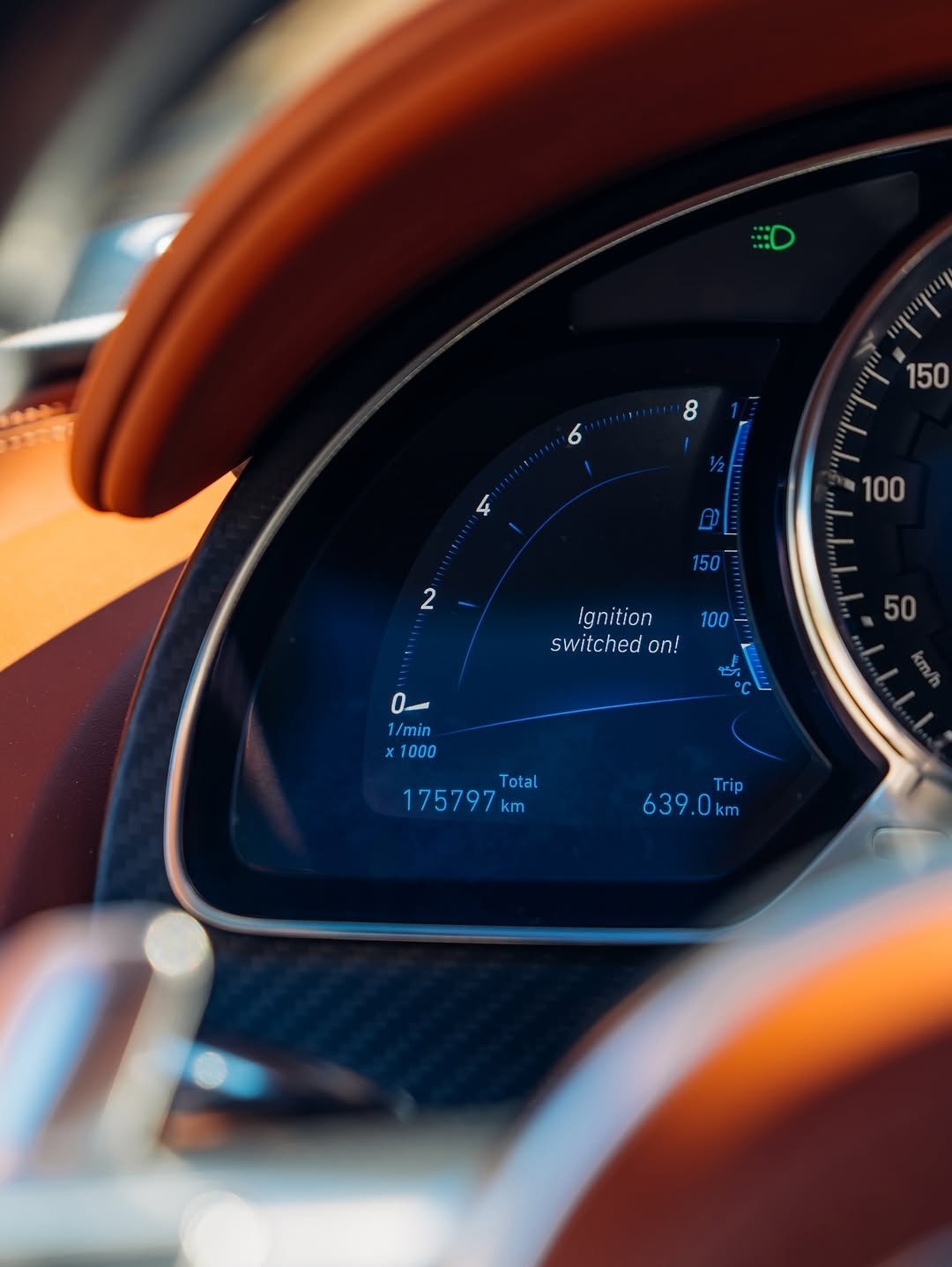
This Bugatti Chiron has more miles on it than a shopping trolley. With an odometer that reads 175,797 kilometers, or 109,235 miles, this could be the highest-mileage Bugatti on the planet.
Who in their right mind would rack up over 100k miles in their Bugatti, you might ask? Well, the answer to it is quite simple and not that surprising.
It is a development car owned by Bugatti. This is the car used by the company to test and validate everything from mechanical components to electronics and other minor bits and bobs.
It’s also a testament to how reliable the Chiron can be if it is maintained properly. Just look at it. The Chiron prototype looks as good as any customer car.
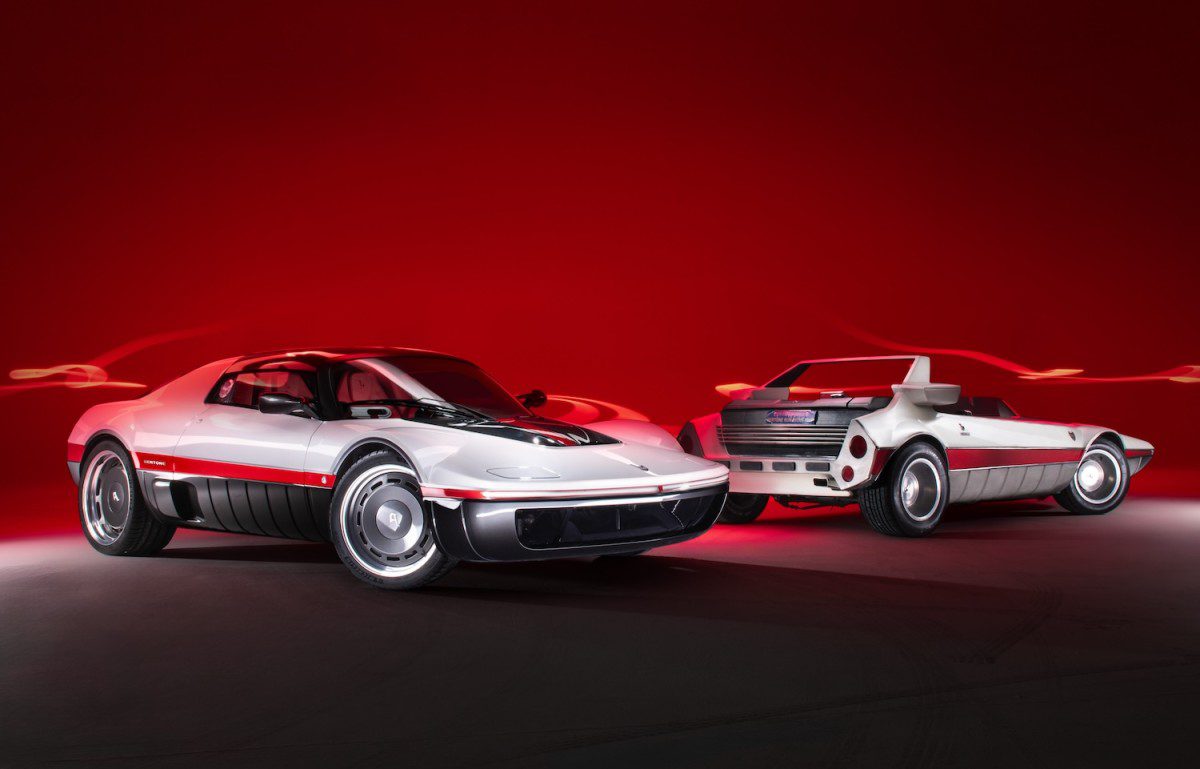
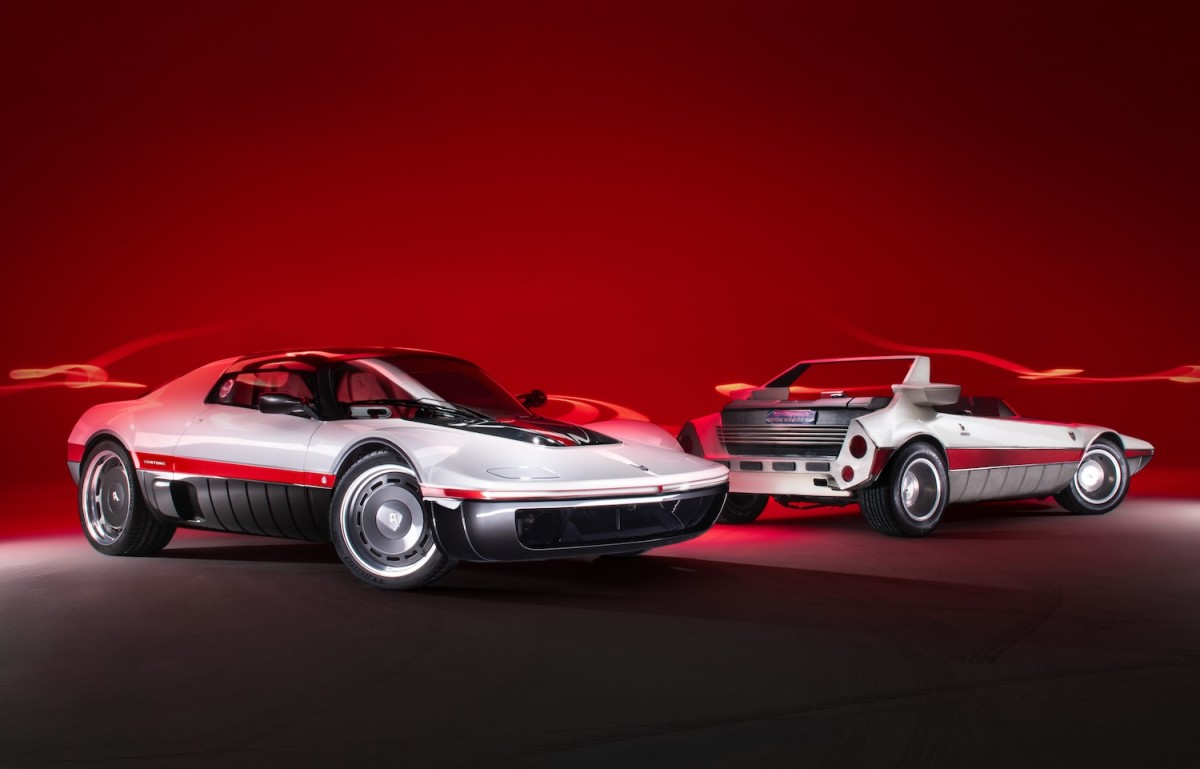
The Runabout might not be the first Bertone name that comes to mind, but it played a bigger role than most people think. When it debuted in 1969, the original concept showed just how far Bertone was willing to push boundaries. This was the same era that produced the Countach and Stratos, the wedge-shaped legends that put Bertone on the map.
Previewed in December, Bertone is bringing back the Runabout – not as a concept car but as a limited-run production supercar. The new Runabout leads off Bertone’s Classic Line, setting the direction for what comes next. With its debut set for Retromobile 2026 in Paris, Bertone is making it clear they’re back in the game as a true low-volume manufacturer.
Bertone
Nautical Inspiration
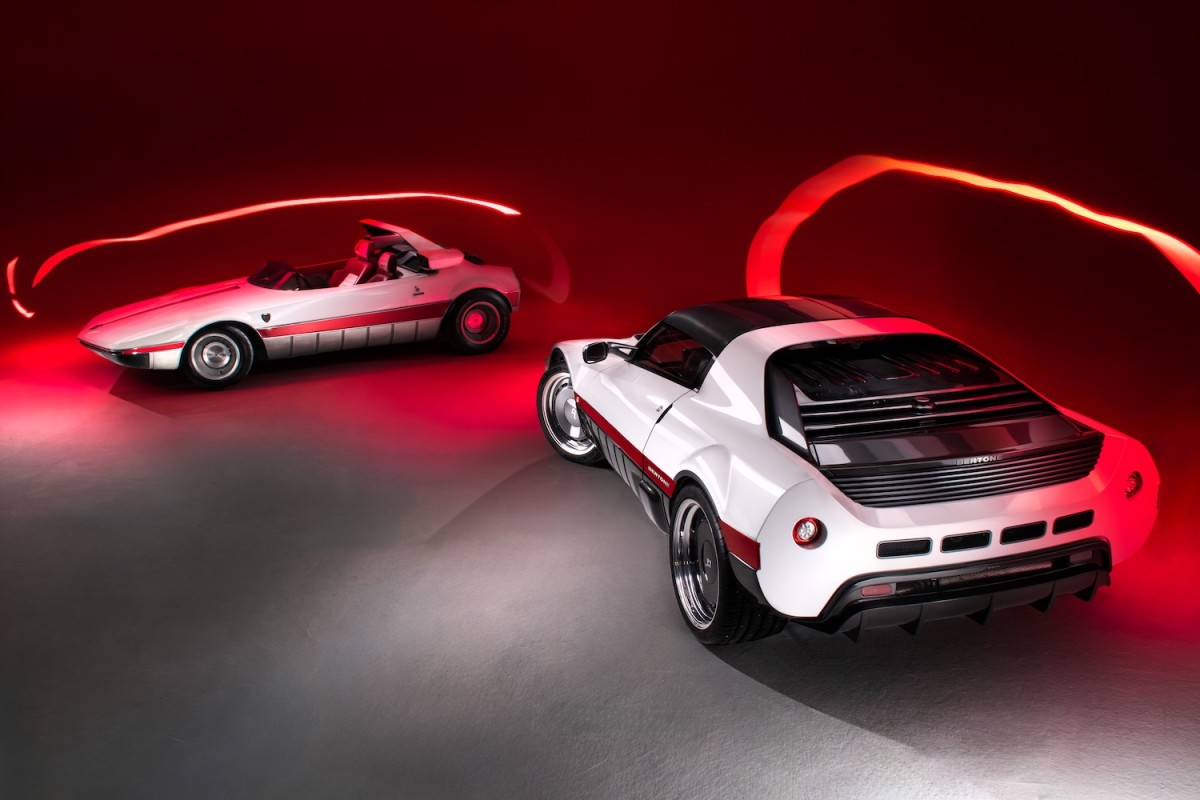
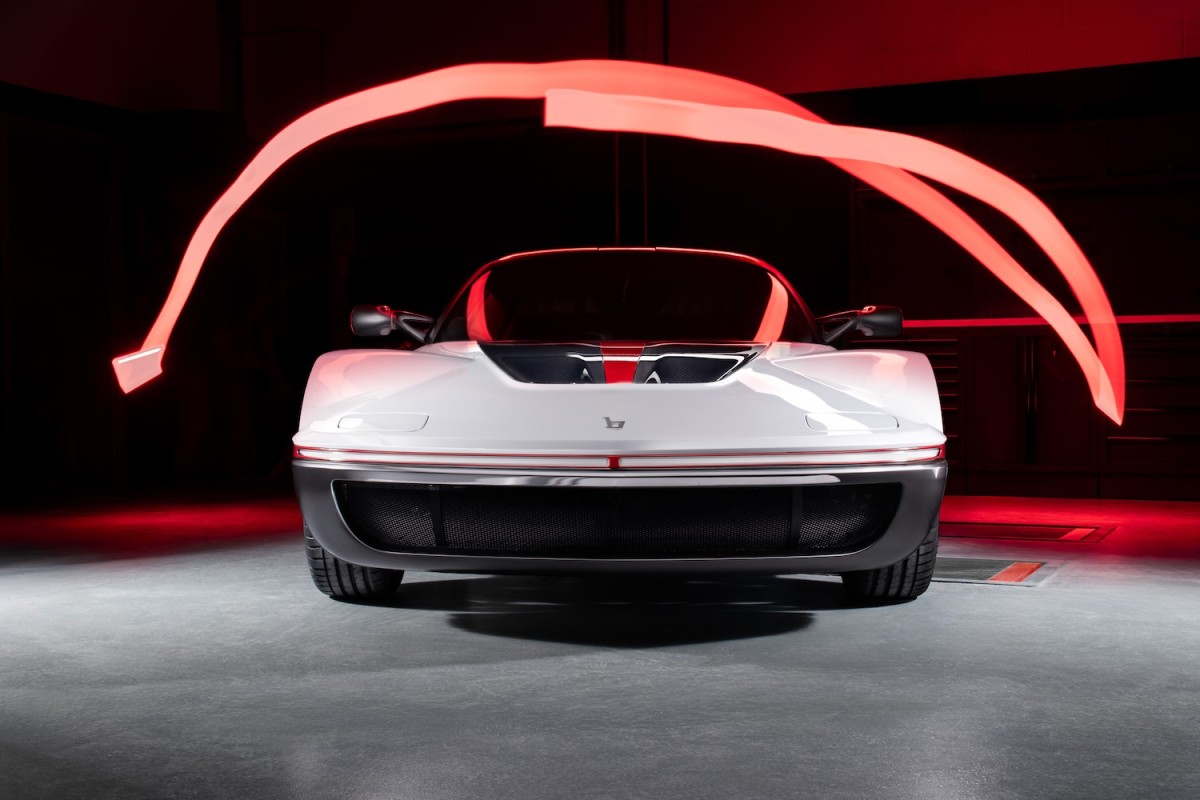
The Runabout’s shape is all about two things: a forward-leaning wedge and a chopped-off tail. No matter where you look, it sits low and compact, with proportions that feel more like a classic concept than a modern supercar trying too hard to stand out.
Pop-up headlights are reimagined here, sitting flush in the clean bodywork. The forged aluminum wheels nod to the original Runabout, but avoid going full retro. Out back, the short tail tucks the exhausts into a neat, geometric setup that keeps everything purposeful.
Step inside, and the cabin wraps you in a hull-like tub, putting you low and close to the car’s structure, which took inspiration from nautical design. There’s just a single digital tachometer instead of a full cluster, and the gated manual shifter plus exposed mechanicals keep things refreshingly analog. Materials like carbon fiber, machined aluminum, and hand-finished leather are used where they matter, focusing on feel and texture.
Bertone
Only 25 Units to be Made
Underneath, the Runabout packs a mid-mounted, supercharged 3.5-liter V6 with 475 horsepower and 361 lb-ft of torque, all going through a six-speed manual. According to Bertone, the focus is on smooth, progressive torque and real driver involvement, not just big numbers. Then again, it’s actually supercar quick: 0 to 62 mph in 4.1 seconds and a top speed of 168 mph.
Moreover, sits on a lightweight bonded aluminum chassis with plenty of carbon fiber, keeping the weight down to about 2,330 pounds. Double wishbone suspension and adjustable dampers all around show this car is built to be driven hard if the wealthy owner chooses to.
That said, only 25 Runabout supercars will ever be built, each on a fresh chassis and finished to order. Prices start at €390,000 before taxes, or about $463,000 at today’s exchange rates. The car will debut next to the original 1969 concept this week, bringing Bertone’s story full circle and showing where the brand wants to go next.
Bertone
View the 9 images of this gallery on the
original article