Author: admin

  • The Pathfinder Helped Invent the Modern SUV

    The Pathfinder Helped Invent the Modern SUV

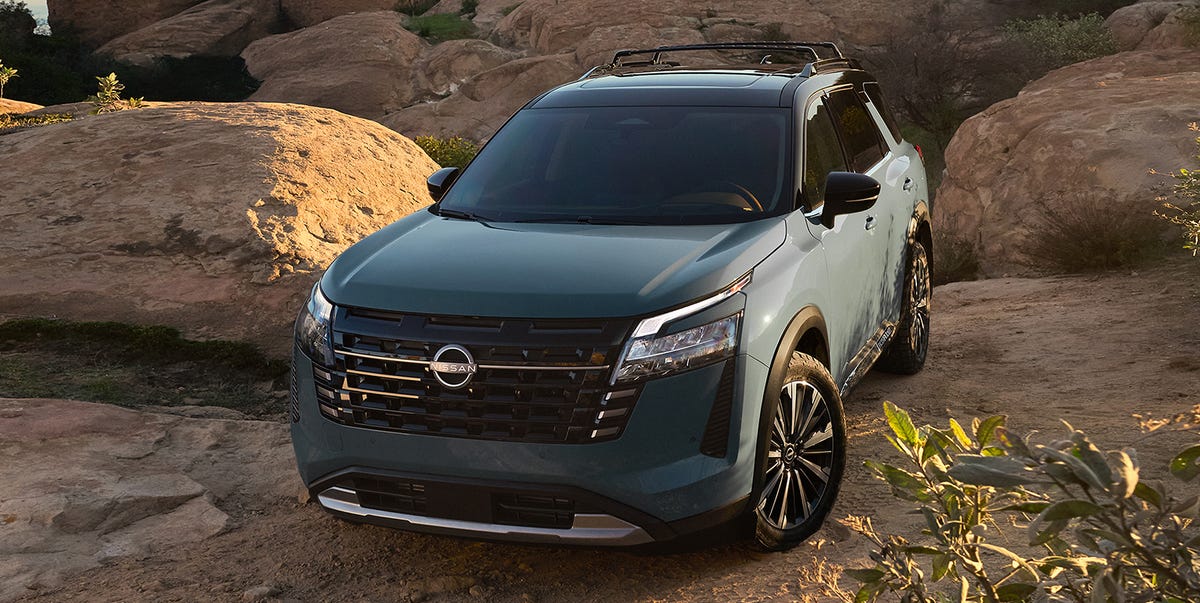
    Nissan is undergoing a product renaissance, with a plan to introduce all-new or significantly refreshed versions of the majority of its models—as well as potential new vehicles—through 2026. This includes a recently unveiled redesign of its venerable and groundbreaking Pathfinder SUV, which can host up to eight passengers in its roomy three-row interior.

    Image no longer available

    Nissan Pathfinder

    Nissan comes by its inventiveness naturally, as one of the oldest carmakers in Japan. Though the company was officially established in 1933, it can trace its roots back to 1911 with the founding of the Kwaishinsha Motor Car Works in Tokyo, and the release of its first models, the DAT—an acronym of the initials of its original investors—and the subsequent smaller Datson (later Datsun). Since its founding, and particularly since it entered the American market in the late 1950s, the brand has been a pioneer in creating vehicles that are affordable, reliable, efficient, design-forward, fun to drive, and innovative, with an emphasis on creating new market segments.

    This can be seen readily in its introduction of vehicles like the Datsun Pickup, the first compact truck, in 1958. With its highly competitive and resolutely affordable entries into the sport sedan and sports car market with the 510 in 1968 and the 240Z in 1970, respectively. And with its continued championing of new categories like the four-door sports car (1981 Maxima), rally-inspired pickup (1982 Hardbody), four-door compact truck (1999 Frontier), and battery-electric vehicle (2010 Leaf). We would be remiss if we didn’t mention the broad diversity of its offerings, from its fuel-sipping Sentra economy car to its world-challenging GT-R supercar.

    But when it was introduced in 1987, the Pathfinder was one of Nissan’s biggest game changers. Brought to market well in advance of the SUV craze that swept the country (and then the world) in the 1990s, it was based on the tough and capable Hardbody pickup, adding an enclosed bed, rear seats, and, a few years later, a pair of well-hidden rear doors. It combined chiseled good looks with acute capability, an adaptable and increasingly luxurious interior, and Nissan reliability. This standard of build quality made adventure feel achievable and was a big hit with consumers. More than that, it established the Pathfinder as a vehicle for people who wanted the freedom to go beyond the familiar, without giving up comfort or reliability.

    It was also a prescient entry into an emerging market of active-lifestyle car buyers, who wanted their vehicles to be able to do everything: haul them and their gear, function well in all weather and roadway conditions (or even if there was no road at all), look cool and ready for anything, and provide increasing levels of creature comforts.

    Refined and Refocused

    Nissan’s latest product push emphasizes its core strengths, bringing fresh creative vision, flexibility, joy behind the wheel, and the implementation of new technologies to vehicles that are attainable by a broad swath of the market. All of this can be seen in the newly updated Pathfinder.

    Revealed at the end of 2025 as a 2026 model, the Pathfinder no longer has a continuously variable transmission (CVT). All Pathfinders now come standard with an adaptive and advanced nine-speed automatic gearbox. This change comes with noticeable improvements to fuel efficiency, acceleration, towing capability, driving feel, interior noise levels, and overall adaptability.

    Coupled to the nine-speed automatic, the Pathfinder’s powertrain also includes Nissan’s durable 24-valve direct-injected double-overhead-cam 3.5-liter V-6 that’s engineered to power your adventure, reflecting Nissan’s emphasis on reliability and long-term quality. This naturally aspirated engine produces 284 horsepower and 259 pound-feet of torque in standard trim, enough to hustle the all-wheel-drive Pathfinder from 0 to 60 mph in 6.6 seconds. And it accomplishes all of this while still delivering a combined EPA rating of 22 mpg (20 mpg city/25 mpg highway) besting much of the competition, and providing a freeway range, in our testing, of up to 510 miles between fill-ups.

    Moreover, when paired with available all-wheel drive, the nine-speed transmission hosts seven different drive modes, including ones specifically focused on loose, slippery, rutted, or off-road surfaces, or for more spirited sporty driving. So, you can get out and return safely from wherever you need, or want, to go. That capability turns uncertain roads and unfamiliar terrain into opportunities rather than obstacles.

    The significantly refreshed mid-size SUV also incorporates new front and rear-end treatments, new electronic comfort and convenience features, and upgraded safety technologies. And it has been enhanced with more adventurous capabilities, making it a standout choice in the highly competitive three-row-SUV market.

    Integrating all these options into one vehicle gives you the capacity to graciously move between all the destinations that define your daily activities: driving to work, running errands, taking trips, and shuttling yourself or other members of your household to appointments and activities. But they also allow the new Pathfinder to seamlessly change up its personality and take you on out-of-the way adventures, away from the everyday. This flexibility, and the expertise that undergirds it, is what gives the Pathfinder its name.

    Awareness, Built In

    Inside, the new Pathfinder upgrades its central touchscreen, which is now 12.3 inches wide and is powered by the latest iteration of NissanConnect software. This provides a larger and clearer display, as well as more ready access to all the features it controls. An available high-definition Intelligent Around View Monitor uses a suite of exterior cameras to create a 360-degree image of everything surrounding the vehicle, so you can clearly see whatever might be beside, in front of, and behind you when backing out of a driveway or getting into a tight parking spot. Moving Object Detection alerts you visually and audibly to animals, bikers, or pedestrians that may be in your path. And the system provides animated path lines that adjust with your steering inputs, so you can see exactly where your vehicle is going and whether it will fit.

    But among its new technology upgrades, Nissan recognizes that analog switchgears remain superior when it comes to accessing commonly used systems, including knobs for adjusting the infotainment system’s volume and the climate control’s temperature settings. An optional head-up display can project key information like vehicle speed or navigation instructions onto the windshield in front of the driver. Because of these features, you never have to take your eyes off the road and the path to your destination.

    Wireless Apple CarPlay and Android Audio are standard, so you can easily cast your familiar phone interface onto the central touchscreen. And to keep your devices ready to use, the optional wireless smartphone charging pad in the center console is now more potent than on outgoing models, juicing up your battery more quickly.

    A second 12.3-inch screen in front of the driver houses an elegant and straightforward digital gauge cluster. This, in combination with another set of analog buttons on the steering wheel, allows drivers access to Nissan’s optional ProPilot Assist semi-autonomous driving technology. This sophisticated and extremely capable system, now in its 10th year, allows the Pathfinder to start, stop, steer, and follow the traffic ahead at a set speed and from a set distance all on its own. It can even, in some circumstances, change lanes—overtaking, and returning after passing another car on the highway. This reduces driver fatigue, physically and cognitively, while driving, and increases safety.

    And even if you pass on ProPilot Assist, potentially life-saving features including automated emergency braking, lane-departure warning, and blind-spot monitoring are standard on all models.

    From Errands to Everywhere Else

    Duality is where the Pathfinder shines. It has always given families the confidence to move seamlessly from everyday obligations to the experiences they’ve always imagined sharing together. Back when it was first introduced in 1987, the Pathfinder built its reputation on its combination of all-terrain adeptness and inviting ease of use. Based on Nissan’s go-anywhere Hardbody pickup truck, but laden with additional creature comforts, it was equally at home carrying passengers and their backpacks to the school drop-off line or to a remote campsite. It wasn’t just about going farther but about making those farther places feel possible, practical, and worth pursuing.

    The new Pathfinder has enhanced both aspects of its versatile personality. Premium versions of the Pathfinder include luxurious niceties like a panoramic sunroof, heated and cooled front seats, heated individual second row captain’s chairs, semi-aniline leather surfaces, and a booming 13-speaker Bose entertainment system. So you’ll always ride, and arrive, in the utmost comfort.

    For those who crave added security and capability, the Pathfinder now offers the tough Rock Creek variant. With a bump in power for the V-6 to 295 horsepower and 270 pound-feet of torque, this specially equipped model comes with a standard hitch and increases towing capacity from 3500 to 6000 pounds, so you can bring your trailer or powersports machines along on all your adventures. In addition, an off-road suspension and all-terrain tires help provide enhanced ground clearance, and a standard tubular roof rack allows you to cart even more equipment to wherever you need it.

    And while the new Pathfinder is a lovely and commanding vehicle to drive in any circumstance, it is especially well constructed to thrive in the crucible of family life. That thoughtful design inspires confidence not only in how the Pathfinder performs, but in how far it can expand a family’s sense of what’s possible because true adventure begins with trust in the quality of what’s carrying you there.

    Whether you outfit yours with a second-row bench to provide an eighth seat for carpool duties, or a pair of separate captain’s chairs to quell your passengers’ arguments over personal space, the rich materials and generous interior accommodations will keep all your occupants happy. Heated seating surfaces for the second-row captain’s chairs are an option. But multiple USB-C ports and rear climate vents are standard, regardless.

    Second-row seats flip and slide easily via a manual or an available electric mechanism, so that additional passengers can readily access the third row. And both rear rows split and fold so you can carry a combination of people and/or cargo simultaneously, even accommodating long objects like skis or surfboards along one interior vertical axis while carrying passengers on the other. By making room for both people and passions, the Pathfinder helps transform once-complicated ideas into experiences that feel not only achievable, but effortless.

    Other storage areas are found throughout the cabin. A big cubby under the front center console can be readily accessed by the driver or front-seat passenger and is handy for totes and shopping bags. Bins below the windows and pockets on the seatbacks can carry books, gaming systems, and other devices. And though there are already 10 cupholders in the cabin, many big enough for large coffees or water bottles, an available center console between the individual second-row seats can provide storage for more beverages (and gear) or can be readily removed to make a clear path between rows.

    Room to Go Further

    All of this combines to make the Pathfinder a great choice for today’s busy, always-on-the-go drivers. With the designed-in ability to comfortably and safely take you and your passengers anywhere—work appointments, sporting events, concerts and recitals, home improvement stores, vacations—it makes your life easier. It also makes your time on the road confidence-inspiring and relaxing.

    And with a starting price of $39,000,¹ the Pathfinder helps make high-featured seating for up to eight people affordable, continuing Nissan’s nearly century-long mission of enhancing access to well-designed, well-engineered vehicles.


    ¹ Price shown is Manufacturer’s Suggested Retail Price (MSRP) for base model trim. MSRP excludes tax, title, license, options, and $1,495 destination and handling charges. Dealer sets actual price. Some color, package, and option selections may include, exclude, or require the purchase of additional options and packages. Some options shown may not be available on all trims. See retailer for details.


    Source link

  • Traveling With Pets – Kelley Blue Book

    Traveling With Pets – Kelley Blue Book

    Planning a trip with your pet can feel overwhelming, but it doesn’t have to be. This page gives you a simple, travel‑ready guide to help you prepare with confidence. You’ll find a quick checklist, practical tips, and a few smart reminders to make the journey safer, smoother, and more enjoyable for both you and your furry companion. Whether you’re hitting the road or taking to the skies, consider this your go‑to starting point for stress‑free pet travel.

    Quick Pet Travel Checklist

    Make your next trip smoother and safer for your furry friend with this simple pre‑travel checklist.


    Before You Book

    • ✅ Confirm pet‑friendly hotels or rentals
    • ✅ Check airline/train/bus pet policies
    • ✅ Schedule a vet visit and vaccinations
    • ✅ Ensure microchip and ID tags are up to date

    Pack and Prep

    • ✅ Food, water, and collapsible bowls
    • ✅ Leash, harness, and waste bags
    • ✅ Favorite blanket or toy for comfort
    • ✅ Medications and vet records (printed or digital)

    On the Road

    • ✅ Use a secure carrier or seat‑belt harness
    • ✅ Plan regular water and potty breaks
    • ✅ Never leave pets alone in a hot car
    • ✅ Maintain a small cleanup kit (wipes, bags, towel)

    A little planning goes a long way—so you and your pet can enjoy the journey, not just the destination.

    Your Airline Pet Travel Guide

    Every airport has its own rules for traveling with pets, and these can vary by location, airline, and whether your trip is domestic or international. Use this section as a starting point, then always double-check the latest information with your airline and the airport you’re flying through.

    Dog in carDog in car

    Pet Travel Rules & Airport Guidelines

    General Airport Rules

    • Pets often must remain in carriers inside the terminal.
    • Some airports require proof of vaccinations or health certificates.
    • Service animals usually follow different rules than pets.
    • Security screening may require pets to be carried or walked through scanners.

    International & Special Rules

    • International flights may require health certificates and microchips.
    • Some countries enforce quarantine or strict entry rules for pets.
    • Breed or size restrictions can apply on certain routes.
    • Always review both departure and arrival airport guidelines in advance.

    Pet Relief Areas

    • Most major airports now offer designated pet relief areas.
    • Some have indoor relief stations past security.
    • Locations are usually listed on the airport’s website or terminal map.
    • Allow extra time to find and use these areas between flights.

    Your Pet Travel Takeaway

    Pet travel requirements vary by destination and mode of transportation, but understanding the basics helps you make informed decisions. Reviewing the guidelines for driving, airports, and airlines ensures you’re ready for a smooth, well‑planned trip with your pet. With the right preparation, you can reduce stress, avoid last‑minute surprises, and create a safer, more comfortable experience for your furry companion. Whether you’re heading out on a quick road trip or preparing for a long flight, a little planning goes a long way toward making every journey enjoyable for both of you.

    Source link

  • This Should Have Been a Bigger Deal

    This Should Have Been a Bigger Deal

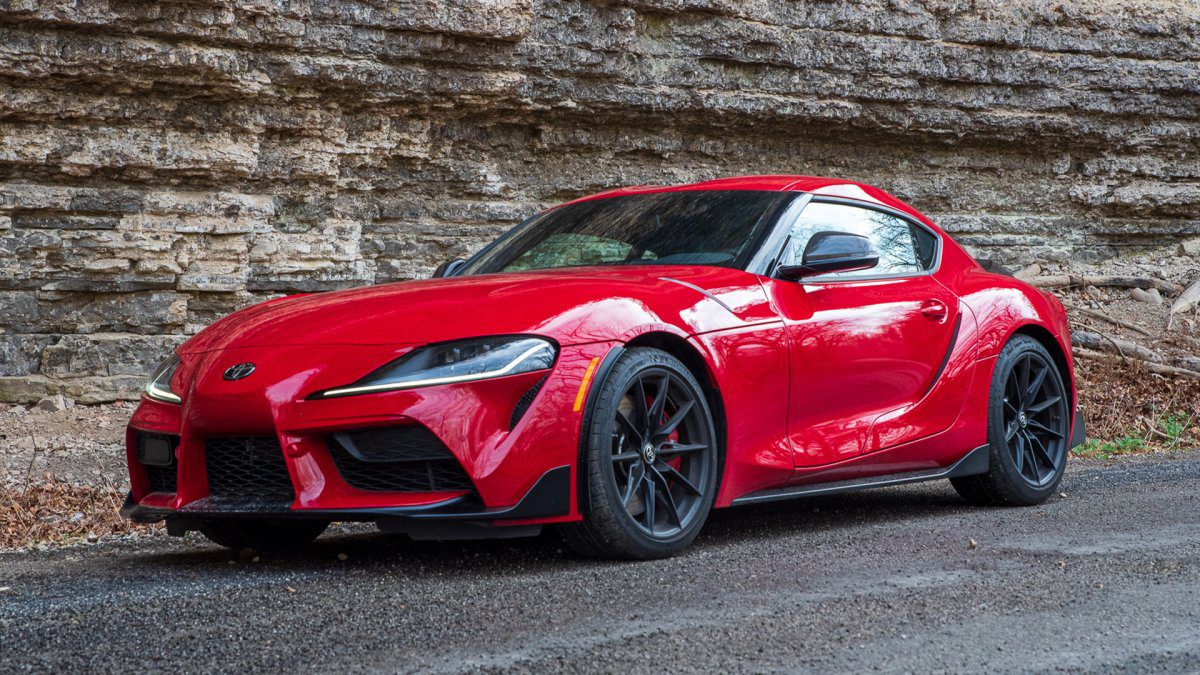
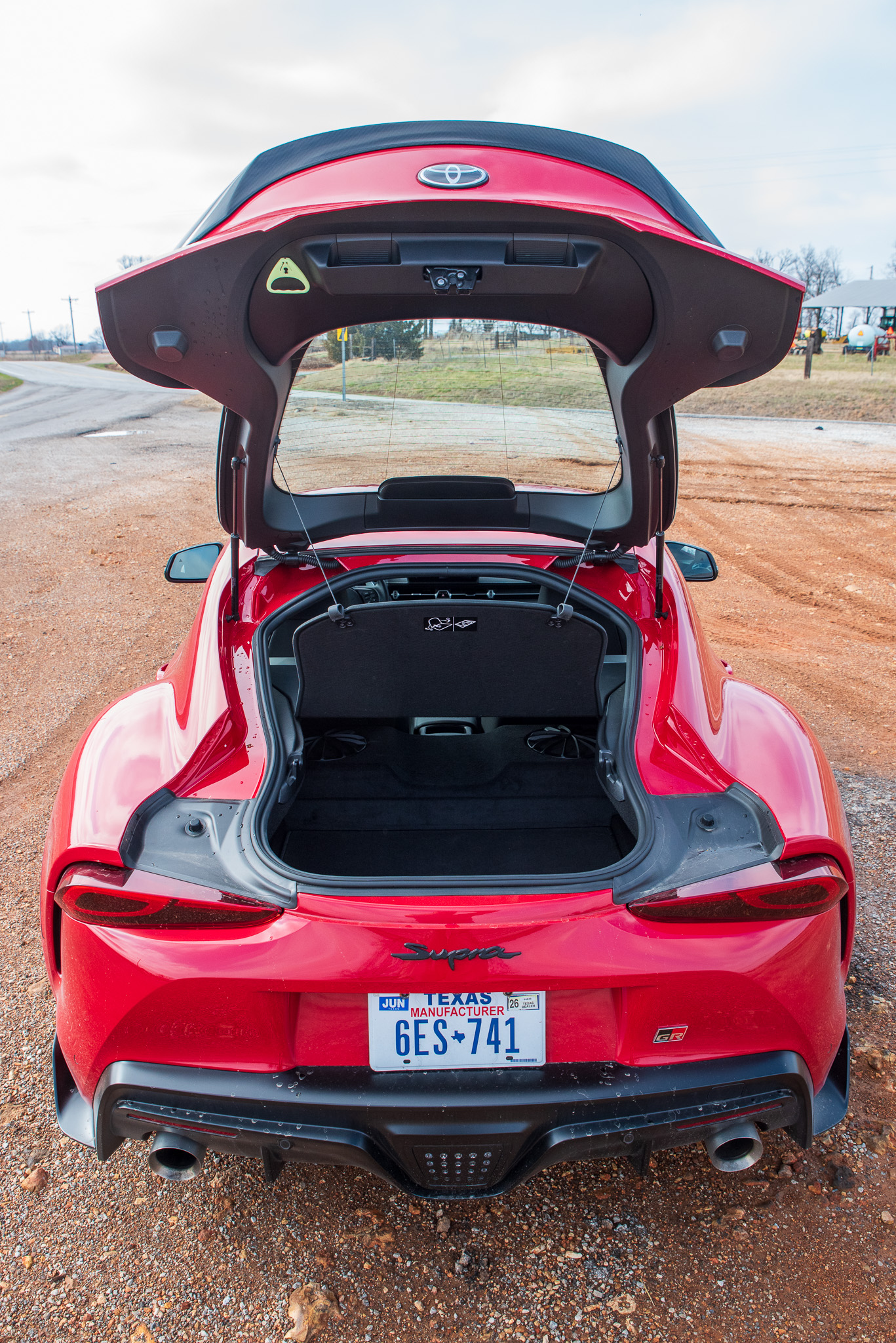
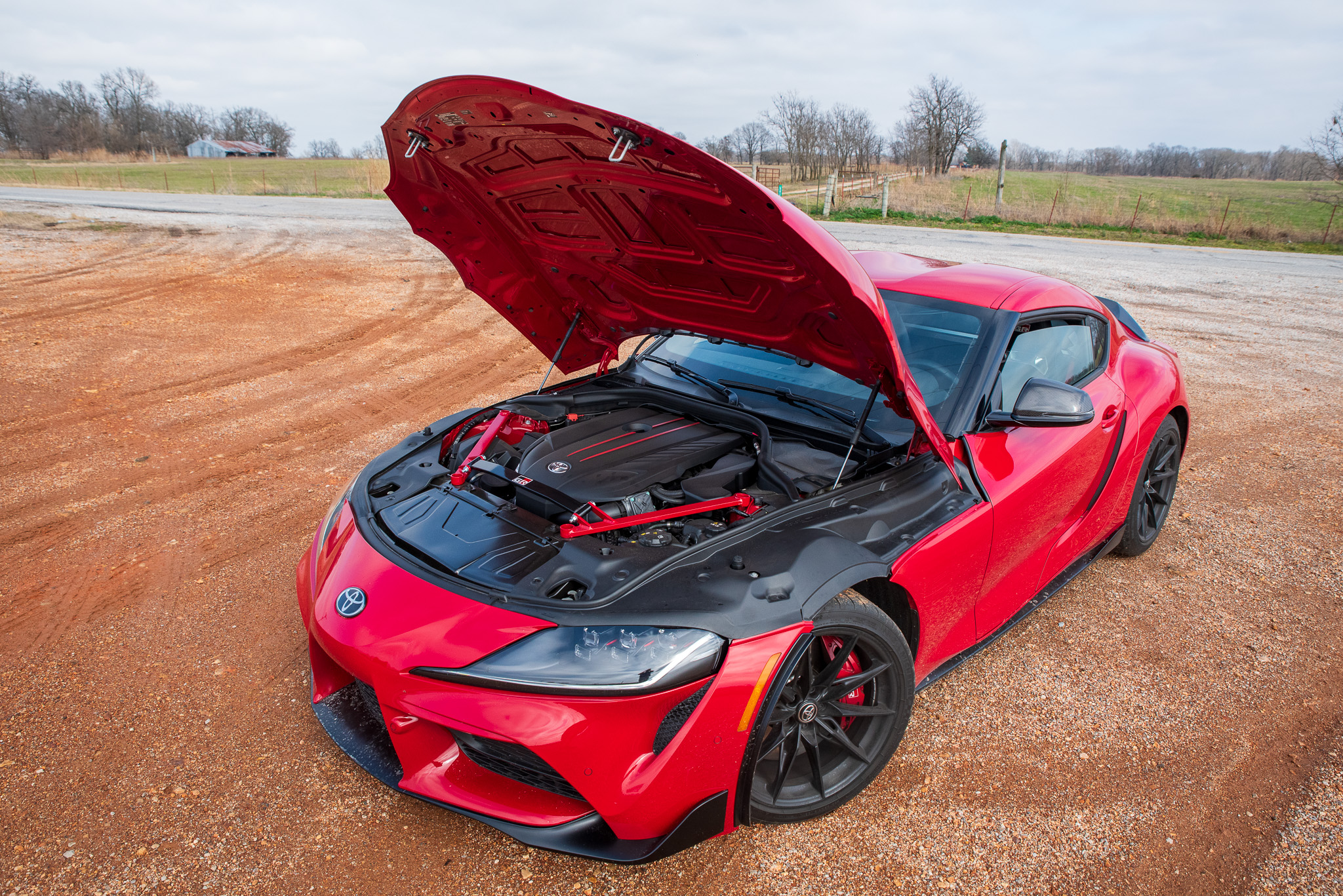
    It feels strange to say goodbye to the MkV Toyota Supra already. I spent a week with one—a 2026 model-year Final Edition—and the phrase that kept coming to mind was, “I hardly knew ye.” Part of that is that I’d never driven one before, but the other part is that I hardly ever see them around. I can’t help but wonder why that is.

    Supra sales have been tough to come by for Toyota. That much is clear. I blame the narrative that they’re all just reskinned BMWs, which, sure, I guess—a Japanese sports car built in Austria is a bit strange. But on the whole, it’s a potent road warrior that’s made more hardcore and rigid by some features on the farewell model. It’s an engaging car, if nothing else, and all I hear from people these days is that cars are too dull. So what else do you want?

    To me, this Supra is everything you’d expect of a two-door sports coupe: Sharper than a Schick Quattro and quick as heck. And yeah, maybe a little twitchy.

    2026 Toyota Supra MkV Final Edition
    Caleb Jacobs

    The Basics

    Despite it still feeling new-ish, the current-gen Supra has been around since 2019. It shares a platform and an engine with the BMW Z4, which is also going out of production (go figure). The Supra has been at the top of Toyota’s sports car lineup for years, but just as it fades away, the GR GT is coming on the scene.

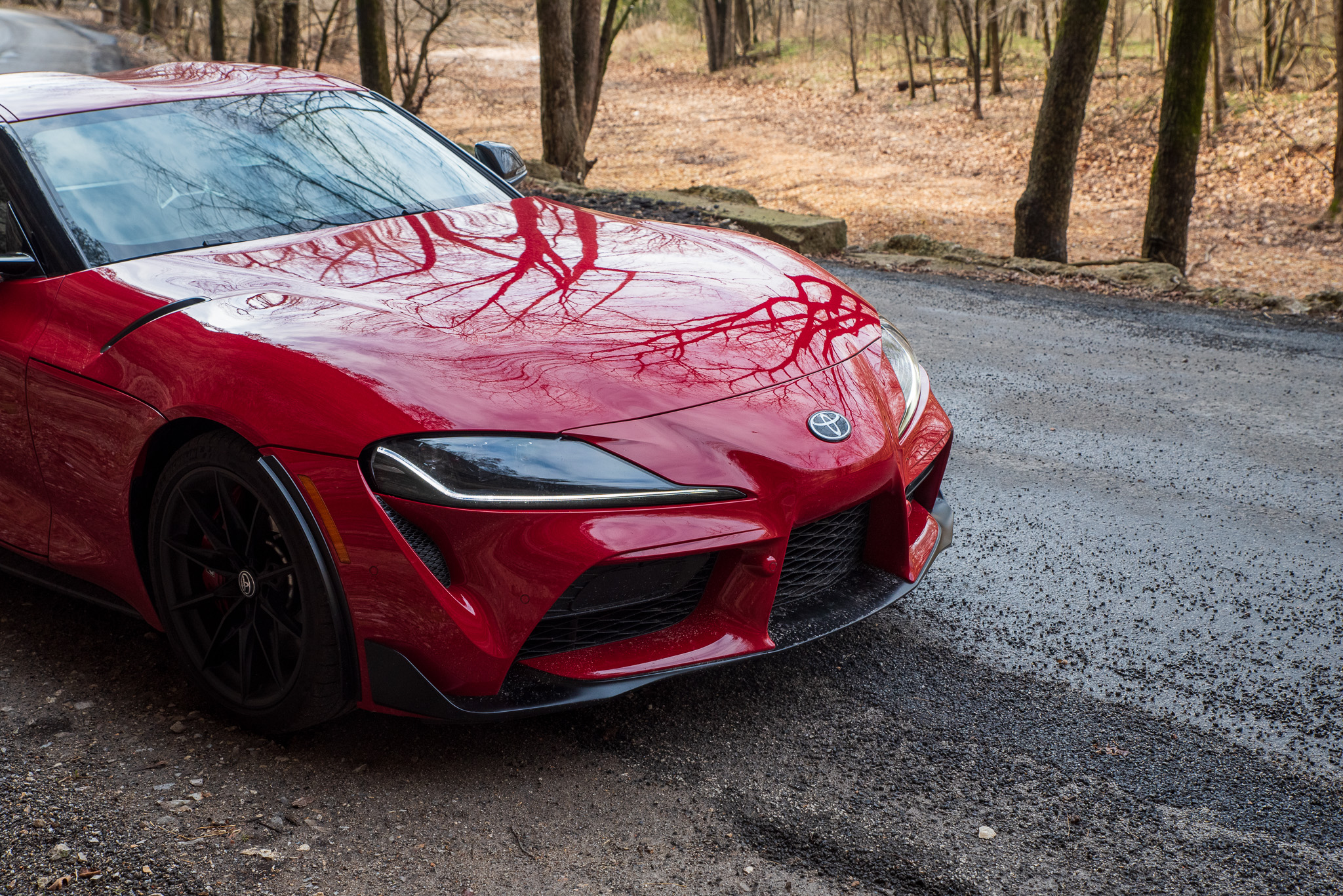
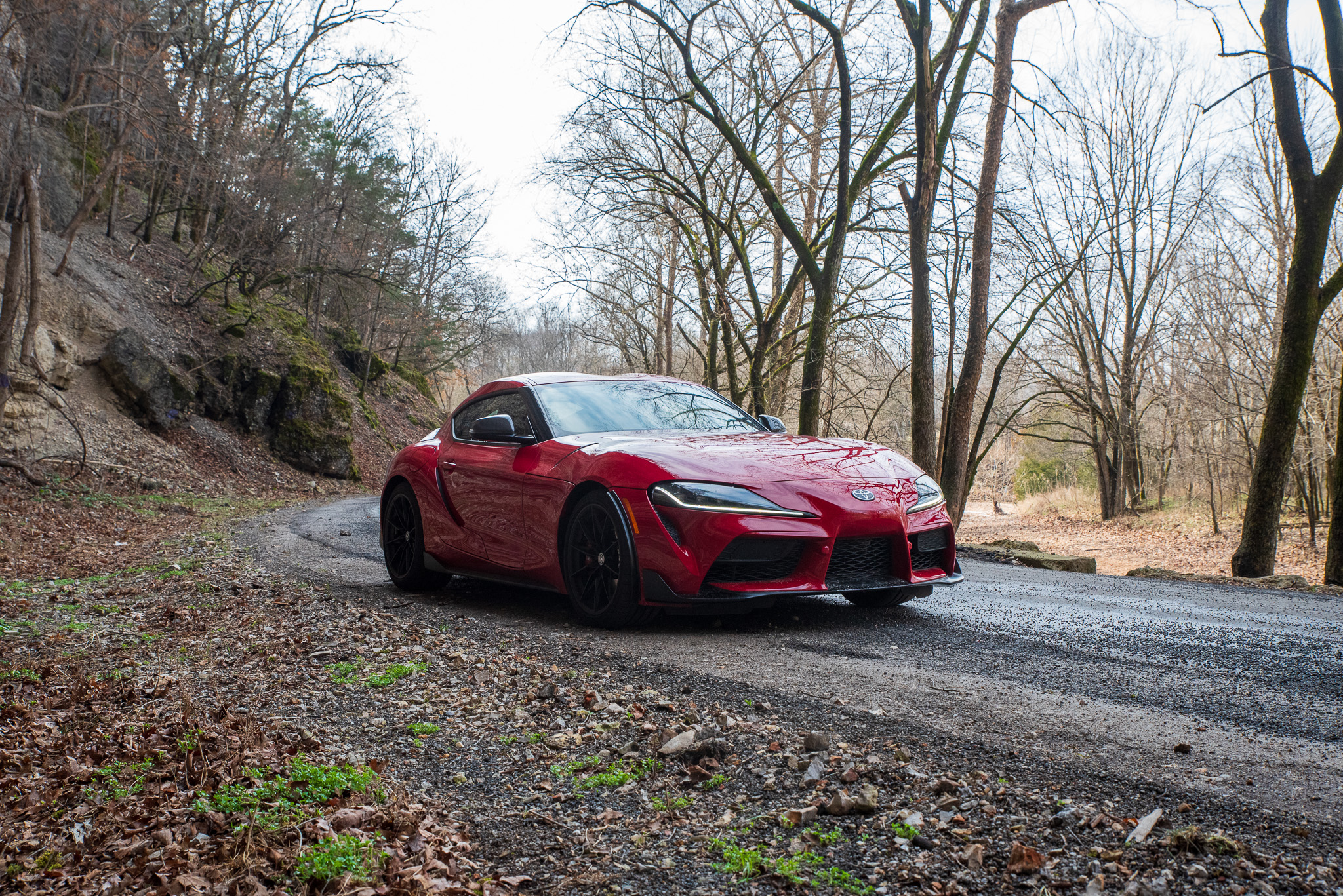
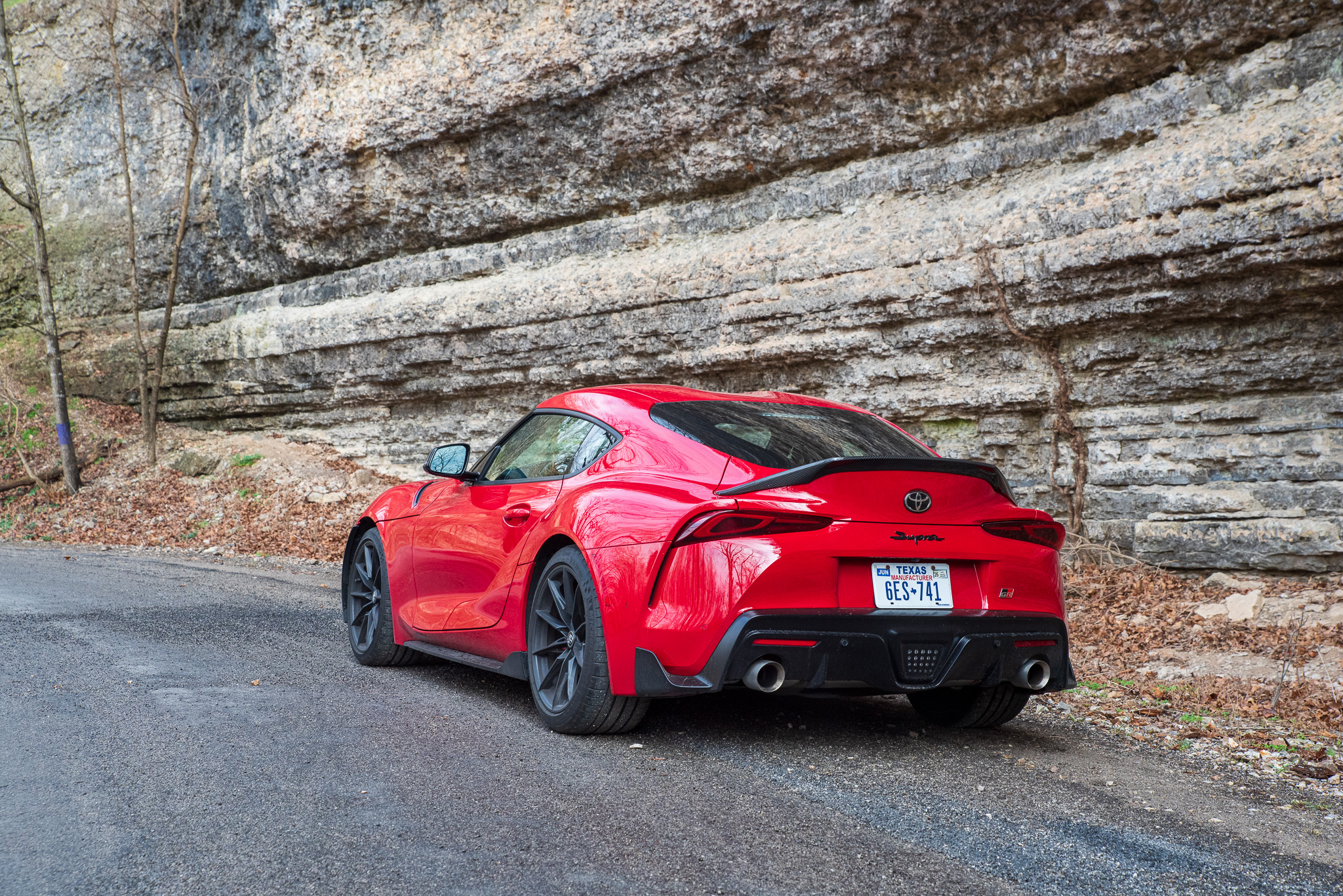
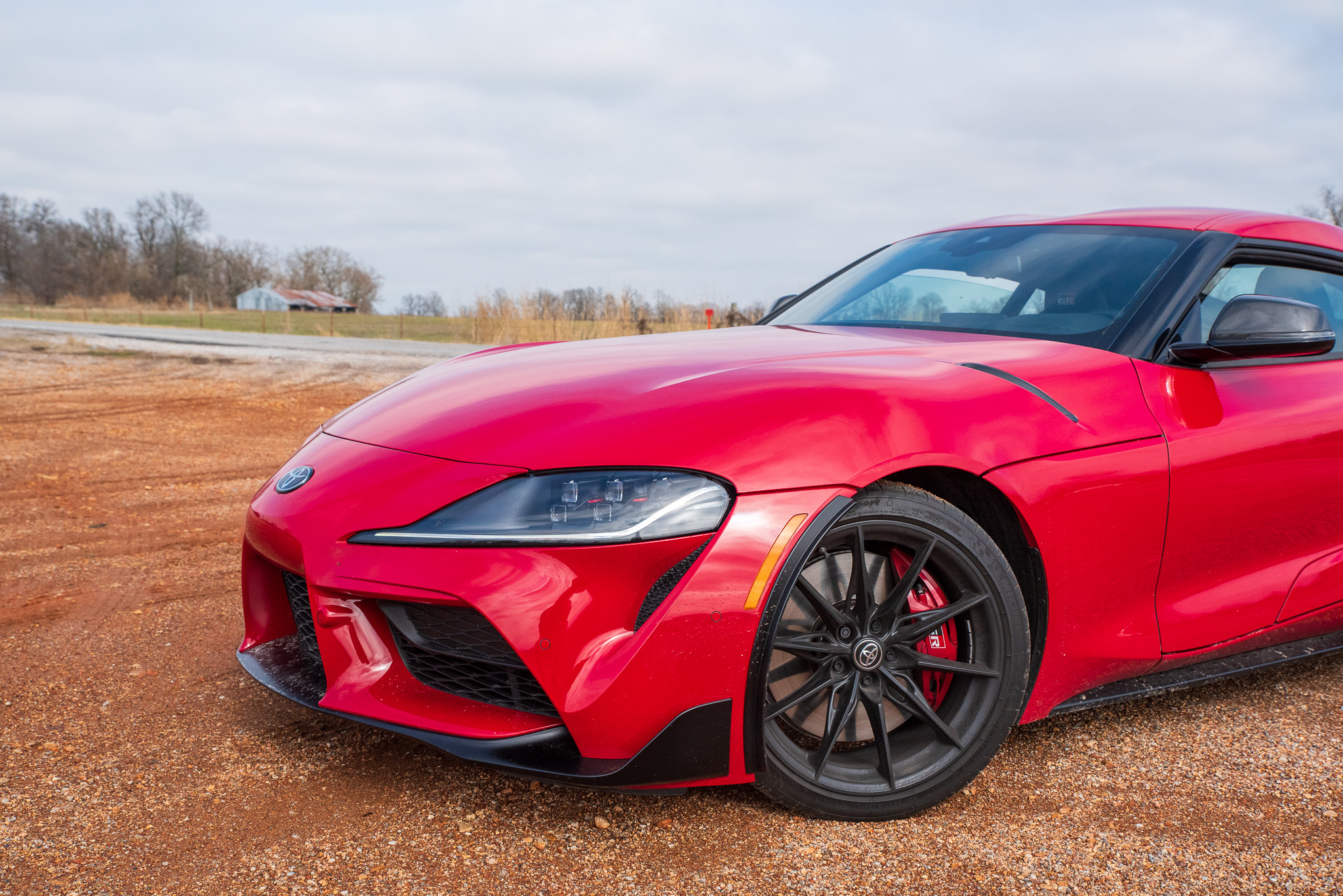
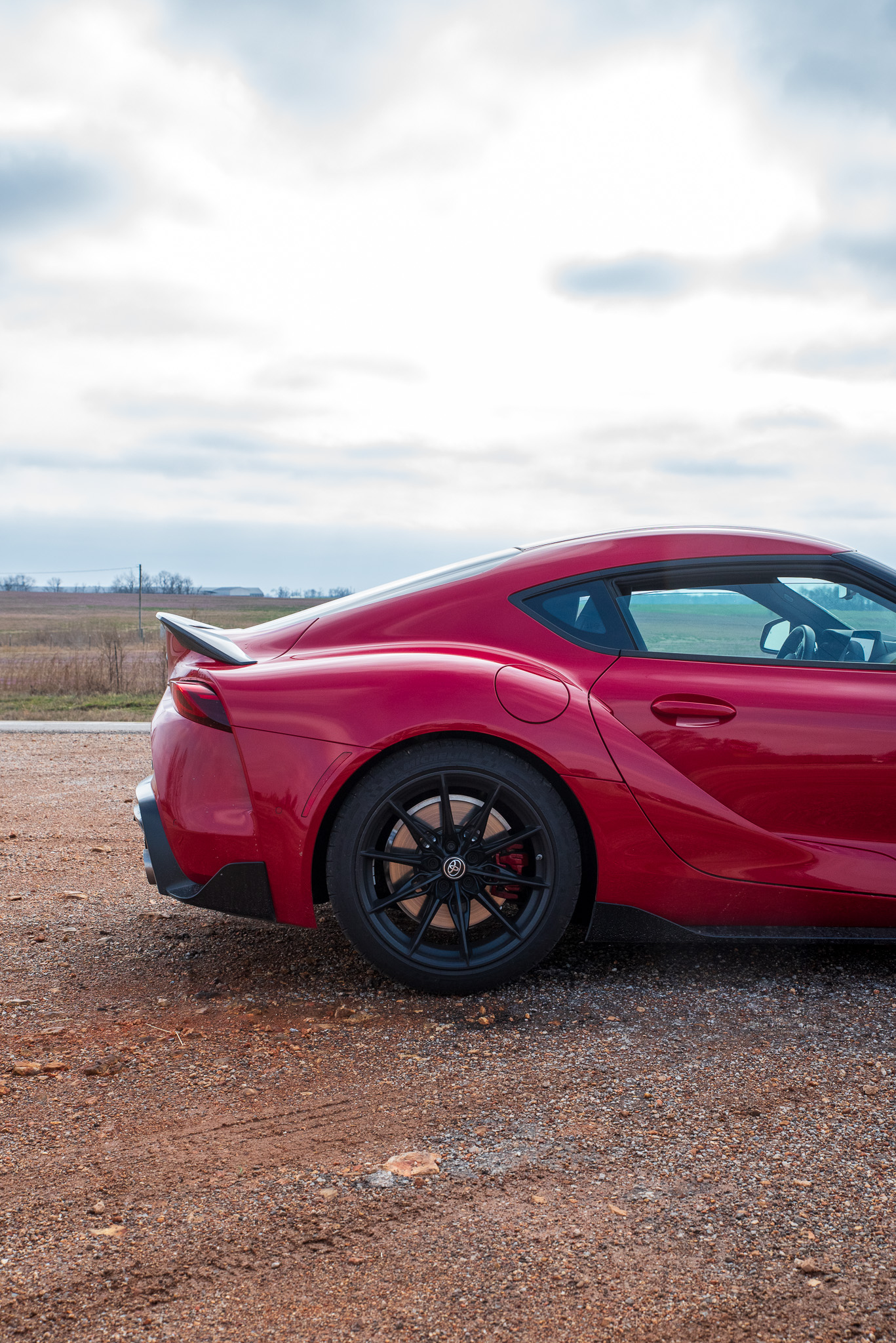
    Not much has changed aesthetically for the Supra over the last seven years. If you ask me, that’s OK. It’s one of those cars that looks fast sitting still, with swoops where you want them and angles elsewhere. I’m partial to the rear three-quarter view, which highlights the car’s wide stance and big ol’ trunk spoiler. I even like the motorsport-style third brake light situated between the exhaust pipes.

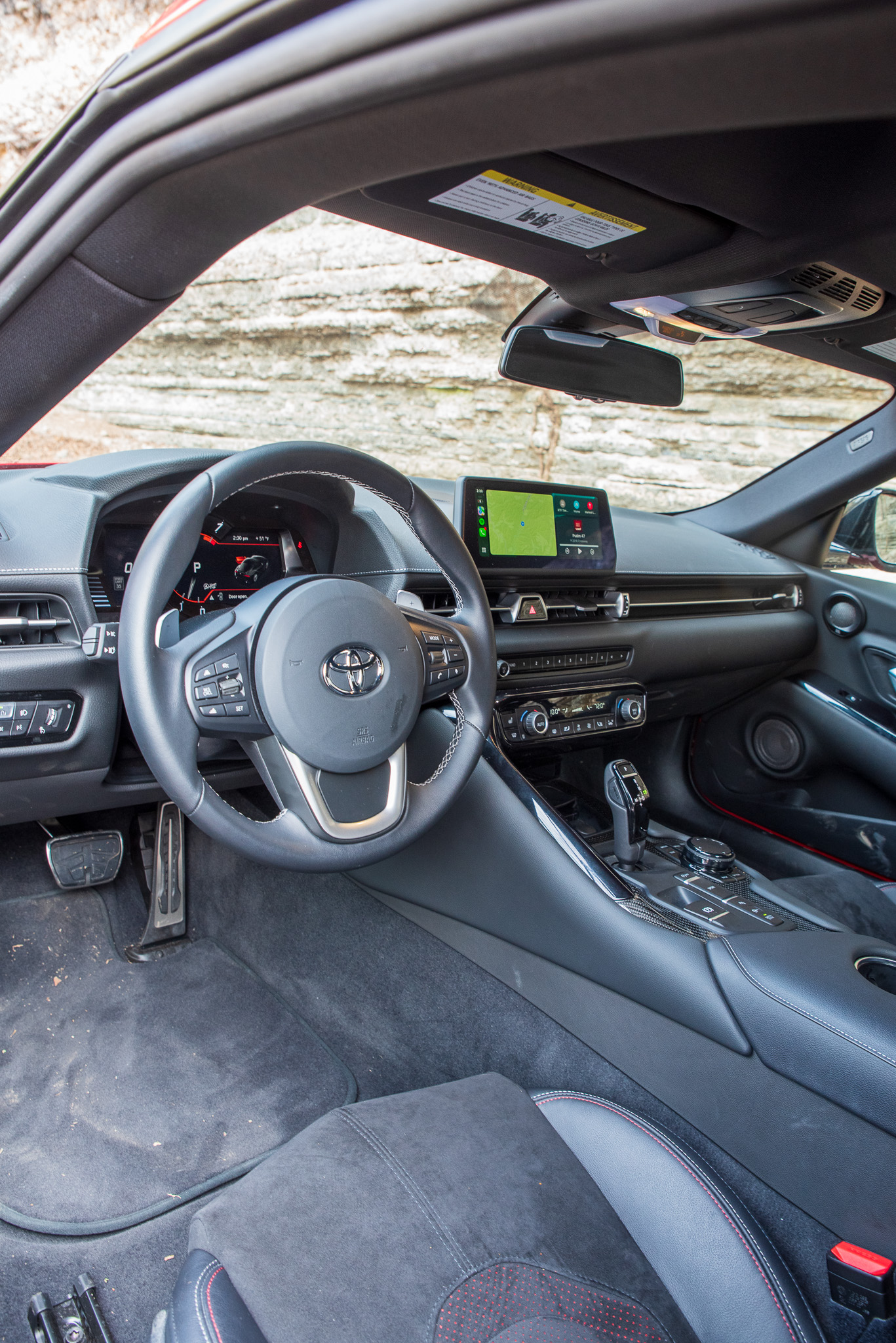
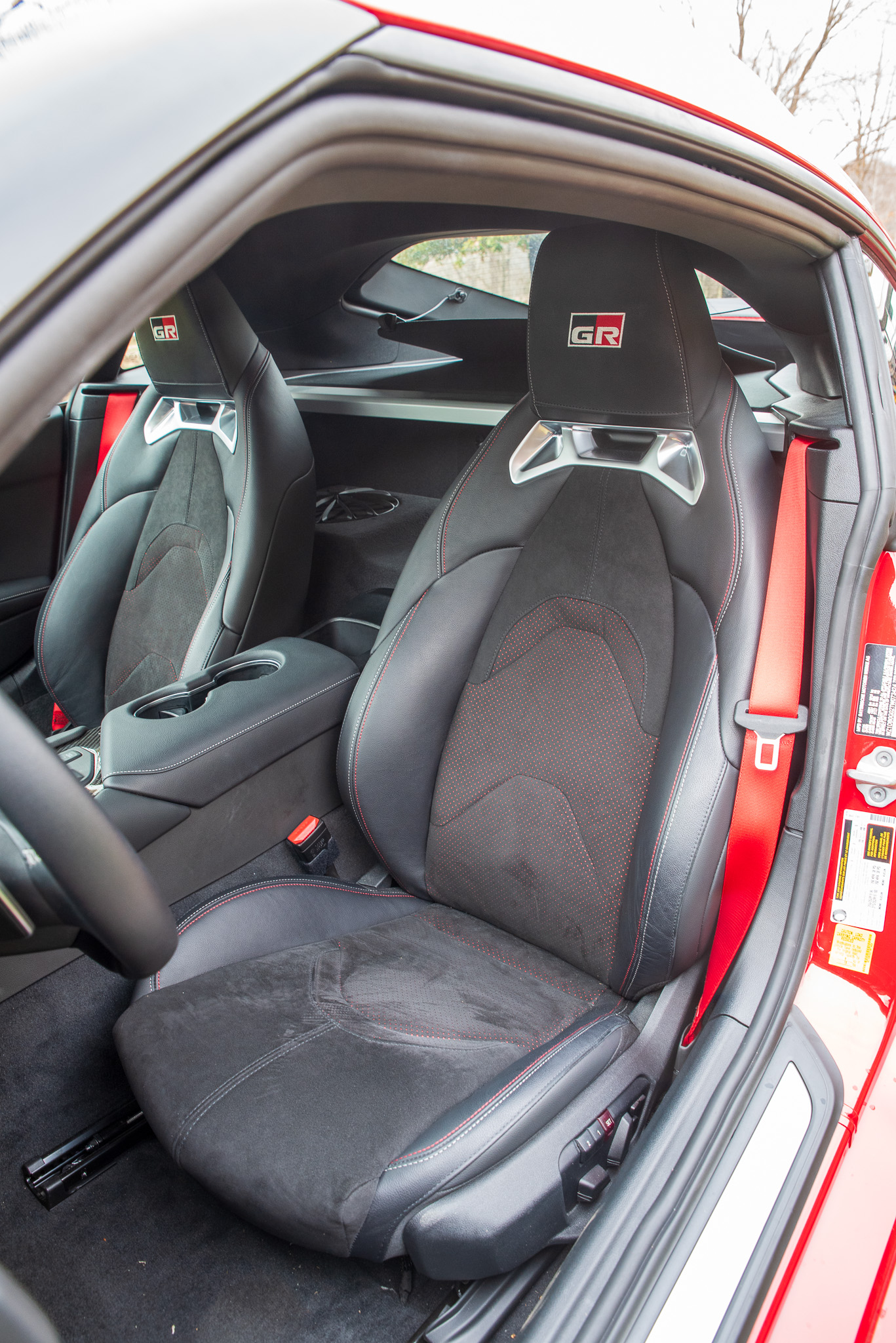
    The interior on my MkV Final Edition was about as nice as they come on the Supra. Black Alcantara and leather cover the seats, which are a bit snug on a big guy like me, but not uncomfortably so. A big pair of subwoofers sits behind you, and the trunk is big enough for a few bags. It took a while to get used to the infotainment, since it’s controlled by both touch and a dial on the center console, but I mostly left the latter alone. The only toggle I messed with there besides the automatic shifter (boo, I know) was the drive mode selector.

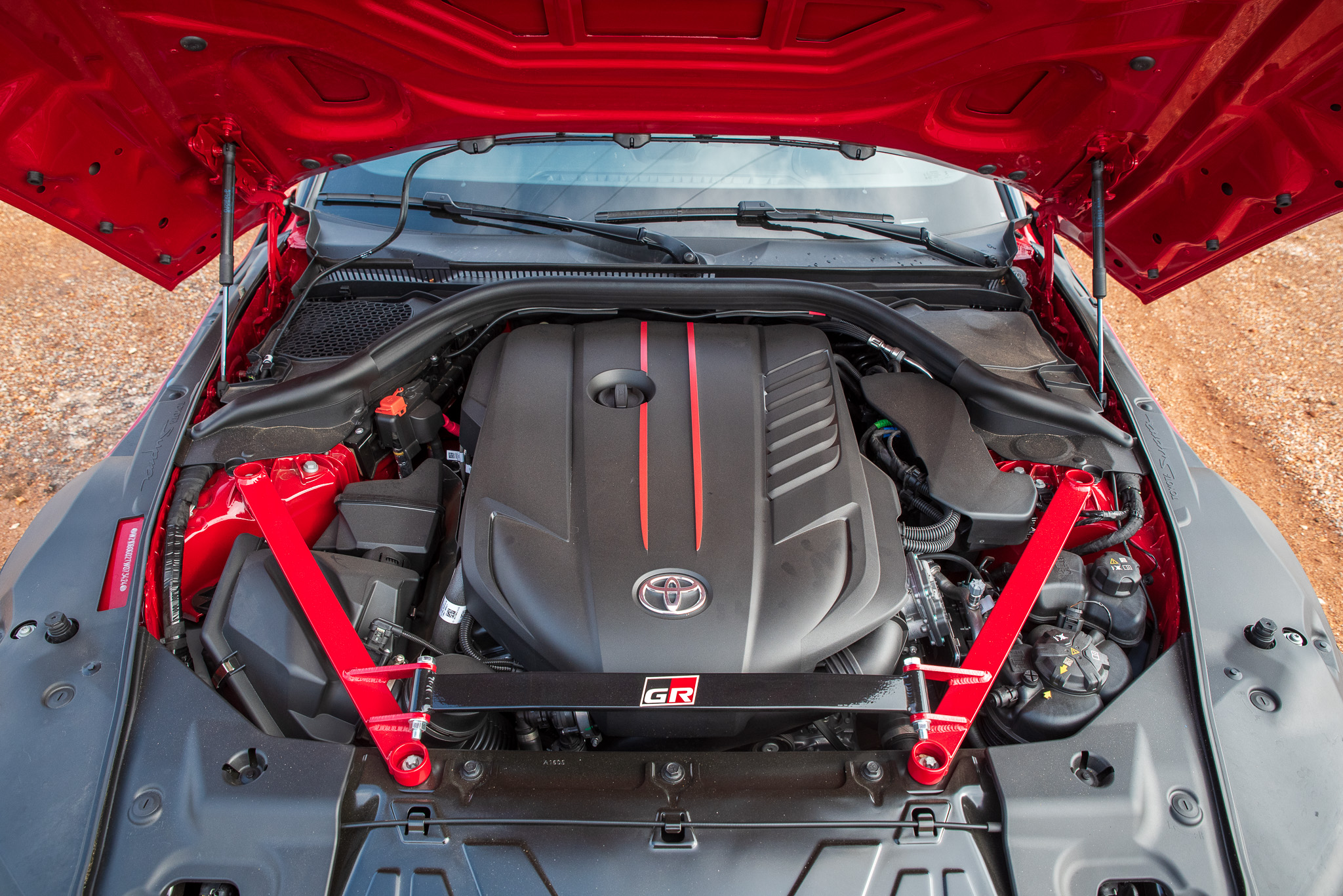
    I won’t lament the Supra’s ZF eight-speed gearbox too much, as it’s legitimately quick. It doesn’t have any problem handling the twin-turbo 3.0-liter inline-six and its 382 horsepower and 368 lb-ft of torque. Instead, it just sends all that power to the rear wheels, resulting in a mighty shove of acceleration.

    Driving the 2026 Toyota Supra MkV Final Edition

    Let it be known that I never bonked my head while getting in or out of the Supra. At least, not that I can remember. Anywho, there is room for you if you’re 6’5″ like I am, or maybe even a skosh taller. Just don’t expect to ride comfortably with another person that size in the passenger seat.

    My first drive in the Supra was at night on a delightfully twisty B-road that’s not exactly well-surfaced. Rows of dead trees meant I could see any oncoming headlights around the corners, and the Supra linked them together like they were nothing. Really, those Michelin Pilot Super Sport tires were so sticky that I winced every time I drove over a patch of pebbles that had washed in from the recent rain. At least it gave me an excuse to scrub them like a Le Mans driver under a full-course yellow.

    A little farther down the road, and it opened up so I could use some more of the ZF box’s gears. If you think 382 hp isn’t enough in a car like this, then I’m not sure what to tell you. The car wants to go fast, and you essentially have to tell it not to—especially in Sport+ mode. The sound gets piped in, and you feel like it’s pestering you to go for it at every fat-radius sweeper.

    Let’s say you listen and put your foot to the floor. You might make it most of the way around that corner, but then you find a big dip or a sharp crack in the asphalt. You’re going to feel it, and you’re going to think that the steering needs correcting. That’s how it went for me, and just as I started reacting, it suddenly found its composure again. It’s like I never left the driving line, except it was a big enough jolt that it had me worried for a split-second.

    Maybe it’s because I’m more used to driving big trucks than tiny sports cars, but I didn’t much care for that.

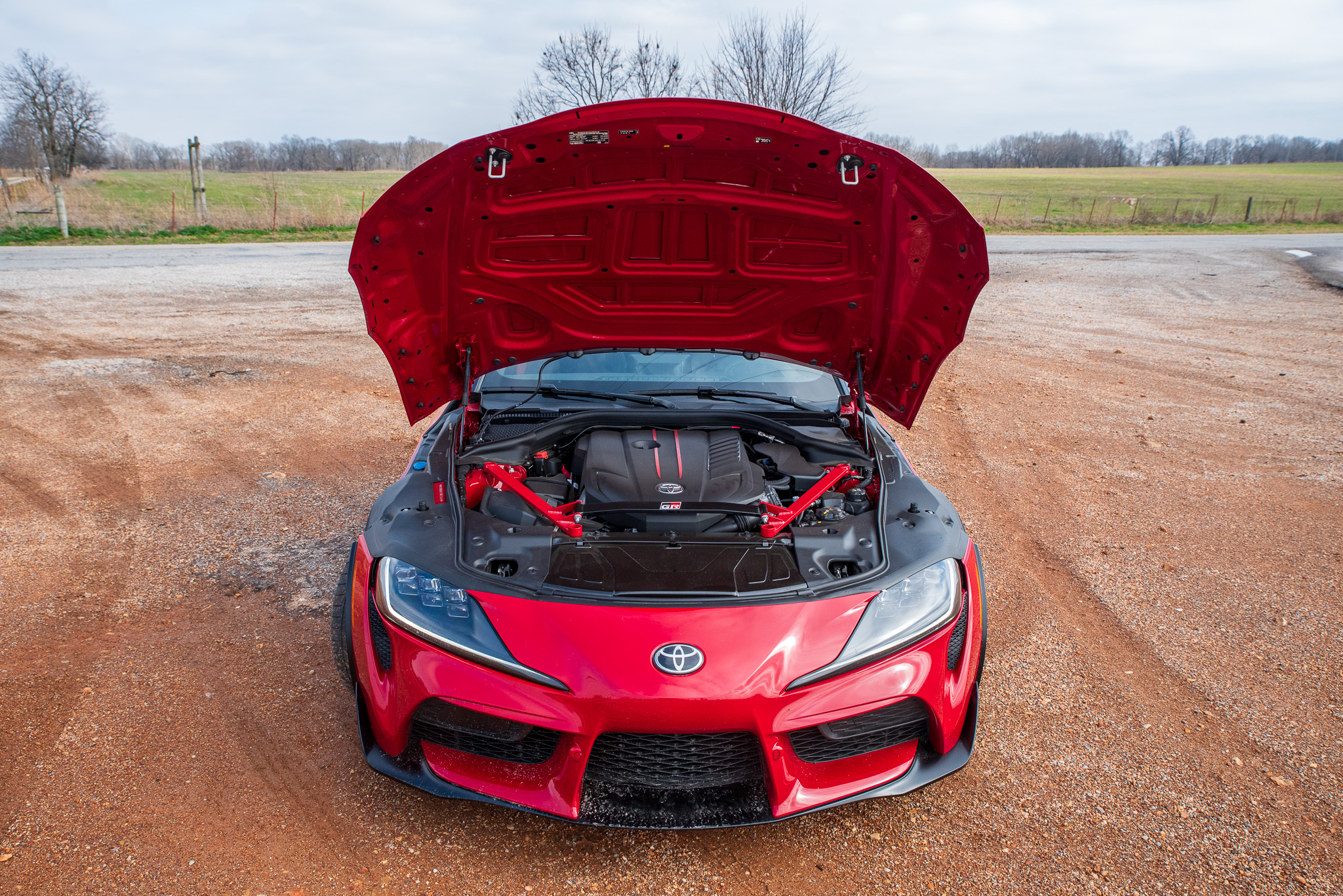
    Toyota added serious bracing to this car. My tester’s window sticker shows a $620 strut tie bar, and lifting the hood shows everything is linked together. Paired with the short wheelbase and stiffened adaptive dampers in Sport and Sport+ mode, this sucker is more rigid than I wish it were. Still, it gets the job done and goes where you tell it to, so maybe I’m not hardcore enough as a driver.

    The Supra is, nevertheless, a fun car that makes you feel like a rockstar driver. The vented, four-piston Brembo brakes bite hard and never fade during my testing on curvy Ozark roads. In short, the engine pulls hard, the front end listens well, and the rear end eventually settles where it needs to. Harsh handling on the limit doesn’t need to steer anyone away from this car; you should arguably expect it.

    The Highs and Lows

    I’m a big fan of the Supra’s powertrain, even if it comes from BMW. You have to remember that the Bavarians have made some of the greatest inline-sixes ever, and while I’m not sure this B58 belongs in that conversation, it’s a strong runner. When you hit a steep hill with a big kink in the middle, it just keeps pulling like you’re driving up Eau Rouge at Spa. And because the chassis and suspension are so tightly buttoned up, there’s practically zero body roll.

    2026 Toyota Supra MkV Final Edition
    Caleb Jacobs

    I only wish the shimmy and shakes were more gradual. I recognize that’s par for the course with boy-racer sports cars, but if a lifetime of driving fast machines on dirt has taught me anything, it’s that controlled rotation is best.

    2026 Toyota Supra MkV Final Edition Features, Options, and Competition

    Every Supra MkV Final Edition comes with the twin-turbo inline-six, as the old 2.0-liter four-cylinder is long gone. You can buy one with the ZF eight-speed or a Bimmer-built, Toyota GR-tuned six-speed stick. They’re fairly loaded from the get-go with heated power seats, a 12-speaker JBL sound system, an 8.8-inch infotainment display, and wireless Apple CarPlay. My press car had only a few options:

    • A $1,195 driver assist package with dynamic radar cruise control, blind spot monitoring, rear cross-traffic alert, and parking sensors
    • The aforementioned $620 strut tie brace
    • A $110 carpet cargo mat
    • $90 wheel locks

    Aside from the Supra’s BMW Z4 platform mate, the Nissan Z is its only real competition. The Z starts in the mid-$40,000 range, so it’s significantly cheaper, and it offers a bit more power with 400 ponies from its boosted V6. While the Nissan and the ‘Yota seem similar on paper, everyone I’ve talked to who’s driven both says they’re pretty different. If you prefer precision, the Supra is it; if you want more of a hot rod, then the Z may be a better choice.

    Fuel Economy

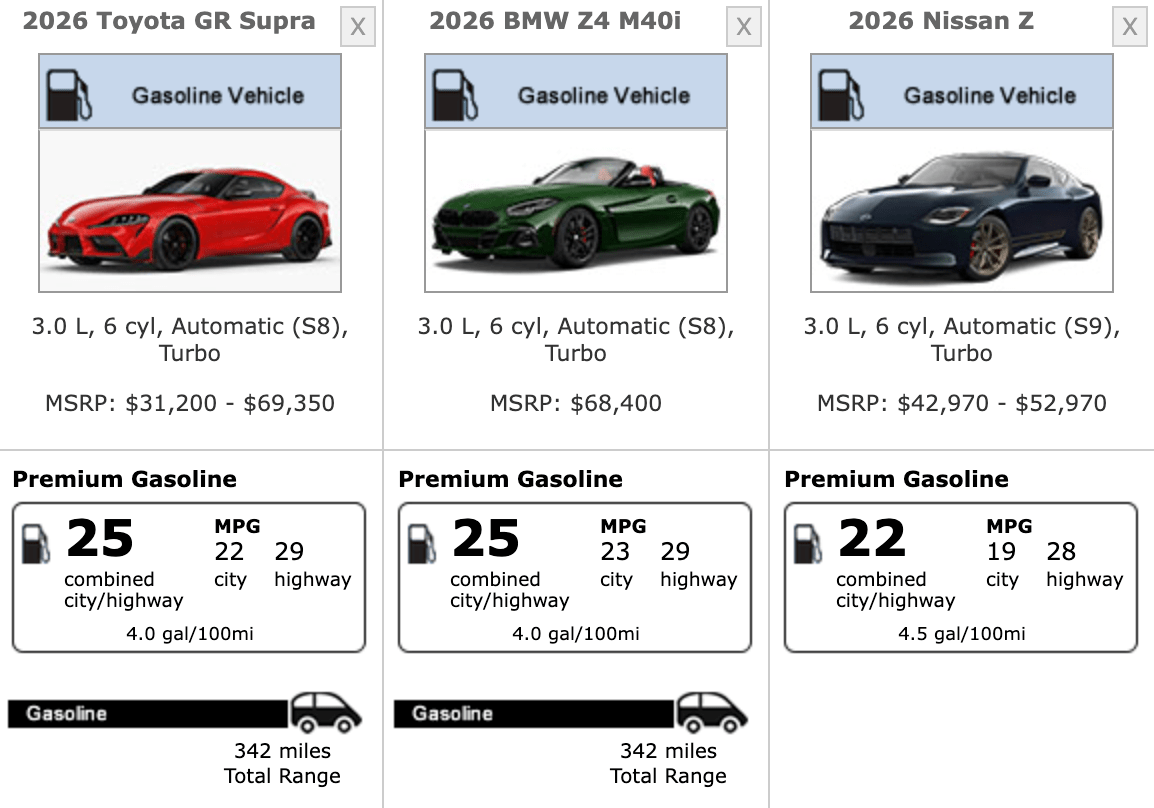
    Fuel economy comparison between Toyota GR Supra, BMW Z4 M40i, and Nissan Z
    fueleconomy.gov

    I’ve never heard anyone talk about fuel economy in this segment, but for what it’s worth, the Supra and Z4 are neck-and-neck. Both get 25 mpg combined and 29 mpg highway, diverging only on the city rating, with the Toyota managing 22 mpg while the BMW gets 23 mpg. Nissan falls behind with its Z at 19 mpg city/28 mpg highway/22 mpg combined.

    Value and Verdict

    We already knew the MkV Supra wasn’t perfect, but I tell you what, it’s not bad either. I’m curious to see what the MkV’s legacy will be in 10 or 20 years, but for now, I’ll remember it as a car that loves to reward drivers while keeping them honest at the limit. I never worked up the gusto to truly challenge the brakes, though I don’t think most folks ever will.

    Most people who stopped and talked to me about the Supra asked, “What even is that thing?” This reiterates the idea that most folks have missed this generation of Toyota’s sports car. That’s a little sad, but for those who know, the MkV is a good-timing car that’s just the right amount of fast.

    So long, Supra. I hardly knew ye.

    Toyota provided The Drive with a GR Supra MkV Final Edition for a week for the purpose of this review.

    2026 Toyota Supra Specs

    Base Price (MkV Final Edition as tested) $59,495 ($71,160)
    Powertrain 3.0-liter turbocharged straight-six | 6-speed manual or 8-speed automatic | rear-wheel drive
    Horsepower 382 @ 5,800-6,500 rpm
    Torque 368 lb-ft @ 1,800-5,000 rpm
    Seating Capacity 2
    Curb Weight 3,389 pounds (MT)
    3,411 pounds (AT)
    Cargo Volume 10.2 cubic feet
    0-60 mph 4.2 seconds (MT)
    3.9 seconds (AT)
    Top Speed 155 mph
    EPA Fuel Economy 19 mpg city | 27 highway | 21 combined (MT)
    22 mpg city | 29 highway | 25 combined (AT)
    Score 7.5/10

    Quick Take

    It’s too bad the MkV Supra never really took off. Maybe, it blossomed too late.

    Got a tip or question for the author? Contact them directly: caleb@thedrive.com

    From running point on new car launch coverage to editing long-form features and reviews, Caleb does some of everything at The Drive. And he really, really loves trucks.


    The Drive Logo

    Car Buying Service

    Source link

  • Ionna Is Teaming Up With Circle K To Boost Its EV Charging Network

    Ionna Is Teaming Up With Circle K To Boost Its EV Charging Network

    • Ionna will install its high-powered charging stations at Circle K locations across the U.S.
    • It will also take over the operations of Circle K’s existing charging network.
    • Retail giants and gas station chains have embraced the build-out of fast chargers.

    Convenience store and gas station chain Circle K is partnering with Ionna to install hundreds of public fast charging stations at its locations nationwide, the companies announced on Tuesday.

    The announcement is the latest in a string of recent tie-ups between retail giants and electric vehicle charging companies, who are racing to build out charging infrastructure with the anticipation that EV sales growth will rebound in the coming years.

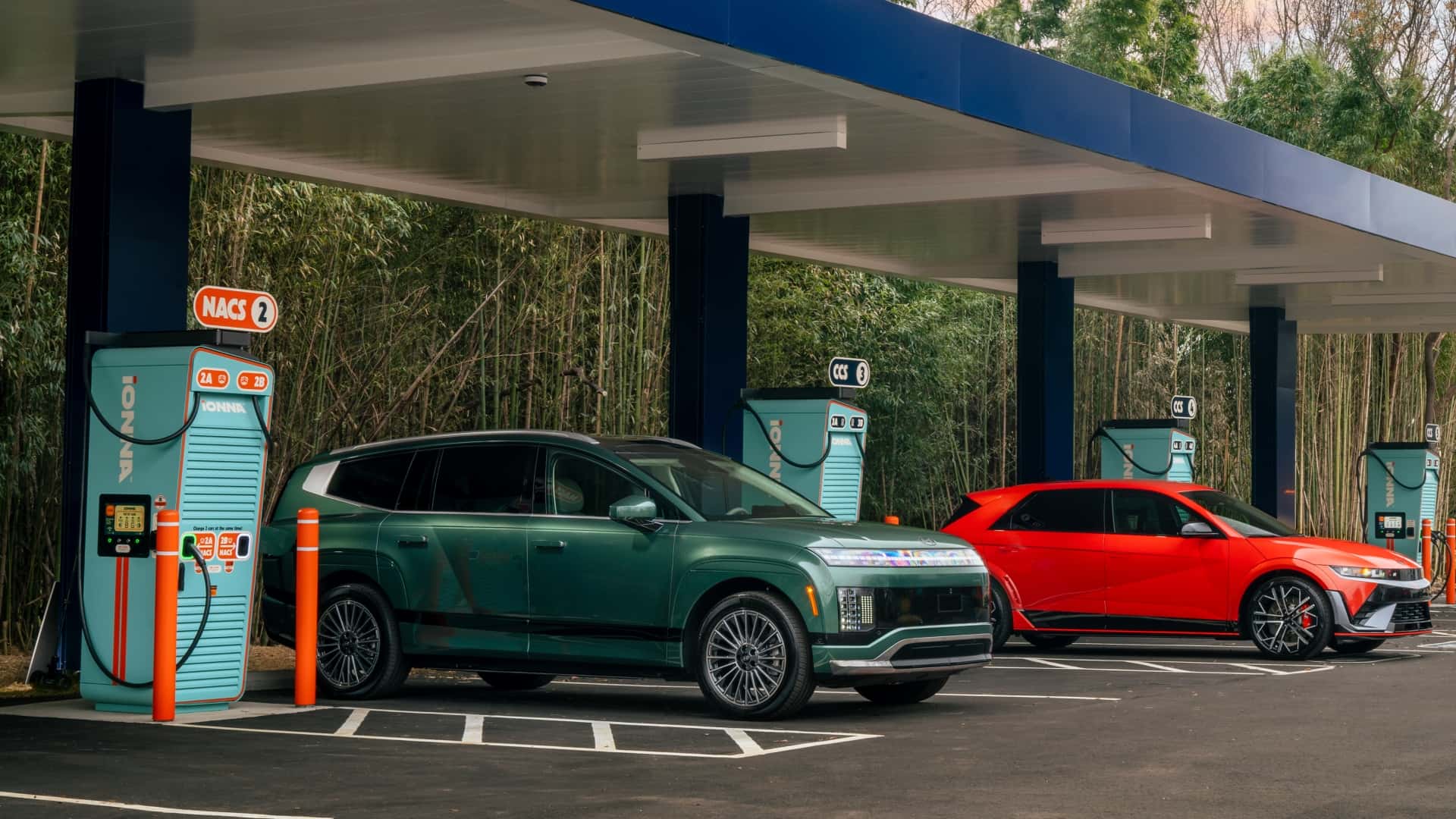
    Ionna, the consortium founded by eight automakers including General Motors, Stellantis, and Toyota, has quickly become one of the fastest-growing charging networks in the U.S. with its so-called Rechargeries. 


    BMW iX At Ionna Rechargery

    Photo by: Suvrat Kothari

    Under the new deal, it plans to bring its high-powered stations to over 350 Circle K locations across the country, pushing it closer to its ambitious target of installing 30,000 charging bays by 2030. All Ionna stations are equipped with 400-kilowatt charging dispensers that support both CCS and the Tesla-style NACS connectors.

    What’s also notable is that Ionna will also take over Circle K’s existing charging network, which will dramatically expand its own footprint. According to the U.S. government’s Alternative Fuels Data Center, the chain already has 378 EV charging ports across 93 locations, which will now fold into the Ionna network. Ionna said it will “rapidly convert and upgrade approximately 85 existing Circle K charging sites.” In other words, existing Circle K stations should become more modern and easier to use, while offering faster charging.


    Ionna Hyundai

    Photo by: Ionna

    Access to reliable public fast-charging stations is one of the top hurdles to the broader adoption of EVs. Even though EV growth has cooled since the end of federal tax credits last year, the nationwide build-out of DC fast chargers has continued at a record pace. Popular convenience stores and gas station chains have leaned into this opportunity. 

    Ionna also partnered with Sheetz and Wawa last year. General Motors and EVGo have continued to expand at Pilot and Flying J travel centers. And Mercedes-Benz High Power Charging is also installing its fast chargers at Buc-ee’s, the Texas-based travel center chain.

    The logic behind these retail partnerships is pretty straightforward. For EV drivers, they help replicate the familiar gas-station and rest-stop experience, offering up amenities like restrooms, restaurants, cafes, and Wi-Fi. Many EV chargers lack those basic conveniences, much less a place to kick back as some of Ionna’s Rechargeries have. 

    The opportunity is also clear for retailers. While a gas stop may only take 10 minutes, an EV driver hanging around for 30 minutes presents an even greater sales opportunity for snacks and the like. 

    Contact the author: suvrat.kothari@insideevs.com

    Source link

  • Porsche 911 GT3 S/C: The GT3 convertible we’ve all been waiting for

    Porsche 911 GT3 S/C: The GT3 convertible we’ve all been waiting for

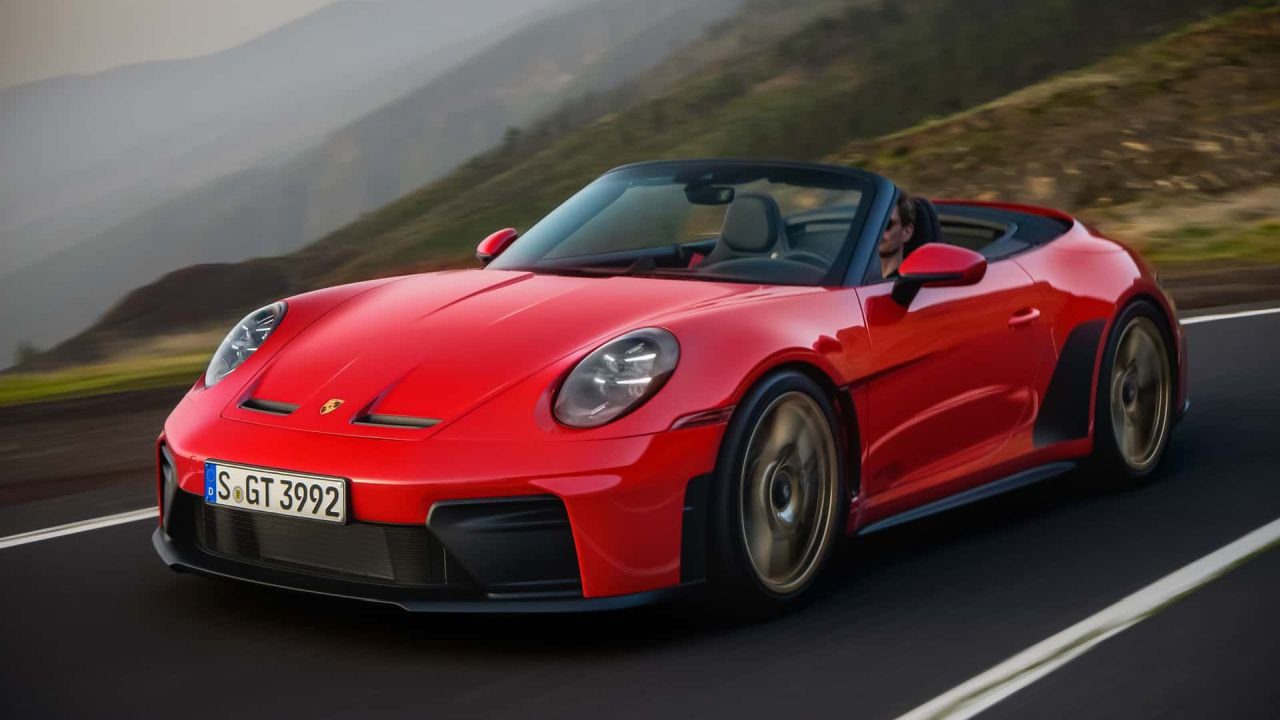
    Porsche has officially revealed the highly anticipated GT3 convertible – the 911 GT3 S/C.

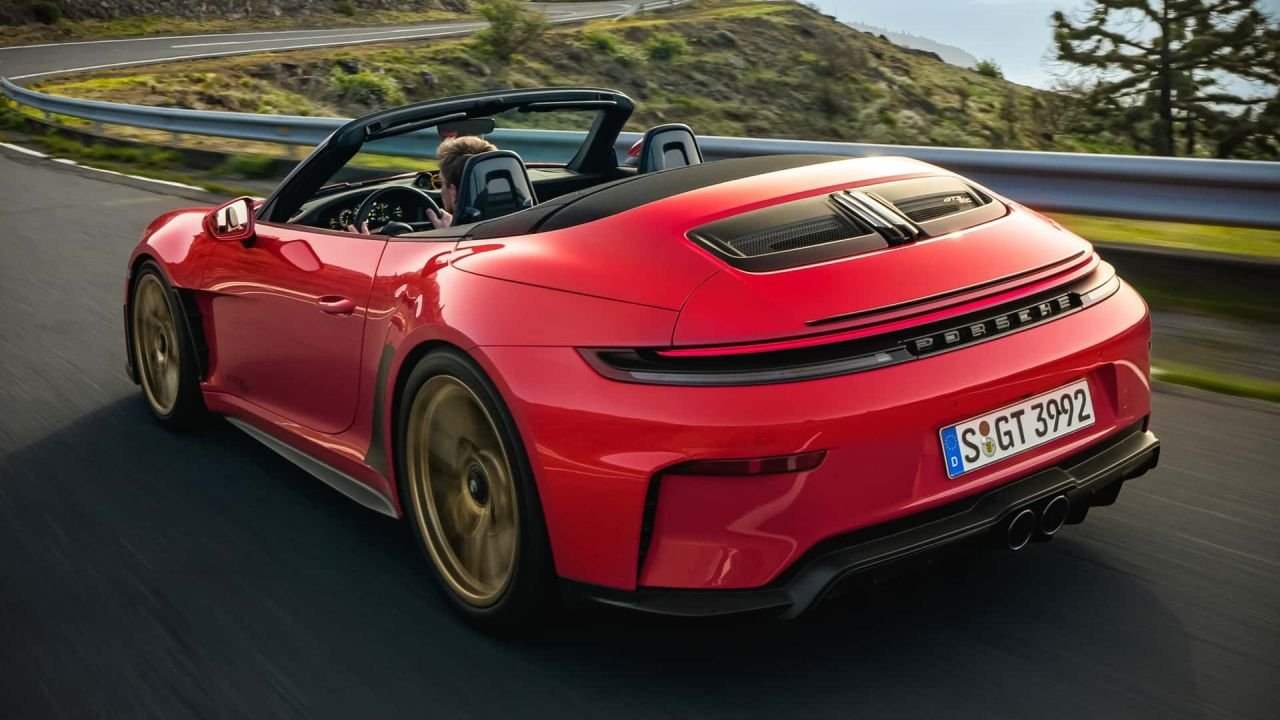
    The 911 GT3 S/C or Sport Cabriolet comes with a folding fabric roof, which can be lowered in about 12 seconds at speeds up to 31 mph. Apart from that, the car looks identical to the GT3 coupe. In the front is a sporty-looking bumper and a bonnet with two distinct nostrils.
    porsche-911-gt3-s-c-2026

    It has a similar aero package, except that the rear wing has been replaced with a retractable spoiler. Porsche has used carbon fibre reinforced plastic panels and magnesium to make the car as light as possible.

    Powering the 911 GT3 S/C is the same 4.0-liter flat-six engine from the coupe. It produces 502 hp and 331 lb-ft of torque and is paired solely with a manual gearbox.

    porsche-911-gt3-s-c

    Porsche claims the 911 GT3 S/C can sprint from 0-62 mph in 3.9 seconds and will reach a top speed of 194 mph.

    Prices for the 911 GT3 S/C start at 275,350 in the United States.

    Source: Porsche

    Source link

  • Genesis GV90 Interior Leak Reveals a Rolling Luxury Lounge

    Genesis GV90 Interior Leak Reveals a Rolling Luxury Lounge

    A Closer Look Inside the GV90’s Cabin

    The Genesis GV90 is gradually revealing more of itself, and this time, a newly surfaced video offers the clearest view yet of its cabin, especially the ultra-luxurious 4-seater coach door version. Expanding on an earlier preview of its screen-dominated dashboard, this latest footage showcases an interior that fully embraces the “mobile sanctuary” concept Genesis has been hinting at.

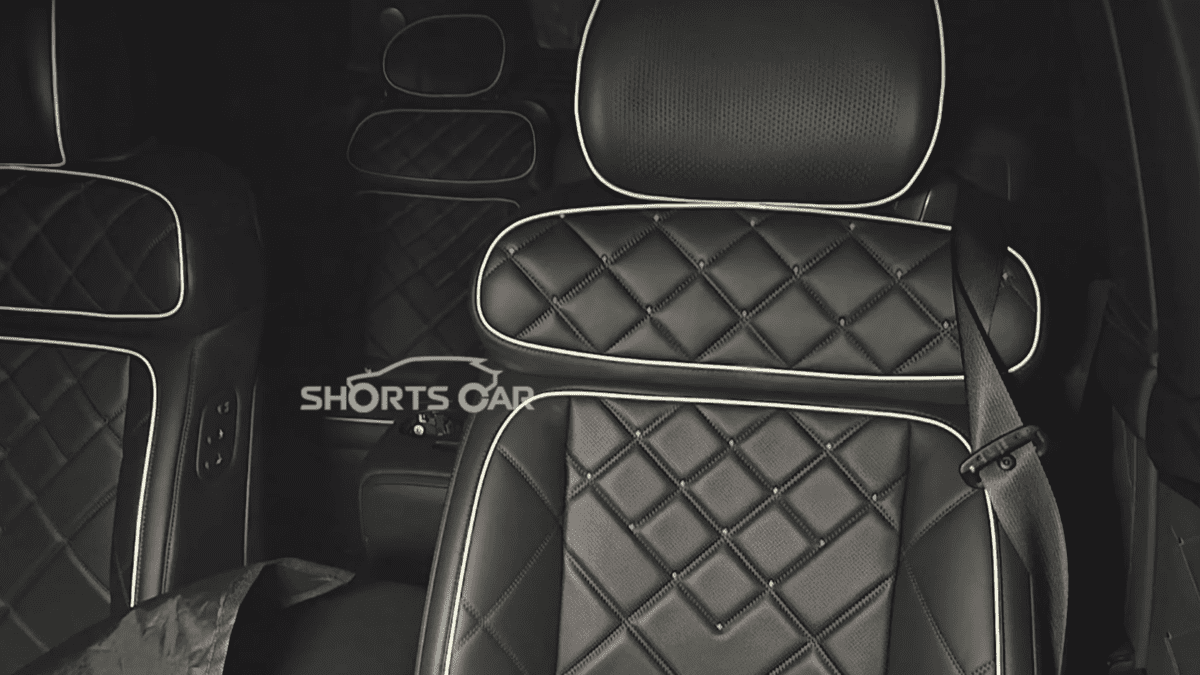
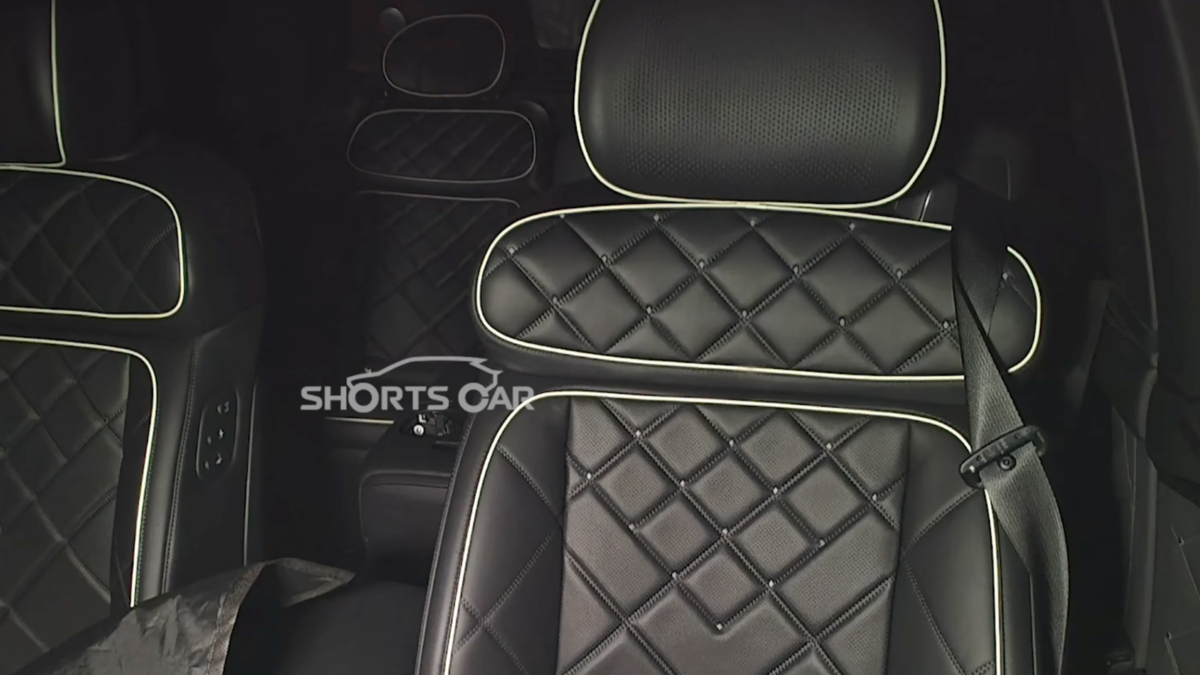
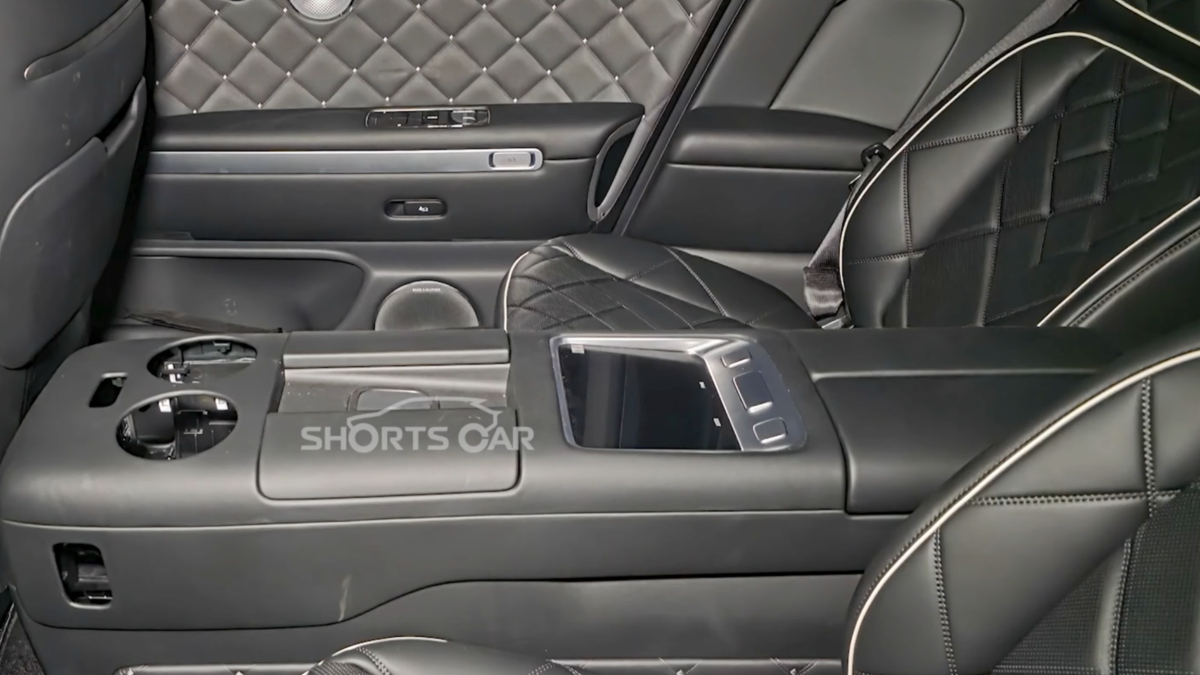
    Drawing strong inspiration from the Genesis Neolun Concept, the GV90’s cabin combines clean, minimalist technology with classic luxury cues. Diamond-quilted leather covers much of the interior, while the second-row captain’s chairs recline deeply and provide ample legroom, emphasizing a VIP-focused layout. A detachable tablet built into the rear console manages key controls, and the lack of a B-pillar has led to inventive solutions, such as seatbelt systems integrated directly into the seats.

    A Mystery Box Worthy of JJ Abrams

    This newest interior glimpse adds to the growing curiosity surrounding the GV90. Previous leaks had already indicated a massive, nearly full-width display that transforms the dashboard into a unified digital surface. Meanwhile, spy shots suggested the presence of Rolls-Royce-style coach doors, rear-hinged and pillar-less, placing Genesis firmly within the ultra-luxury space typically dominated by marques like Rolls-Royce Motor Cars.

    That said, some elements remain uncertain. Reports indicate those striking coach doors might not reach production, even though patent filings show Genesis has developed a complex multi-layer sealing system to support pillar-less construction. Elsewhere, features like MLA headlamps, smooth body integration, and oversized 24-inch wheels highlight a design approach that values dramatic presence just as much as technical sophistication.

    YouTube / @shorts_car


    View the 3 images of this gallery on the
    original article

    Almost Nothing Left to the Imagination

    Bit by bit, the GV90 is becoming clearer, and it’s shaping up to be one of the boldest projects Genesis has undertaken. With earlier interior leaks, new prototype footage, and a steady flow of patent details, a picture is emerging of how luxury, technology, and design are being blended into a single flagship vision.

    Even so, a sense of unpredictability remains. Will the coach doors make it to production? Will the final model keep its concept-like simplicity? With talk of bespoke versions and even a high-performance Magma variant on the horizon, the GV90’s ultimate form is still evolving. For now, attention stays fixed on the next reveal, because from the looks of things, Genesis is deliberately crafting us a story here.

    YouTube / @shorts_car


    View the 2 images of this gallery on the
    original article

    Source link

  • 10 Car Fads That Defined the Past 100 Years

    10 Car Fads That Defined the Past 100 Years

    Car trends don’t always vanish. They peak, fade, and reappear in new forms. Culture, technology, and the messages people want to convey about themselves shape these industry fads.

    Over the past 100 years, automotive fads have defined entire eras; some are flashy, some functional, and all have reflected their time. And while many no longer dominate the road, their influence is still visible in today’s vehicles.

    In celebration of Kelley Blue Book’s 100th anniversary this year, here is a look at 10 car fads that have left lasting imprints on the automotive industry.

    10 Car Fads That Defined the Past 100 Years10 Car Fads That Defined the Past 100 Years
    Image courtesy of Adobe Stock

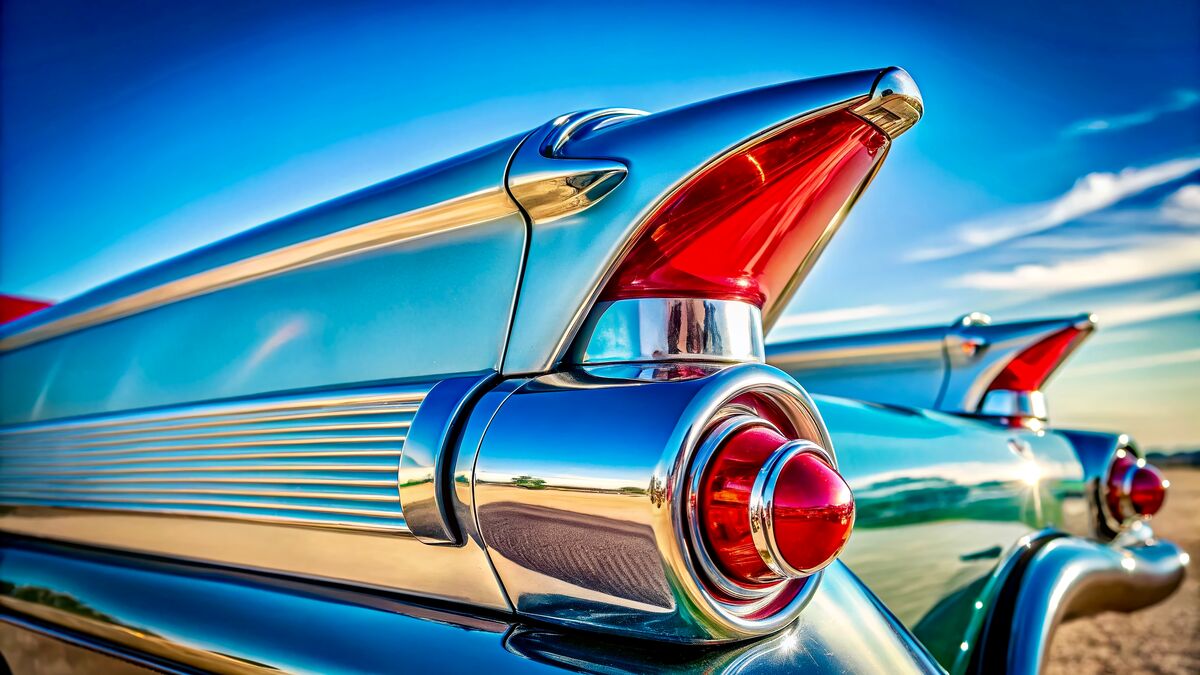
    Tailfins turned cars into rolling sculptures. Early designers took inspiration from jet aircraft and the Space Race to create them. Automakers then competed to design bigger, sharper, and more dramatic rears, especially for luxury models.
    This influence remains in the sharp lines and aerodynamic accents of today’s vehicles, which still echo the same desire for motion and a futuristic look.

    Chrome Overload

    ’50s–’70s

    10 Car Fads That Defined the Past 100 Years10 Car Fads That Defined the Past 100 Years
    Image courtesy of Adobe Stock

    In mid-century America, chrome wasn’t a detail; it was artistic expression. Chrome grilles, bumpers, mirrors, and trim all glistened in the sun, signaling luxury and industrial progress.
    Automakers still use chrome sparingly to highlight premium features today.
    Wood Paneling

    ’40s–’90s

    10 Car Fads That Defined the Past 100 Years10 Car Fads That Defined the Past 100 Years
    Image courtesy of Adobe Stock

    Wood paneling evolved into a defining feature of the American family wagon. From the 1940s until about the 1990s, it was equal parts nostalgic and practical, until it wasn’t. It came to symbolize family life and suburban expansion.

    It has now moved inside vehicles and is used in upscale interiors rather than on exterior panels.

    Bench Seats

    ’40s–’70s

    10 Car Fads That Defined the Past 100 Years10 Car Fads That Defined the Past 100 Years
    Image courtesy of Adobe Stock

    Before cupholders and center consoles took over, the front bench accommodated three passengers. Bench seating up front created a more communal driving experience, reflecting a more social approach to car interiors.

    Automakers still include bench seats in some trucks, but bucket seats and tech-heavy consoles mostly replaced them.

    Convertible Craze

    Pre-’70s

    10 Car Fads That Defined the Past 100 Years10 Car Fads That Defined the Past 100 Years
    Image courtesy of Adobe Stock

    At one point, convertibles weren’t niche; they were everywhere, bringing open-air driving and representing freedom, leisure, and status. They spoke to the more emotional side of driving.

    Convertibles still exist, but now predominantly as lifestyle vehicles rather than daily drivers.

    T-Tops & Removable Roofs

    ’70s–’80s

    10 Car Fads That Defined the Past 100 Years10 Car Fads That Defined the Past 100 Years
    Image courtesy of Chevrolet

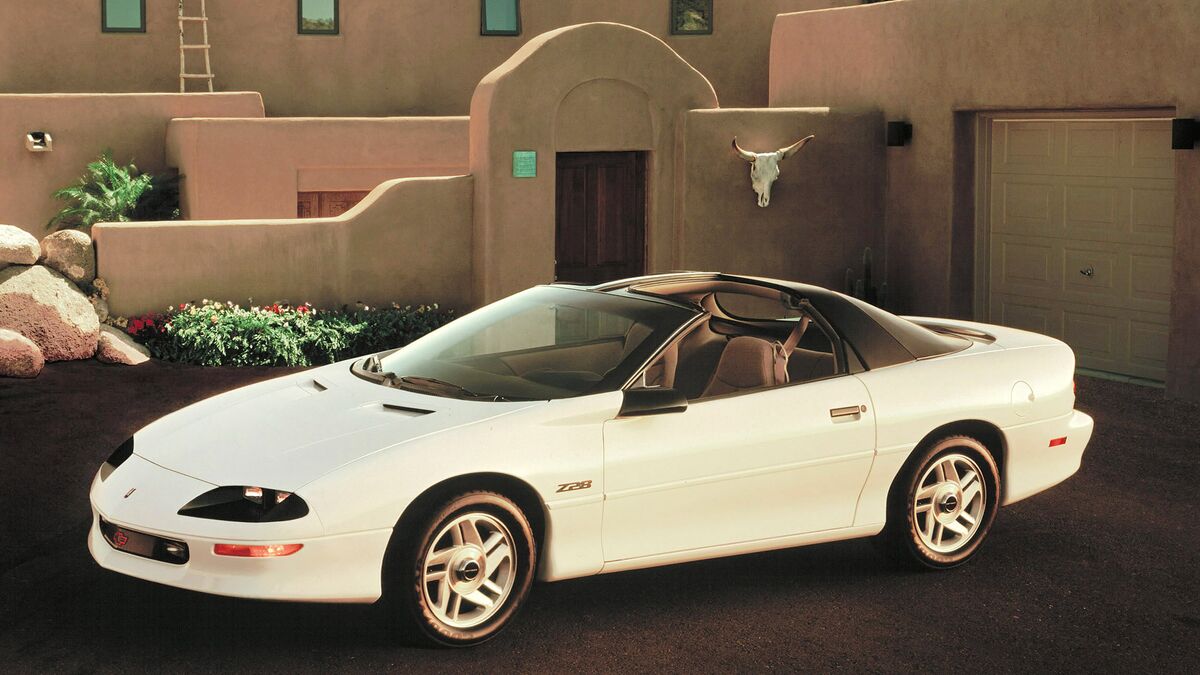
    T-tops offered some of the appeal of open-air driving without fully sacrificing structural rigidity. They became especially popular in sports cars in the ’70s and ’80s, and showed how automakers could balance style, safety, and engineering.

    The T-top spirit continued in targa roofs, where the original idea transformed into a more polished, comfortable mass‑market interpretation.

    Digital Dashboards

    ’80s

    10 Car Fads That Defined the Past 100 Years10 Car Fads That Defined the Past 100 Years
    Image courtesy of Adobe Stock

    In the 1980s, glowing digital dashboards promised a glimpse into the future. Early LCDs and LEDs replaced analog gauges, bringing a tech-driven, futuristic feel to everyday driving.

    Today’s fully digital instrument clusters are a direct evolution, but now they are far more advanced.

    Pop-Up Headlights

    ’80s–’90s

    10 Car Fads That Defined the Past 100 Years10 Car Fads That Defined the Past 100 Years
    Image courtesy of Adobe Stock

    Pop-up headlights gave a car a clean silhouette by day and personality by night. Few elements captivated people quite like this — an innovation that made the car feel as if it had awakened, merging technical brilliance with a touch of personality.

    They were removed from circulation, but they remain beloved among enthusiasts.

    Hydraulics & Lowriders

    ’90s–’00s

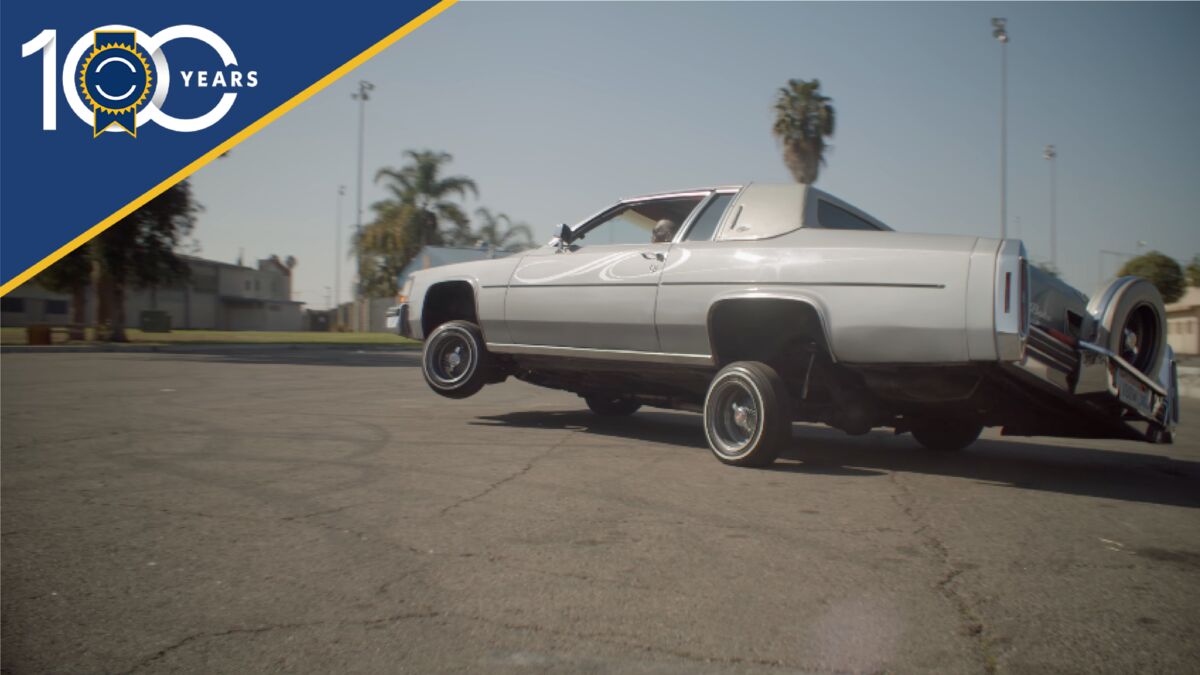
    Hydraulics transformed old-school cars from beautiful driving machines into vehicles capable of theatrical performances. Vehicles could bounce, tilt, and dance, transforming driving into a visual experience deeply rooted in community and culture. This automotive era shifted cars from mere transportation to a form of self-expression.

    Hydraulics still thrive in lowrider culture, even if they are less prominent in the mainstream.

    Body Kits & Customization

    ’90s–’00s

    10 Car Fads That Defined the Past 100 Years10 Car Fads That Defined the Past 100 Years
    Image courtesy of Adobe Stock

    The body kit era pushed customization to extremes, with oversized bumpers, flared fenders, and bold graphics. Cars became canvases for identity, influenced by street racing culture and early 2000s media. Customization became more accessible, and in this car culture, anyone could build something unique.

    Today’s customization tends to be leaner and cleaner, but personalization is still central in enthusiast culture.

    What Fads Await Automotive’s Future?

    Looking back across a century of automotive trends, one thing becomes clear: Car fads aren’t just about the cars. They reflect what people value. They’re how people express identity and show a glimpse of what the future looks like in a given moment, from tailfin shapes during the Space Race to tuner builds influenced by music and film. Automotive trends capture cultural shifts. Yesterday’s bold experiment often becomes today’s creative spark. They never really go away. Instead, they evolve, waiting for their comeback.

    Source link

  • Volkswagen taps XPeng for the new ID. Aura T6 electric SUV

    Volkswagen taps XPeng for the new ID. Aura T6 electric SUV

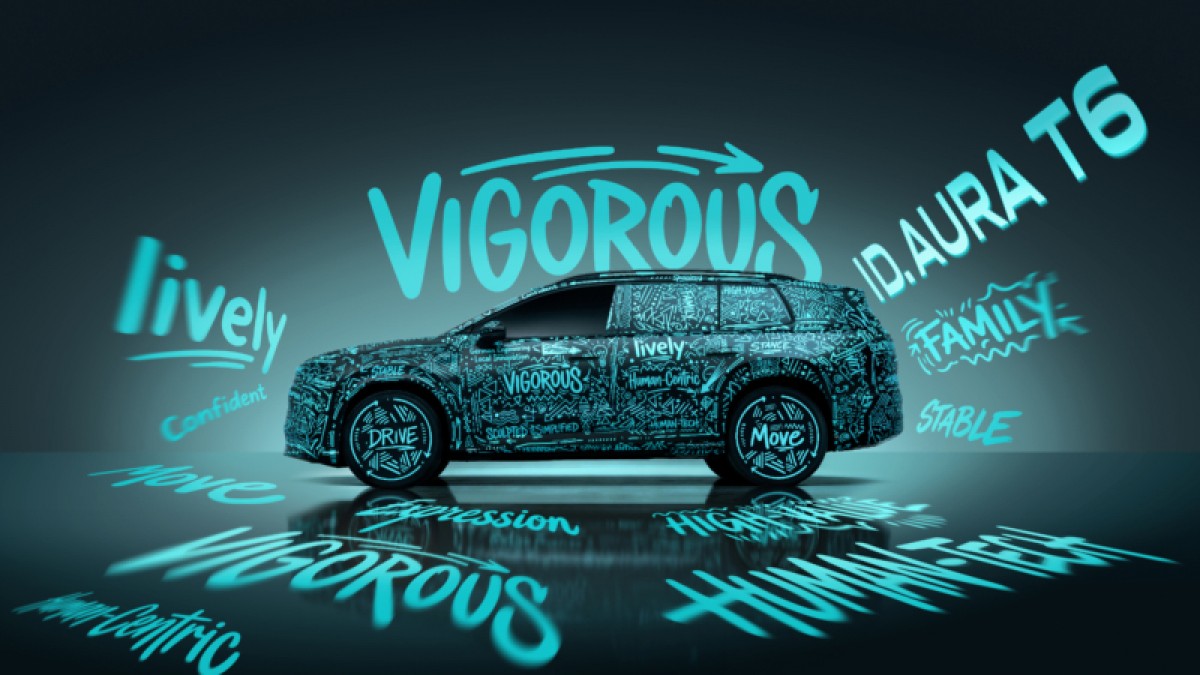
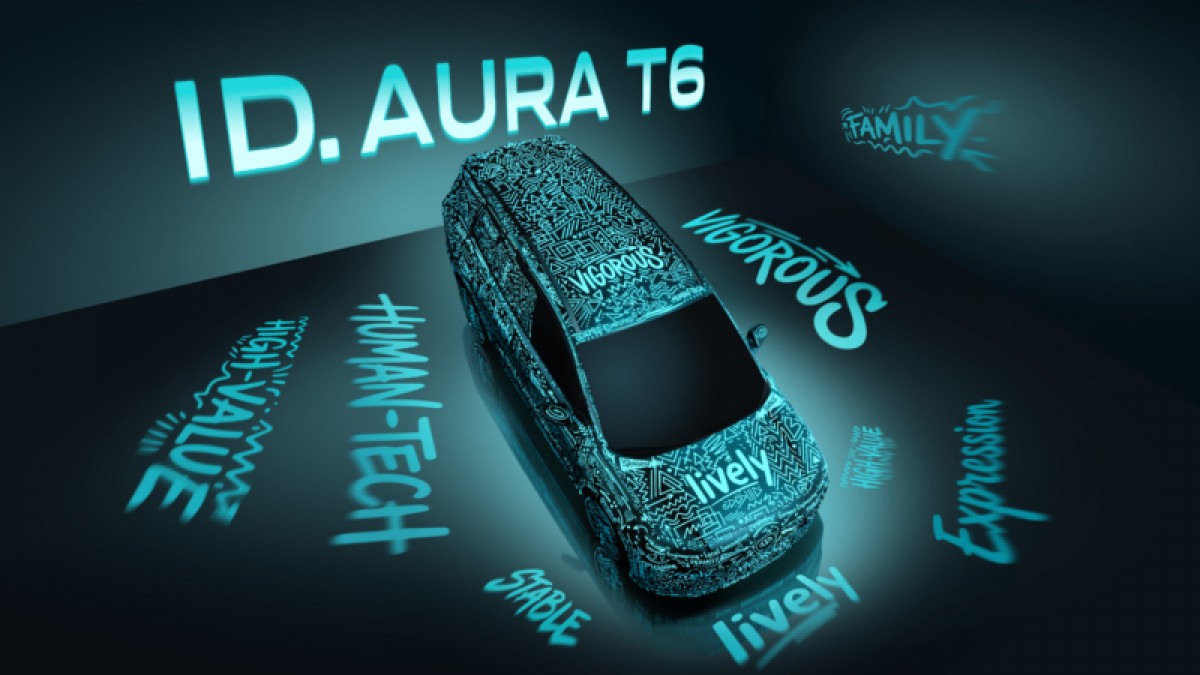
    Volkswagen is making another big move in China. The company showed off the ID. Aura T6 for the first time – a new vehicle designed specifically for the local market. This EV comes from the FAW-Volkswagen joint venture and highlights how German car makers are now working closely with Chinese tech firms. The ID. Aura T6 reveals a shift in how Volkswagen builds its EVs by using technology from XPeng.

    The public will get its first close-up look at this vehicle at the Beijing Auto Show starting April 24, 2026. We’ve seen many electric cars from the ID. family before, but this one feels a bit different. It follows a series of concept cars that first appeared in 2025. Initially, we thought the Aura name would belong to a sedan, but Volkswagen decided to go with a mid-size crossover instead.

    VW ID: Aura T6 - source: FAW-Volkswagen
    VW ID: Aura T6 – source: FAW-Volkswagen

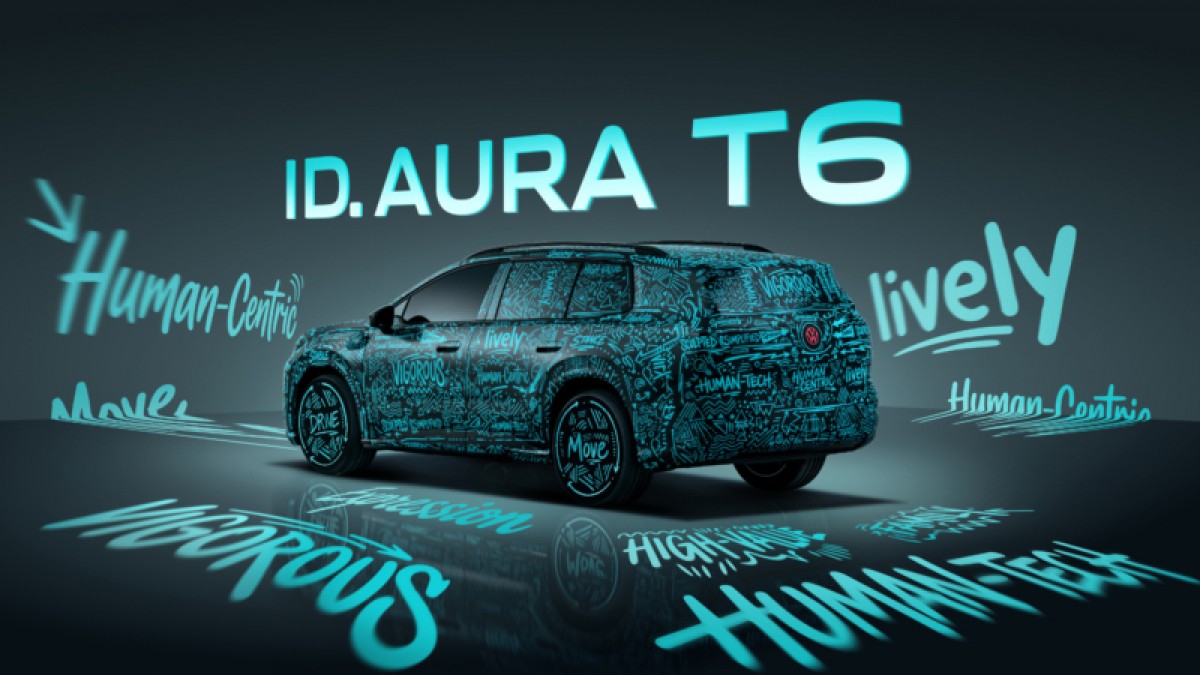
    Volkswagen has a specific meaning for every part of the name. The word “Aura” is actually an acronym. It stands for Advanced, User-centric, Reliable, and All-access. These are the four pillars the brand wants to focus on for its future EVs. The letter “T” simply stands for “Travel.” The number 6 is a bit more poetic, as Volkswagen says it represents the “golden balance point” for this size of vehicle. Whether or not drivers feel that balance is a different story, but it shows the company is putting a lot of thought into the branding.

    When looking at the ID. Aura T6, the design is a bit of a puzzle. It does not look like a traditional, boxy SUV, but instead, it has a body that mixes the styles of an SUV and a minivan. The car has a very short hood and a windshield that leans back quite far. This shape helps the car cut through the air better, which is important for getting more range out of the battery.

    VW ID: Aura T6 - source: FAW-Volkswagen
    VW ID: Aura T6 – source: FAW-Volkswagen

    In terms of size, the new VW is a large machine – it measures approximately 16 ft in length, putting it right in the middle of other Volkswagen models like the ID. Era 9X and the ID. Unyx 08. Because it is so long, the interior is spacious enough for three rows of seats. Volkswagen chose a 2+2+2 layout. This setup is great for families because it gives everyone a bit more personal space than a standard bench seat would.

    The ID. Aura T6 uses the new CEA electronic architecture. This system was built together by Volkswagen and XPeng. By working together, they managed to reduce the number of electronic control units by 30 percent. Having fewer computers sounds like a step backward, but it actually makes the car smarter and easier to update. It allows the vehicle to receive “over-the-air” updates, much like a smartphone, and supports advanced AI systems inside the cabin.

    VW ID: Aura T6 - source: FAW-Volkswagen
    VW ID: Aura T6 – source: FAW-Volkswagen

    Safety and self-driving features are also a major focus for this new model. The ID. Aura T6 is the first electric crossover from Volkswagen to feature a LiDAR sensor on the roof. This sensor acts like a laser eye that helps the car see everything around it. The car uses a system from Carizon, which is another partnership between Volkswagen and Horizon Robotics.

    Volkswagen even used some light humor during the reveal. The test cars were covered in a camouflage wrap that said “German engineering + local innovation.” It is a clear sign that the company knows it needs help from local tech experts to stay competitive. Even with the wrap, you can see the illuminated badges on the front and back, which is a signature look for the brand’s newest EVs. More specific details about the battery size and power will likely come out once the Beijing Auto Show officially begins.

    Via

    Source link

  • Next-Gen Nissan Xterra Revealed, Sort of: Nissan Shares First Images

    Next-Gen Nissan Xterra Revealed, Sort of: Nissan Shares First Images

    The jury’s still out on whether Nissan CEO Ivan Espinosa was right when he told us that “Nissan is back” last year, but one thing is certain: the Xterra sure is. Tonight, alongside announcing a new strategic plan for Nissan and Infiniti, the Japanese automaker shared the first image of the next-generation Nissan Xterra as it commits to relaunching its once-popular off-road SUV in the next few years.

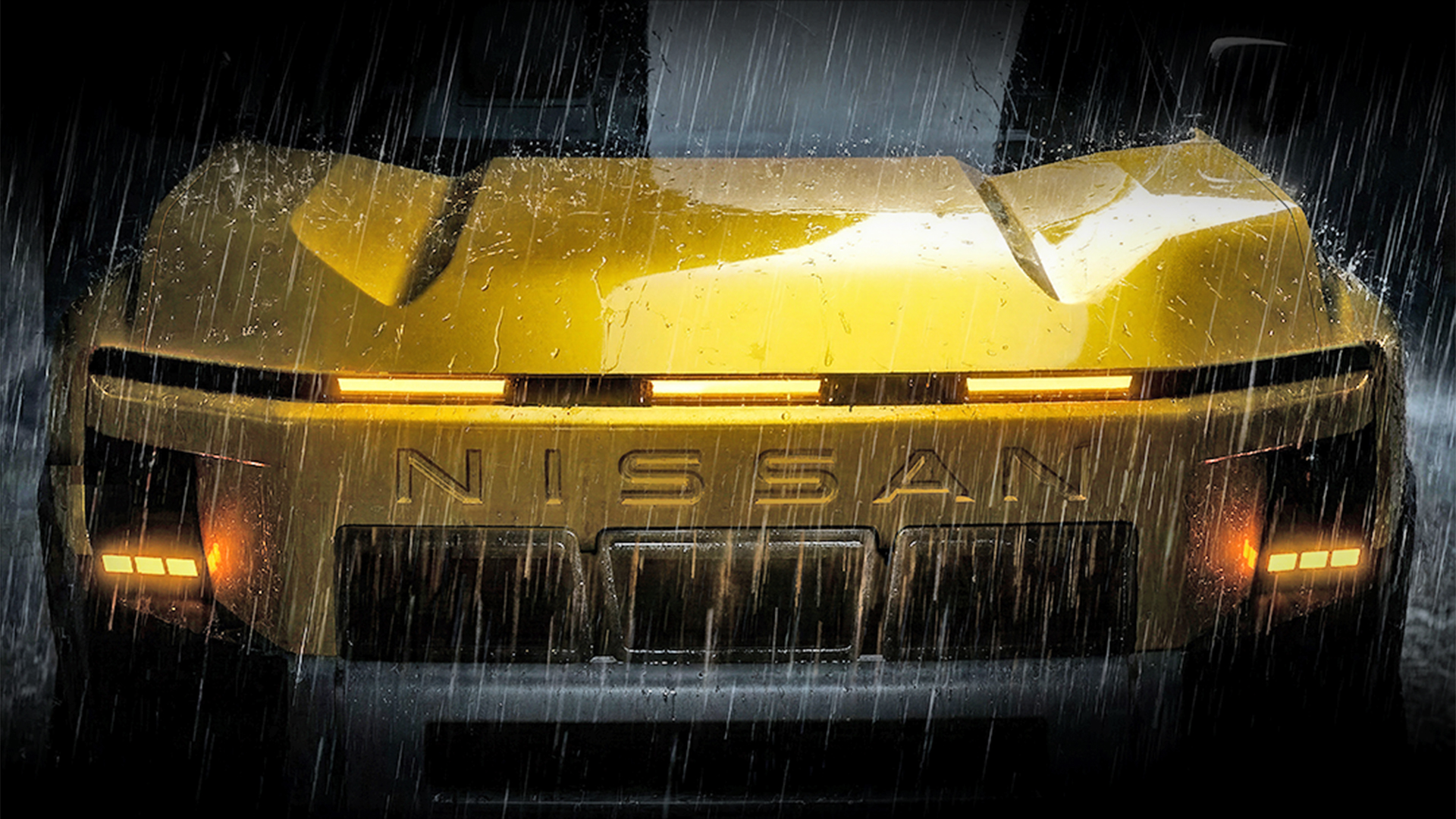
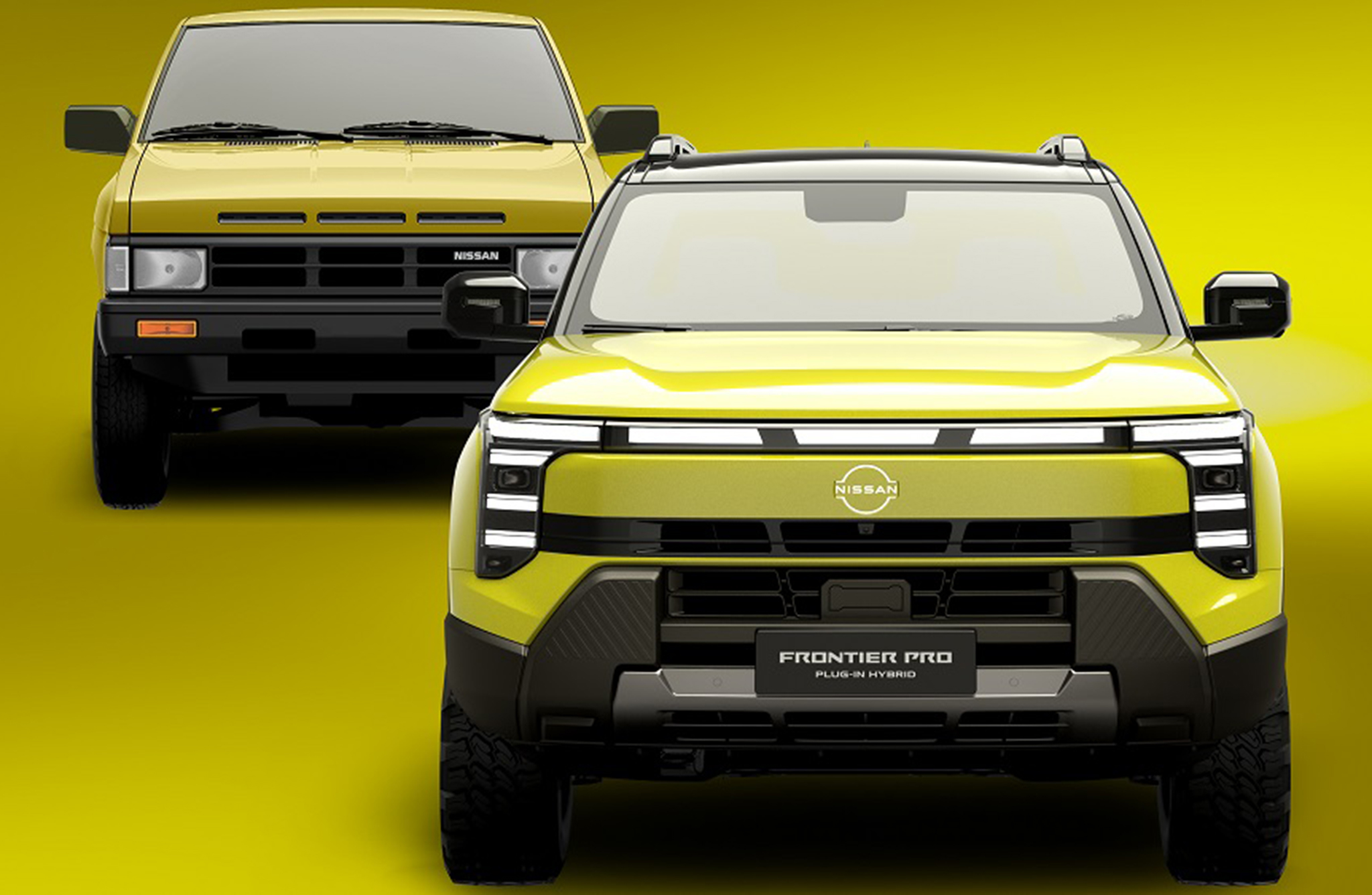
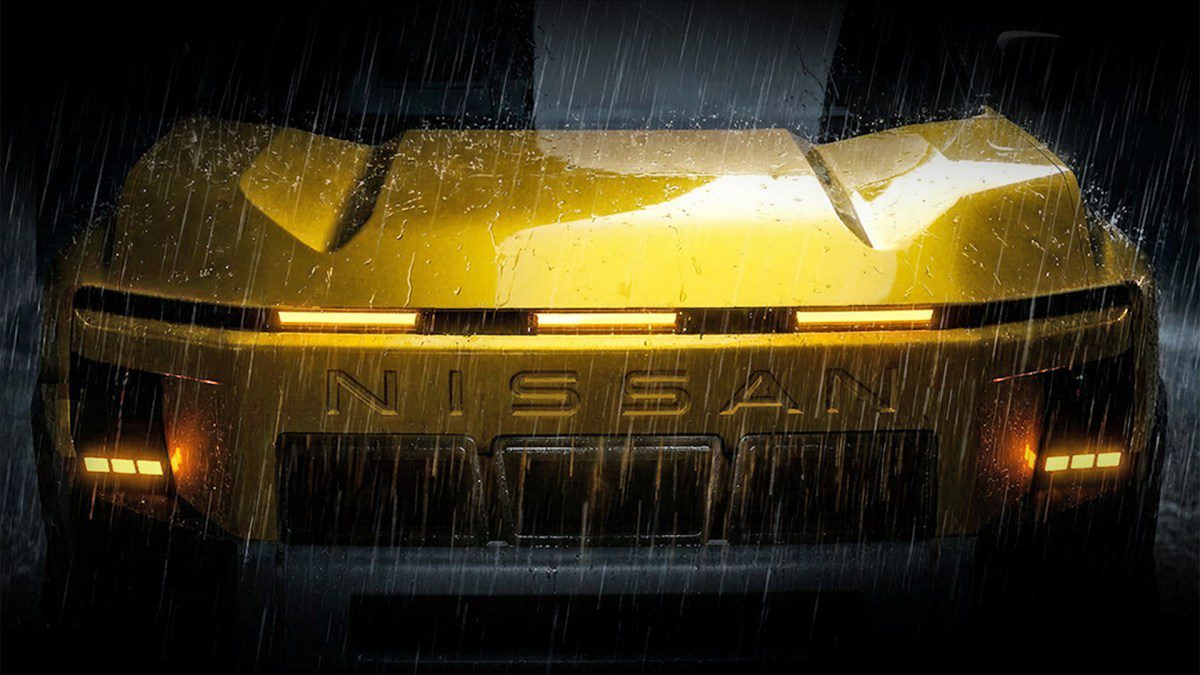
    The teaser image shows the Xterra’s blocky front end above the bumper and below the windshield, revealing a segmented light bar across the nose with the daytime running lights as bookends, lower projector lamps with integrated turn signals, a three-section grille, and deep character lines running down the hood to set off the fenders. NISSAN is stamped across the nose in big letters. (Which, was anyone else hoping for a badge there?) It’s real yellow, as we reported it would be last year. As per usual with these releases, running the image through Photoshop reveals a clearer picture, but not much more information.

    new nissan xterra front end revealed
    Do those side indicators look a little like Hyundai’s pixels to anyone else? Nissan

    But! Here’s a tip. If you want a slightly better sense of how the Xterra might look, take a look at the new Nissan Frontier plug-in hybrid pikcup the automaker recently revealed for the Chinese market. That truck is based on a different platform made by Dongfeng so the details doesn’t line up 1:1 with the new Xterra, which will be built on the actual Nissan Frontier platform while also offering a regular hybrid option (confusing, I know), but you can see the lighting signature and overall motif are largely the same.

    original nissan pickup and new nissan frontier pro plug-in hybrid
    Nissan

    Honestly, it’s pretty good. I won’t lie, as a fan of vehicles with actual faces, I’d much prefer Nissan just slapped the current Frontier’s nose on the Xterra and called it a day, which is basically what it did with the original Xterra. But this one is undeniably sharper and does feel more suited to sharing a lot with the Nissan Z, for example. And unlike the Z’s beautiful design going unappreciated as prices rise and the sports coupe market keeps contracting, the Xterra just might deliver what Nissan needs most of all: sales.

    We’ve been all over the Xterra’s relaunch since rumors first started spilling out, breaking the news that Nissan plans to start pricing below $40,000, use a V6 engine instead of a turbo-four, and use the Xterra as a base to build a new “family” of body-on-frame trucks that just might include a new Pathfinder. As mentioned above, today’s announcement also came with the expected confirmation that the Xterra will offer both hybrid and non-hybrid V6. If it’s wasn’t obvious before, it has the Toyota 4Runner squarely in its sights. This will be interesting.

    Got a tip about the new Xterra? Send us a note: tips@thedrive.com

    As Editor-in-Chief, Kyle draws on 15 years of newsroom experience and a lifelong passion for cars to shape The Drive’s singular approach to automotive news.


    Source link

  • Melbourne Motor Show biggest in over a decade

    Melbourne Motor Show biggest in over a decade

    MELBOURNE played host to one of the largest motor shows in recent memory last weekend, the three-day event featuring more brands over more floor space than previously, attracting record crowds. 


    In terms of scale and public interest, it was reminiscent of the last Australian International Motor Show to be held at the Melbourne Convention and Exhibition Centre (MCEC) back in 2011. 


    Organisers estimate that as many as 120,000 visitors attended the sold-out three-day event (up 45,000+ from 2025), doubling its previous footprint by using all 20 MCEC bays. 


    Primarily centred on Chinese new energy manufacturers – including BYD, Denza, Farizon, GAC, Geely, GWM, JAC, MG Motor, Polestar, Smart, and Zeekr – the event was balanced by more established players that included Harley Davidson, Honda, Isuzu Ute, Kia, Renault, Skoda, Tesla, and Volkswagen, alongside dozens of aftermarket suppliers, car clubs, and automotive accessory vendors. 


    In a boon for crowds, the 2026 Melbourne Motor Show also hosted the Australian public debut of several new models from a wide range of brands, the highlights of which we have included below. 


    Some brands also brought in models sold in other markets and under consideration for Australia, displaying them to gauge public reaction. 


    Denza Z9GT  

    The Z9GT large shooting brake from BYD premium brand Denza is touted as a leap forward in new energy innovation, not only ushering in new levels of performance, dynamism, and luxury, but battery and charging technology that leaves competitors in the stone age. 


    Powered by BYD’s next-generation Blade Battery 2.0, the Denza Z9GT offers ‘Flash’ ultra-fast charging (available only at selected Denza dealerships at launch) that will offer peak DC charging of 1500kW, enabling a 10-97 per cent charge time claim of just nine minutes. 


    For the flagship battery electric version coming to Australia, driving range is listed at 820km and system output 850kW via a three-motor, all-wheel drive configuration. Denza also produces not-for Australia plug-in hybrid and a rear-drive options. 


    The Denza Z9GT is said to accelerate from 0-100km/h in a claimed 2.7 seconds, and rides on DiSus-A air suspension that is said to offer grand touring levels of ride comfort and handling confidence. 


    Inside, the cabin décor pays tribute to “centuries on Chinese mastery in exquisite design” and includes highlights such as Nappa leather upholstery, massaging seats, a 50-inch segmented head-up display, Devialet premium audio bundle, and 128-colour LED ambient lighting to name but a few. 


    “The Denza Z9GT proves the electrification can deliver not just efficiency, but exhilarating performance, extraordinary safety, and genuine long-distance usability,” said Denza Australia chief operating officer Mark Harland. 


    Pricing and further specifications will be revealed when the model goes on sale in Q3 this year. 


    IM Motor LS9

    Touted as a large, high-technology, luxury large three-row SUV, the IM Motor LS9 demonstrates “the future direction of intelligent electric mobility” for MG Motor’s premium brand. 


    The LS9 is offers highlights such as four-wheel steering, lidar-based advanced driver assistance systems, artificial intelligence computing platforms, and “high-level automated driving features”. 


    An 800-volt electrical platform pairs with dual electric motors and a range-extending petrol engine to deliver an output of 390kW/670Nm and driving range of up to 1500km on the more lenient CLTC scale. 


    Inside, the LS9 is said to emphasise a “highly digital and premium cabin experience” with large, integrated displays, advanced connectivity, and “luxury seating configurations” that are designed to position the model as a “flagship technology showcase”. 


    Geely EX2  


    Offered with complimentary home charging equipment, the EX2 will join the EX5 (electric) and Starray EM-i (plug-in hybrid) medium SUVs in Geely’s expanding local line-up and is offered with a choice of six paint colours, a single electric motor, rear-wheel drive dynamics, a sophisticated multi-link rear suspension layout, and efficient liquid cooled battery. 


    While specifications and pricing are yet to be announced, the model is expected to be competitively placed to take on similar-sized entrants from Chinese importers, including those of the BYD Dolphin, GAC Aion UT and MG 4 Urban. 


    Zeekr X 

    Zeekr revealed full specifications and pricing for its updated ‘X’ compact SUV ahead of the model’s May launch, the battery electric crossover positioned as “one of the strongest value offerings in the segment”, according to its manufacturer. 


    The five-seat Zeekr X is priced from $48,900 drive-away ($8000 less than when the X launched Down Under in September 2024) and offers the choice of rear- or all-wheel drive configurations delivering 250kW and 365kW of output respectively, and a driving range of up to 415km on the WLTP cycle. 


    Standstill to 100km/h acceleration times for the duo are listed at 5.6 seconds and 3.7 seconds respectively, with an improved Golden Battery (LFP) pack optimised to offer 230kW DC fast charging for a 10-80 per cent charge time claim of just 18 minutes. 


    The Zeekr X is said to deliver a “richer suite of in-cabin convenience and technology” introducing previously optional features as standard. 


    These include heated first- and second-row seats, inductive steering wheel controls, a 13-speaker Yamaha surround sound audio system, and, on the AWD variant, massaging front seats plus an on-board fridge. 


    With more advanced safety and driver assistance technologies than before, Zeekr Australia managing director Frank Li says the Zeekr X looks set to make its mark in a highly competitive segment, without asking a premium for the privilege. 


    “Our customers have embraced the Zeekr X for its design, intelligence, and everyday practicality,” he said. 


    “With the new model, we’ve added more performance, faster charging, and more features and standard, while keeping pricing competitive. 


    “It offers genuine luxury EV credentials without pushing beyond what buyers expect to pay.” 


    Volkswagen Tayron and Tiguan eHybrid 

    The Volkswagen stand offered visitors to the Melbourne Motor Show a chance to get up close and personal with plug-in hybrid versions of its Tayron and Tiguan SUVs, priced from $62,390 and $64,590 respectively (befoere on-road costs). 


    Available in Elegance and R Line grades, the plug-in hybrid SUV duo is around $2000 and $3000 pricier than their petrol derivatives but offer fuel-saving 1.5-litre petrol-electric drivelines outputting 150kW and 200kW respectively and offering a combined cycle fuel consumption figure of as low as 1.6 litres per 100km. 


    Electric-only driving range is listed at 113km and 117km for the pair, while rapid DC charging is rated at up to 40kW, allowing a 10-80 per cent top-up of the 19.7kWh battery in around 30 minutes. 


    The front-wheel drive pair is available in five-seat format only, owing to the placement of the high-voltage battery pack. 


    Initial customer deliveries are expected imminently. 


    Farizon V7E and F3E 

    Electric light commercial vehicle producer Farizon has showed its latest V7E (van) and F3E (cab-chassis) models at the Melbourne Motor Show, each offering a competitively priced solution to courier, fleet, and trade buyers looking to make the move to an electric vehicle. 


    While details of the F3E are yet to be finalised, the V7E is confirmed for arrival in the Australian market in May with a drive-away price of just $49,990 – undercutting several key competitors including the Kia PV5 (from $55,990 + ORC) and Volkswagen ID.Buzz Cargo (from $69,990 + ORC). 


    Importer Jameel Motors Australia says the V7E delivers payload (over 1300kg) and cargo capacity (6.95m3) that is comparable with traditional ICE-powered vans, right-sized proportions, and “efficient electric performance suited to urban delivery environments”. 


    “The V7E has been developed to meet the real expectations of commercial vehicle operators … with pricing that sits competitively alongside traditional ICE vans,” said Jameel Motors Australia country general manager Adam Lawson. 


    Customer deliveries of the V7E are expected to commence in May with further specification details available soon. 


    GWM Ora 5 

    At the other end of the performance spectrum to the likes of the Denza Z9GT, but still with a lot of offer prospective battery electric vehicle buyers, is the GWM Ora 5 SUV. 


    Replacing the unloved Ora hatch from an sharp $33,990 plus on-road costs, the Ora 5 SUV is slated to arrive in Australian showrooms from June, offering 150kW/260Nm of system output, seating for five, a 58.3kWh lithium iron phosphate battery, and up to 430km of WLTC driving range. 


    GWM says the Ora 5 SUV can be recharged from 30-80 per cent in approximately 20 minutes “in ideal conditions”, the model supported by DC fast charging at up to 120kW. 


    It offers a long list of standard inclusions such as vehicle-to-load (V2L) functionality, LED headlighting, a 14.6-inch infotainment array, over-the-air (OTA) software updates, a 362-litre boot, and a palette of five vivid colours. 


    Further information on the GWM Ora 5 is available here.


    Honda Prelude 

    Honda’s keenly anticipated Prelude hybrid coupe took pride of place on the Japanese importer’s Melbourne Motor Show stand, the model officially priced from $65,000 drive-away ahead of its May launch. 


    Offered in a single grade, and in five colours, the Prelude returns to Honda’s line-up after a 25-year hiatus, bringing with it new technologies, a stylish two-door body design, a performance chassis (based on the Honda Civic Type R) and a “confidence-inspiring drive” that fosters the “ultimate connection between human and machine”. 


    Part of that connection comes from Honda’s new S+ Shift technology that debuts on the Prelude, offering a simulated sound and feel that is said to resemble a quick-shifting automatic transmission with an “evocative engine sound” – all at the push of a button. 


    Speaking at the Melbourne Motor Show, Honda Australia director Andrew Thorp said the 2026 Prelude is a bold reinterpretation of the original model that brings the joy of driving into the hybrid era. 


    “The 2026 Prelude is a bold interpretation of an iconic driver’s car for the hybrid era, developed from the same dreams and with the same spirit and ambition as the first Prelude back in 1978,” he enthused. 


    MG 4 EV, MG 4 Urban, HS Hybrid +, S6 EV, U9 EV, and U9 Black Edition  

    MG Motor debuted its refreshed MG 4 EV alongside a range of new-to-market entrants and revised models in Melbourne. 


    The reveal of the updated MG 4 EV introduces what the Chinese importer says is a family-sized electric hatchback bringing “even stronger technology, enhanced cabin quality, and engaging performance and improved driving” to the range, changes that come from customer feedback. 


    With an improved driving range, larger infotainment screen, the option of rear- and all-wheel drive the MG 4 EV offers a driving range of up to 452km (WLTP). 


    MG Motor also introduced its new S6 EV to Melbourne crowds, the mid-sized electric SUV featuring a high-capacity battery that offers a driving range of up to 530km (WLTP) and a fast DC charging time of 38 minutes (based on a 10-80 per cent top-up). 


    The importer says it will offer the S6 EV in both rear- and all-wheel drive configurations but has kept full specifications and pricing under wraps until the model is launched later this year. 


    Building upon its U9 utility range, MG Motor introduced both the U9 EV and U9 Black Edition at the Melbourne Motor Show. 


    The “next evolutions of the U9 story” mark what MG Motor says is an important step in its electrification journey, moving into a category that “continues to be one of the most popular among Australian drivers”. 


    More information on the U9 EV and Black Edition will be available soon, with official launch timing to be revealed “at a later date”. 


    Also appearing was the recently launched MG 4 EV Urban, a city-centric electric hatch offering a front-wheel drive layout, cleverly designed interior, and competitive pricing from just $31,990 drive-away. 


    MG Motor Australia managing director Dimitri Andreatidis said the model is part of the brand’s broader ambition of lowering the barriers to electrification by offering electric vehicles with pricing comparable to similarly sized petrol-powered cars while still delivering a “balanced mix of technology, range, and convenience features”. 


    The MG Motor stand also hosted the HS Hybrid + SUV, a model that combines turbocharged petrol and electric power to deliver 165kW to the front wheels, a longer all-electric driving range than before, and “seamless acceleration and reduced fuel consumption”. 


    Released late last year, the MG HS Hybrid + is available from $40,990 drive-away, and is said to place a strong emphasis on comfort and practicality designed to support everyday duties. 


    “Not every driver is ready to go fully electric, and that’s where hybrids play an important role,” added Mr Andreatidis. 


    “Vehicles like the MG HS Hybrid+ provide a practical bridge, delivering strong efficiency gains without requiring chargers.” 


    Renault Master and Symbioz  

    Renault showcased both its latest generation Master van (due in showrooms from June) and its new Symbioz compact SUV in Melbourne, alongside a range of offerings from its current portfolio. 


    The new generation Master is the first complete refresh of the commercial offering in over a decade and is available for the first time in both diesel and battery electric formats. 


    With a choice of mid- and long-wheelbase chassis configurations and mid- and high-roof body styles, the model is also available to modify as a camper van or horse carrier, as shown on the Renault stand in Melbourne. 


    Offering a higher standard of interior finish, a more aerodynamic profile, and a suite of all-new connectivity and safety equipment, the Renault Master is also capable of carrying more than the model replaces, while making more power and torque from the carryover turbocharged 2.0-litre four-cylinder diesel engine and nine-speed automatic combination (now 125kW/380Nm). 


    The all-electric Master E-Tech, meanwhile, offers an 87kWh lithium-ion battery pack to deliver more than 400km of driving range and a DC fast-charging capacity of 130kW. 


    Understood to deliver 105kW/350Nm of system power, The Master E-Tech is also expected to land with a 15-80 per cent recharge time of 38 minutes. 


    For the Renault Symbioz – which is slated for local arrival in the second half of this year – within proportions comparable with those of the Toyota Corolla Cross are a choice of mild hybrid and a full hybrid drivetrain options. 


    The mild hybrid powertrain consists of a 1.3-litre four-cylinder engine – producing 104kW and 245Nm – and a seven-speed dual-clutch transmission while the full hybrid uses a larger 1.8-litre four-cylinder engine – producing 80kW and 107Nm – paired with an electric motor generating 36kW and 205Nm and sourcing electricity from a 1.4kWh battery. 


    This is good for a claimed WLTP driving range of up to 1000km, says Renault. 


    Its hybrid system can use electric power only during acceleration up to 60km/h, which Renault says reduces fuel consumption by 40 per cent. 


    Full Australian specifications, pricing and official arrival times are yet to be confirmed, but a 10.4-inch infotainment screen, a 10.25-inch digital instrument cluster, Google Built-in services, a dimming panoramic sunroof, sliding rear seats, and 18- or 19-inch alloy wheels are listed as key equipment highlights. 


    BYD Seal 6 and Shark 6 

    BYD offered Melbourne Motor Show crowds a first look at its newly announced plug-in hybrid Seal 6 Sedan and Touring (wagon) range, as well as its updated Shark 6 PHEV utility, now available with a more powerful 2.0-litre driveline in flagship form and an entry-level cab-chassis configuration. 


    The Seal 6 Sedan and Touring are said to offer an exceptional long-distance range of more than 1000km from a full tank and battery, with pricing from just $34,990 before on-road costs. 


    Rivalling Toyota’s popular Camry, the Seal 5 features BYD’s ‘DM 5.0 Super Hybrid’ powertrain technology comprising a 1.5-litre Atkinson cycle four-cylinder petrol engine and electric motor, a 10.1kWh or 19.0kWh lithium iron phosphate (LFP) Blade battery, and an all-electric driving range of up to 100km. 


    Full specifications are set to be announced closer to the model’s imminent release, though it is noted that equipment highlights include an 8.8-inch digital instrument panel, a 12.8-inch infotainment array, wireless Apple CarPlay and Android Auto connectivity, seven airbags, adaptive cruise control, autonomous emergency braking, blind spot monitoring, child presence detection, and Level 2 semi-autonomous driving functionality. 


    Meanwhile, the Shark 6 PHEV utility range is expanded to offer more trim grades, cab-chassis tray options, and a new Performance grade that combines a a larger 2.0-litre engine, with power and torque figures pushed out to 350kW/700Nm. 


    The 0-100km/h time drops to 5.5 seconds, and towing capacity uprates to 3500kg. The Performance grade also introduces a new Crawl mode – which will also be made available via an over-the-air (OTA) update for the Dynamic and Premium models later this year – joining Mountain mode in the Shark 6’s suite of off-road settings. 


    Crawl mode is designed to tackle off-road obstacles at slow speeds, limiting the Shark 6 to 20km/h, while making continuous torque adjustments to counter wheel slip. 


    Full specifications are yet to be officially confirmed for the updated model line-up, but a smaller 12.8-inch infotainment touchscreen in the Cab-Chassis (compared to the 15.6-inch found in the Premium and Performance models) comes equipped with wireless Apple CarPlay and Android Auto 


    A 10.25-inch digital instrument cluster, 6.6kW vehicle-to-load (V2L) functionality, and a full ADAS safety suite including a 360-degree camera are listed among the standard equipment. 


    Source link