Replicating Chevy’s Record: The Mission Behind the Madness
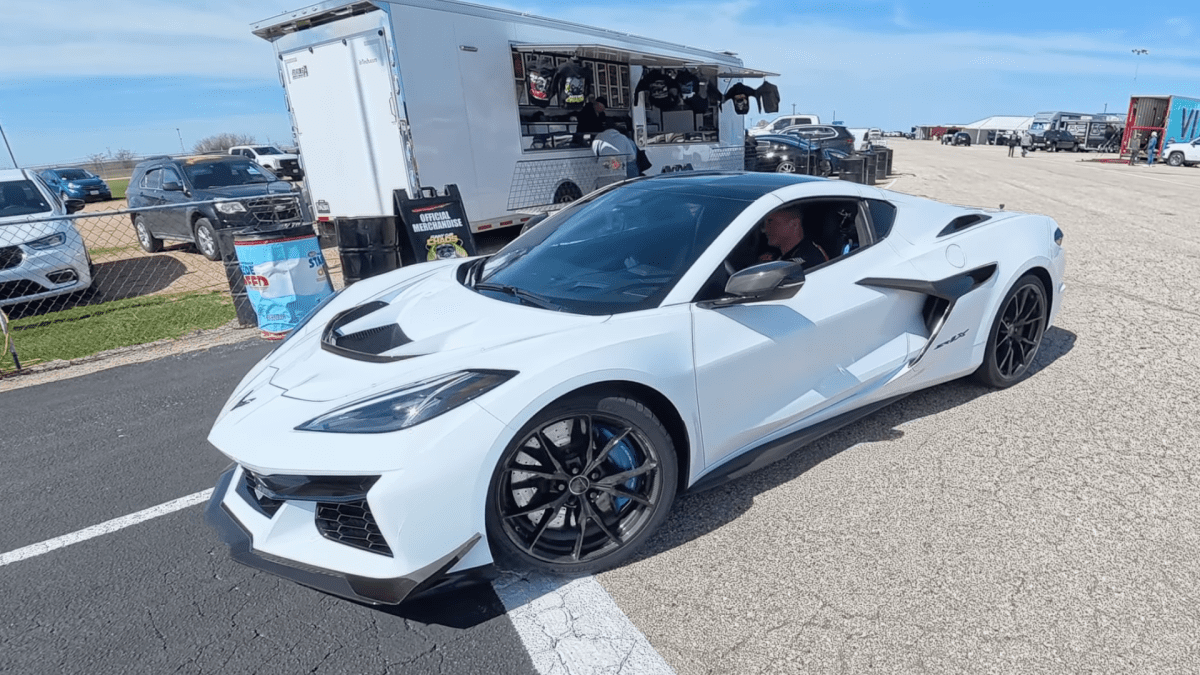
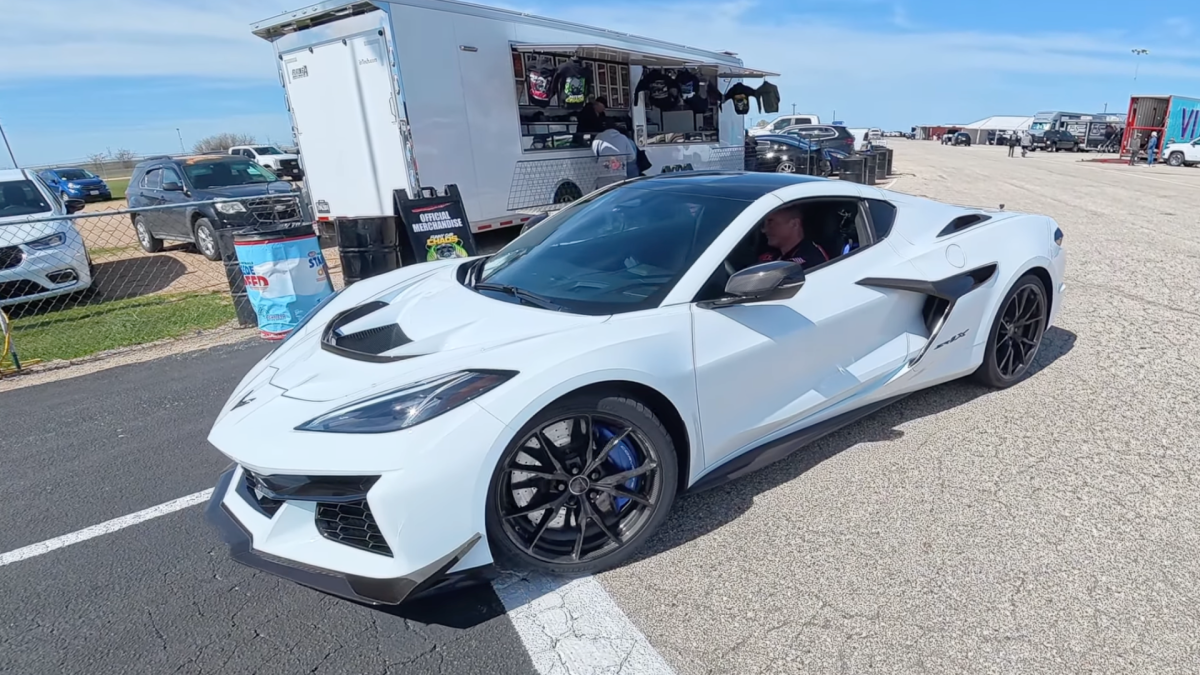
DragTimes set out with a very specific objective: prove that Chevrolet’s headline-grabbing 8-second quarter-mile claim for the Corvette ZR1X wasn’t a one-off, factory-controlled miracle. Instead of a prepped press car with engineers on standby, this was a customer-owned example, piloted under real-world conditions at TX2K in Dallas, Texas. The goal was simple on paper: replicate Chevy’s reported 8.6-second pass while validating whether the ZR1X’s performance is truly repeatable.
That matters because prior tests, including Chevrolet’s own runs and independent validation such as NHRA-backed attempts, suggested that the ZR1X redefines what “production car” even means. With a twin-turbo 5.5-liter flat-plane V8 paired to a hybrid front axle delivering a combined 1,250 horsepower, the ZR1X has already been positioned as the quickest factory street car ever built. The question DragTimes wanted answered: Can a regular owner actually access that performance?
Conditions, Passes, and Brutal Acceleration
The conditions were nearly perfect. Cool air and a well-prepped track gave the team a real opportunity. Minor adjustments were made before the run. Floor mats were removed to save weight. The rear wing was also taken off to reduce drag, despite Chevrolet not recommending it. The goal was maximum straight-line efficiency.
The first run was delivered immediately. The ZR1X posted an 8.74-second pass at 159 mph. The launch was aggressive and clean. The car hooked hard and showed no hesitation. More importantly, it repeated. Additional runs landed at 8.78 and 8.76 seconds. The data backed it up. A 0–60 mph time of 1.7 seconds and a 1.39-second 60-foot confirmed the violence off the line. Even as the electric assist drops past 130 mph, the car continues to pull hard. The fact that they can consistently replicate the results, close to the earlier test results, means Chevy meant business with the ZR1X.
DragTimes/YouTube
View the 3 images of this gallery on the
original article
A $250K Supercar That Rewrites the Rules
The ZR1X carries a price tag between $250,000 and $270,000. That places it deep into supercar territory. The difference is what it delivers for that price. This is a car capable of mid-8-second passes without a factory team. It does it with minimal preparation and repeatable results.
That changes the conversation. The ZR1X is not just fast for a Corvette. It is fast compared to anything. DragTimes proved that Chevrolet’s numbers are not inflated. They are achievable. In real conditions, with a real owner, the car performs. That level of accessibility is what makes the ZR1X significant. It does not just compete with hypercars. It undercuts them.
DragTimes/YouTube
View the 3 images of this gallery on the
original article
The term “miles per gallon,” commonly abbreviated as mpg, is the distance a vehicle can travel on one gallon of fuel. Understanding your vehicle’s fuel efficiency can help you budget for fuel costs, plan road trips, and identify potential maintenance issues. Fortunately, calculating your car’s mpg is straightforward.
Why Does MPG Matter?
Knowing your car’s mpg gives you a better understanding of the vehicle’s efficiency and range. A higher mpg means you can travel farther on one tank of gas, meaning fewer stops to refuel. Lower-than-normal fuel efficiency can indicate issues such as improper tire pressure, inefficient driving habits, or a maintenance problem. While manufacturers typically include mileage estimates in the vehicle’s specs, these ratings don’t always reflect real-world driving conditions, which is why it’s important to calculate your own.
There are several ways to measure your vehicle’s fuel efficiency, but we recommend using the full-tank method to determine mpg.
Step 1: Fill Up Your Tank Completely
Filling your gas tank completely gives you a consistent starting point for your calculations. It’s much easier to begin with a full tank than to estimate how many gallons you already have.
Step 2: Take Note of Your Current Mileage
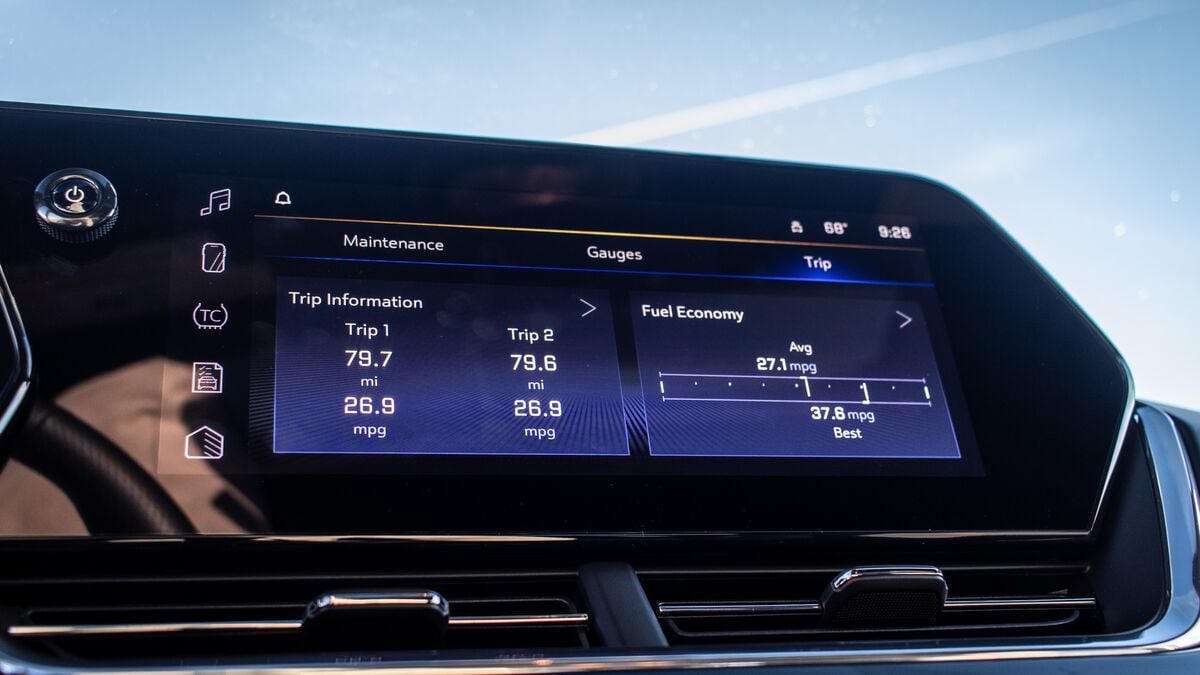
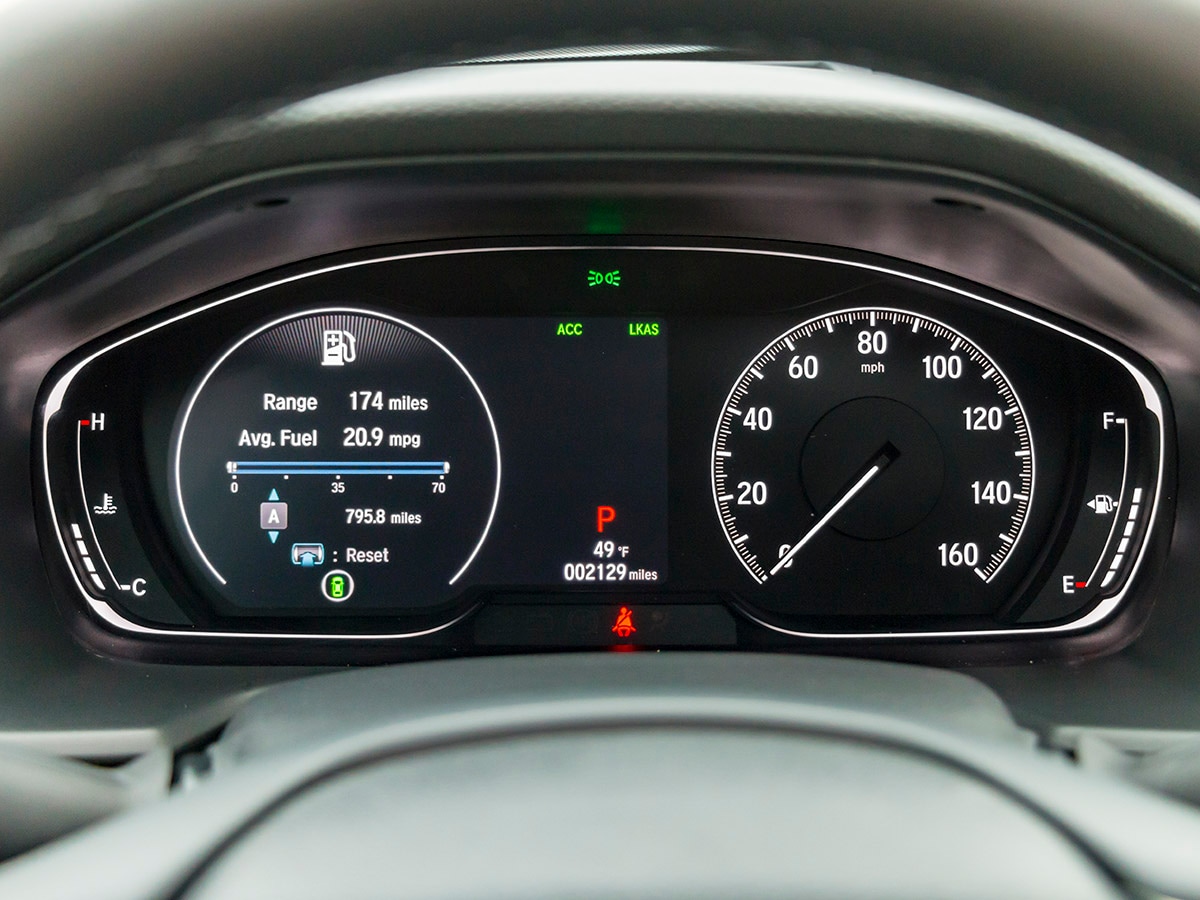
Many cars have a trip odometer separate from the vehicle’s overall mileage. We recommend using this feature if it’s available, since it will save you an extra step later. If you own an older car that does not have this feature, you can simply note your car’s mileage when you fill up. If you drive a newer car, its instrument cluster might have a fuel economy indicator that displays mpg in real time.
Step 3: Drive Normally
Follow your usual routine. In general, the more you drive, the more accurate your mpg calculation will be.
Step 4: Refill the Tank
The next time you’re at the gas station, fill up completely once again. Take note of the exact amount of gas needed to refill the tank.
Step 5: Record Your Updated Mileage
Check the odometer to see how many miles you’ve driven since this process started. If your vehicle has a trip odometer, you won’t need to manually calculate your miles. If not, subtract the original mileage from the current mileage. This will tell you how many miles you traveled.
Step 6: Calculate Your MPG
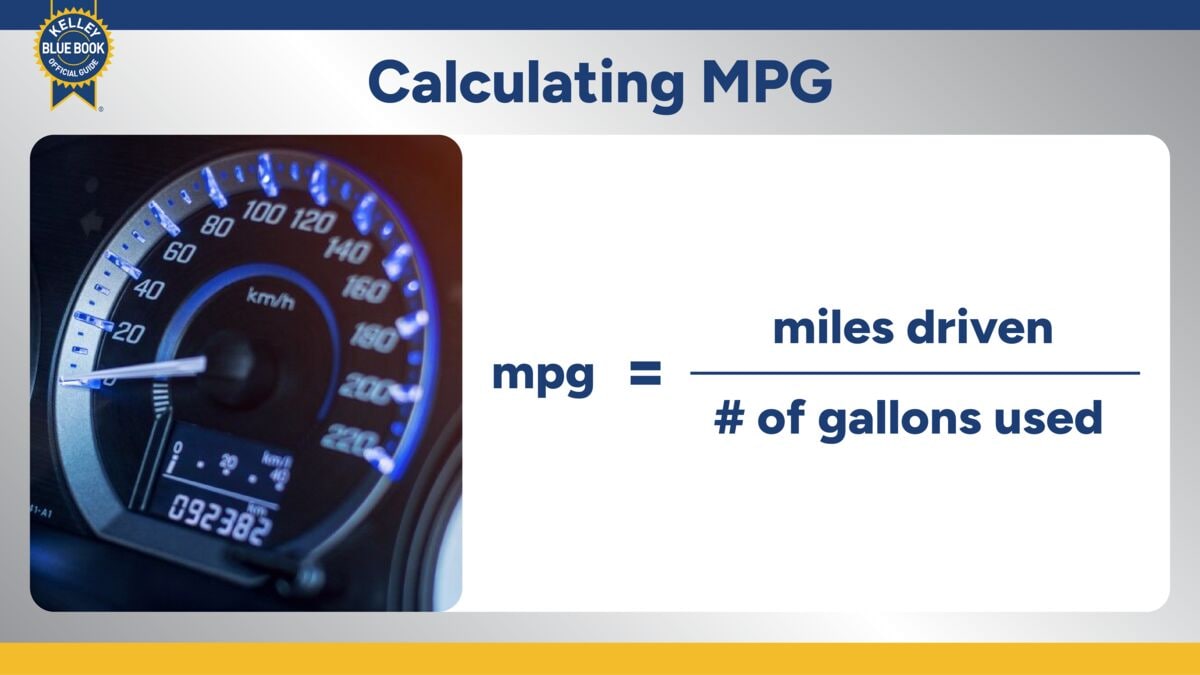
To get the mpg figure, divide the miles driven by the number of gallons used. For example, let’s say you drove 250 miles since the last fill-up, and the car used exactly 10 gallons. You would divide 250 by 10, which would equal 25 mpg.
Final Notes
Calculate your fuel economy regularly to get a sense of your average mpg and be aware of fluctuations that might offer a clue to a mechanical issue. Keep a log and track measurements for local versus highway driving, driving conditions, or seasonal changes.
Lucid’s upcoming midsize platform will open a new chapter for the California automaker, one that’s arguably its most consequential yet. The luxury EV maker is rapidly burning cash, and the midsize models may be its clearest shot at profitability. But success is far from guaranteed in this highly competitive environment.
When I walked into the Investor Day conference in New York City last week, I expected the same industry playbook: plenty of hype, missing details, and bold promises with little substance. What I got was the exact opposite of that.
Lucid bombarded us with information. The automaker not only shared a clear roadmap but also brought along a Cosmos prototype for an early preview and then surprised us with the Lunar robotaxi concept. It went a step further, showing us the midsize EV’s body in white, its new Atlas drive unit, and a look at its next-generation electrical architecture. Photography wasn’t permitted, but I can tell you everything I saw.
With a starting price of around $50,000, the Cosmos midsize crossover will lock horns with the Tesla Model Y, Rivian R2, BMW iX3, Volvo EX60, and a growing list of newer EVs jostling for a share of the segment.
8
Source: Suvrat Kothari
Lucid Cosmos Exterior Design
The automaker brought along a shiny red prototype at the event, with officials claiming it was a near-final design. And it indeed looked that way. There were no concept-car-like fender bulges, unusually large wheels, or any other outlandish design elements that would never make it to production.
At first glance, the Cosmos looked like a baby Gravity with a coupe-like roofline. It has a stubby, curvaceous nose and illuminated Lucid emblems at both ends with spaced-out letters in a much larger font than on the Air and Gravity.
The sharp, angled daytime-running lights and Matrix headlamps give it a striking appearance. There’s also a front-facing lidar sensor embedded in the grille to support Lucid’s personal autonomy and robotaxi ambitions.
The side profile reveals a cab-forward greenhouse similar to the Gravity. But the biggest change here is the manual door handles. They still sit flush with the bodywork, but now have a carved-out recess where you can insert your hand and pull the lever back to open the door.
Photo by: Suvrat Kothari
It’s a small but meaningful departure that’s part of a broader industry reckoning with electronic door handles, which have sparked safety controversies worldwide. When the low-voltage battery powering them fails, the handles can fail too. Automakers are now returning to manual door handles to prevent that from happening.
The rear end of the Cosmos is where things get polarizing. Think Audi Q6 Sportback e-tron, but lower, sportier, and more aggressive. The slippery shape helps the Cosmos achieve a 0.22 coefficient of drag and enables a projected range of over 300 miles. But how broadly people will like it remains an open question.
Derek Jenkins, the Senior Vice President of Design and Brand at Lucid, explained why Cosmos’ sharp rear end looked the way it did. He said the automaker needed a solution for several functional requirements at the back.
“It’s a three-dimensional puzzle,” Jenkins told a group of reporters at the Investor Day. “You not only (want) great space and headroom, but also a great cargo area, great rear visibility, and a great aerodynamic taper.”
Jenkins acknowledged the rear would be an acquired taste, but said it was inevitable given the functional requirements, and felt confident it solved many of the traditional drawbacks that come with a coupe shape.
The exact cargo dimensions remain unconfirmed, but both the rear cargo area and frunk looked generously sized on the prototype.
Lucid Cosmos Interior Design
Inside, the Cosmos felt minimalist and upscale. The steering wheel is identical to the Gravity’s. The curved display and center console screen have been replaced with a single, wide display stretching from behind the steering wheel across to the passenger side. However, it stops short of a full pillar-to-pillar span like the MBUX Hyperscreen on Mercedes-Benz EVs. It’s slightly offset toward the driver.
Lucid made the switch from the Gravity’s screen layout to better support autonomy-related features and to create a more shared experience in the cabin. Jenkins called that a “democratic experience” for passengers.
“We have a lot of plans for how to show navigation, how to show our AI system,” Jenkins said. “Third-party applications could occupy not just a small portion of the screen, but perhaps the entire screen if it were the right opportunity, either through higher levels of autonomy, or even when the car is stationary while charging.”
Photo by: Suvrat Kothari
A right-hand drive version of this screen is also planned, which will come with different mounting points. The automaker is planning to expand to seven European countries this year, including the U.K. and Germany.
The interior will offer a mix of fabric and “non-leather” seat materials depending on the trims, with recycled materials on the door panels. And thankfully, Lucid is not ditching the physical buttons, so drivers can easily access important functions like climate and volume without getting lost in touchscreen menus.
While the Cosmos has a sporty and performance-focused design, the Earth will have a more squared-off silhouette, going by the teasers shared by the automaker. A third, unnamed model will be more adventure-oriented, Lucid said.
Lucid Cosmos Range, Battery Options And Charging
While Lucid didn’t confirm the exact battery size and driving range for the Cosmos, CEO Marc Winterhoff said the midsize platform will offer both lithium-iron phosphate (LFP) and nickel manganese cobalt (NMC) battery packs.
LFP is the dominant battery type in China, known for its durability, lower cost, and less reliance on rare earth materials. The trade-off is energy density. LFP batteries are less energy-dense compared to NMC packs, which makes them more suited for lower-priced, entry-level trims. That said, advancements in packaging by Chinese battery giants have narrowed the range gap considerably in recent years.
Lucid said the midsize platform only needs 69 kilowatt-hours of capacity to achieve 300 miles of range. The actual battery size and range could be higher, and that’s something we’ll know more about further down the road. But it sounds like a promising start, as most electric SUVs need bigger packs to deliver that kind of range.
Photo by: Suvrat Kothari
The Cosmos’ battery will also have a structural design, similar to the Tesla Model Y. Its power electronics are housed under the rear seats, which is great for serviceability since most battery issues often trace back to the electronics and not individual cells, Lucid said. This way, technicians don’t have to lift the car and lower the battery for repairs; they can simply access the power electronics from under the rear seats.
This is also an 800-volt battery architecture, capable of adding 200 miles of range in just 14 minutes of charging. That’s comfortably faster than the Model Y and the new Rivian R2, and in a similar ballpark as the BMW iX3 and the Volvo EX60.
It will also support an important feature most Teslas don’t have yet: AC bidirectional charging. That will include vehicle-to-home (V2H), vehicle-to-load (V2L), vehicle-to-vehicle (V2V), and vehicle-to-everything (V2X) capabilities. So you will be able to power external appliances, light up your camping site, and even power your home with the appropriate installation and equipment.
Power will be moved into and out of the vehicle via a Tesla-style North American Charging Standard (NACS) port, positioned at the rear left of the car.
Lucid Cosmos Centralized Architecture
The midsize platform takes the Gravity’s zonal architecture a step further with a centralized architecture. That means a simpler, more capable electrical and computing system that also costs less to build.
Photo by: Suvrat Kothari
The automaker showed us a torn-down version of this electrical system, and the component count looked shockingly lean. While the Gravity has about twelve electronic control units (ECUs), the midsize platform has a total of only three ECUs. There’s a large central ECU and one each on both sides of the car. ECUs are essentially the computers serving as the “brains” of the car, controlling and managing its various functions.
The result is that the Cosmos has just 0.6 miles (1.1 kilometers) of wiring, which is less than the Tesla Model Y’s 0.8 miles and the Xiaomi SU7’s 1.4 miles, according to Lucid. Fewer ECUs will allow more frequent over-the-air updates, and enable more AI and autonomous features over time due to the simplicity of the system, Lucid said. It also simplifies vehicle assembly and lowers manufacturing costs, which is critical for the automaker to hit that $50,000 starting price.
Lucid Cosmos “Atlas” Drive Motor
In a closed room, Lucid officials showed us the new Atlas drive unit that will go into its midsize EVs. A drive unit typically consists of a planetary reduction gear set, differential, rotor, stator, along with an inverter and an integrated cooling system.
To illustrate just how compact Atlas is, Lucid placed it alongside the drive units from a Model Y, a Hyundai Ioniq 5, and the Gravity. Atlas looked visibly smaller than both the Tesla and Hyundai units, and even smaller than Lucid’s own Zeus motor from the Gravity. The Ioniq 5’s unit looked bulky, by comparison.
Photo by: Suvrat Kothari
Atlas has 30% fewer parts compared to Zeus, a 37% lower bill of materials, and is 23% lighter. And the front and rear Atlas drive units are essentially the same, further lowering the manufacturing complexity. Its tiny size also explains the Cosmos’ excellent packaging and interior roominess—both of which are also the Gravity’s hallmarks.
With 40% better power density and 10% better energy efficiency than the Model Y’s drive unit, Lucid is projecting the Cosmos to deliver up to 4.5 miles per kilowatt-hour of efficiency. Most EVs in the U.S. today deliver between 2.5 and 4.0 miles per kWh of efficiency in the real world. Although efficiency also gets affected by driving style, climate, and road conditions.
On the performance front, you can expect the all-wheel drive versions to go from 0-60 miles per hour in 3.5 seconds, while the rear-wheel drive models will be the range and efficiency champions.
Lucid Cosmos Body And Megacastings
I also saw the Comos’ body in white, which is the bare steel and aluminum shell of the car before the powertrain, interior, and chassis components are installed.
A notable difference here was the lack of gigacastings. Lucid engineers said that instead of casting the entire front or rear underbody as a single massive aluminum piece—as Tesla, Volvo, and a growing number of automakers have done to cut costs—the Cosmos uses smaller steel and aluminum castings along with aluminum extrusions.
Photo by: Suvrat Kothari
However, it does use megacastings above the wheel arches on all four corners. Lucid said avoiding the larger gigacastings will help keep insurance costs down and lower the total cost of ownership over time. It’s a direct response to a well-documented concern in the industry, where EVs have faced criticism for being expensive to repair after even minor collisions.
Avoiding gigacastings also allowed engineers to design a multi-stage crumple zone up front, which is the part of the body that gets impacted in a frontal collision. This first collision layer is designed to absorb minor impacts and repair easily. A second, stronger layer handles more serious collisions while keeping the shell intact, and repairs still feasible. But gigacasting does tend to lower production costs, so there’s a tradeoff here. We’ll know more about whether it was worth it when we see how much the Cosmos costs, and how easy to repair it really is.
Looking Forward
Lucid plans to make the Cosmos in Saudi Arabia initially and the U.S. eventually. Initial production will begin in Saudi Arabia by the end of this year, and some early batches will first head to the U.S. The plant in King Abdullah Economic City, outside of Jeddah, Saudi Arabia, will cater to the Middle East, Europe, and other global markets in the future. About six to 12 months after production in Saudi Arabia begins, Lucid is also planning to begin secondary production at its Arizona factory, where most U.S. market cars will be built in the long-term.
It’s also worth keeping in mind that the midsize EVs are also central to Lucid’s robotaxi dreams. Lucid has already confirmed that the midsize models will launch on the Uber platform in the future. Given the current geopolitical climate and ongoing supply chain disruption due to the war in Iran, the midsize EVs could face some headwinds. However, Lucid officials said the war in Iran had not slowed down things just yet.
But based on everything we know today, the Cosmos will indeed be the most important car Lucid has ever made. And if it lives up to these promises, it could be a game-changer for the brand.
Our free daily newsletter sends the stories that really matter directly to you, every weekday.
I discovered Michigan-based mechanic supply house JB Tools this year, and it’s quickly become one of my favorite sites for garage gear. JB Tools regularly runs great deals on its clearance page, which is a perfect place to buy things you need once or twice but don’t necessarily want to spend a fortune on. Here are some great picks deeply discounted to be under $10 right now.
A lot of these items below I’ve bought from auto parts stores in a pinch and spent way too much on. These deal prices are so good, you can preempt that problem—stock up now, no need to race to AutoZone before closing on a Sunday because you didn’t realize you need a giant fork-shaped thing to remove ball joints!
$13 Heavy-Duty Gloves for just $0.99!
See It
See more great scores at JB Tools’ clearance page.
CUPRA and sibling-brand SEAT have reported record sales and revenue but almost no profit in 2025 as tariffs, competitive pressure and substantial capital expenditure associated with converting key plants to build low-cost electric vehicles (EVs) wiped out earnings at the Volkswagen Group (VAG) subsidiary.
Operating profit at Cupra plunged to 1 million euros in 2025 ($A1.63 million), down from 633 million euros in 2024 ($A1.03 billion) despite posting record sales of 657,400 vehicles and record turnover of 15.3 billion euros ($A24.9 billion).
Executives told media including GoAuto that the decline reflected a deliberate investment phase as the business prepares to launch affordable BEVs while reshaping its production network.
“Let’s be clear: our results are not where we want them to be,” Cupra chief executive officer Markus Haupt said.
“They are also not unexpected. They reflect exactly the phase that we are in—an investment phase.”
Chief financial officer Patrik Mayer said profitability was squeezed by several factors, including a 20 per cent tariff levied by the European Union on the China-built Tavascan BEV, high production costs, and aggressive competition from Chinese carmakers.
Investment weighed heavily on the balance sheet as the company poured 1.3 billion euros ($A2.1 billion) into capital expenditure and R&D while transforming its Martorell and Pamplona factories for BEV production—as well as production of batteries at the former location.
As a result, net cash flow fell to –431 million euros (–$A701 million), highlighting the financial strain of electrification before new models hit the market.
However, Cupra says several factors should improve its financial performance this year.
A boost has already been secured in the removal of countervailing tariffs on the Tavascan, after VAG reached an undertaking agreement with EU regulators.
“The relief on the Tavascan is a big step forward,” said Mr Mayer.
Cupra’s big bet is the Raval, an affordable BEV hatchback set to launch in Europe this year. An Australian release is on the cards for 2027 or 2028.
Priced from 26,000 euros ($A42,000), the Raval will debut the new MEB21 platform, which underpins a family of small BEVs being built by SEAT/Cupra on behalf of multiple VAG brands.
Haupt described the Raval as “the backbone of our EV strategy”, saying the hatch is designed to democratise electric mobility while improving BEV margins by lowering costs.
Finance vice-president Mayer added that profitability for Cupra BEVs should improve as the new platform scales.
“Our margin on BEVs will look completely different with the Raval, and any other car that might come on this platform, than what we currently have in our portfolio,” he said.
VAG has now confirmed that SEAT/Cupra will take on long-term responsibility for upgrading MEB21 in future.
Despite its push into lower-cost BEVs, Cupra has confirmed it will maintain petrol and plug-in hybrid models alongside BEVs during the industry’s transition period.
“For us, it is super important to stay flexible during the next years, because the speed of acceptance of EVs, and the speed of infrastructure for charging, is different between countries.
“We are betting still on combustion for some countries…and we have plug-in hybrids as a very good transition technology.”
That strategy is relevant for Australia, where PHEVs help carmakers meet New Vehicle Efficiency Standard (NVES) limits while offering customers long driving range and the practicality of filling up at the bowser.
Cupra executives confirmed the brand is also examining additional hybrid technologies, including a range-extender electric vehicle (REEV) powertrain previewed by the Tindaya concept.
“Range extenders are being discussed,” said Mr Haupt.
“We need to take a very detailed look at the trend, and we need to make these decisions on a group level to ensure we have the right powertrains for the future.”
At the same time, Cupra is planning to continue its expansion into new markets—but the crown jewel of this strategy remains on hold.
In 2024, Cupra announced ambitions to launch in the United States by 2030, with a range of electric and hybrid vehicles, but the US plan was put on hold last year.
Executives say the project remains frozen due to geopolitical uncertainties. The US market has seen major shifts in EV purchase incentives and local vehicle production policies in recent years.
“We took a very bold decision to freeze the plans to enter the US,” Mr Haupt told GoAuto.
“We were convinced it was not the right time to take a decision that requires a big investment in that changing environment.”
For now, Cupra says its focus remains on stabilising profitability while retaining combustion and hybrid models for some markets and expending its electrified portfolio for others.
A target of six per cent return on sales has been set for 2030, with executives confident of gradually moving towards that margin goal over the next four years.
From the March/April 2026 issue of Car and Driver.
Lap Time: 3:11.3
Class: LL2 | Base: $42,105 | As Tested: $42,750 Power and Weight: 241 hp • 3285 lb • 13.6 lb/hp Tires: Hankook Ventus S1 evo3 235/35R-19 91Y +
The Golf GTI is no longer offered with a manual transmission. Boo-hoo, right? Here’s why that’s not worth crying over.
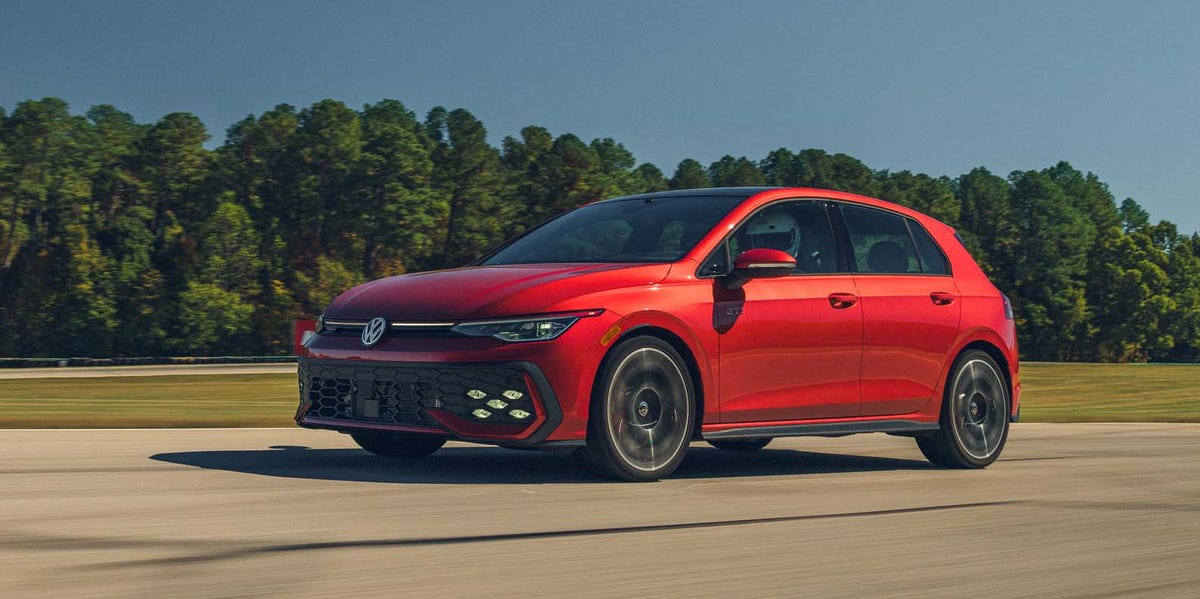
This year’s dual-clutch automatic car just beat all six of the GTI’s previous Lightning Lap lap times. It shaved eight-tenths off the first eighth-gen GTI we ran in 2022 and even bested the six-speed manual by a tenth. Dare we mention it did so in its first session on track?
Unlike the Golf R, no meaningful equipment changes put the GTI on the grid this year. Well, it did get actual buttons on the steering wheel instead of capacitive switches. Could we get through an entire lap without accidentally turning on the heated steering wheel? Only one way to find out. And, unsarcastically, on a track with two straights that stress test the GTI’s brake system, the steering wheel isn’t the only part that will get hot.
View Photos
Michael Simari and Marc Urbano|Car and Driver
The GTI’s brakes are good for one lap, followed by a nice, relaxing cooldown. Lean on them too hard into Turn 1 or slowing from 118.7 mph on the Back Straight, and they become considerably less effective. If you’re hoping for the cooling effect of the long Front Straight to reset everything, prepare for disappointment.
Keep the brakes from getting too hot, and you’ll find that, unlike the awkward dance steps of the GR Corolla’s conventional eight-speed, the GTI’s seven-speed dual-clutch automatic moves quickly and decisively. The limited-slip differential eliminates any inside-front-wheel spin in corners, with this traction boon helping the GTI prevail over the understeer-revealing Infield section.
View Photos
Michael Simari and Marc Urbano|Car and Driver
Very little threatens the stability of the GTI, even when it’s averaging 113.3 mph through the Climbing Esses. And while the brakes need to be babied, the rest of the GTI wants to stay on track. That’s high praise for a car surrounded by entries boasting four-figure horsepower and six-figure prices.
Back to Lightning Lap 2026
Austin Irwin has worked for Car and Driver for over 10 years in various roles. He’s steadily worked his way from an entry-level data entry position into driving vehicles for photography and video, and is now reviewing and testing cars. What will he do next? Who knows, but he better be fast.
Yet the new dual-motor version boasts the most arresting numbers. This top-spec model bumps power up to a colossal 442bhp and drops the 0-62mph time down to 3.9 seconds.
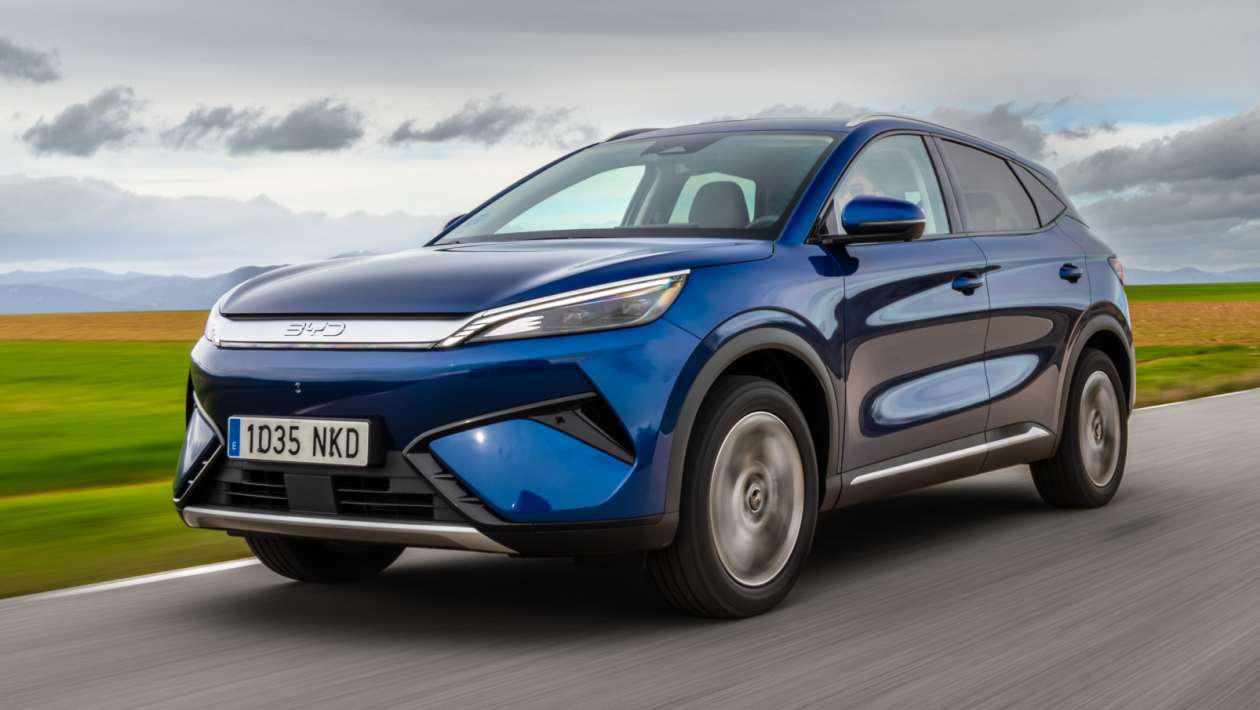
Beyond the powertrain improvements, BYD’s also given the Atto 3 EVO a new set of digital interfaces, with sharper, larger screens, and re-arranged the cabin layout. There’s some new colour and trim options inside, plus several simplified panels on the exterior that give the fairly anodyne design a cleaner look. Amongst urban traffic, the Atto 3 completely blends into the background, so depending on your preferences this is either a good or bad thing.
Advertisement – Article continues below
Precise UK pricing hasn’t been announced, but it’ll be more expensive than the £37,000 starting price of the current car. The dual-motor version will be in the low £40,000s.
There are other manufacturers out there with impressive models at this price point. Rivals such as the former Auto Express Car of the Year Skoda Elroq, Kia EV3 and new Nissan Leaf impress at the smaller end of the C-segment, with larger but no more expensive rivals like the Citroen e-C5 Aircross and Vauxhall Grandland improving the value-for-money proposition yet further.
For now, we’re only driving the entry-level rear-drive car that should make up a majority of UK sales. And given the level of technical change compared with the previous Atto 3, it’s not surprising to note that it drives quite differently, if not in a particularly positive sense.
At low speeds the steering feels a little bit rubbery, and has a tendency to hobble over speed humps. A collection of inconsistent bumps can rock the body side to side in quite an unpleasant way. It is quiet in general, but we found that – particularly under regen – the e-motor emits a very high-frequency whine. It’s not loud, but it is persistent; we’ll have to verify if this is still an issue on cars when they arrive in the UK.
Road trips are supposed to be about freedom and adventure, not stress every time you approach a gas station. But when fuel prices climb, even a simple getaway can start to feel expensive. The good news is that with a few smart strategies, you can still hit the road, stretch every gallon, and keep your trip on budget.
Before you head out, take a look at these practical tips to help you save fuel and avoid unnecessary costs along the way.
Skip gas stations right off the exit
Highway-adjacent stations often charge more. Driving a few minutes into town usually means
noticeably cheaper fuel.
Use apps to compare fuel prices
Checking prices ahead of time helps you plan the cheapest stops instead of settling for the
nearest pump.
Keep your speed steady
Rapid acceleration and high cruising speeds burn more fuel. Smooth driving can improve
efficiency and reduce fuel stops.
Lighten your load
Extra weight lowers fuel economy. Remove unused gear, rooftop carriers, or anything that adds
drag or bulk.
Plan meals and snacks ahead
Packing food reduces impulse stops and helps you avoid high convenience-store prices.
Check tire pressure before leaving
Underinflated tires increase rolling resistance and fuel consumption. A quick check can save
money over long distances.
Gas prices may be high, but with a little planning and a few smart habits, road trips can still be affordable, even when gas prices soar. Small changes behind the wheel and before you leave can make a noticeable difference over long distances. This way, you can focus less on the fuel gauge and more on enjoying the journey.
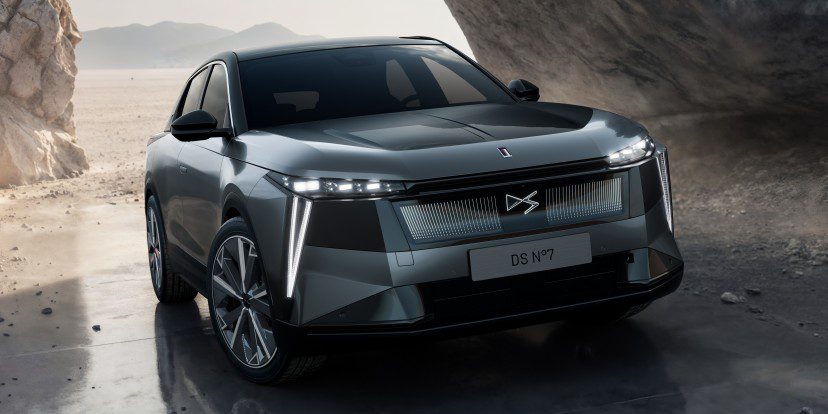
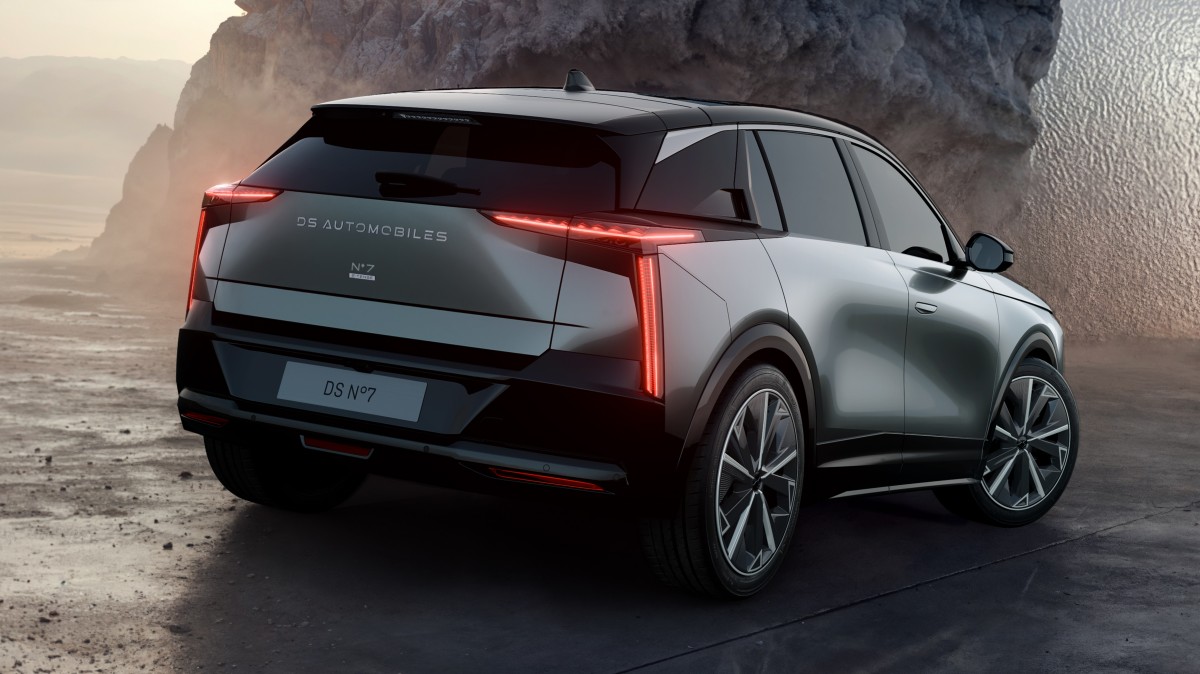
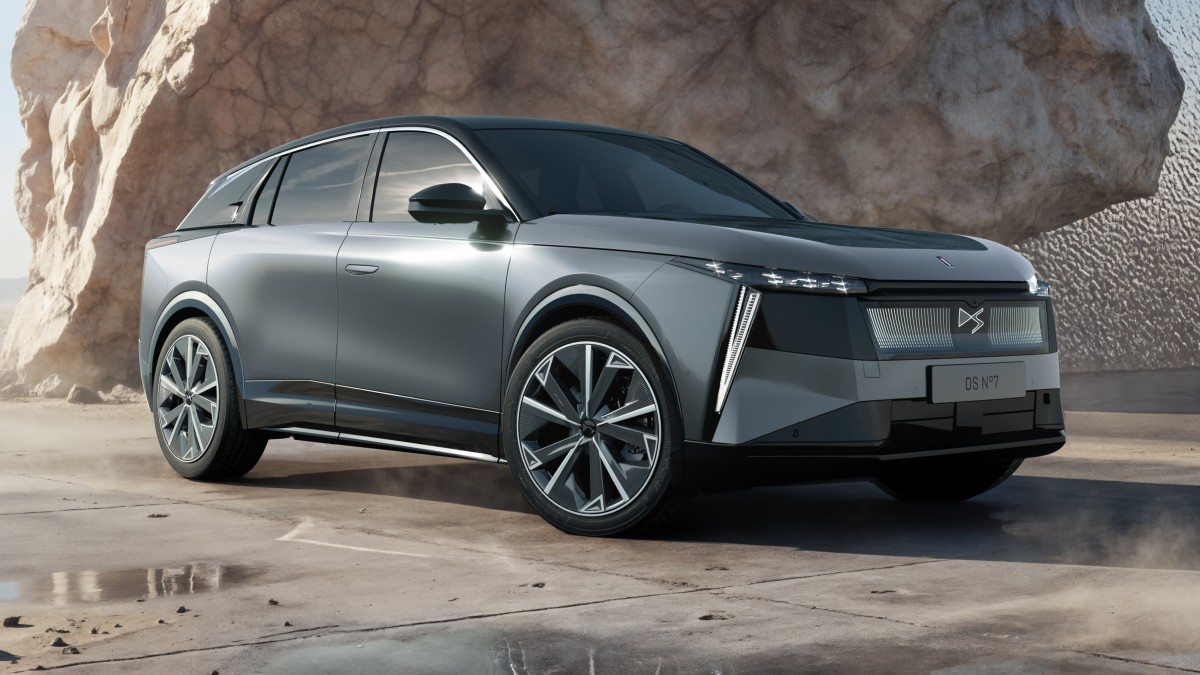
French car maker DS showed off today its newest creation – the DS No7. This vehicle is the direct replacement for the older DS 7, which was the brand’s most popular model. The company hopes the new SUV will help it sell many more electric cars in the future. The No7 looks like a standard SUV, but it has some very French touches inside and out.
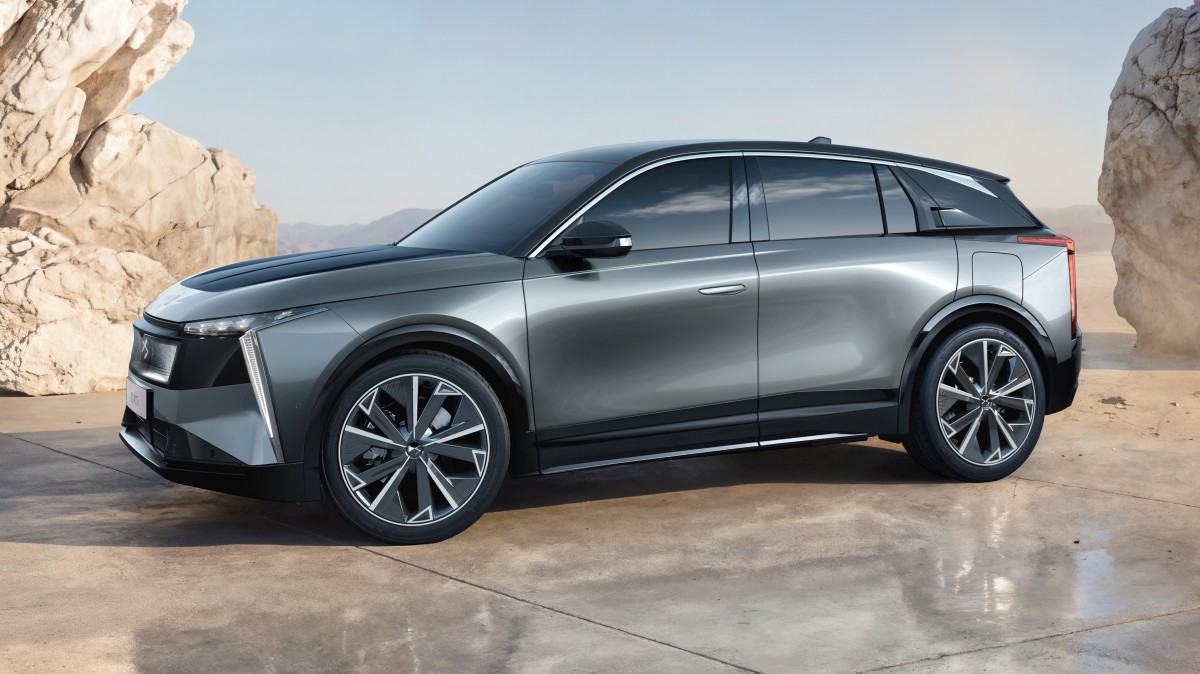
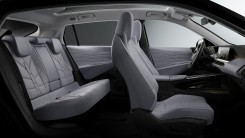
The DS No7 is a bit bigger than the car it replaces: it measures 15.29 ft long, which is 7 cm longer than before. Most of that extra space is between the wheels, giving people sitting in the back more legroom. The car is 6.23 ft wide and 5.35 ft high. Even with its tall shape, it is very good at cutting through the air thanks to a drag coefficient of Cd 0.26.
DS No7 – source: DS Automobiles
Range is the most important thing for many people buying EVs, and DS answers that need with a 97.2 kWh battery in the Long Range version. This big battery allows the No7 to travel up to 460 miles before it needs to plug in again. That is a decent distance for a medium-sized SUV. Even on the highway at fast speeds, DS says the car can still go about 280 miles.
If you do not need that much range, there is a smaller battery option. It has 73.7 kWh of energy that gives the No7 up to 337 miles of range. Both versions use a front-wheel-drive motor. The smaller battery model has 230 horsepower, while the bigger one has 245 horsepower. If you want more speed, you can pick the all-wheel-drive version. It has two motors that together deliver 350 horsepower, with a momentary “boost” bringing that number up to 375 horsepower. This version hits 62 mph in 5.4 seconds.
DS No7 – source: DS Automobiles
The DS No7 can charge at speeds up to 160kW. If you find a fast charger, you can add 118 miles of range in about 10 minutes. It takes roughly 27 to 31 minutes to go from 20% to 80% power. The car also has a V2L feature that lets you plug regular electronics, like a laptop or a coffee maker, directly into the car’s charging port to use its battery power.
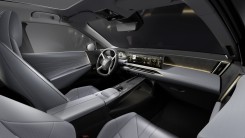
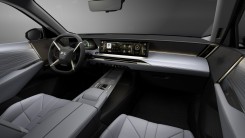
The inside of the DS No7 looks like a posh lounge – there’s a 16-inch touchscreen in the middle of the dashboard, and a 10-inch screen for the driver. DS even put ChatGPT into the system so you can talk to the car. The seats appear to be very soft and use memory foam to keep you comfortable. You can even get seats that massage you or blow warm air on your neck.
Interior of the new DS No7 – source: DS Automobiles
DS is famous for making cars that ride smoothly, and the DS No7 is no different. It uses a camera to look at the road ahead – if it sees a bump or a pothole, it tells the suspension to get soft before the car hits it. This system is called Active Scan Suspension. It tries to make the road feel as flat as a pancake. The car also uses acoustic glass to keep the wind and tire noise out of the cabin, making it very quiet inside – perfect for listening to the 14-speaker sound system.
Since not everyone is ready for EVs yet, DS is also making a hybrid version. This model gets a small 1.2-liter gas engine and a tiny electric motor. It has 145 horsepower and does not need to be plugged in – the small battery recharges itself when you slow down. DS says this version can drive using only electricity about half the time when you are in the city, and it uses about 5.4 liters of fuel for every 62 miles it travels.
The new SUV will be built in a factory in Melfi, Italy and it will share many parts with cars from Jeep and Peugeot. DS claims their car is more “premium” because of the expensive materials like Nappa leather and real wood. They are even using recycled materials for the carpets and mats, and the company also removed most of the chrome trim because painting or using stainless steel is better for the environment.
You can expect the hybrid version to start at around $49,000. The full electric DS No7 will likely start closer to $55,000. In France, a special business version is already for sale for $75,000. That is a lot of money, but the No7 is meant to compete with luxury brands like Audi and BMW. If you want a car that looks different from everything else in the parking lot, this French SUV might be the right choice.