Author: admin

  • Next-gen BMW X5 & 7 Series facelift leaked!

    Next-gen BMW X5 & 7 Series facelift leaked!

    BMW is gearing up to debut the all-new i3 on March 18. We had shared the first leaked images of the electric sedan recently. Now, images of two other upcoming BMW models have surfaced online – the next-generation X5 and i7 facelift.

    Next-gen BMW X5

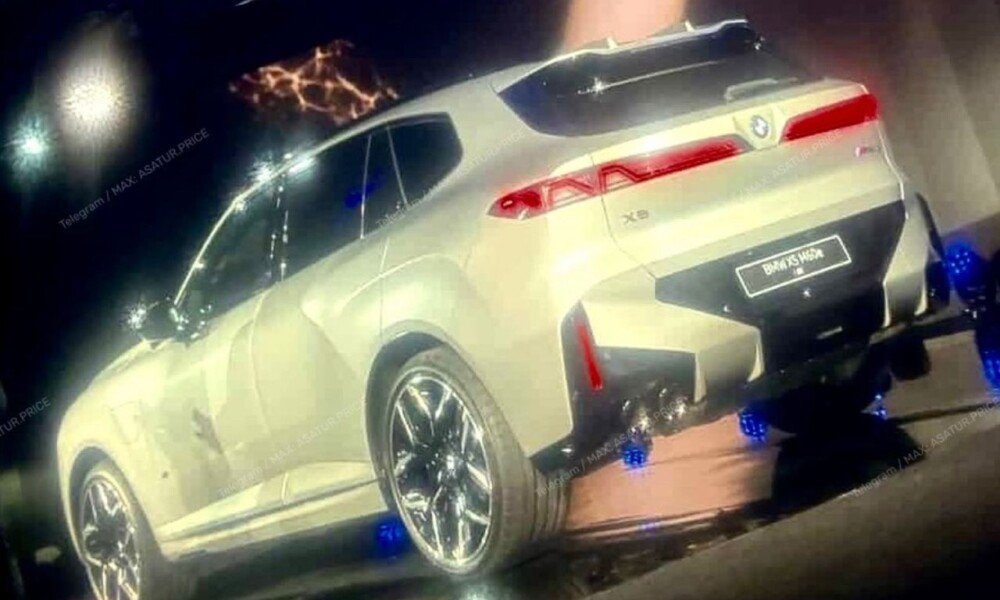
    The design of the new BMW X5 is based on the brand’s Neue Klasse design philosophy. Like the new BMW i3, the X5 will feature a slim kidney grille and a new LED light signature.

    As you can see from this leaked image, the X5 carries forward the muscular profile with its flared wheel arches and a bulky rear section. The rear fascia, though, has been completely redesigned and now features slim wraparound LEDs and a dual-tone bumper.

    The new-gen X5 will be offered with petrol, diesel and plug-in hybrid powertrains. The example featured here is the M60e xDrive variant powered by a 3.0-liter twin-turbo 6-cylinder petrol engine paired with an electric motor. It is said to produce around 570 hp.

    BMW will also offer a pure-electric version of the SUV, the iX5.

    BMW i7-leaked-1

    BMW 7 Series facelift

    BMW’s flagship limousine, the 7 Series, is also getting a major makeover this year. It will be presented at the Beijing Auto Show in April.

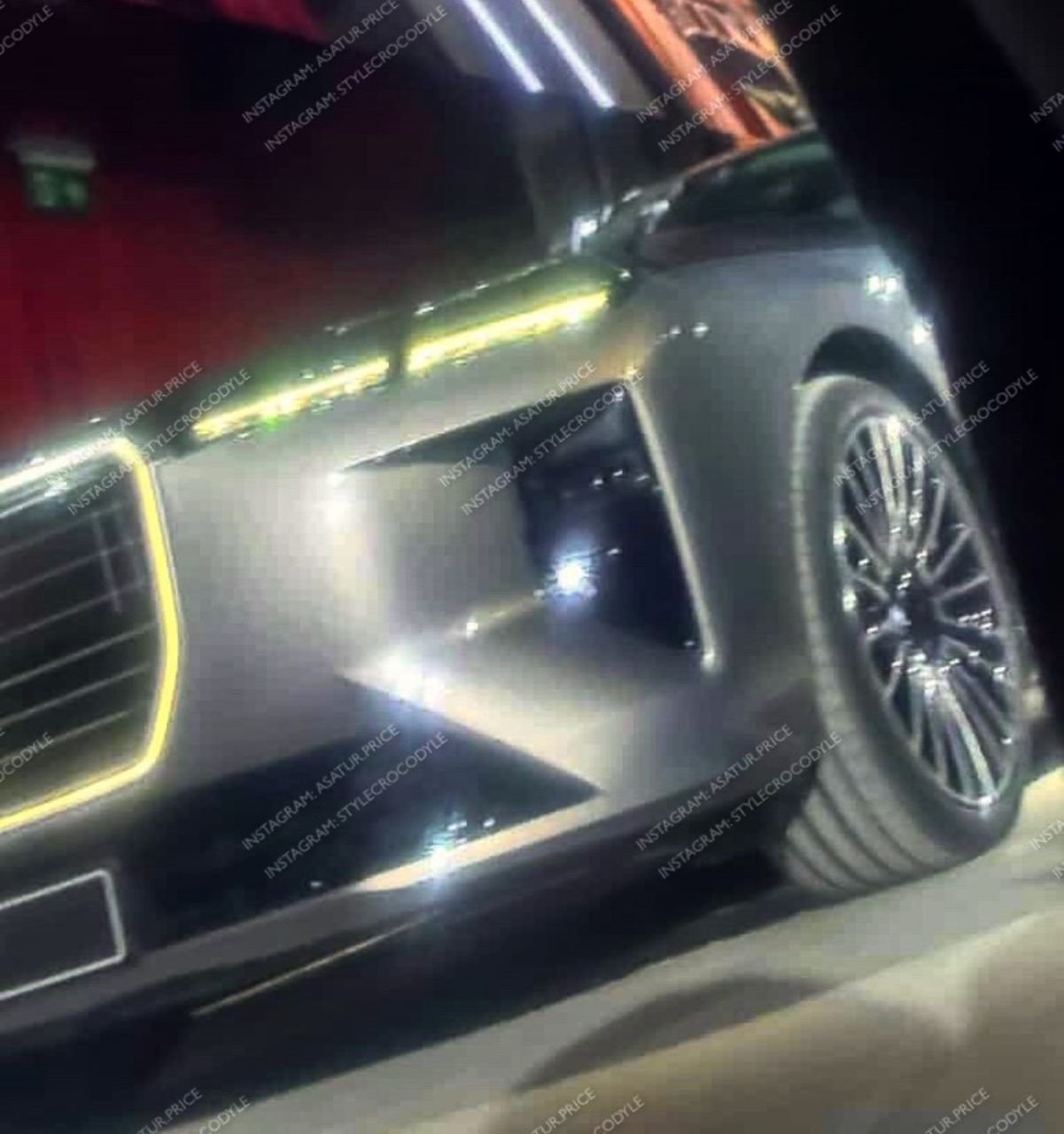
    The 7 Series facelift gets a completely reworked front end. It has a sharper-looking kidney grille. It’s still ginormous and has an illuminated surround. It has a split headlamp setup, featuring dual LED DRLs and the main headlamps positioned on the front bumper in a separate pod.

    The BMW 7 Series LCI will be offered with petrol and diesel powertrains upgraded to Euro 7 standards. The pure-electric i7 will also receive similar cosmetic and feature updates.

    Source: @asatur.price


    Source link

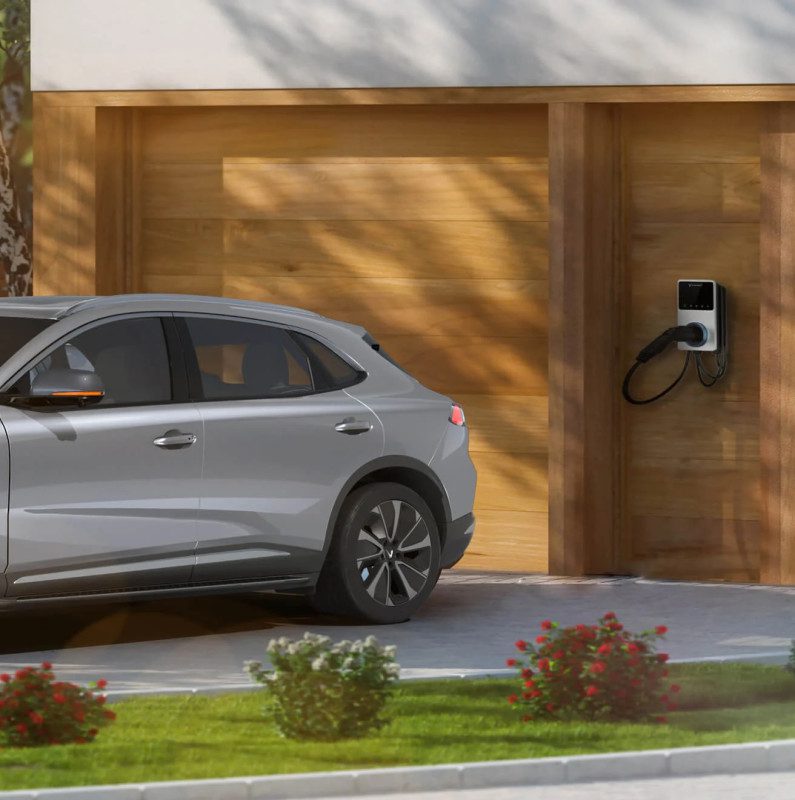
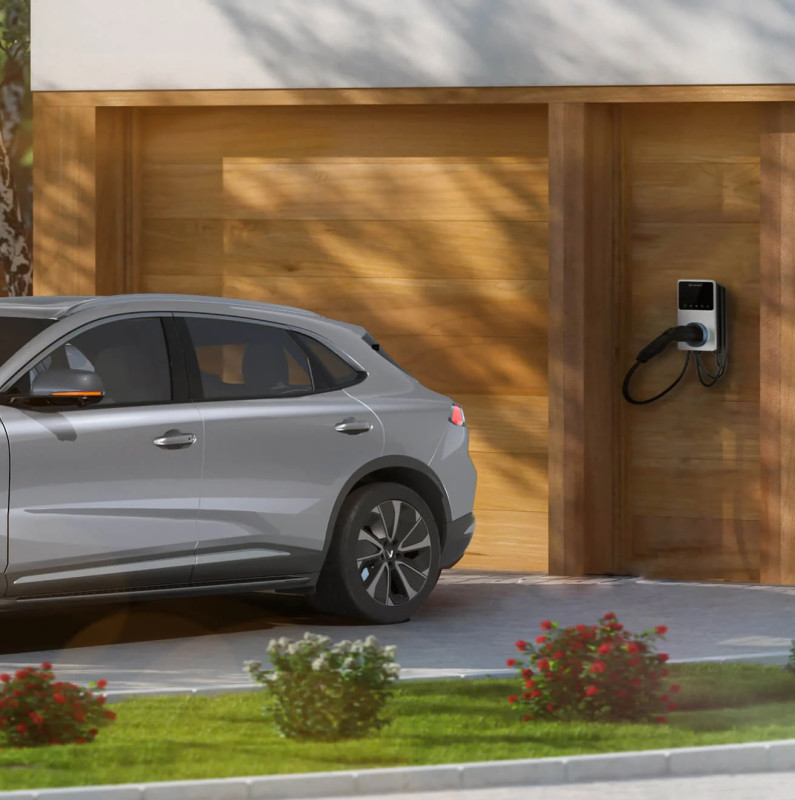
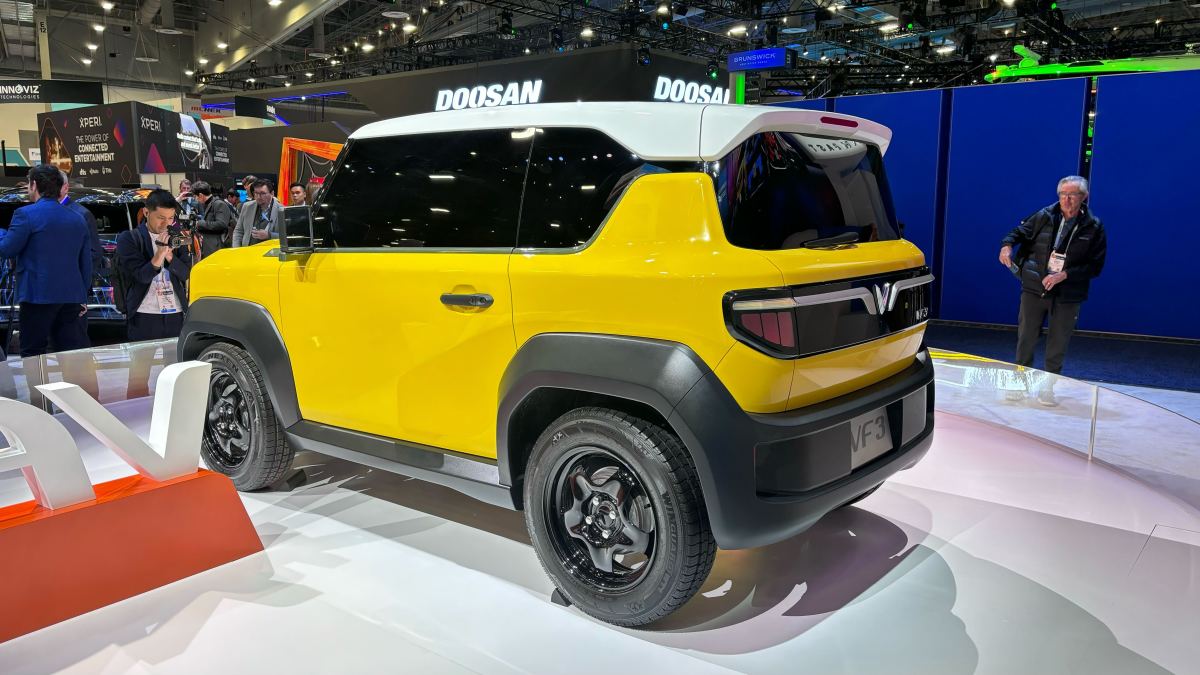
  • VinFast’s U.S. EV Gamble Is Costing Billions—but It’s Not Backing Down

    VinFast’s U.S. EV Gamble Is Costing Billions—but It’s Not Backing Down

    Aiming High

    VinFast remains somewhat of an enigma despite being in the industry for quite some time now. The Vietnamese EV carmaker started off with intent by entering the U.S. market as early as 2017-2018, when EVs were just about to take off. It was a huge gamble for an unknown brand to enter a huge market.

    Now, in 2026, we can say that the gamble did and didn’t work; it worked in the sense that VinFast remains a major EV player the world over, but it hasn’t carved out a decent enough following in the U.S. Despite slow growth stateside, and a tough 2025, they are committed as ever to continue playing for top spot in the EV space.

    A Tough End To 2025

    VinFast’s gung-ho attitude toward being in the U.S. is now biting back, according to Reuters. The company reported that its fourth-quarter net loss increased from the previous year. This is mainly due to the chargers’ impairment caused by the delay at the U.S. production plant. They aim to restart construction sometime this year.

    They registered a net loss of 35.2 trillion dong ($1.34 billion) in the final quarter of 2025, which is 46% more than the same period in 2024, and 15% higher than the third quarter of 2025. Around $235 Million of the loss came from the proposed North Carolina EV plant. During an investor meeting, Chairperson Thuy Le said they are still very committed to the U.S. market and have been working hard behind the scenes. She also said they are targeting 2028 for the soft launch.

    VinFast’s America production plant was first announced in 2022 and broke ground in 2023. However, due to a sudden slowdown in EV demand in 2024, they delayed construction to raise more capital. Approximate total investment will be in the neighborhood of $4 Billion, and the plant will also provide around 7,500 direct jobs for the state. When fully operational, the North Carolina plant will be capable of producing 150,000 EVs annually across the VF7 and VF8 SUVs.

    Ronan Glon

    REEVs On the Horizon

    One thing VinFast plans to do to possibly return interest to EVs is to launch Range-Extended Electric Vehicles (REEVs). This emerging powertrain option pairs a full EV with a small gasoline engine that is solely used to charge the batteries. The automaker sees this as a valid option for smaller countries that don’t yet have sufficient advanced charging infrastructure. They plan to roll out these REEVs in Vietnam by 2027.

    Source link

  • Steering Wheel Vibration: 5 Potential Causes And Fixes

    Steering Wheel Vibration: 5 Potential Causes And Fixes

    Imagine you’re on your morning commute to work, when the steering wheel of your Ram 1500 suddenly starts vibrating – shaking in your hands. Naturally, this would not just disrupt your drive, but it would likely send most of us into a panic! These shakes or jolts often begin as a faint rhythmic pulse, but they can quickly escalate into something more jarring that feels unnatural – and makes you worry about your vehicle, and your safety. While a shuddering steering wheel can be a common occurrence, it is not something that should be ignored or taken lightly.

    A vibrating steering wheel often serves as an early warning system for your vehicle. It signals that a component – be it tires, brakes, suspension, or something else – has fallen out of sync, and that your vehicle’s health, your in-car safety, and your budget have all come under threat. Fortunately, if you know what to look out for and understand the cues, then you’re well on your way to ensuring and maintaining both the longevity of your vehicle – and your personal safety.

    This article is not an exhaustive list of causes for steering wheel vibration nor is it a DIY guide; instead, it acts as a reference for what to do in the event your vehicle exhibits steering wheel vibration. CarBuzz advises diagnosis and repair by accredited professionals in all cases.

    Steering Vibrations: When You Can Experience It

    2026 Porsche Cayenne Electric Interior Steering Wheel
    2026 Porsche Cayenne Electric Interior
    Porsche

    There are many different circumstances that can cause a vibrating steering wheel, and it’s usually a sign of an underlying problem. In most cases, the issue manifests as a steering wheel vibration at high speed, which typically becomes noticeable when you hit 50-60 mph. Depending on the severity of the issue, it can either smooth out or intensify the more you accelerate. Whether the vibration you’re experiencing dies away or persists, it should raise the alarm bells.

    If your steering wheel shakes at high speeds only when you apply the brakes, the reason can, in all likelihood, be traced to the friction surface of your vehicle’s stopping system. It’s crucial to identify whether the vibration is felt through the seat (which can be indicative of rear-end issues) or strictly through your hands. Conversely, you might notice a wheel wobble when driving at lower speeds, showing itself in the form of a side-to-side tugging. If the vibration occurs when executing a sharp turn, it could suggest a different mechanical failure or issue than one that occurs while cruising in a straight line.

    How To Diagnose The Cause Of Steering Wheel Vibration

    2025 Acura TLX
    2025 Acura TLX interior steering wheel
    Acura

    It may sound cliché, but diagnosis begins with a process of elimination and eagle-eyed observation. Start by asking, “Can low tire pressure cause vibration?” While low pressure on a tire usually causes a “pull” to one side, extreme under-inflation or uneven pressure across an axle can create a subtle shimmy or wallow. If the below DIY checks don’t reveal a clear culprit for the vibration, it is probably time to visit a professional.

    DIY Tests For Steering Wheel Vibration

    Visual Inspection

    Park the vehicle on a level surface and check for “cupping” or uneven tread wear on your tires.

    The “Hand Test”

    Safely feel the rims after a drive. If the wheel is unusually hot, it could indicate a sticking brake caliper.

    Physical Check

    With the car safely jacked up, grab the tire at the 12 and 6 o’clock positions and shake it. Any play could suggest a bad wheel bearing. Shaking it at 3 and 9 o’clock often reveals worn tie rods.

    Road Surface Check

    Ensure the vibration persists on different road textures to rule out “washboard” pavement.

    Here are the most common causes for steering wheel vibrations in your car:

    Reason 1: Tires

    Worn, Out Of Balance, Or Misaligned

    2026 Jeep Gladiator Mojave X
    2026 Jeep Gladiator Mojave X tire wheel rim front 3/4
    Stellantis North America

    Tires are the most common source of vibration for a simple reason: they are the only part of your vehicle that’s in constant contact with the road. If a tire becomes unbalanced – or was fitted incorrectly without being balanced and aligned – it creates a centrifugal force that shakes the assembly. Similarly, internal belt separation or “flat-spotting” from sitting too long can cause the tire to lose its shape, resulting in the shudder you’d feel through the steering wheel.

    How to Fix Tire Issues, Like Imbalances

    To resolve tire-related vibrations, you must restore the uniform shape and weight distribution of the rubber. Here are a few simple steps:

    • Visit a tire shop for a professional computerized wheel balance.
    • Perform an alignment test on all four tires, as well as the spare tire.
    • Rotate your tires every 5,000 to 8,000 miles to prevent uneven wear patterns.
    • Inspect for “out of round” tires or internal belt shifts. Replace damaged tires where necessary.
    • Maintain the manufacturer-recommended PSI to prevent sidewall deformation.
    • Replace worn tires on time.

    Reason 2: Wheels

    Worn Bearings Or Damaged Rims

    2026 Lexus IS
    2026 Lexus IS badge logo wheel tire rim
    Lexus

    Sometimes the rubber is fine, but the metal it’s mounted to may be compromised. A bent rim that’s been caused by a pothole or hitting a curb can create a persistent wobble that balancing cannot fix. In addition, the wheel bearing – the component that allows the wheel to spin freely with minimal friction – can wear down. This causes the entire wheel assembly to tilt or shake during rotation.

    Fixing wheel issues involves inspecting the structural integrity of the rim and the health of the hub. For the most part, this requires you to see a professional for a complete diagnosis and repair of the issue.

    • Use a dial indicator to check for “runout” or bends in the wheel rim.
    • Replace worn wheel bearings if you hear a growling noise or feel play in the hub.
    • Straighten bent alloy rims at a specialized wheel repair shop.
    • Ensure lug nuts are torqued to the specific requirements for your vehicle.
    • Clean the hub mounting surface to ensure the wheel sits perfectly flush.

    Reason 3: Brakes

    Warped Rotors Or Sticking Calipers

    02 2026 Honda Prelude Brembo Front Brake Assembly
    Honda Dual-Axis Front Suspension and Brembo Brakes
    Honda

    If your steering wheel only vibrates when you hit the brakes, it is almost guaranteed that the issue lies in the braking system. When brake rotors (the discs) get too hot, they can warp or develop “cementite” spots. In other words, uneven deposits of brake pad material can collect on the rotors. As the pads squeeze the uneven rotor, the pulsations travel through the caliper and up the steering column.

    How to Fix Brake System Issues

    Restoring your braking system requires smoothing out the friction surfaces and ensuring free movement of the hardware. If you’re not familiar with the DIY steps of this amendment process, rope in a professional.

    • Replace warped brake rotors or have them “turned” (resurfaced) on a lathe.
    • Install high-quality new brake pads to ensure even material transfer – and check for brake wear on existing pads.
    • Clean and lubricate the brake caliper slide pins to prevent sticking.
    • Inspect the brake calipers for seized pistons that apply uneven pressure.
    • Check the hub-to-rotor mating surface for rust or debris buildup.

    Reason 4: Suspension

    Worn Bushings Or Joints

    2026 Jeep Gladiator Mojave X
    2026 Jeep Gladiator Mojave X suspension
    Stellantis North America

    Your vehicle’s suspension system is not just something to brag about at the BBQ. In a practical sense, it’s designed to absorb road shock and give you the best possible ride quality. However, when the components wear out, they allow for “extra” movement. Worn ball joints or bushings (the rubber cushions between metal parts) can allow the wheel to move independently of your steering input. The degree to which this happens depends on the severity of the issue. Off-road vehicles or high-mileage vehicles should be inspected regularly.

    1970 Ford Bronco Roadster
    1970 Ford Bronco Roadster by ICON 4×4 Suspension Detail Shot
    ICON 4×4

    How to Fix Suspension Issues

    Suspension repairs involve replacing the rubber or metal joints that have developed excessive “play.”

    • Replace worn outer and inner tie rod ends to tighten steering response.
    • Install new control arm bushings if the rubber is cracked or missing.
    • Swap out failing ball joints that allow the wheel to “clunk” or shimmy.
    • Inspect CV (Constant Velocity) axles for torn boots or clicking sounds during turns.
    • Replace worn-out shocks or struts that no longer dampen wheel oscillations.

    Reason 5: Steering System

    Worn Components

    2023 Honda Accord Touring Interior Steering Wheel
    2023 Honda Accord Touring Interior Steering Wheel
    Honda

    In some cases, the vibration originates within the steering rack or gear itself. A worn sector shaft bushing or a loose steering rack mounting bolt can allow the entire steering assembly to vibrate against the chassis. Steering system issues are less common than the other mentioned issues, but are a cause for concern.

    How to Fix Steering System Issues

    Given the more complex nature of addressing steering system vibrations, it’s likely that the repairs would have to be completed by a professional, who would look at the following:

    • Tighten or replace the steering rack’s mounting bolts and bushings.
    • Adjust the steering gear “preload” if your vehicle’s service manual allows for it.
    • Replace the steering universal joint if it has developed a “notch” or play.
    • Flush and refill the power steering fluid to ensure consistent pressure and lubrication.
    • Replace the entire steering rack if internal seals or gears are failing.

    What About EVs?

    Do Electric Vehicles Have Steering Issues Like This?

    2025 Porsche Macan Turbo EV
    2025 Porsche Macan Turbo EV driving front 3/4
    Porsche

    When it comes to steering vibrations, electric vehicles present unique challenges. Because EVs are significantly heavier than internal combustion engine vehicles due to their very heavy battery packs, they put much more stress on tires and suspension components. This extra weight can cause the tires to develop “flat spots” more quickly if left parked for extended periods, which, as we’ve established, causes vibrations through the steering wheel.

    EVs also produce instant torque. While fun, it can lead to rapid and sometimes uneven tire wear if the driver/owner frequently explores that acceleration prowess.

    EV tires are also designed with specialized foam inserts to reduce road noise. If this foam becomes loose inside the tire – known as “foam delamination” – it can cause an imbalance that can result in vibration. Given EVs’ complex nature, it is important that qualified technicians inspect the vehicle if you are experiencing steering wheel vibrations as you drive.

    Whether you drive an EV, hybrid, or regular ICE car, a steering wheel shaking while you’re driving can be unsettling – we recommend having it checked out by a professional as soon as possible.

    Sources: Old Ox Tire, Yokohama Canada, Firestone, Trodo, My Bushing, Springs Auto, Car Parts

    Source link

  • A practical electric SUV at a practical price

    A practical electric SUV at a practical price

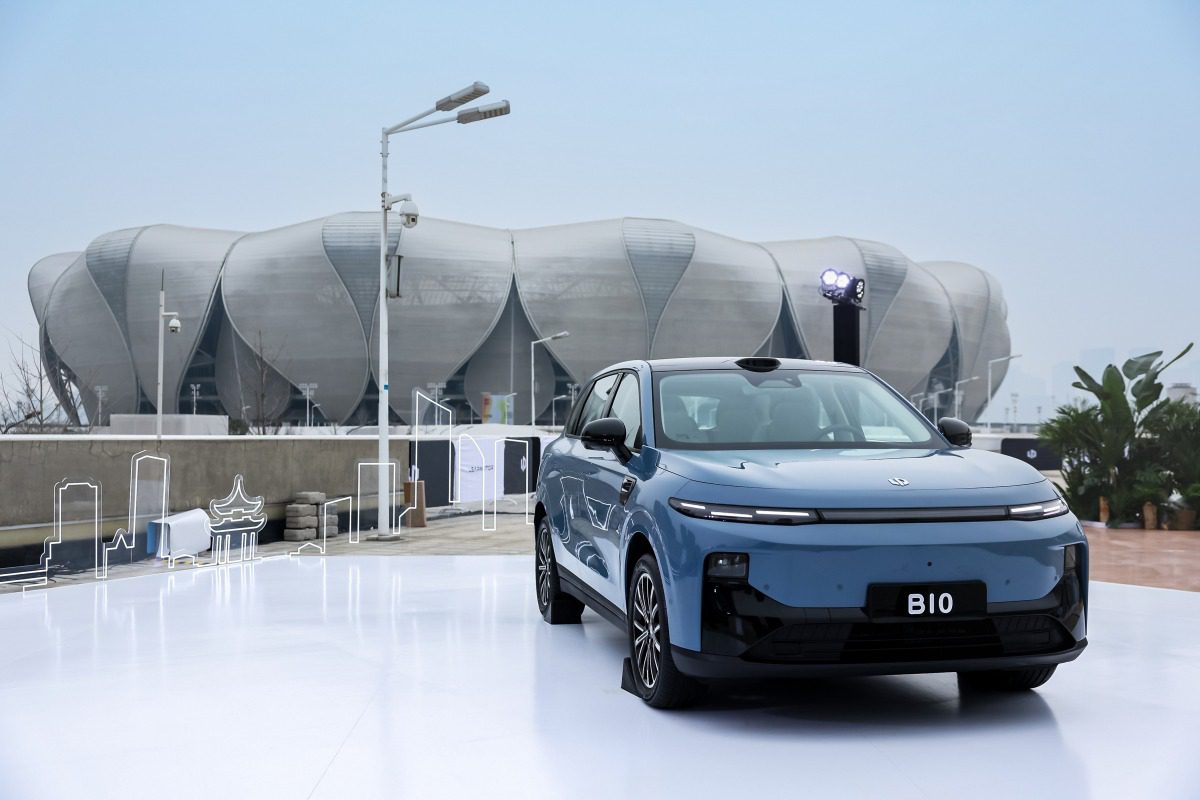
    After pulling up on my street with the Leapmotor B10 for the first time, my neighbour wandered over and asked if I’d bought a new Peugeot. Then he paused, squinted at the rear of the car, and revised his guess: “Actually… is that some sort of cheap Porsche Macan?”

    It wasn’t the worst observation. The rear three-quarter angle in particular does have a hint of Macan about it. Up front though, things are more generic EV: a smooth nose, slim LED light bar stretching across the bonnet, and the sort of minimalist face now shared by half the electric SUVs arriving in Australia.

    The design feels contemporary without being overdone: an upright front end gives it a practical stance, while a gently sloping roofline softens the profile. Spend a bit more time with it though, and the B10 begins to develop its own identity.

    The next question people tend to ask is: what exactly is a Leapmotor? Fair question. The B10 is only the second model from the Chinese brand to arrive in Australia, following the launch of the larger C10 in late 2025, making Leapmotor one of the newer names entering an already crowded EV market.

    Behind the scenes, however, there is a familiar name involved. Leapmotor has backing from Stellantis, the global automotive group that already sells brands such as Jeep, Peugeot, Fiat, Alfa Romeo and Maserati in Australia. So while the badge may be new, the company helping bring it here has been operating locally for decades.

    The price of $38,990 drive-away for the base spec, $41,990 for the Design spec is why people will likely start pay more attention. This pricing places it right in the midst of Australia’s most affordable electric SUV vehicles.

    The B10 looks modern, but not overly out there. A sensible upright silhouette at the front is complimented with a slight slope at the roofline.

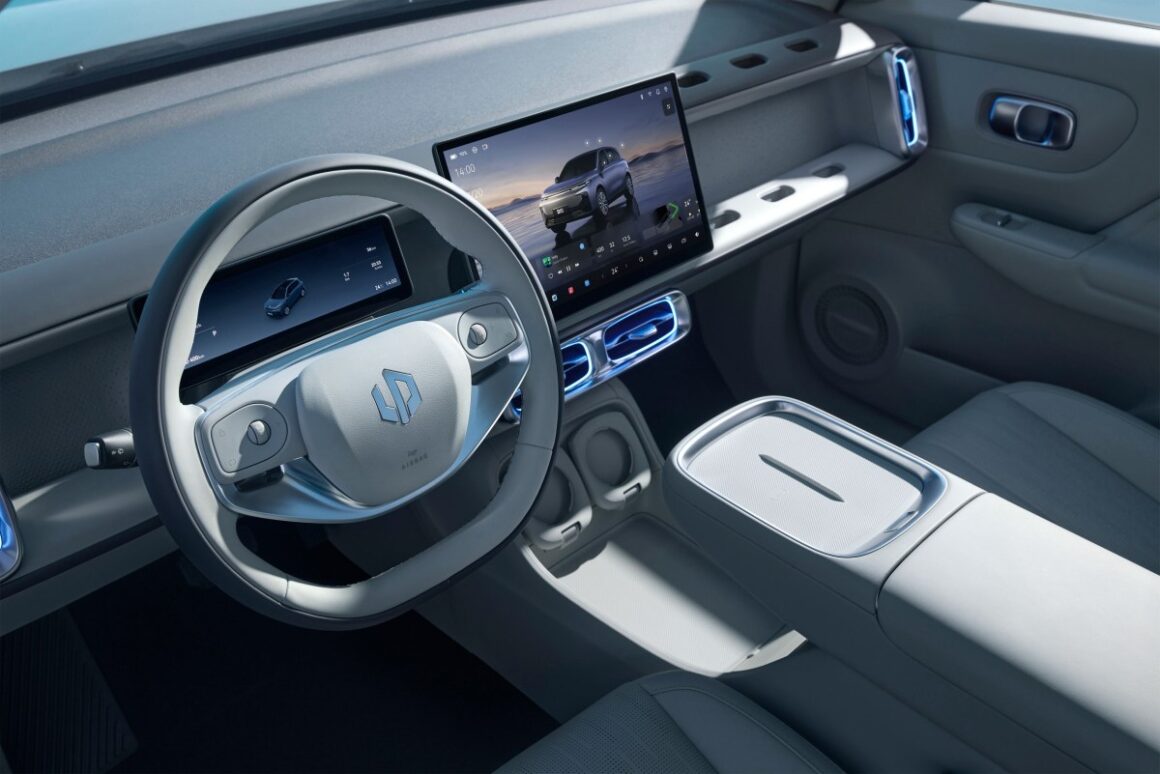
    Climb inside and you’re greeted by a sea of grey. Not unpleasant, but certainly not colourful. The cabin leans heavily into the minimalist EV playbook with a large central screen, very few physical buttons, and an overall vibe that feels a bit like sitting in a spaceship simulator.

    One detail that initially caught me off guard sits directly in front of the passenger seat. At first glance it looks as though the factory simply forgot to finish assembling that section of the dashboard. In reality, it’s a deliberately designed as a kind of blank canvas where owners can attach accessories and customise the space however they like.

    Some buyers may enjoy that level of flexibility. Personally, I suspect mine would remain exactly as it was delivered – empty and looking slightly unfinished.

    This being the upper Design spec, the cabin does get a few welcome upgrades. The seats are trimmed in higher-grade synthetic (“silicone”) leather and the front occupants get both heating and ventilation, along with a heated steering wheel for colder mornings.

    The doors are also treated to softer materials rather than the hard plastics often found in cars at this price point, which lifts the sense of comfort and gives the cabin a faint hint of luxury.

    And while the daytime interior is largely shades of grey, things brighten up after dark thanks to the ambient lighting. Like many modern EVs, the B10 lets you cycle through a range of colours to give the cabin a bit more personality at night.

    Image: Leapmotor

    A 14.6-inch touchscreen sits at the centre of the dashboard and controls almost everything in the car, aside from a couple of Tesla-style scroll wheels on the steering wheel. It fits with the minimalist approach adopted throughout the cabin, although I still find myself missing the reassurance of a physical button, particularly for climate control and other everyday functions you want to adjust without digging through menus.

    Ahead of the driver, the instrument display is relatively small but surprisingly effective. Despite its size it presents the key information clearly, and there’s a degree of customisation available, allowing you to add things like navigation prompts or efficiency data alongside the speed readout.

    Wireless Apple Carplay & Android Auto are welcome and necessary features, but in my experience about 25% of the time my car did not connect wirelessly. While I can’t rule out the issue being with my phone rather than the car, it’s not an issue I’ve experienced before on other vehicles.

    The ride is comfortable and well suited to everyday driving, with acceleration more than adequate. Flick it into Sport mode and the instant torque delivers a brief moment of thrill before the reality of Sydney’s 40–50 km/h streets quickly brings things back to earth.

    Apparently strong one-pedal driving isn’t especially popular in China, which may explain the tuning here. But for Australian drivers who’ve become used to smoother and more predictable systems in other EVs, it could feel a little underwhelming. Even the strongest regenerative braking mode outside of one-pedal is relatively mild compared with what many other electric cars now offer.

    The Design LR gives you a 67.1 kWh LFP battery with a claimed NEDC range of 516 km, while the base Style uses a smaller 56.2 kWh pack rated at 442 km. Real-world figures will be a bit lower as they always are. But even allowing for highway speeds, warmer weather, multiple passengers, and air-conditioning, the B10 still offers a comfortable driving range. In the week of driving I had the B10 I averaged an impressive 14kWh/100kms.

    Both variants support up to 11 kW AC charging, while DC fast charging reaches 140 kW on the base Style and up to 168 kW on the Design LR.

    I left the ADAS (driver attention monitoring system) on its default settings and, while it clearly keeps a close eye on both your gaze and your speed, the dulcet tones it uses to remind you of your driving responsibilities are thankfully not overly obnoxious.

    Not too long ago, when you thought about electric SUVs in Australia, you were usually looking at $50,000 to $60,000. Within that bracket there are now plenty of excellent options, but it still meant EVs sat firmly above the price of many comparable petrol models.

    More recent arrivals such as the Jaecoo J5, BYD Atto 2, and now the Leapmotor B10 are beginning to shift that equation. They’re bringing genuine choice to the more affordable end of the market and offering reassurance that a well-equipped electric SUV can be just as  approachable as its combustion-powered counterparts.

    The B10 is a compelling addition to this growing segment, and yet and another reminder that real value has already started arriving in Australia’s EV market.

    View the full specs sheet here.


    Source link

  • Looks Like the Toyota Tundra Raptor Rival Has a Name: TRD Hammer

    Looks Like the Toyota Tundra Raptor Rival Has a Name: TRD Hammer

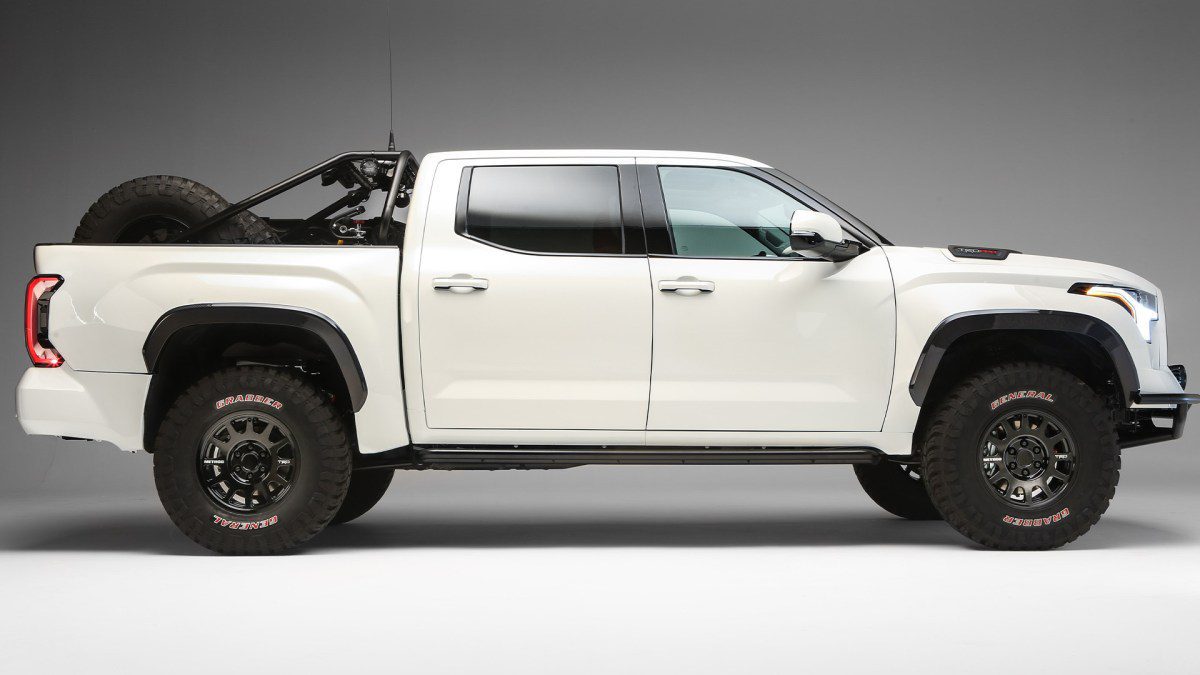
    Toyota is still playing coy about whether or not it will build a Ford Raptor rival. Even then, there are several signs pointing to a high-performance Tundra, from an insider tipping us off about the development of such a truck years ago to spy photos of a wide, high-riding prototype in 2025. On top of that, a Toyota R&D crew took a Tundra racing at the Mint 400 just a couple of weeks ago (and won).

    There’s now another potential clue, as Toyota applied to trademark a new name: TRD Hammer.

    A post on the United States Patent and Trademark Office’s website says the application was filed March 10. It doesn’t provide all that many details, but it does identify the applicant as Toyota Motor Corporation. Additionally, there’s no particular font style, size, or color assigned to the name.

    “TRD Hammer” was one of several naming options that Toyota provided in a recent survey. The list of other proposed names included “TRD Baja,” “TRD Iron,” “TRD Pro-S,” “TRD Bizurk,” and “TRD Quake.” Importantly, that same survey gave a brief description of the vehicle that one of those names would be applied to:

    “This high-performance truck package is designed for off-road enthusiasts, featuring an engineered long-travel suspension and 37” all-terrain tires. With the truck’s unique wide fenders, high-clearance bumpers, and a powerful engine, it achieves exceptional off-road capability and performance.

    A friend of The Drive corroborated the 37-inch tire detail and said it will be “badass.” No mention of a V8, though.

    Toyota Tundra Desert Chase concept truck
    Toyota Tundra Desert Chase concept truck. Toyota

    A Tundra variant positioned above the TRD Pro seems like a sure thing, then. And if it makes more than that truck’s 437 horsepower and 583 lb-ft of torque, then “Hammer” would be an appropriate name. It also recalls the annual King of the Hammers off-road race in Johnson Valley, California. Whatever the inspiration, the name deserves its place on the stringboard in every Toyota fanboy’s basement right now. (And before you laugh, just know this is a frequent topic of conversation in the Tundra owner forums.)

    I’m itching to see if and when Toyota pulls the trigger on this project. The name might take some getting used to, but if the truck itself is rowdy enough, it won’t really matter what it’s called. People just wanna go fast.

    Got a tip or question for the author? Contact them directly: caleb@thedrive.com

    From running point on new car launch coverage to editing long-form features and reviews, Caleb does some of everything at The Drive. And he really, really loves trucks.


    Source link

  • Juke, Pathfinder axed in Nissan’s hybrid push

    Juke, Pathfinder axed in Nissan’s hybrid push

    NISSAN has confirmed it will cull the Juke and Pathfinder SUVs from its Australian model range as it turns its attention to a fresh influx of hybrids to be headlined by the Frontier Pro plug-in hybrid ute. 


    The move is in line with the brand’s long-term strategy to bolster its petrol-electric line-up and meet ever-tightening CO2 emissions regulations while preparing for the new-generation Y63 Patrol that is planned to more seriously take the fight to the rival Toyota LandCruiser. 


    As part of the model remix Nissan has also ruled out the new Leaf battery electric crossover for Australia, for now at least, saying the model is indefinitely paused and suggesting it is not heading Down Under in a hurry. 


    Soon-to-depart Nissan Oceania managing director Andrew Humberstone – returning to Europe to be based at the company’s regional headquarters in Paris – said the company’s local line-up had been reassessed with an eye firmly on where the market is heading. 


    “The strategy was very much future back,” Mr Humberstone said. “What works 15, 10 years, five years from now? And then how do we bridge it?” 


    This assessment led Nissan to embrace electrification, kicking off with hybrids as the focus. 


    “We see about 70, 75 per cent of this market is really going to be for at least the next five or so years in the hybrid/E-Power space,” he said, referencing the Nissan hybrid system that uses a petrol engine purely as a generator, leaving electric motors to power the wheels. 


    “It’ll not be an electric. It will not be an ICE vehicle.” 


    The shift in strategy means some models will fall by the wayside as Nissan reallocates resources towards hybrid vehicles capable of meeting Australia’s New Vehicle Efficiency Standard (NVES), which has car makers scrambling to balance penalties with credits earned from zero- and low-emissions vehicles. 


    “In addition, we’re going to have some losers,” Mr Humberstone confirmed. “Juke – not working for us. Pathfinder – not working for us.” 


    Mr Humberstone said the economics of importing the US-built Pathfinder large SUV no longer stacked up. 


    “Great product, did very well for us this year as part of a run-out, but very expensive, dollar-based,” he said. 


    “And most importantly, there’s no future E-Power technology on that US-based product. So it doesn’t make sense for us, regrettably.” 


    Similarly, the UK-sourced Juke is overshadowed by the larger Qashqai, which will switch exclusively to Nissan’s E-Power hybrid system within months. 


    Mr Humberstone added that trimming the range would enable Nissan to focus on vehicles with the greatest potential. 


    “It’s about focusing where you’ve got mass and volume,” he said. 


    “Products like Juke and Pathfinder … historically, they’ve been a distraction because of the economies of scale and because of cost base and exchange rate.” 


    Instead, Nissan is concentrating on expanding the hybridised middle of its range – a space currently occupied by models such as the Qashqai and X-Trail. 


    As well as the all-hybrid Qashqai, Nissan wants to expand its X-Trail E-Power line-up to include more affordable single-motor, two-wheel drive versions to sell alongside the existing dual-motor, all-wheel drive models. 


    With a new all-hybrid Toyota RAV4 arriving within weeks and increasing hybrid share from key rivals it is a logical move. 


    “Ideally before the end of this year,” Humberstone said of the two-wheel drive X-Trail E-Power. 


    At the same time, Nissan still intends to maintain a traditional internal combustion presence in segments where it has strong heritage. 


    “You need to have your ICE footprint, which we have with Patrol and Navara,” said Mr Humberstone. 


    “It’s where we’re known – strong brand, strong heritage. We can talk about our Australianness, our longevity.” 


    However, there is plenty more bubbling away on the hybrid front, even with utes. 


    The next big step looks set to be the Frontier Pro plug-in hybrid ute developed through Nissan’s joint venture with Chinese partner Dongfeng. 


    The model has been under evaluation for more than a year and appears tantalisingly close to sign-off for the Australian market. 


    Nissan has yet to confirm the vehicle for local showrooms, but Mr Humberstone indicated that discussions are well advanced. 


    “We have JVs with Dongfeng, we have JVs with Renault, we have JVs with Mitsubishi – we have options,” he said of a hybrid ute, while ruling out fitting a Nissan powertrain to the new Navara that is essentially a rebadged Mitsubishi Triton with dynamic tuning specific to Nissan. 


    “For us, it’s about what makes sense and what serves our market, that provides us with that technology.” 


    When asked whether the Frontier Pro could potentially wear the Navara badge locally, Mr Humberstone stopped short of confirming the possibility. 


    “I couldn’t possibly comment at this stage,” he said. “But I think within the next two months we’ll be able to share more.” 


    The naming question highlights the challenge with Nissan’s future ute strategy, with the new electrified model set to run alongside the existing Navara – albeit a very different beast. 


    While Mr Humberstone says the company had not yet received final sign-off for the Australian market, “we’re highly optimistic”. 


    “If you’re still running Navara, then is that a Frontier?” he said. “Or if you’re not running a Navara, is it a Navara? You’re probably running them parallel. So do you have a Navara and a Frontier?” 


    Regardless of the badge it ultimately wears, the Frontier Pro is expected to represent a shift away from the traditional hard-working formula that has defined the Navara in Australia for decades. 


    As a plug-in hybrid developed with a Chinese partner, the model is likely to lean more towards lifestyle and technology than the rugged workhorse image long associated with Nissan’s ute line-up. 


    Given the fast-changing face of the Australian ute market – being shaped by Chinese newcomers such as the BYD Shark 6 and GWM Cannon as well as soon-to-arrive contenders such as the diesel-electric Chery XP31 – evolution may be necessary. 


    The company’s Australian sales have slipped in recent years as a wave of aggressively priced Chinese brands has surged into the market, reshaping competition across multiple segments. 


    Nissan also wants to leverage some traditional strongholds, including the off-road space with the Patrol. 


    The all-new Y63 Patrol is still on target to replace the Y62 late in 2026. 


    As with its rival LandCruiser, that means a shift from V8 to V6 power, in the Nissan’s case a twin-turbo unit powered by petrol. 

    But that has not stopped Mr Humberstone forecasting big things. 


    “Y63 I’m exceptionally optimistic with -– the car is amazing,” he said. “I’m pushing very hard to get extra capacity, extra volume.”
    Source link

  • Fuel Economy and Gas Prices

    Fuel spending is one of the most significant ongoing costs for today’s vehicle owners. Prices can fluctuate daily and vary widely from state to state, making it hard to know whether you’re getting the best deal. To help, we’ve assembled expert-backed articles and tips for boosting your fuel efficiency, gathered useful resources for tracking the best fuel prices locally and nationally, and included a handy search tool for fuel-economy estimates from the U.S. Department of Energy and the Environmental Protection Agency. Let’s get rolling.

    Jump to today’s gas prices.


    Loading data…

    Source: Data provided by fueleconomy.gov (U.S. EPA).
    Results may vary based on specific trim and options. Actual mileage will vary with driving conditions.

    Kelley Blue BookKelley Blue Book

    Smart Fuel Savings Strategies

    🚗
    Driving Habits That Save Fuel

    Avoid rapid acceleration and hard braking. Smooth, gradual speed changes can improve fuel economy by up to 40% in stop-and-go traffic.

    Use cruise control on highways to maintain consistent speed. Each 5 mph over 50 mph reduces fuel economy like paying an extra $0.30 per gallon.

    Turn off your engine if you’ll be stopped for more than 60 seconds. Idling wastes fuel and costs you money without moving an inch.

    Remove unnecessary items from your vehicle. Every extra 100 pounds can reduce fuel economy by up to 2% depending on vehicle size.

    🔧
    Keep Your Vehicle in Top Shape


    • Check tire pressure monthly – Properly inflated tires can improve gas mileage by up to 3%

    • Replace air filters regularly – A clean air filter can improve acceleration and protect your engine

    • Use recommended motor oil – The right grade reduces friction and can improve fuel economy by 1-2%

    • Get regular tune-ups – A well-maintained engine runs more efficiently and saves fuel

    • Fix oxygen sensor issues – A faulty sensor can reduce mileage by up to 40%

    💰
    Find the Best Gas Prices

    Download gas price tracking apps to compare local stations in real-time. Many offer user-reported prices updated within the hour.

    Gas prices typically rise on Thursdays and peak on weekends. Monday through Wednesday often offers the lowest prices of the week.

    Sign up for station rewards programs and use affiliated credit cards. Many offer 5-10 cents per gallon in savings or cashback.

    Membership warehouse stores often sell gas at lower prices than traditional stations. The savings can quickly offset membership costs.

    💡 Pro Tip: Plan Your Routes

    Combine errands into one trip and plan the most efficient route. Multiple short trips from a cold start can use twice as much fuel as a single trip covering the same distance. Apps with real-time traffic can help you avoid congestion and save fuel.

    National Average Gas Prices

    Source link

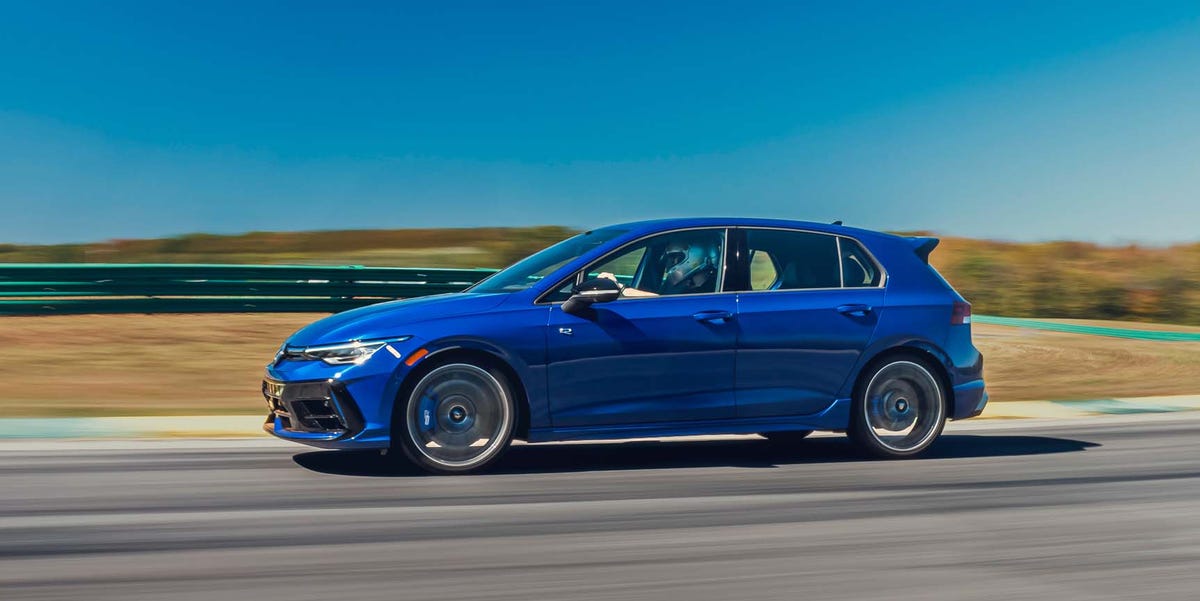
  • 2025 Volkswagen Golf R at Lightning Lap 2026

    2025 Volkswagen Golf R at Lightning Lap 2026

    From the March/April 2026 issue of Car and Driver.

    Lap Time: 3:03.7

    Class: LL2 | Base: $52,120 | As Tested: $52,416
    Power and Weight:
    328 hp • 3369 lb • 10.3 lb/hp
    Tires:
    Hankook Ventus S1 evo3
    235/35R-19 91Y +

    Life is all about give and take. Volkswagen gave the Golf R another 13 horses for 2025, so we took the R to VIR and chopped 0.6 second off the model’s previous best time.

    Let’s examine the data. Despite two different drivers, when we overlay a fast lap from a 2022 Golf R in Lightning Lap 15 onto this year’s the similarities are staggering, except for one critical moment. The improvement doesn’t reveal itself until the series of fast downhill corners—the Roller Coaster and Hog Pen sequences—that come before the Front Straight. It’s there that the updated Golf R carves out 0.6 second during a lap that’s otherwise identical to the 2022 car’s.

    2025volkswagengolfrView Photos

    Michael Simari and Marc Urbano|Car and Driver

    Thirteen horses are nice, but more confidence in the brakes than in the GTI allowed us to brake later and carry more speed into the first downhill right, Roller Coaster. From there, the R’s stability and all-wheel-drive traction took over. Trust grew, and as confidence grows, lap times tend to fall until you find a tire wall.

    In low-speed corners, the Golf R’s all-wheel-drive system is indispensable, as it lets you mash the throttle without any time-robbing drama. But the car still demands discipline. Overcommit in the braking zones, and the R will leave the racing line just like any other car in favor of a path of destruction. Just ask the tire wall at the end of the Back Straight about the R’s love tap.

    Like the changes brought by the refresh, a 3:03.7 lap is not shockingly greater. It’s simply better. And at a track this demanding, being a little better, even for just a single sector, pays off in a big way.

    Back to Lightning Lap 2026

    Headshot of Austin Irwin

    Austin Irwin has worked for Car and Driver for over 10 years in various roles. He’s steadily worked his way from an entry-level data entry position into driving vehicles for photography and video, and is now reviewing and testing cars. What will he do next? Who knows, but he better be fast.

    Source link

  • Do You Need a Third Row?

    Do You Need a Third Row?

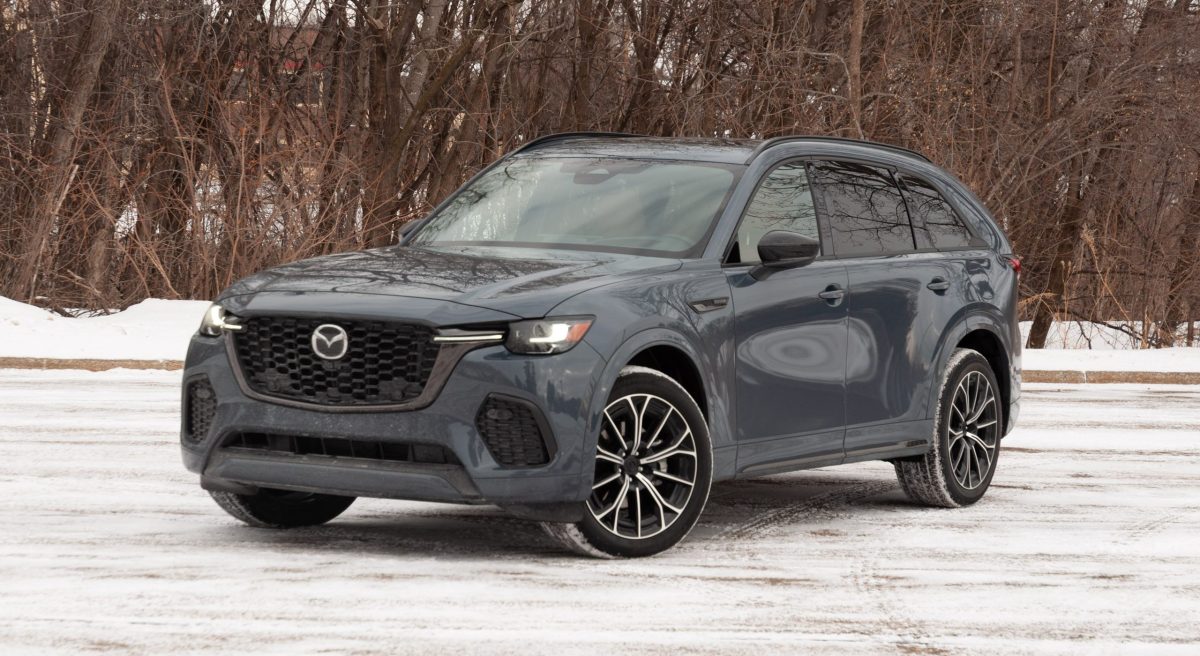
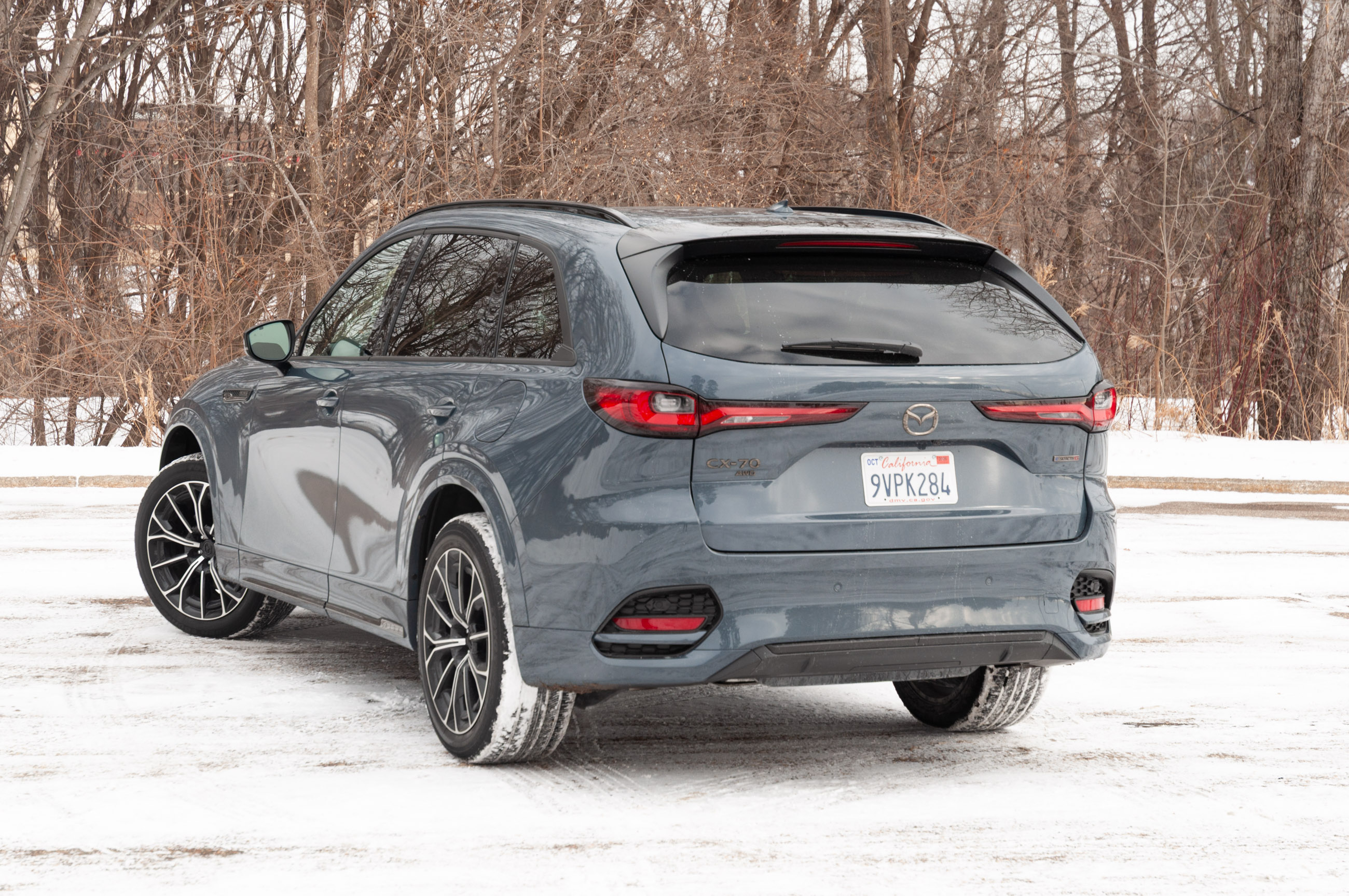
    If you’ve ever thought, “I wish there was an SUV with the space of a three-row but with only two rows of seats.” Here’s the solution: the 2026 Mazda CX-70.
    It might seem weird, but there must be a subset of vehicle shoppers who want more cargo room than a Ford Explorer or Jeep Grand Cherokee, but they have no need for a third row. While one might argue the third row could just be left down at all times, there is a vehicle that fits this bill.

    The CX-70 delivers the space, footprint, packaging compromises, and driving dynamics of its CX-90 sibling, sans the third row. I’m still not entirely sold that this vehicle is necessary for the marketplace, but I halfway understand why Mazda is offering it after spending a week living the family life with one.

    The Basics

    The CX-70 was introduced for 2025 and rolls into the 2026 model year with a handful of small, but meaningful updates. The plug-in hybrid model features a few extra miles of range, though that wasn’t the powertrain tested here. Base models, dubbed Preferred, now feature standard heated and cooled front seats and a heated steering wheel. And of course, with the blackout trend, the CX-70s all get gloss black Mazda emblems for 2026, so I hope you didn’t like the chrome badges.

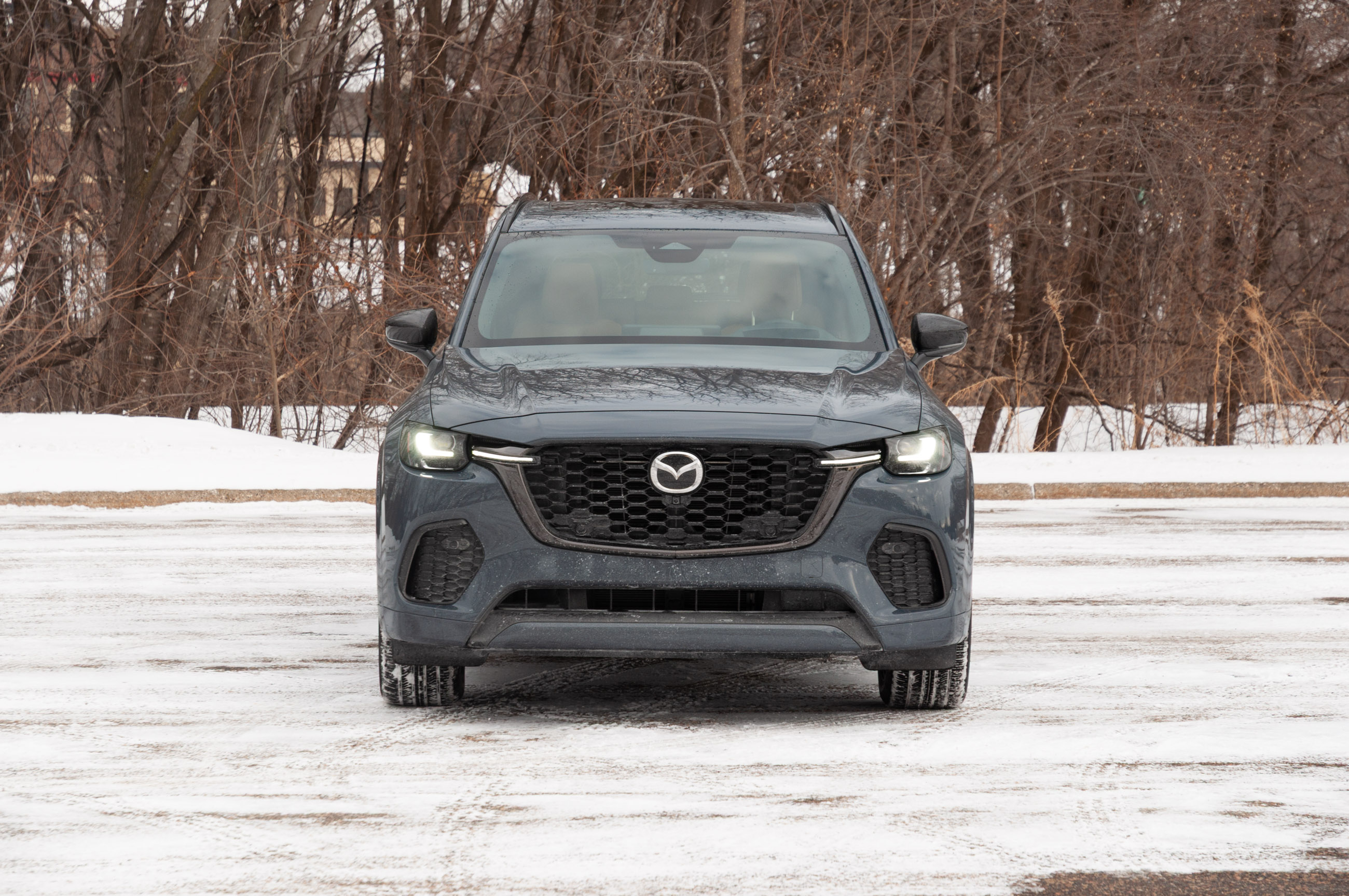
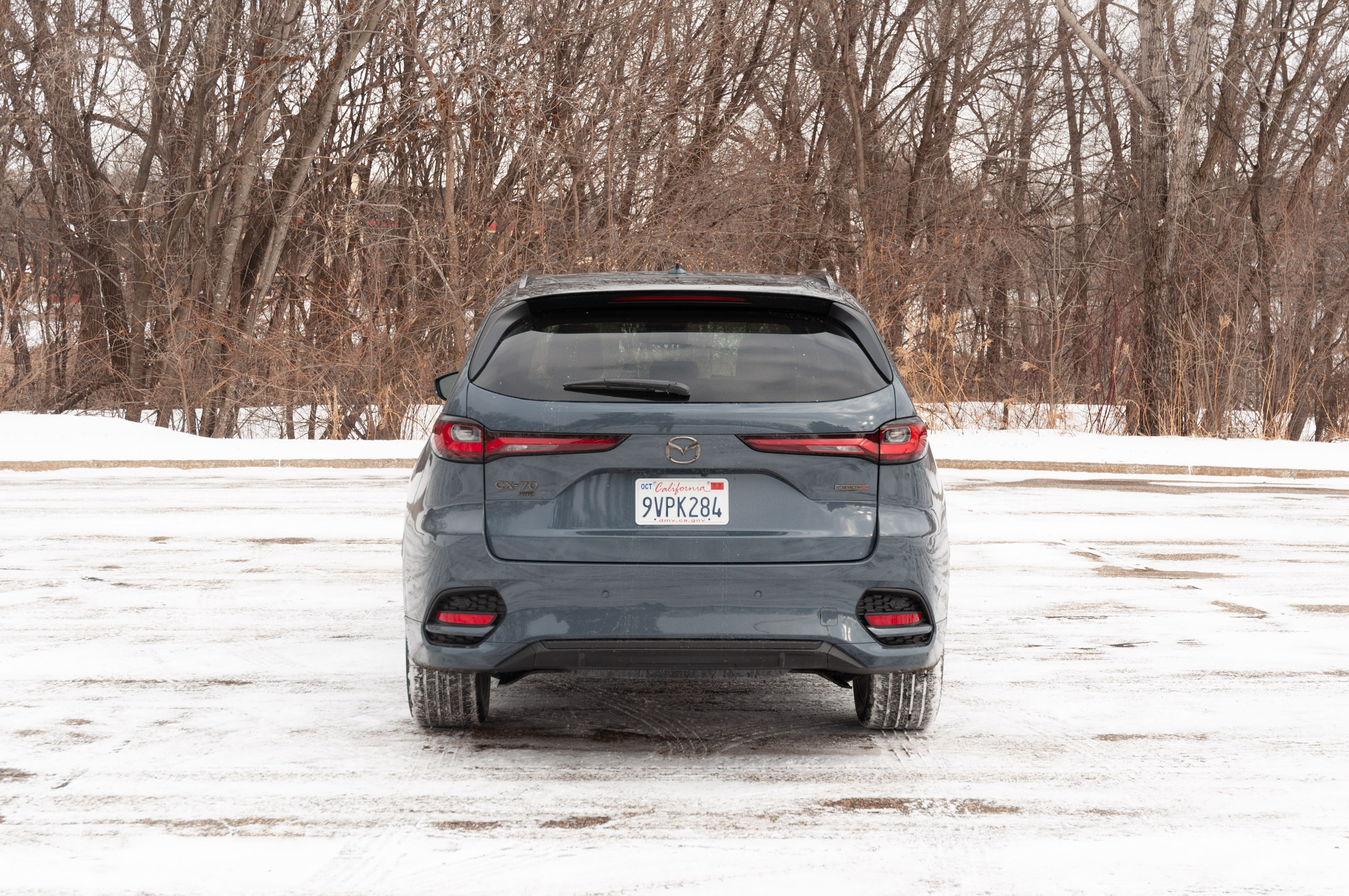
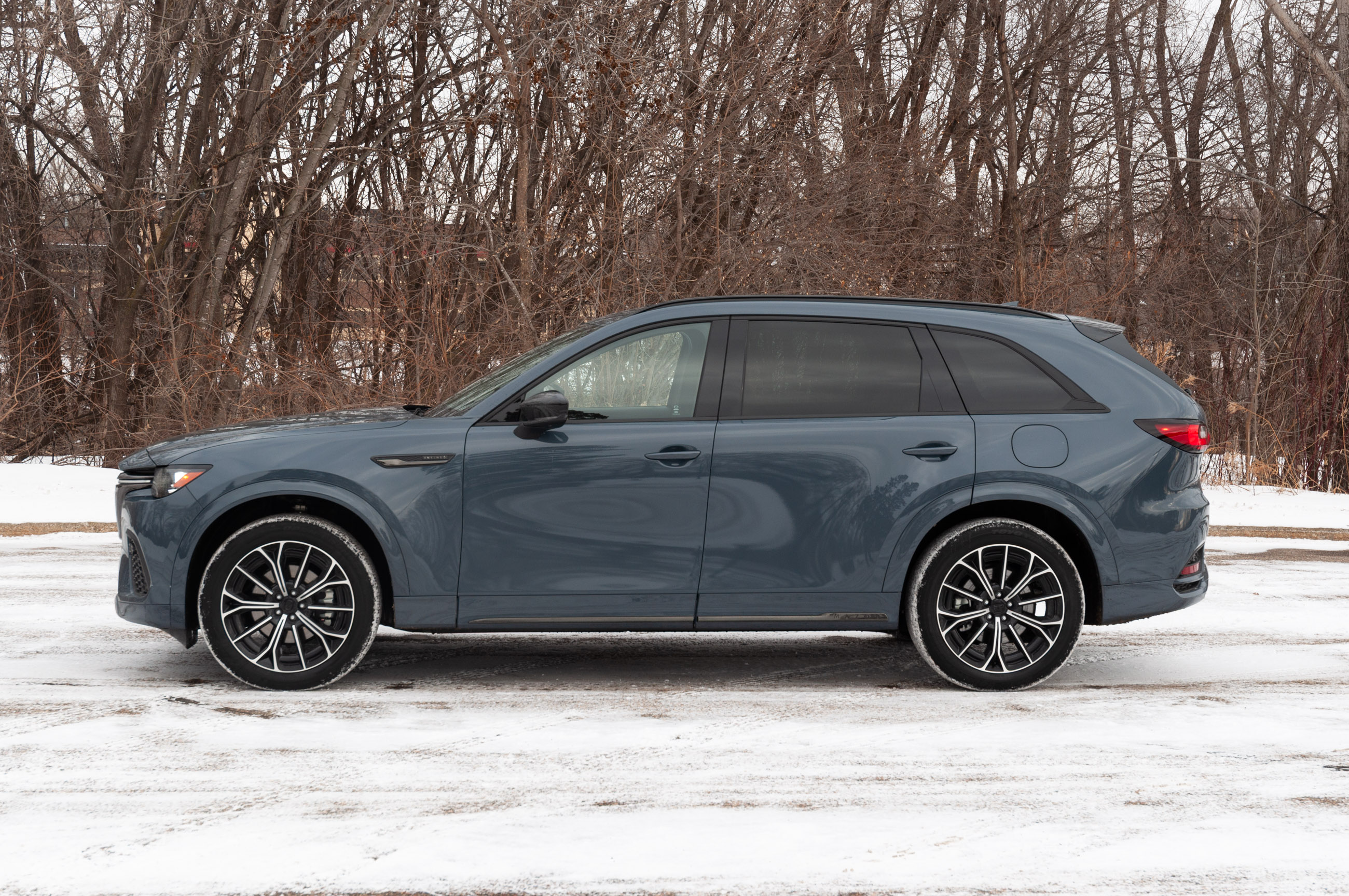
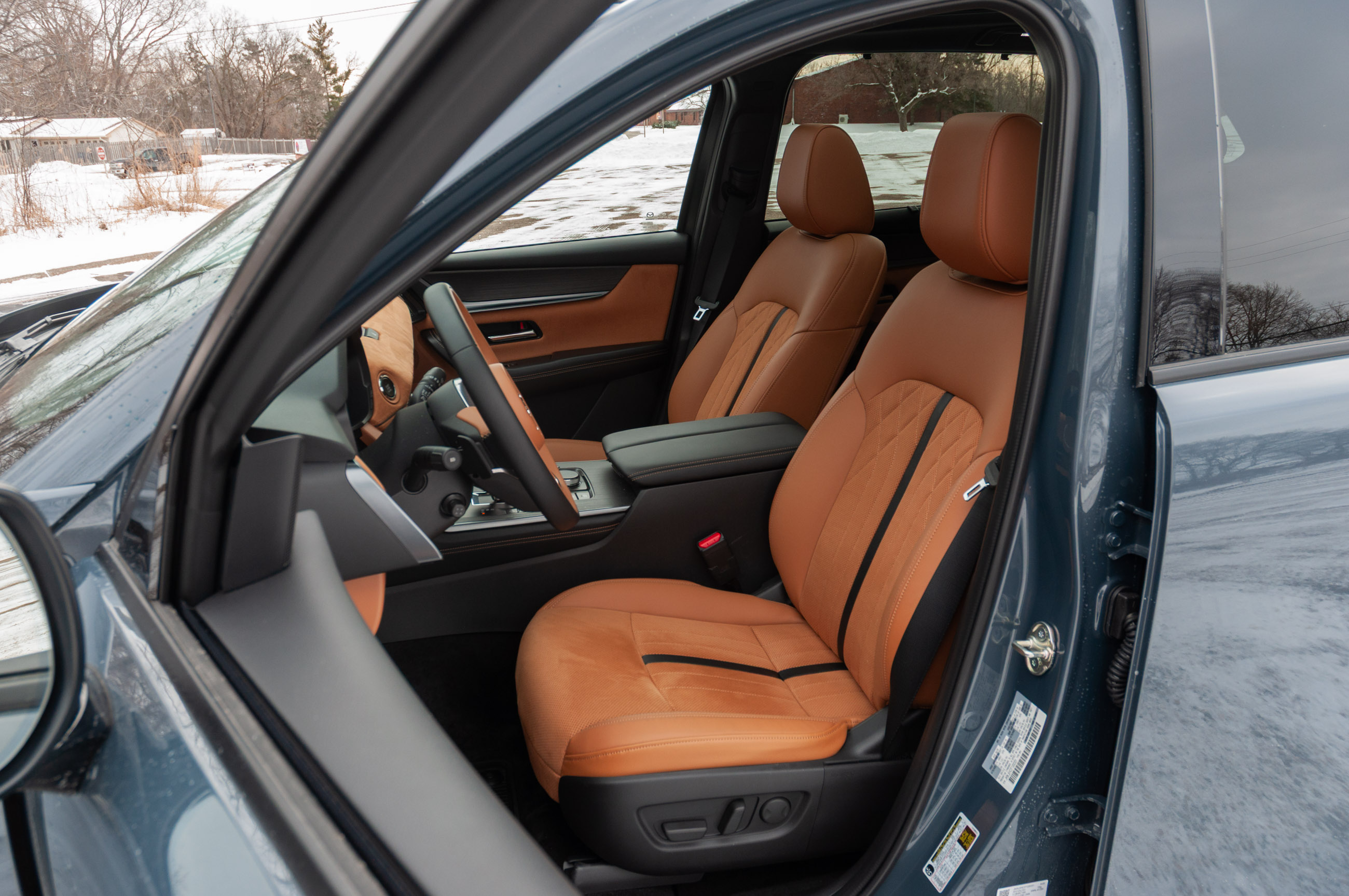
    A glance at the CX-70 won’t easily distinguish itself from its three-row CX-90 sibling. That’s not a terrible thing given how gorgeous the CX-90 is with a long dash-to-axle ratio, tidy rear end, and short front overhang. It’s upscale-looking.

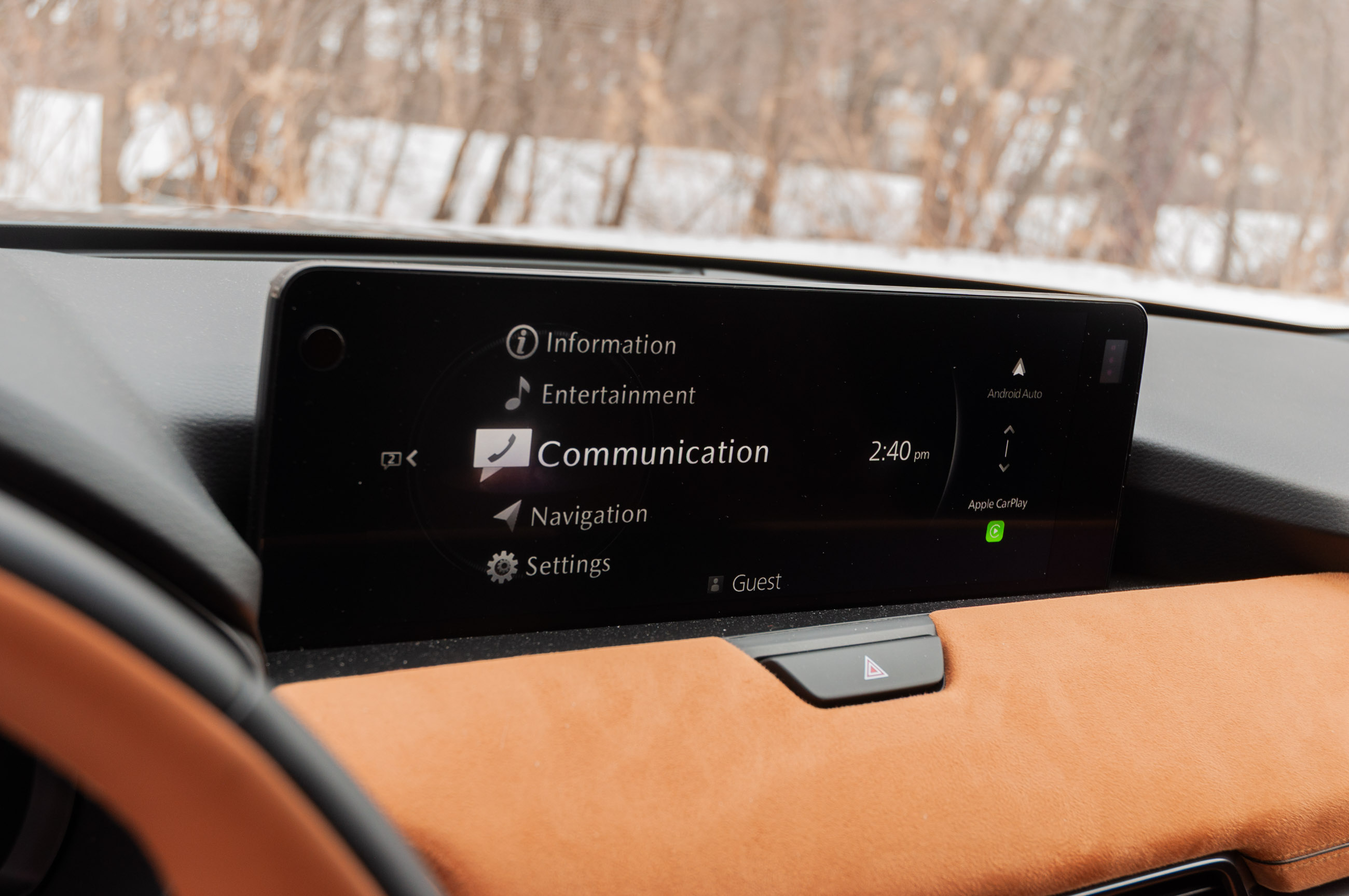
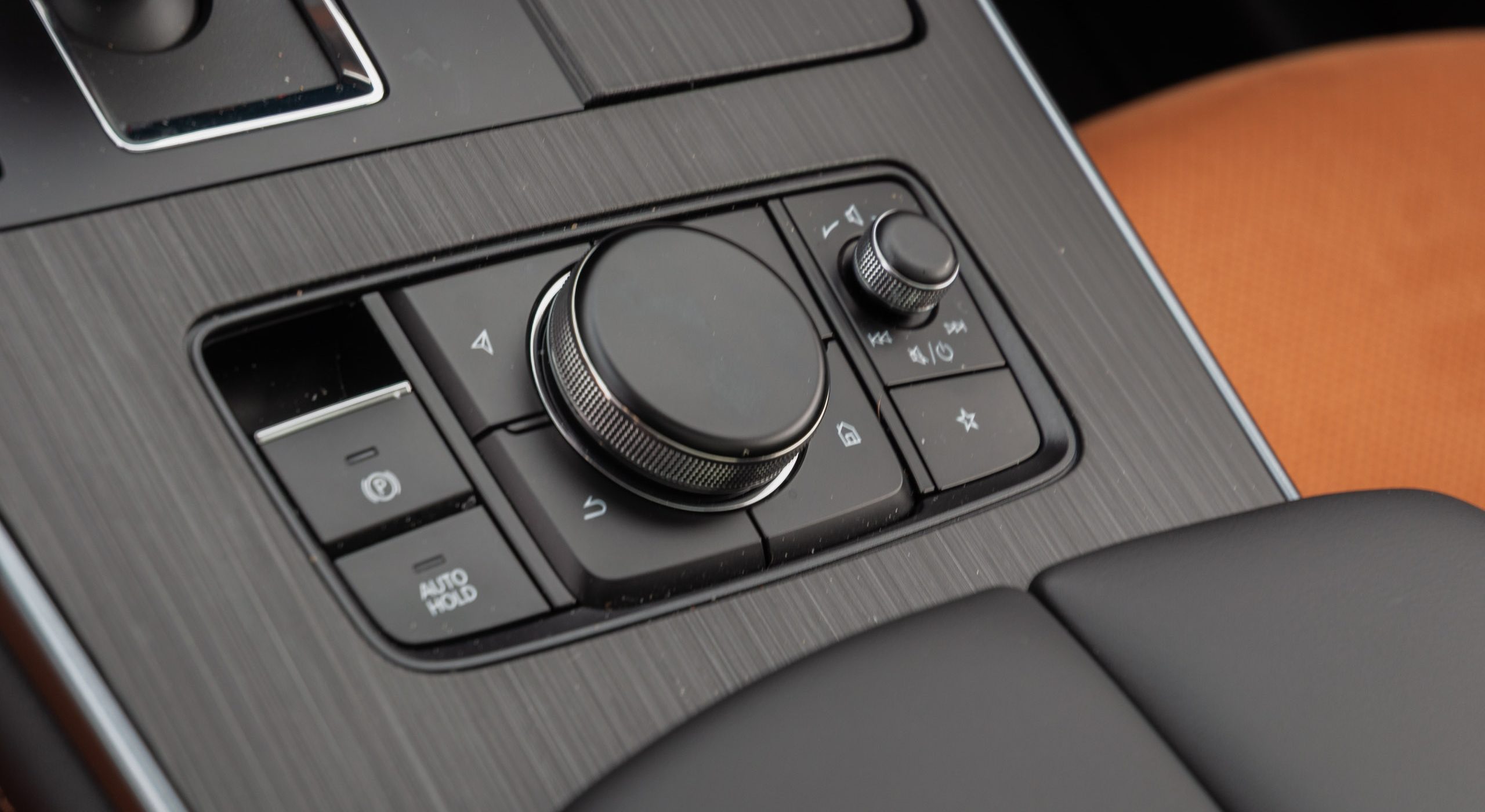
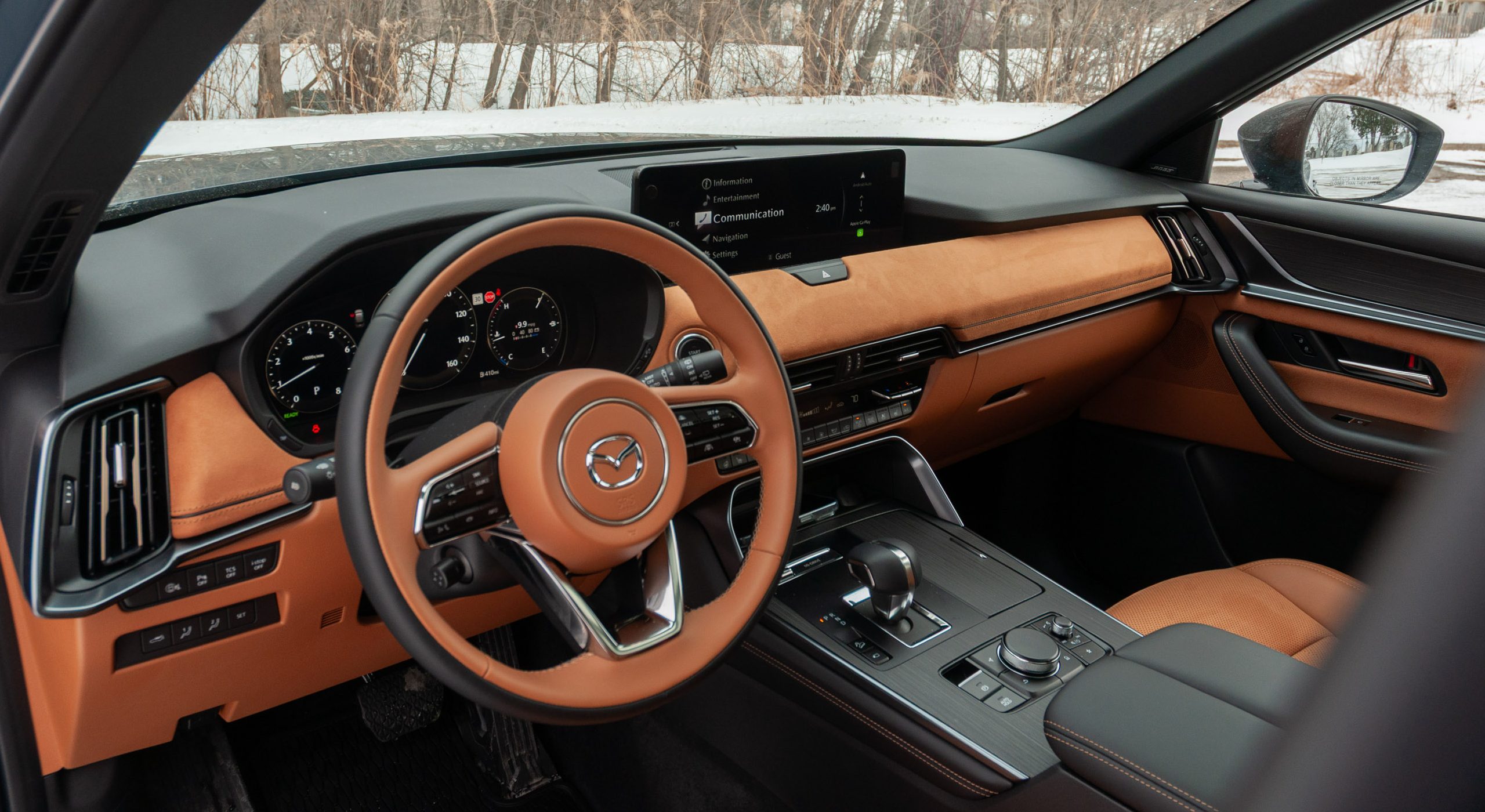
    Inside the dashboard is the same as the CX-90’s, with upscale materials ranging from suede and leather to soft-touch bits and toggles or knobs that all move with precision to deliver a satisfying click. The CX-90’s 12.3-inch infotainment system, which is controlled via a scroll wheel and some hard buttons, is standard, though it can be a touchscreen when using Apple CarPlay under the right conditions. A 7-inch digital gauge cluster is standard, while a 12.3-inch digital cluster gets swapped in for Turbo Premium trims and above.

    2026 Mazda CX-70
    Joel Feder

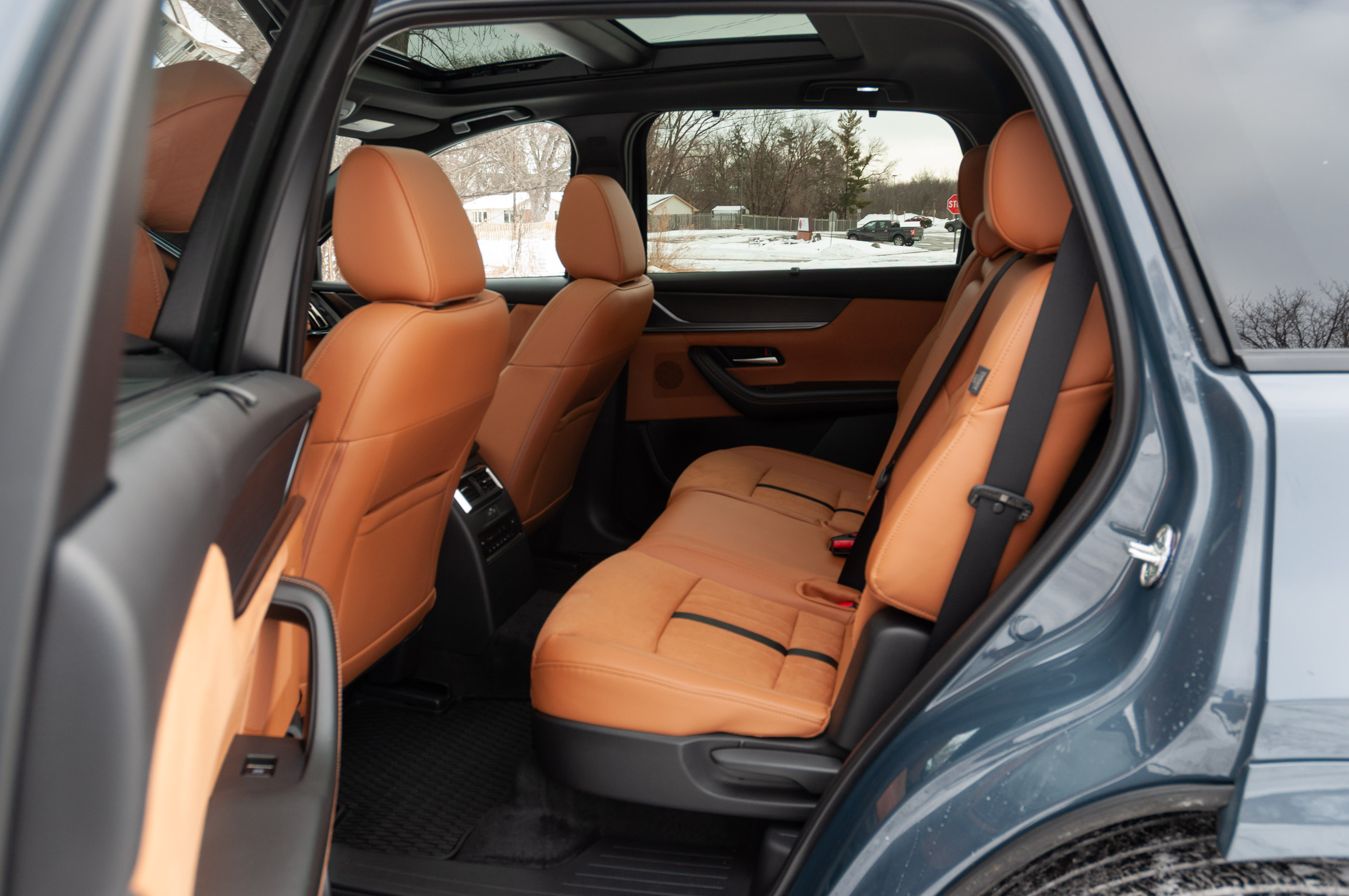
    A key differentiator between the CX-70 and CX-90 is that the two-row seats five people in every configuration. A second-row bench seat is standard, and captain’s chairs are not even available. The top-trim of the CX-90 can not be optioned with a bench seat and only has second-row captain’s chairs. The two rows of seats inside the CX-70 are directly from the CX-90, which means they are comfortable and supportive, though the seat bottoms are a hair short. The rear seats are still mounted in a stadium-style configuration, with occupants looking over those sitting up front. My kids disliked this situation as did I. The setup makes you feel like a perched bird.

    2026 Mazda CX-70
    Joel Feder

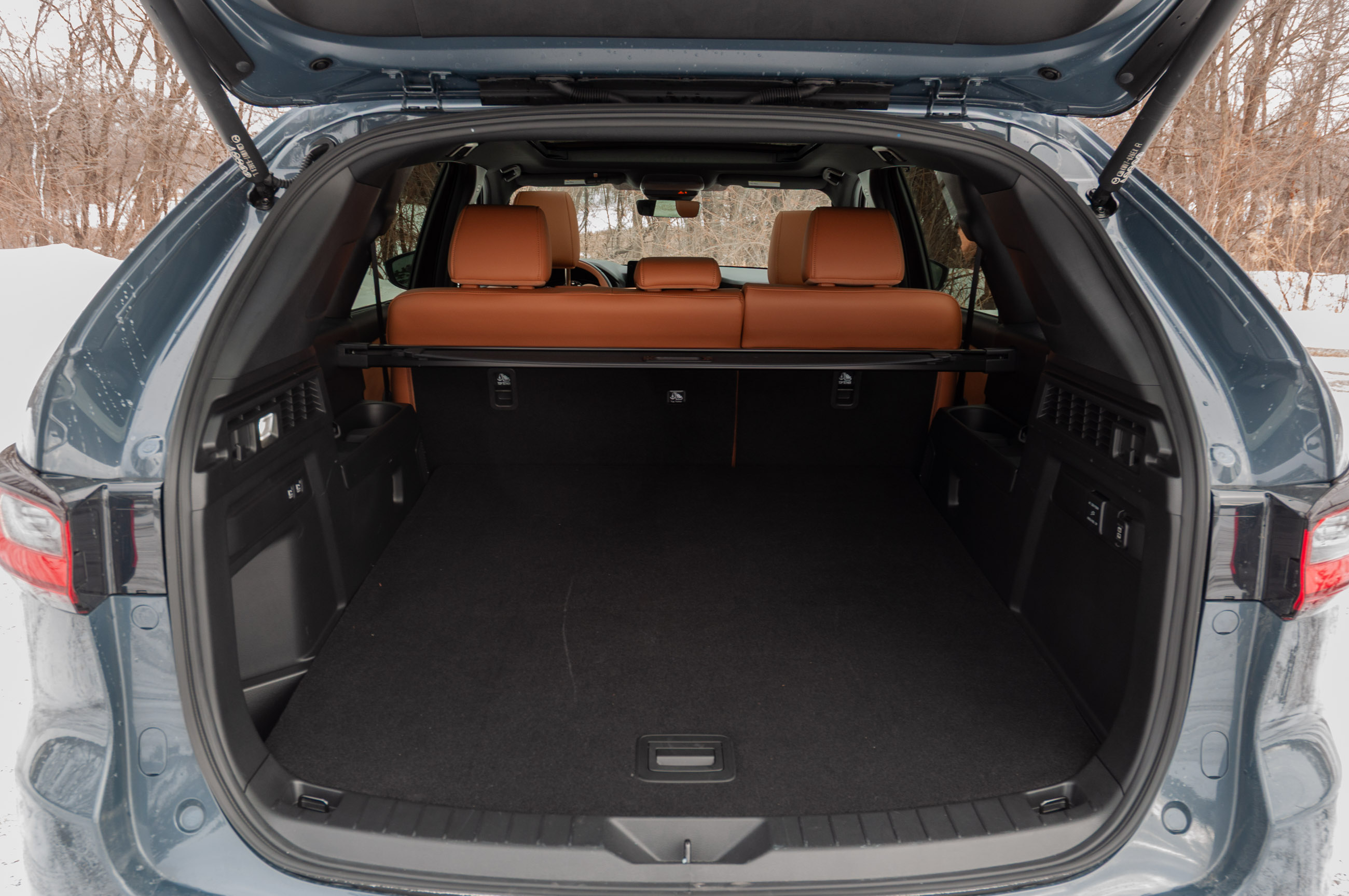
    More annoying is that, despite not having the third row of the CX-90, the “flat load floor” is still sloped towards the hatch. An object could easily roll out of the back of this thing. A soccer ball might be on the right slope. This is a compromised packaging holdover from the three-row CX-90, with the placement of the available plug-in hybrid powertrain’s battery pack. Though the CX-70 does feature some underfloor storage since there’s no third row.
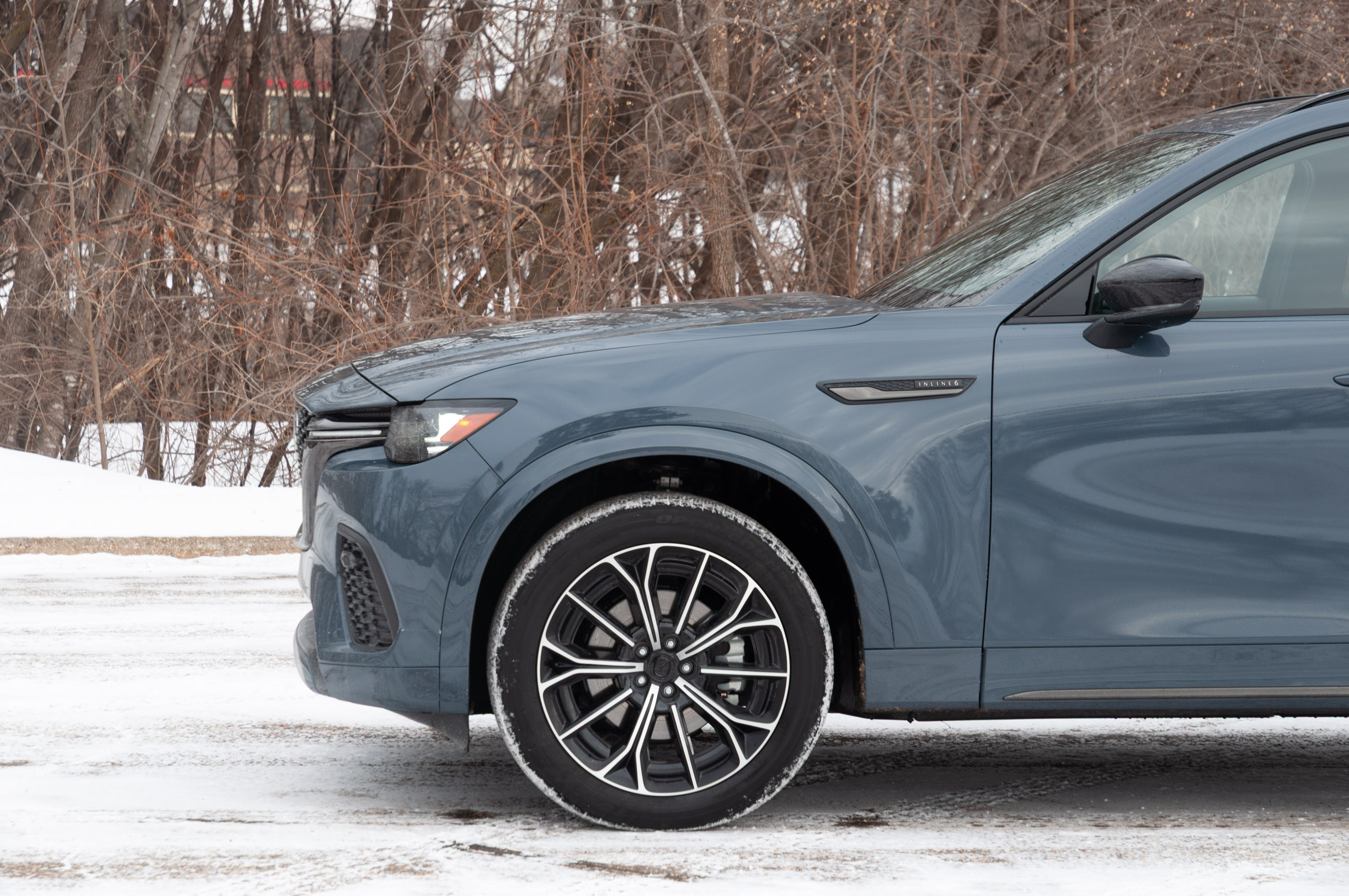
    2026 Mazda CX-70
    Joel Feder

    Driving the CX-70

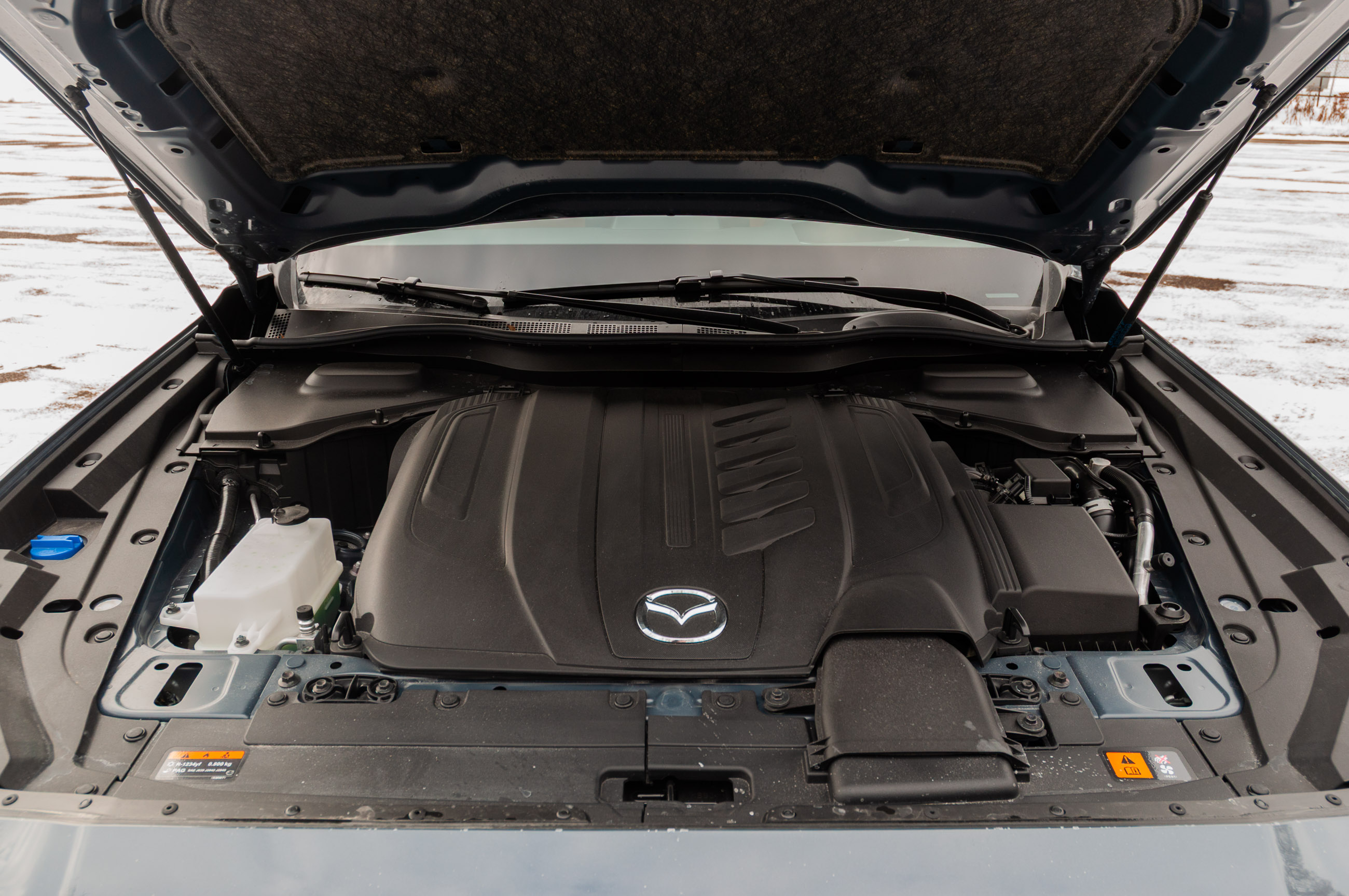
    The powertrain options are the same as the CX-90, meaning buyers can choose between a turbocharged inline-six and a plug-in hybrid with an inline-four. The former was tested here with the higher output spec of 340 horsepower and 369 lb-ft of torque sent to all four wheels via an eight-speed automatic transmission. A lower output version of this engine with 280 hp and 332 lb-ft of torque is in lower trim models, while the plug-in hybrid powertrain has a combined output of 323 hp and 369 lb-ft of torque.

    2026 Mazda CX-70
    Joel Feder

    Shocking no one, the CX-70 drives like a CX-90. That’s mostly a good thing. The steering is nicely weighted, with quick turn-in and a stable feel on the highway, even in crosswinds. The suspension felt a bit harsh and lacked a hair of travel over the broken, heaving, frozen Midwest roads.

    The turbo-six lacks the refinement of a straight-six from BMW or even Stellantis, with a growl that sounds grittier and deeper than other, higher-pitched inline-sixes. It’s still a gem compared to many V6s, but somehow Stellantis might’ve done it better. The eight-speed automatic transmission was designed in-house and isn’t as smooth during 1-2 or 2-3 shifts as a ZF unit in the Jeep Grand Cherokee. At times, there’s a stutter as the torque converter locks up, especially when cold. 

    Notably, the turbo-six is surprisingly efficient. Despite the winter temperatures, the CX-70 averaged 23.2 mpg over the course of 398 miles of mixed suburban driving. That’s in the right range with EPA ratings of 23 mpg city, 28 highway, and 25 combined.

    Anyone thinking that the CX-70 must carry a weight advantage over the three-row CX-90 would be correct, but just barely. Depending on the trim, the CX-70 is anywhere from 27 to 51 pounds lighter than the CX-90. That’s less than the weight of my 10- or 12-year-old. Which is to say, you won’t feel the difference behind the wheel. In fact, a base three-row CX-90 weighs 154 pounds less than the CX-70 because it lacks a sunroof, has smaller wheels, and some power features.

    2026 Mazda CX-70
    Joel Feder

    Quick Verdict

    The CX-70 costs $43,780, including a $1,530 destination charge. That’s about a $2,000 premium over a CX-90, but in reality, it’s only $250 more. The CX-90 has a base Select trim the CX-70 skips, and the base Preferred trim for the two-row is only $250 more than the CX-90 Preferred. It’s still somewhat odd to comprehend that in any capacity, $250 or not, the CX-70 with two rows of seats costs more than the same car with three rows of seats. That equation flips as the trim lineup moves upward, since every other CX-90 model costs about $2,000 to $3,000 more than the CX-70. The 3.3 Turbo S Premium Plus CX-70, as tested, cost $56,670, about $2,000 less than a comparably equipped CX-90, but it had a second-row bench seat.

    The main argument for buying the CX-70 is that you don’t want to pay for a third row you won’t use and don’t want to haul around. If you fall into that subset, Mazda’s reaching for the margins that include you. Either way, you’ll end up with a gorgeous crossover SUV that drives better than most of the bland competition and features a more premium cabin to boot. Just don’t put anything heavy that rolls in the back cargo area and forget about it when you open the tailgate.

    Mazda provided The Drive with a seven-day loan of this vehicle for the purpose of writing this review.

    2026 Mazda CX-70 3.3 Turbo S Premium Plus Specs

    Base Price (3.3 Turbo S Premium Plus) $43,780 ($56,670)
    Powertrain 3.3-liter twin-turbo inline-six | 8-speed automatic | all-wheel drive
    Horsepower 340
    Torque 369 lb-ft
    Seating Capacity 5
    Curb Weight 4,863 pounds
    Towing Capacity 5,000 pounds
    Cargo Volume 39.6 cubic feet behind second row | 75.3 cubic feet behind first row
    Ground Clearance 8.1 inches
    EPA Fuel Economy 23 mpg city | 28 highway | 25 combined
    Score 7/10

    Quick Take

    The 2026 Mazda CX-70 will only make sense for a subset of people, but those buyers are probably thankful.


    The Drive Logo

    Car Buying Service

    Source link