The biggest car news and reviews, no BS
Our free daily newsletter sends the stories that really matter directly to you, every weekday.
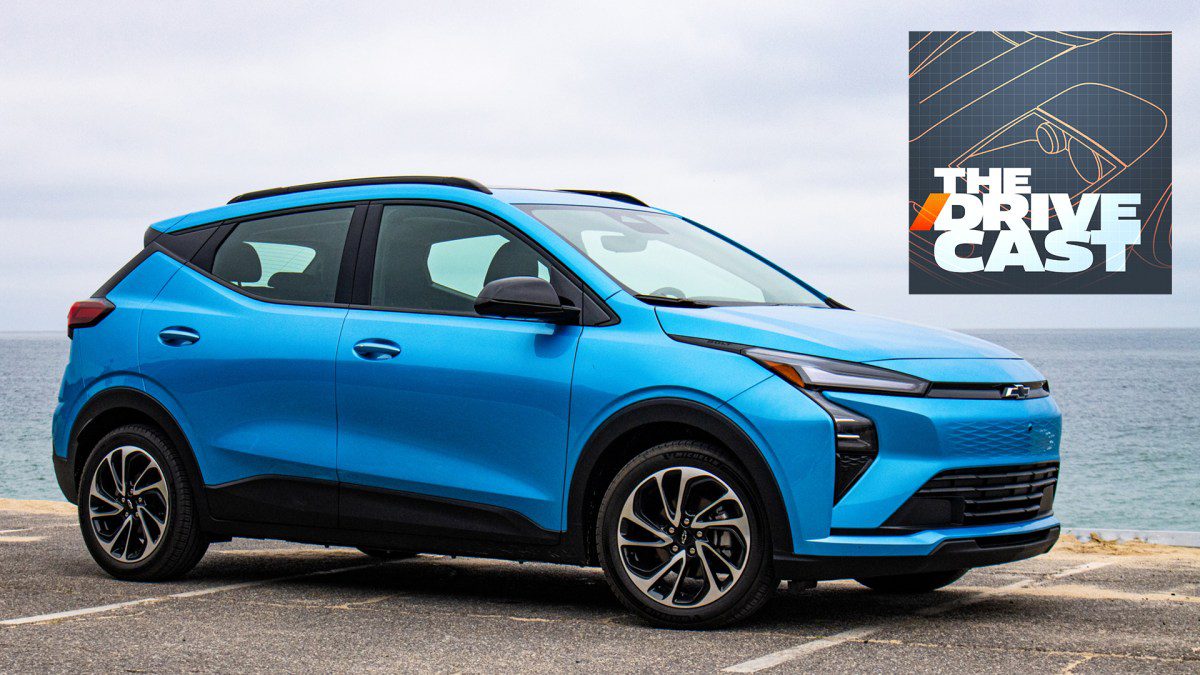
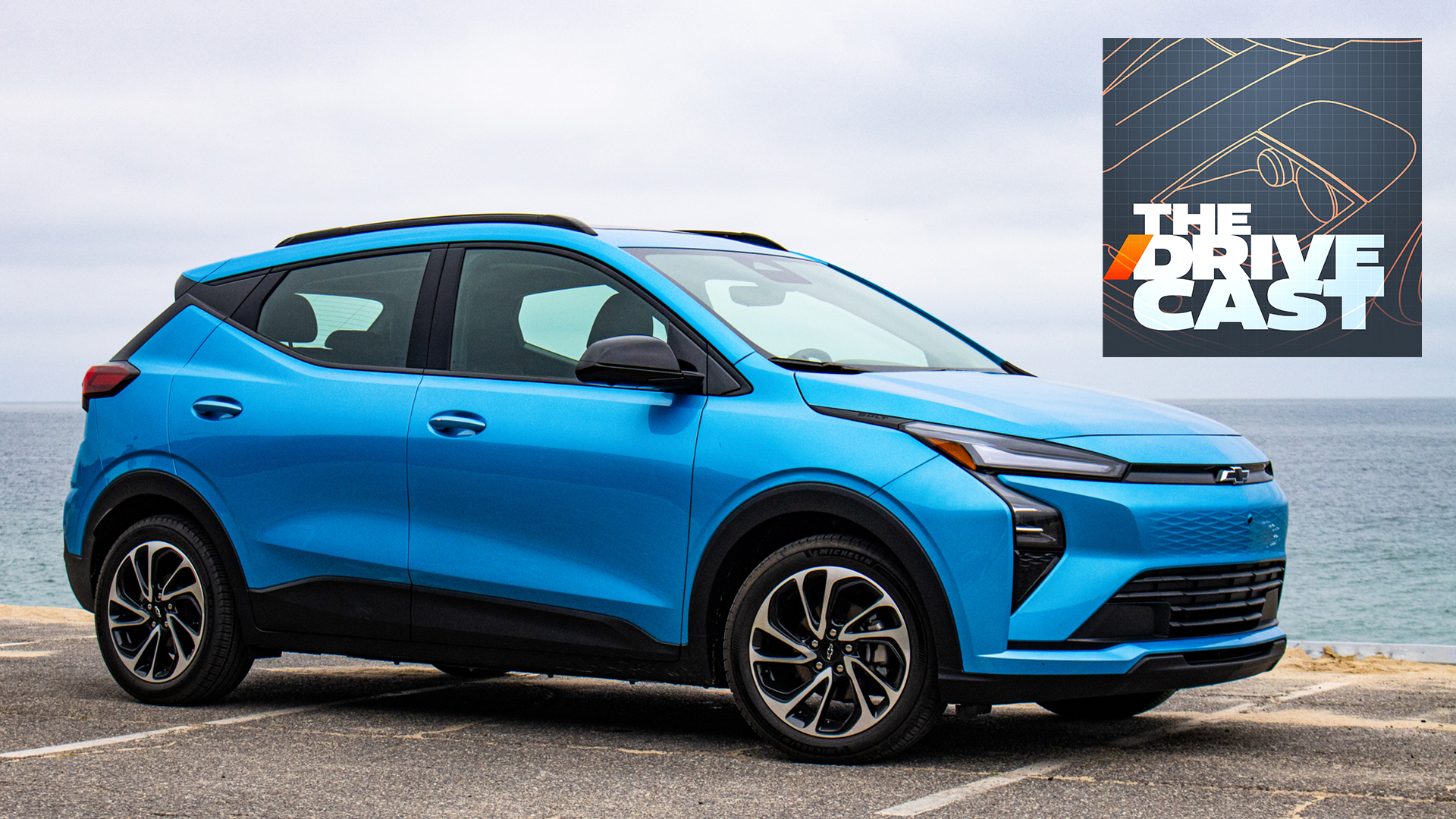
GM has a bad habit of killing off its best ideas when it comes to electric cars: see the GM EV1, or the Chevrolet Volt. But after it did the same to the Chevy Bolt, the public outcry around the death of America’s most affordable EV forced the automaker to change its mind and bring the car back from the dead. For now.
On this week’s episode of The Drivecast, we’re diving into the life, death, and temporary resurrection of the $29,000 Bolt, which is now back on sale in largely the same form three years after GM unceremoniously threw it in the dumpster. From the backstory of how engineers scrambled to relocate the car’s assembly line, to the use of virtual crash testing to speed the updated model’s development, to GM’s surprising luck in reviving it at a time of slowing EV sales and still-rising prices, it’s a pretty fascinating story that says a lot about General Motors as a company and what’s wrong with the electric car market in America today.
Especially because GM has only promised to keep the Bolt in production for another 18 months. After that… it’s anyone’s guess. Our editor-in-chief Kyle Cheromcha spent a day test driving the 2027 Bolt—check out his full review here—and grilling the car’s engineering team for answers on how GM made this unprecedented move and whether the Bolt might get a third act.
If you’re new here, The Drivecast is our weekly podcast giving you a behind-the-scenes look at the big stories, controversies, and characters shaping the automotive industry and the way our roads look today. Powered by The Drive’s inside access, the show takes you through our original reporting, shares our exclusive insights, and expands on those stories in ways that aren’t possible with just one article.
Listen every Wednesday on Spotify, Apple Podcasts, or Amazon Music, and if you’re enjoying it, toss us a five-star review to help get The Drivecast in front of more people. If you’ve got suggestions or requests for future episodes, hit us up at feedback@thedrive.com.
Full Transcript
Joel: Hello everyone, and welcome to The Drivecast. This week, Kyle and I will be talking about the life, death, and resurrection of the cheapest electric car you can buy in America, the Chevrolet Bolt. Few cars have been through a journey like this little Bolt, launched ahead of its time as one of the most affordable mass market EVs back in 2016, which side note, GM has a history of this. It was a practical, quirky, and surprisingly forward-looking move for a traditional automaker like General Motors.
Kyle: And of course, GM did what it’s often done with its best ideas, took it out back and shot it. Bolt sales were solid and owners absolutely loved their cars, but in 2023, GM announced it would be discontinued at the end of the year because it needed the factory space to start cranking out full-size electric pickups as part of its moonshot plan to go all electric by 2035. There were other factors too, but the message was clear. A quirky, cheap EV hatchback just wasn’t a priority anymore. Fair to say that GM didn’t realize just how pissed Bolt buyers would be about that decision. Extremely is the answer. Or how people would come at the company for basically doing the same thing it did to the pioneering EV1 over 25 years ago. So a few months later, the automaker made an about face and announced it would find a way to bring back the Bolt at some point in the future.
Joel: That future is now, because we’re at that point. Three years later, after GM moved the entire production line to a new factory, the 2027 Chevrolet Bolt is about to go back on sale pretty much the exact same as it was before. Sure, it’s got a new battery and new motor thanks to the automaker pouring a little money into its EV R&D over the years, plus the standard NACS Tesla-like charge port to make use of the Tesla Supercharger network. But from the outside, it’s largely the same car that GM didn’t see the value in making just a short time ago.
Kyle: And that’s the key. What’s not the same at all is the world the Bolt is being reborn into. EV sales have slowed in America. The federal tax credit that made them affordable enough is gone. Cheap Chinese cars are at our doorstep, and no one is buying those electric pickups GM booted the Bolt for. Car companies have started to realize that they’re running out of people who can afford to drop $50 grand on an electric car and low cost models like the Bolt, which now starts around $29,000, are going to be essential to keep EV adoption moving forward.
But there’s a catch. Despite the fanfare, GM says it’s only going to keep making the Bolt for another 18 months because once again, it’s going to need that factory space for higher priority models. This time, it’s because tariffs are forcing it to move production of gas powered Buick and Chevy crossovers from China and Mexico back to America. The Bolts rebirth, it seems, will be short-lived. Here we go again.
Joel: Last week, Kyle spent a day test driving the newish Bolt and pressing the Chevrolet team for answers on the bizarre and basically unprecedented move to bring an old car back into the production because people got mad. So today it’s inside the resurrection of the Bolt—how we got here, what it took to make it happen, and whether it might have a life beyond the limited window GM is promising. Again.
All right, Kyle, you spent time with Team Chevy. What is the deal with this company? Literally, look, I’m Jewish, and the Jewish people have a saying: history repeats itself. And it’s true. We went through the desert for 40 years and all these things, but like EV1, the Volt, the Bolt. What is the deal?
Kyle: I think the general answer is that GM is a company that employs some of the best engineers in the world. That’s just straight up. They can do incredible things, but it is also a massive sprawling enterprise that just really has a hard time letting those ideas bubble to the surface. And then when they do, there’s enough cost concerns and people just trying to be involved in these decisions. And it’s just the organization of that company means that the incentives are rarely lined up to keep something going when there are reasons, sure, that maybe it should be discontinued or maybe something should only be available for a certain amount of time, but it’s not good at responding to that and adapting to that once something like the Bolt goes into production and then people love it and they’re like, “Well, we’re losing 10 grand per car on selling this thing. So let’s move to higher margin vehicles like full-size electric pickups.”
Even though the Bolt had a proven market, people were buying it, the sales actually reached an all time high the year it was discontinued and yet they were like, “All right, that’s enough of that. Won’t you guys love an Equinox EV instead? Won’t you guys love an electric Silverado instead? You will, right?” It’s like economists treating people like widgets. We don’t make rational choices here, especially in cars. Specs are worth something, model comparisons are worth something, but people buy cars on vibes all the time. And GM is just historically very bad at reading the vibes.
Joel: I really feel a little attacked right now because I just feel like that was a thinly veiled attack on my whole, I need a Rivian R1T quad thing, but whatever. I’m going to let it go. I’m going to let it go. We’re not going to hold things against you now.
Kyle: It’s a compliment. It’s a compliment. You’re not a rational actor. You are unpredictable and therefore you have the power. I think that’s the way to look at it.
Joel: I would like that in my performance view. Anyway, you’re an EV guy. You literally own an EV. Ironically, I’m the one who wants to buy Rivian and you’re the one who owns an EV, but I digress.
Kyle: I do. I leased a Hyundai Ioniq 5 last March, and I did it because I had an old E46 that finally shit the bed. And I just, as someone who runs a car site, I figured I had never had an ownership experience in an EV and I really should experience that. I picked the Ioniq 5 because it was really, really cheap. The incentives Hyundai was using at the time, this was right before the tariffs hit. So there was just a lot of worry about whether or not these would continue to be positioned correctly in the market. And so dealers were really trying to move their stock. It’s like a ridiculously low monthly lease that I managed to score.
I don’t consider myself an EV guy. I’m just a person who happens to own an EV. I’m not like, an EV enthusiast, but at the same time, I’m the buyer that these companies are really, really struggling to reach right now. I would consider an EV if it fits my needs. I’m not obsessed about it. I’m not totally willing to put up with software issues and headaches and any other problem that comes from being an early adopter. I am right where these companies need to be targeting right now. And frankly, I mean, the Bolt as we’ll talk about, it’s an impressive package. If the Bolt was available, I would’ve really considered it because when it went out of production in 2023, I mean, for the model that had Super Cruise, which is GM’s hands-free driving tech, which is really great, by the way. They did a really excellent job making a system that you have confidence in and that can really perform almost flawlessly on the freeway. That was around $35,000, I believe, $36,000. I would’ve been all over that. Perfect package for me. And yet GM missed me as a buyer because they decided to stop making the damn thing for three years.
Joel: So let’s transition here. Let’s talk nuts and bolts, right?
Kyle: Oh, good one.
Joel: You’ve driven every Bolt known to man.
Kyle: All three of them. Yes.
Joel: Tell me some background around the Bolt.
Kyle: Yeah. So the development of the Bolt started back in 2012, actually. And similar to what you’re seeing automakers do today, it was a small team that was tasked with, “Hey, figure out the solution to this problem.” In this case, an electric car, because except for Tesla, which also launched in 2012, there were no mainstream electric cars. The Nissan Leaf did exist, but it had really, really low range. And outside of that, it was just really high-end models, German companies, Mercedes, Audi, kind of experimenting with electric, luxury cars and supercars. So that’s the environment. It started out in, and again, GM ahead of the game. Ford, Fiat Chrysler, EVs were a glint in their eye, as the saying goes, at the time. GM poured a lot of money into figuring this out. And then yeah, in 2016, it launched. And it was a surprise debut. They had a concept at an auto show the previous year, and then when the production car came in 2016, it looked pretty much like the concept.
And it was a little weird. It’s kind of a tall hatchback looking thing. They planned it as a global car, so this was designed to meet both European buyers and their demands and be a bit smaller. It’s certainly not the size that you’re used to seeing GM operate in. Because it was a different era—again, we’re talking 10 years ago at this point—battery tech was not what it was today. Charging tech was not what it was today. It had a lot of hurdles to overcome. And frankly, it did. I mean, the early battery, the Bolt launched with a 60 kilowatt hour battery. It was an early version of a lithium ion battery supplied by LG, and that becomes important later because there were some issues, and it had about 240 miles of range.
Those numbers don’t seem impressive today, but back then it was the only EV for under 50K that had over 200 miles of range. The Model S was pretty much the only other game in town and that cost a lot more. And it was actually the second best selling EV in America behind the Model S in its first full year in 2017. So all of that is an amazing start. And remember when I test drove that early model in 2018, it really felt like, this is the future. This is GM moving the goalposts, setting a standard that other companies are going to have to race to catch up to. At that time, the Model 3 hadn’t actually launched yet and there was a question of whether it actually would or whether Tesla would go bankrupt in the process. Meanwhile GM is like, without seemingly a lot of effort externally, “here’s a mass market electric car that you can buy before any other company, and it actually has a decent amount of range” that’s enough, statistically, I should say, enough for most everyday drivers. Most people are not driving more than 200 miles a day.
And one of the big early adopter struggles was charging because the Tesla supercharger network existed. Fast charging outside of that was pretty spotty at the time. Still is, for the record, but it didn’t even come with a standard fast charging port. Like you had to option that, and eventually that was the standard option on higher trims. Otherwise, you were stuck with the J1772 for level one or level two charging. It takes hours to recharge even a small battery like that. And then the big issue came in 2020 when what started as a small number of battery fires grew into a bigger number and prompted what eventually became a massive recall of every single Bolt built. I think it was around 141,000 units from 2016 to 2021. All those batteries had to be replaced.
There was a lot of finger pointing between GM and LG about who was responsible for the defects and where things went wrong, but they wanted to move all of this stuff in house, battery production, motor production. This was their moment of, we are going to be full EV by 2035, come hell or high water, and here are 20 new models we’re previewing that are going to be riding on this modular platform and da, da, da, da. The Bolt really wasn’t a part of that conversation, mainly because it was built around tech that had now kind of passed its prime. And so in GM’s mind, I mean, they could have made the decision they made now to upgrade the Bolt with its current battery tech, its current motor tech, but they were also losing something like $10,000 on each Bolt sold. And so they were looking at the calculations and thinking, “Okay, we need higher margin vehicles. We need stuff that’s going to lose us less money or even make us money. And we don’t see a path to doing that with the Bolt.”
So even though they went through the trouble of doing a refresh in 2022, they came out with the bigger EUV, Bolt EUV model, which is, instead of a hatchback, is basically like a subcompact crossover, a little taller, a little longer. They added Super Cruise, like you said. And then a year later they were like, “All right, that’s it. We’re done with the Bolt guys. If you want an entry level EV, why don’t you check out the Equinox EV,” which is not the same at all. That’s a much bigger crossover. It’s still technically a compact, but it’s much bigger. It didn’t have that singular look of this kind of weird hatchback looking thing, and it ended up launching with a fair amount of issues, software related, that had already been ironed out in the Bolt. So that solution of, “We’re going to take away this car that’s really affordable. Why don’t you try buying one that’s a little less affordable and a little less proven, even though it should fill the same void?” People did not take kindly to that. And there were a lot of angry Bolt owners.
And it’s funny to think about a small group of passionate people actually affecting change like this and forcing a company to, without saying, “Hey, we were wrong,” to admit that they were wrong, but it happened. And I think a small part of it was also the pressure just from the media, people like us, and the general public. It seemed to make no sense to kill the Bolt like they did. Sure enough, a few months later GM CEO Mary Barra came out and said, “You know what? We’re going to bring it back at some point, TBD, stay tuned, stay tuned, we’re going to figure it out, don’t worry.” And then it took them about three years to figure it out. It was not an easy process as we’ll get into, but here we are with the 2027 Bolt, which is basically the 2023 Bolt, but with new motor, new battery, new interior, but dimensionally the same.
And as we’ll talk about it, it is kind of an uncanny experience to drive a new car that was gone for a while and is essentially the same as the old one minus stuff that is changed that you can’t see. So visually, apart from some new headlights, it looks the same because it is the same. All the hard points are the same. It’s just there’s new tech underneath that does make it a more compelling offer in today’s market. It does update it to be with the times, but it’s a strange situation. I was talking to a few people there and none of us could think of another time that an automaker did this and figured out how to satisfy people by resurrecting a car like this. It just doesn’t happen.
Joel: Well, it’s funny because something you said earlier stuck with me. The first time you drove the Bolt, it was this moment of like, this feels like history or whatever. And it’s funny because the first time I drove a Bolt, I didn’t get that. I’ve gotten that a couple times the first time I drove a Model S, this is like, wow, right? The original Leaf for different reasons, similar timeline. Again, similar thing because that one was cheap compared to a Model S at the time. And then I remember doing that with a Rivian because this is now a truck and this is better because it isn’t a V8 and the packaging was crazy. And the Model 3 also, because now we have a mainstream compact sedan, right?
But the Bolt, when it first came out, yes, it was important. Cheap car, 200 some plus miles of range and all that stuff. But like you said, things dampened it for me with no fast charging. Even a leaf at the time with CHAdeMO could do fast charging. I’m using air quotes, people can’t see me. So there were so many things in that that originally came and compromised, but then they offer Super Cruise. I’m like, “Well, now this is a cheap car with Super Cruise.” So there’s always been this dichotomy when it comes to this car for me.
Kyle: Fair points. And I do see that in retrospect, especially it was maybe not the historical moment. It didn’t turn into the historical moment that it could have turned into. I think I felt that way because to me it was another kind of EV1 moment for GM where they went outside of their comfort zone. They made something that despite the early issues felt like a true effort in a way that no other major automaker had done. I mean, the Leaf, as you just said, sure, it had faster charging, but it also had an air cooled battery. The batteries died very quickly in that car because they did not have the temperature management under control. This one had a liquid cooled battery. And so that alone felt like the major piece of the puzzle in electric car is the battery and how that is managed and maintained and GM figured out a way to make it feel more reliable and get people to trust it.
And I also think that an electric car coming from a company like Chevrolet, which is very traditional and has a lot of traditional buyers, it’s much easier to get those people to at least consider something like this when it comes from the same company versus some other startup or even another major automaker trying to conquest those buyers. It felt like this could be not a tipping point, but the start of what could eventually become a tipping point in getting people to seriously consider an EV who might never have done so otherwise. So that’s why I felt like it had significance and it was good. It was a good car. It was fun. I especially loved that it had this little hand regen brake on the back of the steering wheel that was essentially like a hand brake on a motorcycle, but it was just weird in a interesting, refreshing way that GM can do sometimes, as we’ve said, but rarely gets it together to put all that through the process of making a production model.
All this weirdness gets ironed out in the company as big as GM. And this one felt like the id of the engineers coming out and expressing itself. And I don’t know, I found that very refreshing.
Joel: I felt that way around the original Chevrolet Volt. Those first buyers of that car that looked futuristic with the Apple-like center console and all that were so passionate. And then they made the second one look mainstream like a cruise and didn’t do well. People didn’t like it anymore. It didn’t make sense. And also they had a crossover concept and they ready to put it in production, which was a huge flub. They should have just kept going with it. So anyway, whatever. They had this car, everyone loved it, they killed it, everyone cried about it, and now they brought it back. Why is GM doing this? What is going on here?
Kyle: GM is great at marketing speak. And so when I asked that question directly to the engineering team behind the Bolts, their response is very much in the, “We’re listening to our customers. We’re serving our customers. We know people love the Bolt and we just wanted them to be happy again.” Sure. And a company like GM exists to sell cars and they need to respond to what people want. So there’s a little bit of truth to that, but they’re very careful to not say, “Oh, we got it wrong. We should not have killed this. This was a really important part of a comprehensive electric lineup that we then just didn’t have once we killed it and that was a mistake and now everything has changed around us and we need to start offering this again,” which is the real truth. They misjudged where the market was going.
And as we’ve talked about on this podcast several times now, car companies, they have to look five, six years into the future when considering a new car and how long they’re going to make it. And in the early part of this decade, five, six years into the future, they’re looking at these sales charts and EV adoption rates and thinking, “Oh, we’re going to be at 50% by the middle of the decade, even higher.” We might even be all electric by the end of the decade. So we need to start making moves that reflect that lineup and offer things like full size electric pickups or have an electric version of every crossover we sell and that didn’t happen.
They booted the Bolts to make room in the factory in Michigan to build the electric Silverado and Sierra pickups. Those are not selling. People are not buying into those. They’re way too expensive. They’re way too big. They’re way too heavy. And the reality is that GM’s full size pickup buyers are not just going to go buy an electric truck because GM makes it. There’s a lot of brand loyalty there, but they buy those things and they buy those gas powered trucks because they use them or want them in very specific ways. And the electric versions don’t offer that to them. Things like towing or payload or even just the sound and feeling of driving a V8. They try to look at their customer base as rational actors who if the electric version offers relatively the same and maybe except for towing, then of course people will buy it and people will fall in love with it like they fell in love with the gas version and then we don’t have to make the gas version anymore.
And this was all in service of their 10, 20 year strategic plan. The Bolt just didn’t fit in to that and they had a strong sense after making the announcement that this could really come back to bite them. I think it was only like a couple months between them discontinuing it and saying, “Oh, just kidding. No, we’re going to bring it back.” I think they just got a sense that a loud group of buyers complaining about a decision like this, an loud group of loyal buyers, because Bolt buyers are traditionally very loyal, that’s going to become a problem in some way down the line.
And I also think it’s pretty fair to say that they have still have very strong feelings and memories around the fervor around the EV1, their first electric car in the mid ’90s. And when they decided to kill that program and then recall all of the cars they had leased out and then crushed them, that became like a cultural moment.
Joel: I mean, there’s a whole movie on that!
Kyle: There’s a whole movie made about their decision to do that. I think they probably had a sense of like, “Oh, we might be looking at a sequel here.”
Joel: We Don’t want a part two.
Kyle: Yeah, we need to get ahead of this because we can’t take another one of these expose docs. So I think it was just a combination of all of that, that they realized we need to figure out how to do this. And from talking to the team, they had a general sense when that announcement was made that it would be coming back about how they could actually do this, but there was a lot that they had to figure out. And that’s why it ended up taking about three years to bring it back because restarting production on a car, not an easy task, not an easy task whatsoever.
Joel: Well, how’d they do it, Kyle? How’d they bring it back? How’d they resurrect it from the dead?
Kyle: There are two or three parts to this. One is the actual physical assembly line. So it was originally made in Michigan, and as the production of the Bolt was winding down at the end of 2023, they’re looking around, figuring out, okay, where can we do this? And they settled on one of their plants outside of Kansas City, which had some spare capacity at the time. It was making the Cadillac XT4 and a couple other crossovers. But regardless, there was room to do it. And so they first had to disassemble some of the big machinery they used, some of the big tools, the metal stamping tools to move all that stuff over there and restart it and start figuring out how to assemble the rest of the line.
And when you’re developing a car, you need prototypes. You need working prototypes to validate all the stuff that you’re going to do. And they already knew in their minds, well, if we could bring it back in three years, we need to update the tech. We need to not just be the exact same car with the exact same range and battery and all that stuff. They needed the drivetrain to be updated. So they had to build prototypes. So that also involved them literally squirreling away parts of the car, like taking them off the assembly line as the final Bolts were being made, putting them in storage in a back room, body panels, suspension parts, drivetrain components, all that stuff. So they kind of put that stuff into storage for a little bit. As they’re moving the assembly line from Michigan to Kansas, they’re also sending all those parts so that early prototypes can be hand built in the Kansas plants assembly area. So they didn’t have an assembly line up and running yet, but they at least had enough parts and then the manpower, once they started the process, to begin building prototypes.
So I was talking to the Bolt’s chief engineer Jeremy Short about this, and he said it was about 16 months from when the plant in Michigan stopped making Bolts fully and when they could start making new bodies on the assembly line in Kansas. So a little less than half of the time in between the Bolt ending production and today was spent just getting everything set up in the factory and getting that line going again.
The other part of this was crash testing because they, in addition to having a new battery with new cell structure, and it’s part of GM’s own battery production now, it’s not coming from a supplier like LG, they had a new drive unit, a new electric motor. And that’s the same motor that was developed, the X76. It’s the same drive motor that was developed for the Equinox EV and is going to end up in a number of other GM EVs in time. New drive motor, new battery, that required a new subframe. So a part that you’re not seeing when you’re looking at it and seeing if this looks like the same Bolt. There’s a new subframe in there, and that meant it needed to be crash tested again. And crash testing is a very time consuming process. As Jeremy told me, it’s very difficult for them on a personal level to spend a lot of time hand building these prototypes and like the first ones they make just get run into walls. So that was already, they saw that as going to be an issue. I found this really, really interesting.
GM, like a lot of companies, has the ability to do virtual crash tests. And you still do need to do a physical one, but there’s a lot of the legwork that can be done virtually before you go to the NHTSA and say, “Okay, here’s the real crash test.” So they really ramped up the virtual crash testing and that allowed them to … I think he said it saved about a dozen cars, a couple dozen cars from running into walls, as he put it. “We’ve greatly reduced the number of cars we have to run into walls” was his exact quote. I thought that was pretty funny, but it simultaneously allowed them to not burn prototypes on crash testing, but the virtual process, the way he described it is it allows them to make very small adjustments to things like spot welds or the thickness of a tab or a little supporting bracket. If you were just doing real crash testing, if you did one and you got a result, you’re like, “Okay, I need to change the position of this weld so it performs better,” you got to build a whole other car and then do that all over again. With a simulation, you can just change the dimensions in the model and then run it into the same virtual wall and look at those results. And again, this is not new technology per se, but as they said, it’s the first time they’ve really used it in a way to really speed up the development of a car like this and it really cut down the man hours, the labor and the overall timeframe that a car can be crash tested in.
So that was a huge part of it. And he said that they’re looking at this as a template for how to speed development of other models in the future, because if they can cut a few months at least out of crash testing, that adds up. That really does add up and allows them to start hopefully making money on sales and start recouping the investment they put into it. You got moving the assembly plant, you’ve got virtual crash testing, and then the final bit is just getting the latest EV tech in there. It wasn’t enough to just bring back the Bolts, as I said, with the same battery, the same motor or whatever. They needed to put this new stuff in and that required calibration, they had to retune the suspension, the battery’s a bit heavier. There was a lot of finishing touches that needed to be done and Even though it looks the same from the outside to make it drive like a new vehicle and not a three-year-old one with the same downsides that the old Bolt went out of production with.
So a very, very complicated process and they managed to save some time and I think some pretty creative ways.
Joel: Seems like it could be done faster, but what do I know anyway?
Kyle: I’ll let Jeremy know. Yeah, I’m sure it’d be thrilled to hear that. How
Joel: How hard is it to move in assembly line? Come on. Just hire some movers. Let’s go. So okay. Now that you’ve told me exactly how complicated it really is, what’s actually different?
Kyle: All right. So you’ve got the new motor, which has more power, a little bit more power at least. You’ve got the new battery, which went from the older nickel-based lithium ion battery that had some issues, as we talked about, to a new lithium iron phosphate battery, LFP. That battery style is increasingly seen as the key to cheaper EVs because it’s cheaper to make, it’s cheaper to produce, it’s cheaper to maintain the long run. What you get in exchange for that is the capacity is a little bit lower, the energy density is a little bit lower. It’s not as great in cold weather, which is very relevant to you, I understand, but it is more stable and it is more durable. And so fingers crossed, we won’t have the same issues with battery fires or anything else going wrong with that. So new battery, new motor.
The Tesla charging port is key because as we said, one of the Bolt’s issues as a front wave EV 10 years ago was that it didn’t even come with fast charging at first and then it was an option. It eventually did come with CCS fast charging right at the end of its lifespan, but now you can use the Supercharger network. And impressively, even though it’s a 65 kilowatt hour battery, so pretty small compared to 80, 90, over 100 that you see on most EVs, it can reach peak charging speeds of 150 kilowatts.That’s fast. That’s faster than my Ioniq, first of all.
Joel: Whoa, whoa, whoa, whoa. 150 is faster than your Hyundai?
Kyle: Faster on the Supercharger network. It can supposedly do … I don’t know if everyone’s ever gotten 350 on a 350 charger from Electrify America, for example. I certainly haven’t. My car is maxed out at I think like 240 something on that. And it only does that for five minutes-ish. But this, we expect to see not 150 straight through and charging therefore is super fast. But with that peak charging speed, you should be able to get from 10 to 80% in 25 minutes, which could be lower, but again, it’s a small pack. It’s enough. If it was enough for Bolt buyers three years ago, it should be enough for them today. And that’s big. That’s big. The convenience of charging, this is not the first GM EV with a standard NACS for the Tesla Supercharger network, but it is the cheapest one. And so that alone is … Again, if I was looking for my first EV, like I was a year ago, and it was actually now and not a year ago, that plus available Super Cruise, that’s a really compelling offer, honestly.
And I think everyone who has experienced using a Tesla Supercharger network, for all that company’s faults, they rarely have issues. They usually always work. And it has plug and charge too. So you can use the app within the infotainment screen to set up your charging system. You don’t have to get out your phone and use the Tesla mobile app. You just plug in, activate, and off you go. So the charging experience really, really improved.
The battery, motor, all those are better. They have more standard safety stuff. Adaptive cruise, lane keep, kind of the standard package that you’re seeing most automakers offer for free these days, or are building into the base price. Super Cruise is an option on the lower trims. It is standard on the, I believe it’s the LT plus Comfort. Don’t quote me on that. The point is you can get a Super Cruise enabled Bolt for around $35, $36,000.
That’s the impressive thing too, is there’s all these improvements. The Bolt is basically the same price as it was when it went out of production. That is a reason enough, I think, for people to check this out. Then I think that the interior is new. I mean, it’s not a luxury car and then it shouldn’t be. So you’ve got two 11 inch screens, one for the infotainment, one for the gauge cluster, the new infotainment, the graphics are good. It’s pretty snappy. It’s pretty fast. Fair amount of buttons in there still, thankfully. But otherwise, it’s the same Bolt.
Joel: Does the new one have the manual brake paddle for regen? And why did the original one have one anyway?
Kyle: So this was a manual little paddle on the back of the steering wheel where you press it and it activated the regen brakes. And it was fun. It was just like a little fun thing that as a buyer, as a normal person just walking up and seeing it, it’s like, why does that exist? You have a brake pedal. Why does that exist? That’s because they did not have the experience as no automaker had the experience yet of really blending friction brakes and regenerative braking using the electric motor through the pedal. So to maximize regen and maximize the amount of energy going back into the battery as you’re coming up to a stop, they needed to give you an additional way to activate that so that it could surpass its EPA numbers. That is what their chief engineer told me.
Now, they’ve gotten good at making regen and friction breaking blend through just pressing the pedal and you can get the same energy back into the battery that you got by using the single regen paddle. And so you don’t need that paddle anymore. And they do acknowledge that people, some people like weirdos like me, thought it was fun and enjoyable and enjoyed doing it, but overall people were kind of confused. And actually they did a customer clinic and found that most people treated that paddle as a cruise control cancel button. That was the primary use for most of the owners. It was just at hand and they would tap it to turn off cruise control like you would tap the brake pedal, but it’s right there and your fingers are already sort of on it the way you’re holding the steering wheel.
Anyway, that’s how people were using it, so the paddle goes away.
Joel: So the last one had up with CarPlay, which none of GM’s EVs have that anymore, even though the Hummer launched with it, the Lyric launched with it. I’m going to presume you’re going to tell me the new one does not have CarPlay.
Kyle: You presume correctly. They are all in on their Google, built-in Google services and you don’t need CarPlay. I drove it for a few hours, which is not enough to get a full comprehensive experience. I will say that upfront, that’s usually how these kinds of events work. And sometimes we get a little bit more time, but in this case, it was only a few hours. I missed CarPlay because I’m used to it. The built-in Google Maps is a very solid navigation system and the stereo, I mean, I paired my phone and it worked. I did miss the interface there on the screen, but I understand if people look at this and be like, “No CarPlay, I’m not interested.” If you can get over that, I think it will end up being okay for you in the long run, but I also am like, “There’s no CarPlay, I don’t know about this. ” So I understand it.
Joel: It’s worth noting, Stu Fowle from GM, if he listens to this, will absolutely text me if I do not say something here. They did at the end of last year, in December of 2025, update over the air for free their cars to have built in native Apple Music and they already had built in Spotify and other apps. So for someone like me, I’m an Apple Music user, right? I can log in natively to that. And just like you can at Tesla or Rivian, I’m naming other cars that don’t have CarPlay, and then they have obviously native Google Maps.
So the really only thing that’s missing at that point is texting, which A, I’ve got in many arguments about this. Stop texting while you’re driving. If you tell me doing it via voice is less distracting, I will tell you you’re wrong and I bet you can find data. It’s still distracting. You’re still thinking about something else. More importantly, they do have a workaround. I’ve tested it, it uses the Google system and it pairs with your phone. It works fine. It’s fine. There’s no onscreen element to it. So that’s like eh, but quit texting while you’re on your phone or you’re driving. I’m sure someone in the comment’s going to say something.
Kyle: And it is worth noting that the data for those music streaming services you just named, that’s included for eight years if you buy a new Bolt. So if you buy a new Bolt, you will be able to use those services and stream to your heart’s content until, what is that, 2034? And then my obvious question following up that was, what happens in eight years? Well, they’re not saying numbers.
Joel: They’re like, “Ask us in seven years.”
Kyle: They pointed to the fact that you can get OnStar in a monthly subscription. So yeah, it’ll become a monthly subscription. We don’t know the numbers yet. That is a little less than a decade into the future. I mean, who knows what’ll happen between now and then, but at least for the next eight years, free data for your music might take the sting out of no carplay, depending on who you are, not you apparently.
Joel: Here’s what I’ll say about the complaint thing, and I’m sure we should do a whole podcast about this, by the way. So I’ve driven a Tesla, I’ve driven a Rivian, et cetera, those cars don’t make me miss Carplay. CarPlay was born—there was an executive at Volvo, and we talked about this on the first podcast, the launch podcast. He literally just talked about how CarPlay was designed and created because automakers gave you shitty infotainment systems. It’s a band-aid, right? If you have a car that has a good infotainment system, you really don’t need CarPlau. The future does not need to include CarPlay, unless you have a car that has a shitty infotainment system, in which case you need CarPlay.
Kyle: Yeah. I mean, and you can argue that there’s always going to be a lag between what your phone can do and what a car can do because of how those development timelines don’t really line up, and people keep cars longer than they keep their phones generally, but true, true. CarPlay came out of necessity. You can convincingly argue that it’s not as necessary anymore.
Joel: Talk to me a little about, and I know this is not the main point of that car. Everything we’ve been talking about is the main point of this car, but we can’t talk about the car and not ask, how’s it drive?
Kyle: Pretty much the same. No, there’s a little more power. You do feel that, especially in the old one, I mean, I didn’t do a top speed running it. The old one was limited to 91 mile an hour top speed, which depending on where you live, you could run up into that. I did not get to do a top speed blast in it, but it is quicker when you’re on the freeway doing 60, 70 and you punch it to pass someone. EVs don’t always have the torque at that speed. It just, the off the line torque is where you feel most of the power. And this one, even though it’s a single motor front wheel drive, less power than my ionic, I think I felt a little more sprightly. It felt like I was getting a little more acceleration going to pass someone on the freeway.
So that alone is, that’s people’s probably main concern in driving a small low power car is that I’m going to get creamed on the freeway. It won’t be the case here.
Joel: See, but low power is all relative in electric car because instant torque is a hell of a drug. And when you get instant torque of 200 pound feet or 189 pound feet, it kind of scoots from zero to 30. If I remember correctly, zero to 30, this thing was quicker than Corvette or some nonsense like that.
Kyle: Yeah. Yeah. No, it was. And it still is. I mean, that off the line performance is still there. And front wheel drive, rear wheel drive, like in a car like this, I don’t think you’re going to feel much of a dynamic difference there. I mean, if you are people like us and really, really attuned to driving, of course you will. But for most buyers, front wheel driver, rear wheel drive, it really doesn’t make a difference and it doesn’t feel like it’s missing something because it’s front wheel drive here. Although it is missing a frunk because it has the drive unit and the onboard charger stacked up on top of each other there. So there’s no frunk.
I did think it handled better. I remember taking the Bolt I reviewed in 2018 up into the mountains outside Malibu, which is also where I drove this one and going downhill, just trying to have a little fun with it, the tire squeal was insane.
I mean, it was just pushing, pushing, pushing through every single curve and the tires just couldn’t keep up. I did not feel that in this one. It felt a lot more nimble. It felt a lot more willing to turn and to be … It felt capable of having some fun in a way the old one didn’t really. I asked them about that and they did retune the dampers a little bit, again, because it’s a little heavier. The main thing they said is that tire technology has improved in the last eight years to a point where they can still have low rolling resistance tires that deliver the range they need to deliver, but also are grippier and better in a situation like that and make the car drive better in a way that it was limiting before. So a little more nimble, a little quicker, otherwise it’s pretty much the same—as it should be, because if they spend a lot of time trying to make this a performance EV or something that is sporty… it does have an RS trim that looks a little sportier, but there’s no power difference or anything.
That would be wasted money and time. The order of business was to get this thing back as quickly as possible. They did not mess around trying to change what worked with it. They just nipped and tucked a few places and made it a little bit sharper. And that’s plenty, honestly, that’s plenty.
Joel: So basically what I heard is it’s the sports car, handles on rails. Got it. Also, people listening don’t know this, but I am a tire nerd. So we should actually do a whole podcast talking about tires, technology on that at some point,
Kyle: Stay tuned, you fellow tire nerds.
Joel: Which is like five of them, I’m sure. The real question, obviously, what happens from here? What’s going to happen now? Now what?
Kyle: That is the many million dollar question. The first thing I said when we finished the drive and sat down with the team, okay, you guys became pros at moving production lines in a very short time and restarting this development and just speeding it all up. And you’ve proven that you can bring a car back from the dead like this and make it better at the same time. If the intention is only to make it for 18 months, which is what they’ve said, who’s to say you can’t just pick up the line and move it again to another factory where there’s room to do it? And I got some very tight lipped smiles when I asked that and they admitted that yes, that is physically possible. It is feasible to do that. They have no intention of saying whether or not they will or won’t. That is as far as they would go.
I could tell they were not thrilled to get that question and fair. They want people to just be excited as back, not think about what happens in 18 months, but that’s going to come quicker than any of us wants because that’s how time moves these days. And I personally think depending on how the takeup goes with this car, depending on how other automakers are trying to hit this $30,000 price point without the help of an EV tax credit, we know Ford is working on a cheap electric truck, Nissan just launched the next generation leaf and they then had to turn around and say, “Oh, the sub $30,000 model that we were promising, actually we don’t know how it’s possible for us to make that work financially to sell in America. So stay tuned on that.” But I think it is very possible that in 18 months, we’re going to see enough competition in the cheap EV space that GM might see the value—like they didn’t before—in continuing production.
Joel: I mean, look, the market, we all talk about cheap EVs. Everyone complains about how expensive EVs are. Suddenly we have a $30,000 Nissan Leaf, no tax credit. You just buy one for 30 grand for 303 miles or whatever it is, right? Now we have a $28,000 Bolt, I’m rounding numbers, don’t quote me. And we got a $35,000 Equinox TV. So suddenly we do have EVs that are legitimately affordable when the average transaction price of a car is $50 grand and the average transaction price of a truck is $66K. That said, I mean, talk about used EVs. You pick up an Ionic six or ionic five, two, three years old off lease for 20 grand with 30 to 50,000 miles. It’s crazy. That’s nuts. It’s a lot of car.
Kyle: The $30,000 price to me feels like a magic number for the industry right now. That is what everyone is glomming onto as this is the dividing line between too expensive and cheap enough to encourage people to give it a shot. And the more companies we see targeting that and hitting it successfully, even if it’s costing them money, as most new cars do, that will encourage more and the sales stay up, that will encourage more investment in that space and more decisions made around how do we sell a car for this price versus how do we just make an EV that looks fancy and crazy and cool enough that people are going to way overextend their budgets to buy it. And that’s been how the industry’s been operating the last five years—we’re going to sell a car for 60K and people are going to show up because we’re going to make it so cool and so awesome they just can’t resist.
And as we said at the top, they’ve run out of those buyers. Those buyers have their EVs now and if they’re ready to buy a new one, it’s coming in waves in a way that doesn’t make the chart just go up into the right continuously and away as people expect it. It is going to be a lot more of a roller coaster. And I do think electrification will continue to take hold and you will see more and more EV buyers every year, but that line’s going to become a lot more stable if the Bolt is a success and other companies try to match what GM is doing here as we expect them to.