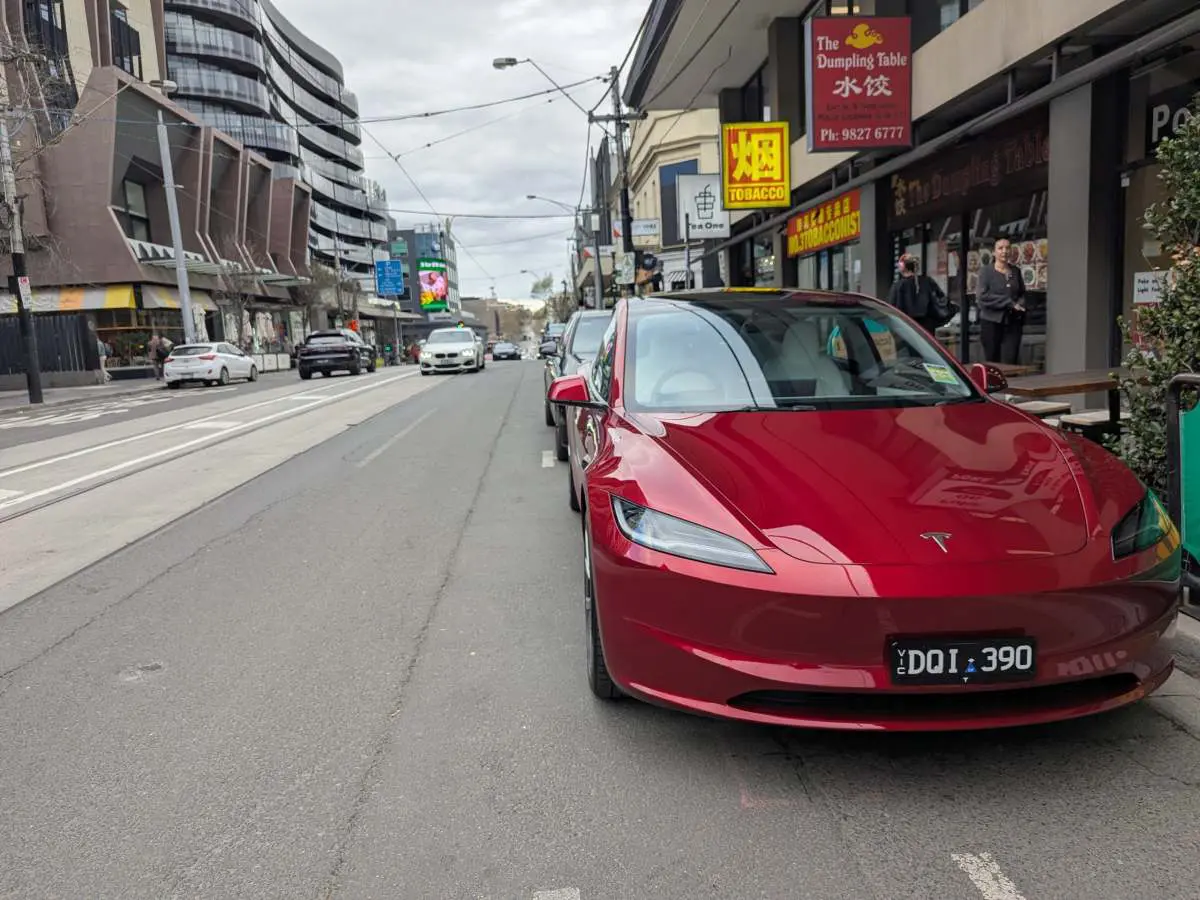
Tesla has renamed its local lineup to be more in line with its global naming convention, while also revealing that the cheaper models it has launched in other markets will not be available in Australia and New Zealand.
Tesla’s local lineup now is named and priced (before on-roads) from:
Tesla Model 3 Premium Rear-Wheel Drive – $54,900
Tesla Model 3 Premium Long Range Rear-Wheel Drive – $61,900
Tesla Model 3 Performance All-Wheel Drive – $80,900
Tesla Model Y Premium Rear-Wheel Drive – $58,900
Tesla Model Y Premium Long Range All-Wheel Drive – $68,900
Tesla Model Y Performance All-Wheel Drive – $89,900
There is no change to the local specifications or the pricing aside from Premium being the new name for all non-Performance models.
Earlier this week, we shared that Tesla had added to the trade-in bonus, which it offered on the Model 3 sedans to kickstart 2026, to also include the Model Y SUV, Australia’s best-selling EV.
This is for interested buyers of a new or demo Model Y RWD or Long Range, who will receive $2,000 off the purchase price when trading in a used vehicle.
It also comes on top of a similar $3,000 trade-in bonus for those looking to purchase a Model 3 RWD or Long Range variant.
All new purchases of Model 3 or Model Y vehicles will also come with Tesla’s recently upgraded 5-year unlimited km warranty for any buyers who get into a car as of the beginning of 2026.
That warranty is up from the previous 4-year or 80,000 km warranty on offer, and according to Tesla Australia, it is a global first to be offered in a market where Tesla vehicles are sold.
Tesla’s refreshed Model 3 was launched in late 2024 with the RWD and Long Range vehicles on offer initially, as the Performance followed in 2025.
In October 2025, Tesla officially launched Australia’s longest range EV with the new Model 3 2026 Long Range RWD variant offering an incredible 750 km on a single charge.
The range upgrade was due to an increase in the NMC battery size to 84 kWh, providing 230 km more range than the entry-level RWD and 121 km more than the previously offered Long Range AWD variant in Australia.
Pricing for this long-range variant also dropped due to its single motor, coming in at $61,900 before on-road costs. That was down from $69,900 before on-roads for the Long Range AWD model offered previously.
The Model Y was also refreshed in 2025, with first deliveries starting in May. There has been reasonable demand for the upgraded model, and now with the unique FSD offering in our market, it’d be interesting to see how 2026 pans out for the brand and if it can retain the top spot.
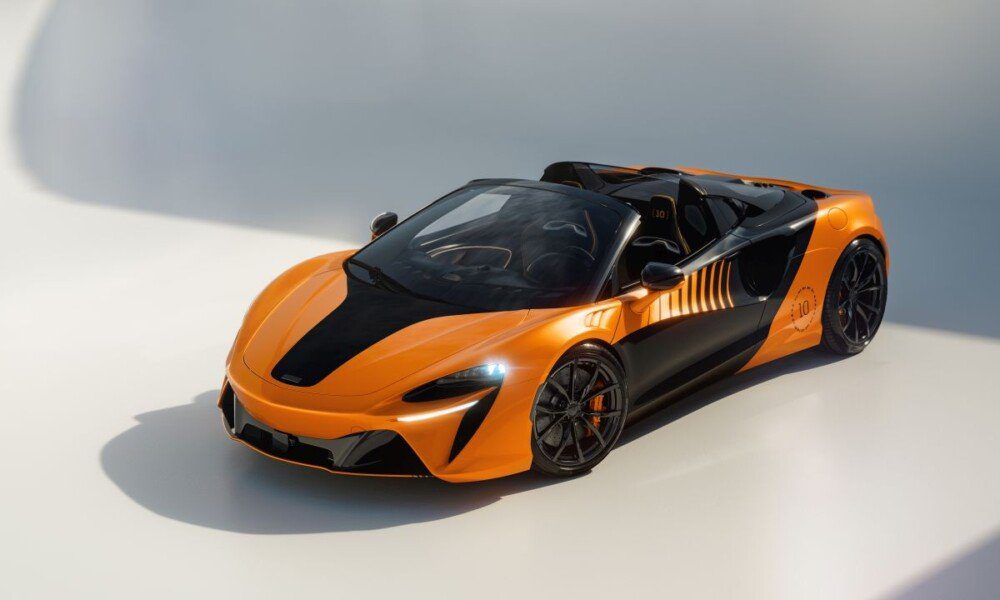
McLaren is celebrating McLaren Racing’s 10th Formula 1 World Constructors’ title with a special edition Artura Spider. It’s called the MCL39 Championship Edition, and it will be limited to just 10 units.
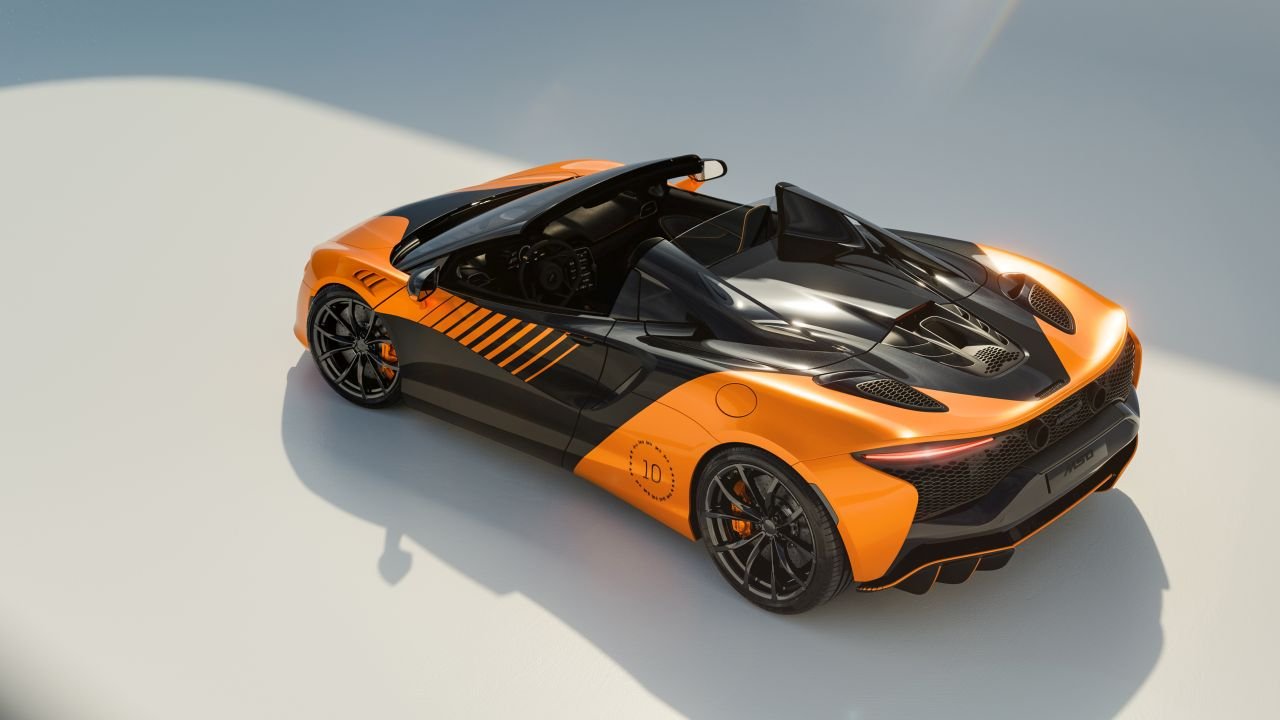
The Artura Spider MCL39 Championship Edition is finished in a two-tone colour scheme of MSO Bespoke Myan Orange and Onyx Black with a hand-painted livery, commemorating the brand’s 10th F1 World Constructors’ Championship.
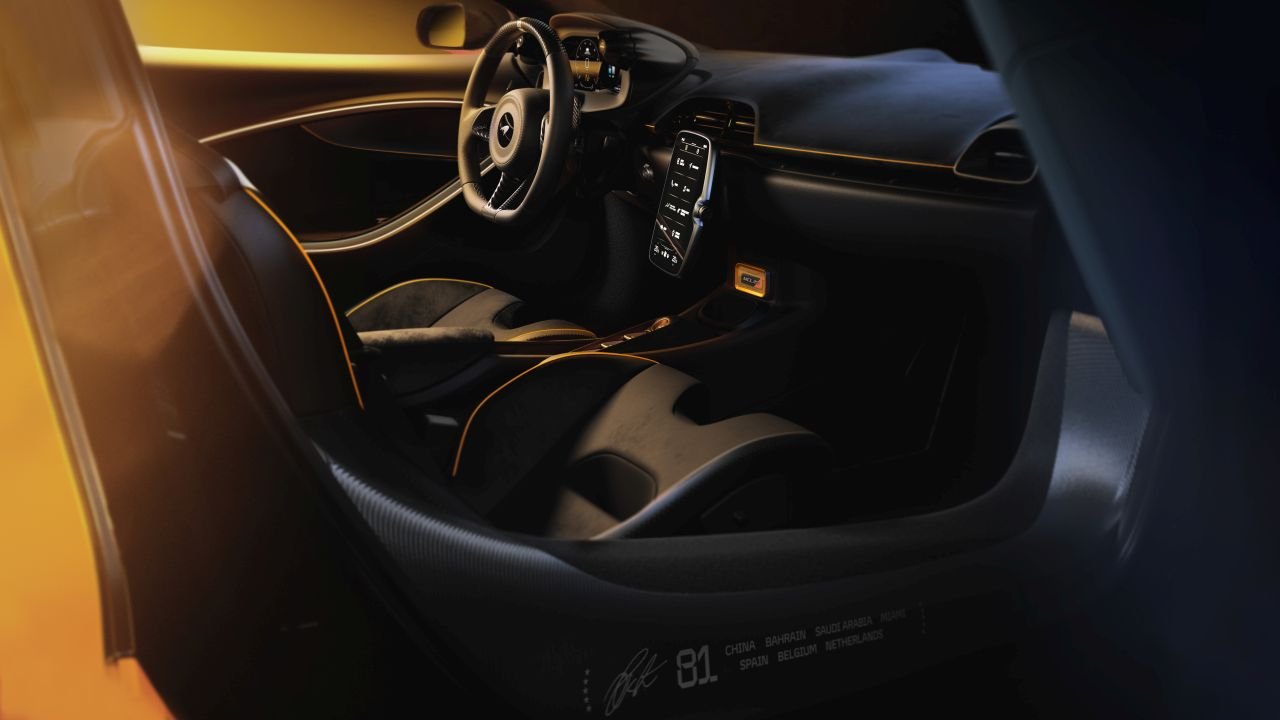
The special edition Artura Spider rides on 10-spoke lightweight forged alloy wheels painted in Gloss Black, paired with Myan Orange brake calipers, featuring black McLaren logos. The supercar is also fitted with the Stealth Badge Pack and a Sports exhaust. Also, the satin carbon fibre sill finishers are hand-signed by McLaren drivers Lando Norris and Oscar Piastri.
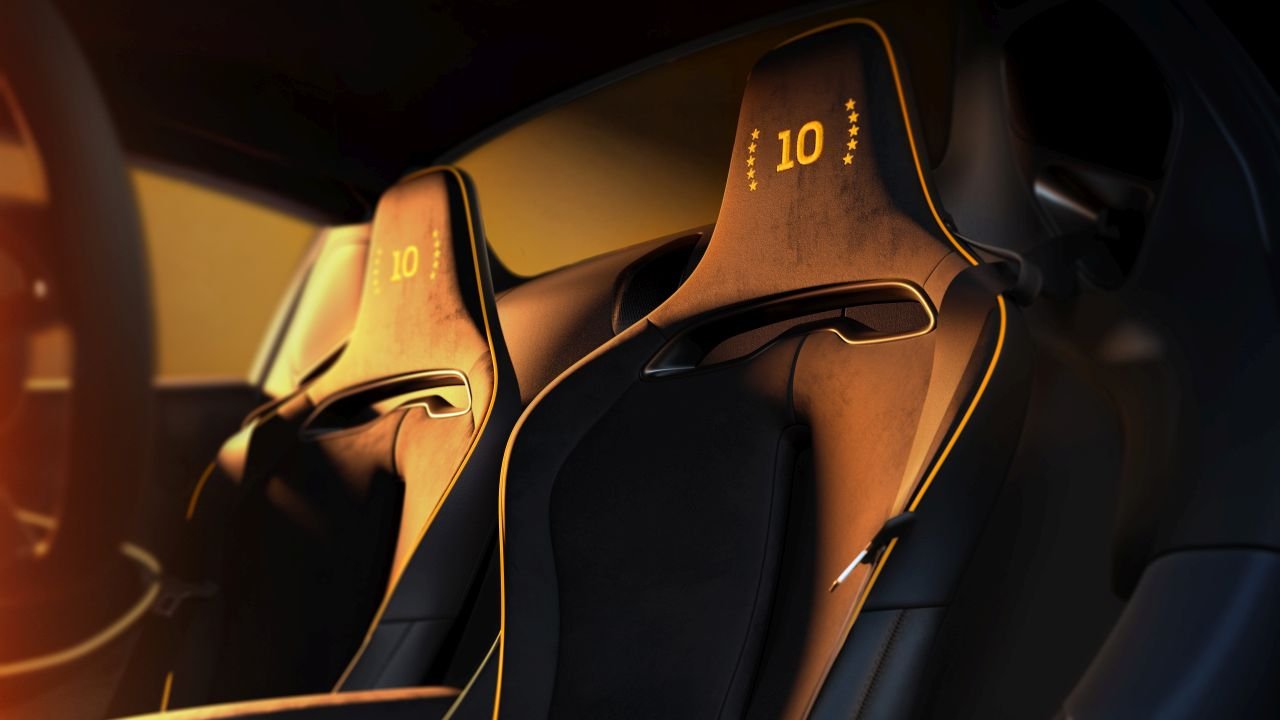
It has a special interior with MSO Bespoke details such as unique ’10’ headrest embroidery in McLaren Orange and a Myan Orange Painted 12 o’clock steering wheel marker with ‘10’ detail. Every car will also receive a Custom Casement Plaque on the centre console, underpinning the exclusivity of the car’s specification. The cabin is trimmed in Performance Carbon Black Alcantara and Jet Black Nappa Leather with McLaren Vision Orange piping.
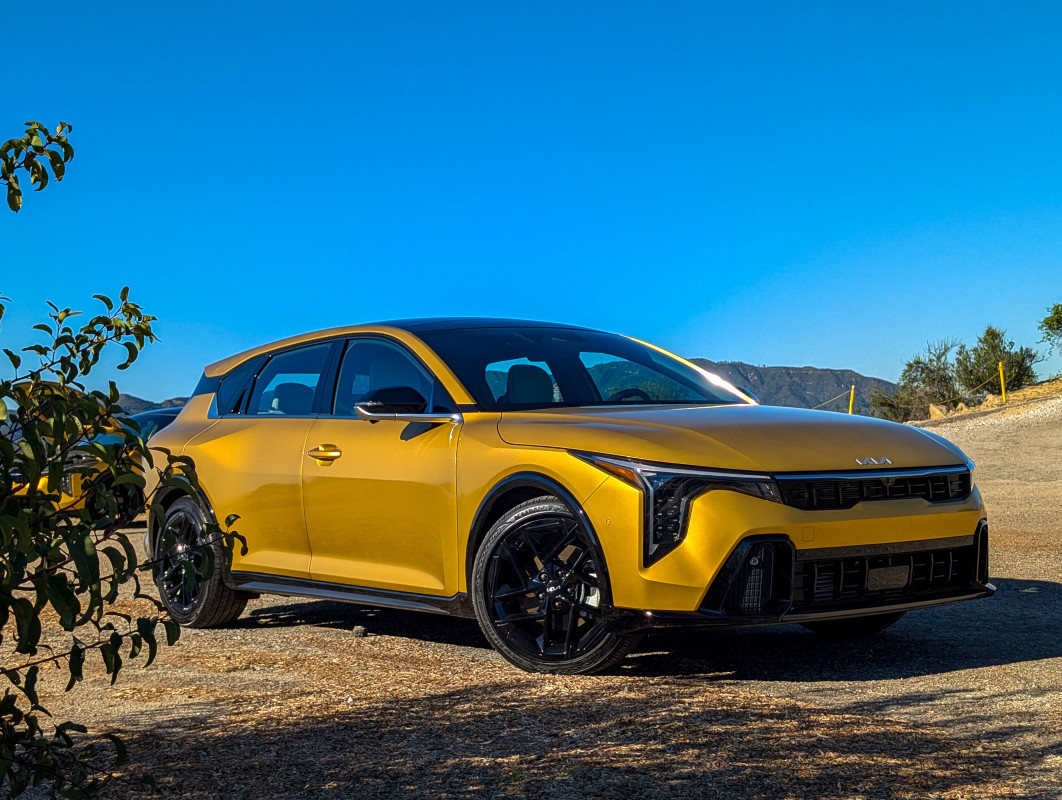
Kia’s momentum in the United States has carried over to the new year. Throughout 2025, the manufacturer sold 852,155 vehicles across the country, a record result, and January 2026 sales reached another all-time high. Last month, Kia sold 64,502 vehicles, a 13% increase over January 2025. No less than six different Kia models set January sales records, while sales of electrified models and SUVs also set new records. And, while the Kia Soul went out of production last year, this appears to be benefitting sales of the brand’s other affordable crossovers.
From Sedans To Minivans, Kia Is On A Roll
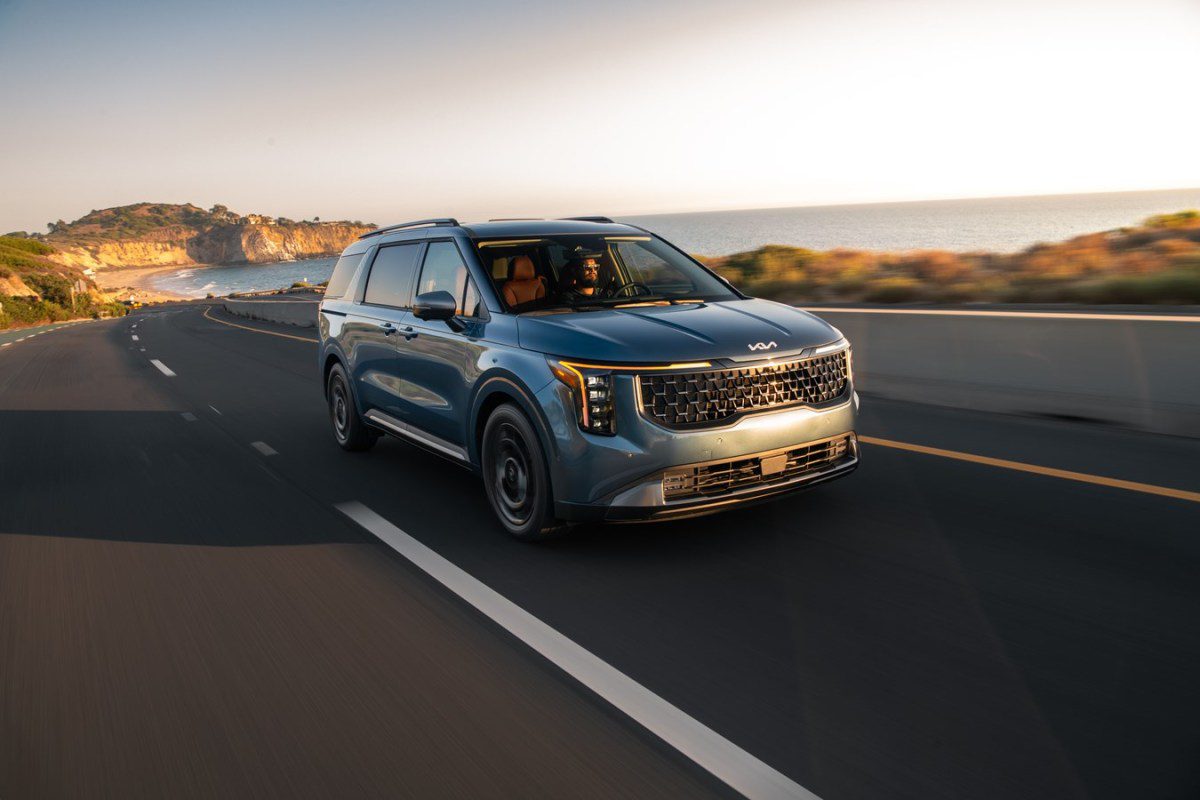
2026 Kia Carnival
Kia
View the 3 images of this gallery on the
original article
Kia saw great sales results for sedans, SUVs, and minivans alike last month. The Carnival (5,879 units sold), Sportage (13,984), K5 (6,276), Telluride (9,424), Seltos (5,278), and K4/Forte (11,642) all posted record January sales. While the K4’s January sales were up by just 2%, the Carnival managed a 60% increase, part of a general trend where minivans are gaining some ground again.
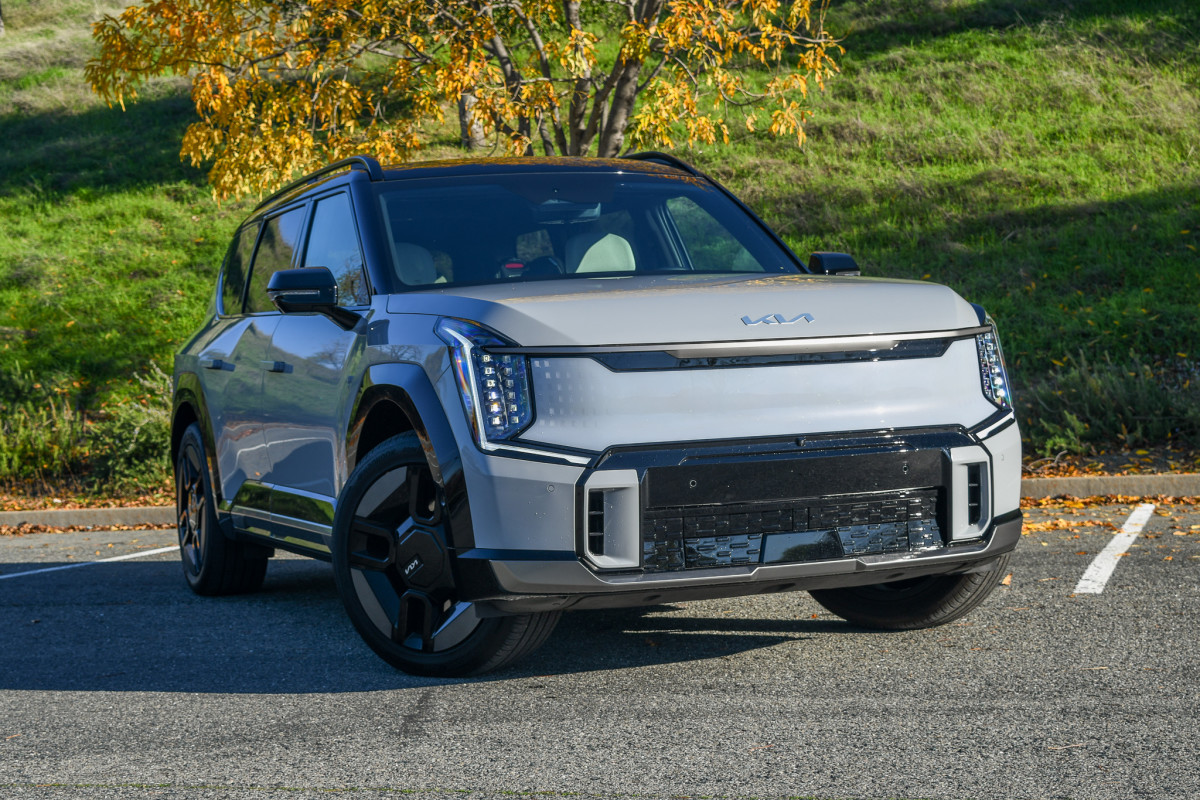
The Sportage was Kia’s top-selling model, followed by the K4/Forte and Telluride. Kia’s EVs didn’t perform as well, but that’s not a surprise as many manufacturers have seen lower EV sales in recent months; the EV6 reached 540 units and the EV9 was on 674. However, electrified Kia models (including both hybrids and EVs) were up by 45%, and SUV sales grew by 14%.
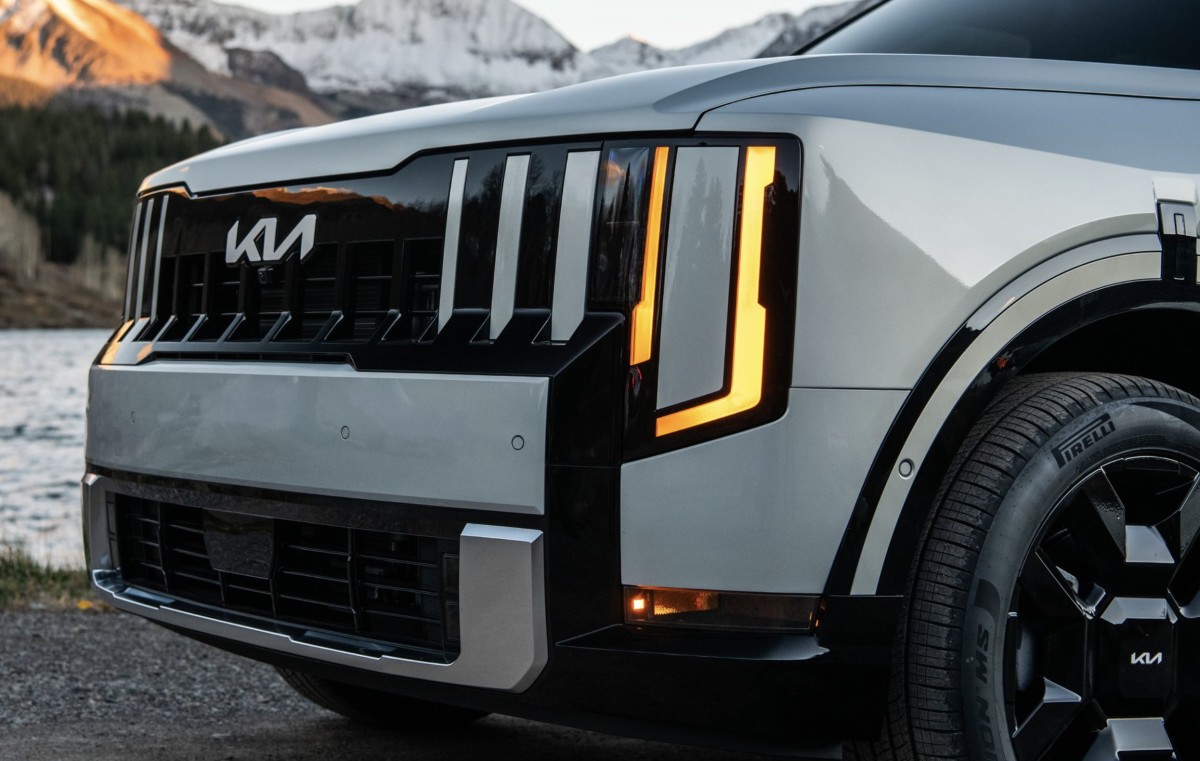
2026 Kia EV9
Kristen Brown/Autoblog
The Kia Soul, which was discontinued last year, saw sales dip to 1,731 units, down from 3,554 in January 2025. This is likely due to remaining inventory of the subcompact crossover gradually drying up. However, sales of the Niro (3,170) and Seltos (5,278) were up, so it’s possible that Soul customers turned to one of these affordable Kia crossovers instead.
“Building on three straight annual sales records, January’s record performance shows that Kia is not slowing down as the brand’s strategy of giving customers everything they need and more than they expect across a variety of segments and powertrains attracts more and more new customers,” said Eric Watson, vice president, sales operations, Kia America.
Two New Models Expected To Be Big Sellers
2026 Kia K4 Hatchback
Gabriel Ionica
View the 2 images of this gallery on the
original article
January’s sales don’t take into account the new K4 Hatchback and Telluride, both of which will reach showrooms imminently. The K4 Hatchback’s starting price of under $25,000 should make it very popular, especially as Kia hasn’t had a small hatchback on sale for a few years. The second-generation Telluride, which will launch as a 2027 model, is a lot pricier, but it’s bound to take over where the old one left off. A new hybrid powertrain option and starting price of under $40k bode well for the three-row crossover.
We expect these new entries to start significantly impacting the sales charts before the end of the first quarter.
Why Are Kias So Popular?
2027 Kia Telluride
K
Kia remains a value-oriented brand, much as it was when the first Kia arrived on our shores in late 1993—that was the Sephia sedan. But everything else has changed since then. Kia has branched out into the SUV, minivan, and EV segments, so it covers all core categories, much like its long-running Japanese rivals, Honda and Toyota.
Kia also sets itself apart in design. Its models are boldly styled (just take a look at the new Telluride next to the old one), and even the brand’s cheapest cars don’t blend into the background. The brand is on a rapid path to hybridization, too, as underlined by its record electrified vehicle sales last month.
It’s the combination of these factors that have catapulted Kia into the mainstream. It’s an established household name at this point, but it’s backing that up with solid, well-rounded, and daring products.
The next-generation Porsche 718 Cayman and 718 Boxster were supposed to be purely electric.
Porsche later said it would launch gas versions, and is now reportedly considering canceling the EV version entirely.
The sports car market has already shrunk considerably, and its unclear if sports car buyers are open to EVs.
The all-electric Porsche 718 Boxster and Cayman may die before they ever get the chance to live, a new report from Bloomberg says.
Porsche is in the midst of an ongoing cash crisis, as both the luxury brand and its parent automaker, the Volkswagen Group, have seen sales collapse in China. At the same time, Porsche in particular is seeing a slower-than-expected transition to EVs and struggling to develop competitive software, all while tariffs hammer its bottom line. The company urgently needs to cut costs.
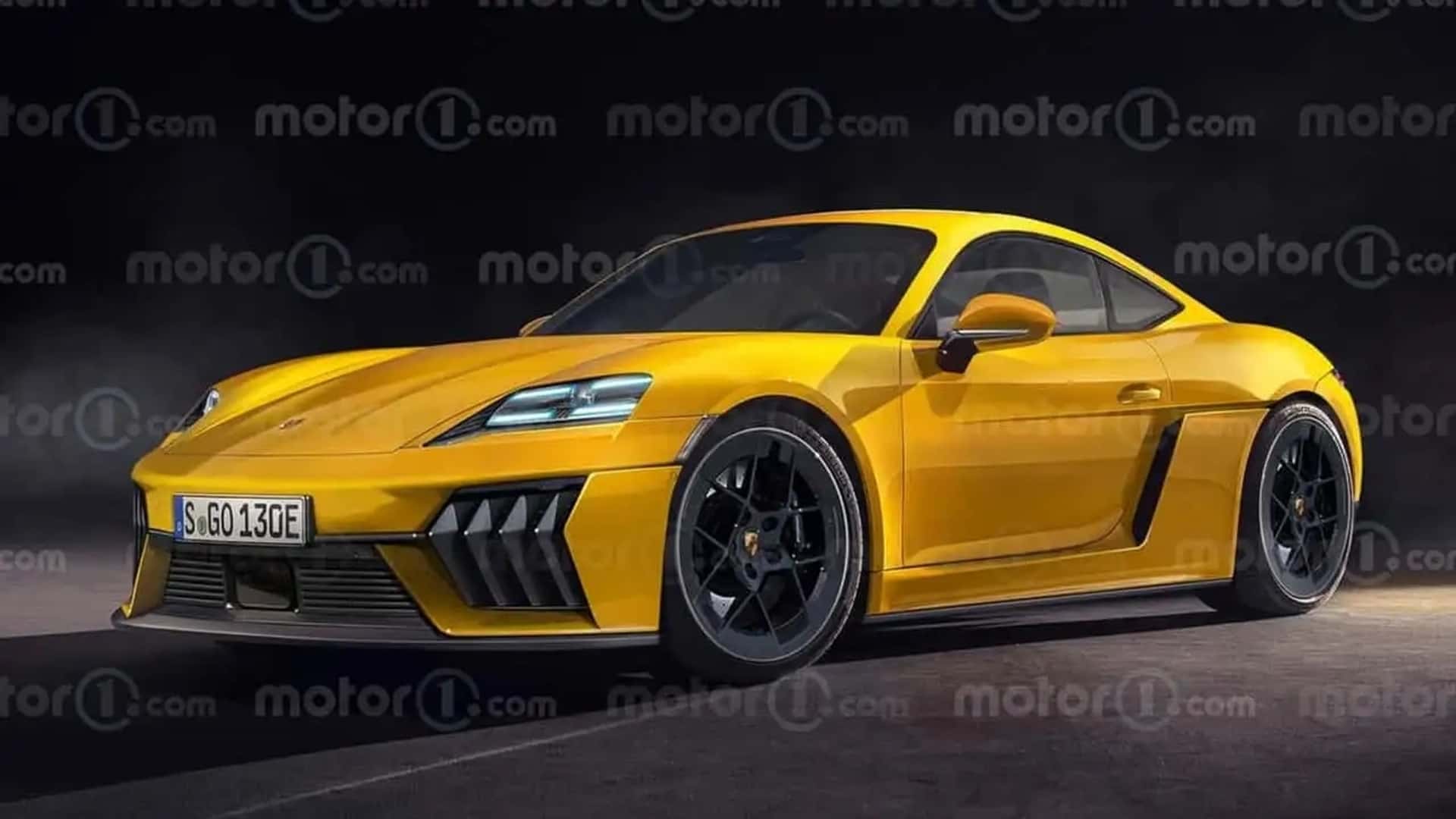
Now, that could put the electric 718 Cayman and 718 Boxster on the chopping block. Porsche’s entry-level coupe and convertible models, respectively, the 718 Cayman and 718 Boxster, were supposed to go all-electric for their next generation. The company announced in March 2022 that the purely electric sports cars would debut in 2025.
Photo by: Motor1
This was supposed to be a huge deal for the sports car market. Porsche is arguably the most important sports car brand, and making one of its two core sports car lineups all-electric would be a huge sign of confidence.
Unfortunately, in the years since the company made its bold claim, it has lost much of that confidence. It first planned to make the Macan SUV fully electric, but quickly decided to keep selling the gasoline Macan alongside the electric version when demand seemed lower than expected. Porsche now says there will be a gas replacement to go alongside the electric version. The Cayenne EV, too, won’t replace its gas counterpart fully. A new gas and hybrid generation will arrive in a few years.
Photo by: Porsche
Meanwhile, Porsche has been backpedaling on its ambitions for the electric 718 for some time. First, it said that high-performance trims of the 718 would offer gas engines. Shortly thereafter, Car and Driver reported that there would be gas variants across the entire lineup.
But now, the EV version—the lone powertrain plan for the first few years of development—may not come at all. Bloomberg cites multiple sources with knowledge of internal Porsche discussions, who say that new CEO Michael Leiters is weighing cutting the company’s losses.
The tumultuous development process has left the company with an EV-oriented platform in a segment that, for now, seems cool on electrification. And while I’m a big fan of sports cars and EVs, I can certainly see Porsche’s hesitation.
Photo by: Porsche
I was with a group of Porsche 911 and Boxster owners this weekend, and the discussion largely centered on weight, the relative engagement of manual and dual-clutch transmissions, the exhaust note of the 911 GT2, different light-weight option packages, the history of air-cooled motors and the “purity” of driving experiences. If you know Porsche folk, this is all they talk about, even during therapy. They have spent decades specifically worshiping rear- and mid-engined cars with flat sixes. They are a tough market for silent electric sports cars, which are bound to be heavier and less traditional than the 20th-century legends they worship.
Yet Porsche owners are excited about technology, and persuadable. The Taycan’s performance credentials are unassailable, and the new Cayenne Electric seems to be a high-tech powerhouse. I remain confident that, in the long-term, electric sports cars will take off. The opportunities offered by quad-motor designs and instantaneous, limitless power remain broad and largely untapped.
But right now, in a cash crunch, I can see the logic here. The sports car market is a shadow of its former self, with few options, and fewer still that are popular and profitable. Those who do buy sports cars are typically older, richer and more passionate about their engines.
Try as you might, I don’t think you’re going to win over 50% of those buyers next year, let alone all of them.
To win them over, EVs have to far outstrip gas sports cars not just in acceleration, but also in dynamics, engagement and outright pace. It’s not enough to beat gas-cars in a straight line; They have to smash gas-car track records, and get cheaper, and, most importantly, lighter. Because as fast as modern EVs are, the lighter curb weight of gas sports cars gives them more responsive handling, better turn-in, better steering feel, better braking, and a more engaging experience overall.
On the flip side, the engine in a $500,000 gas supercar can’t compare to an electric motor. Electric motors are more responsive, more torquey, more powerful for your dollar and smoother than any gas engine, with no obnoxious noise to annoy passersby. They’re more efficient, more robust, easier to make long-lasting, easier to cool and simpler. Just plain better.
Once a company can pair those attributes with the curb weight and price of a gas sports car, the EV transition will progress naturally. Until then, though, I expect electric sports cars to remain a tiny fraction of the overall sports car market, which is itself a rounding error to the industry at large.
Few automobiles transcend transportation to become cultural milestones. The Lamborghini Countach is one such icon. For a generation, it was not just a car but a dream made of angles, and outrageous performance. It dominated posters on bedroom walls, etched into the imagination of countless teenagers who would grow up equating success with the day they could finally park one in their garage.
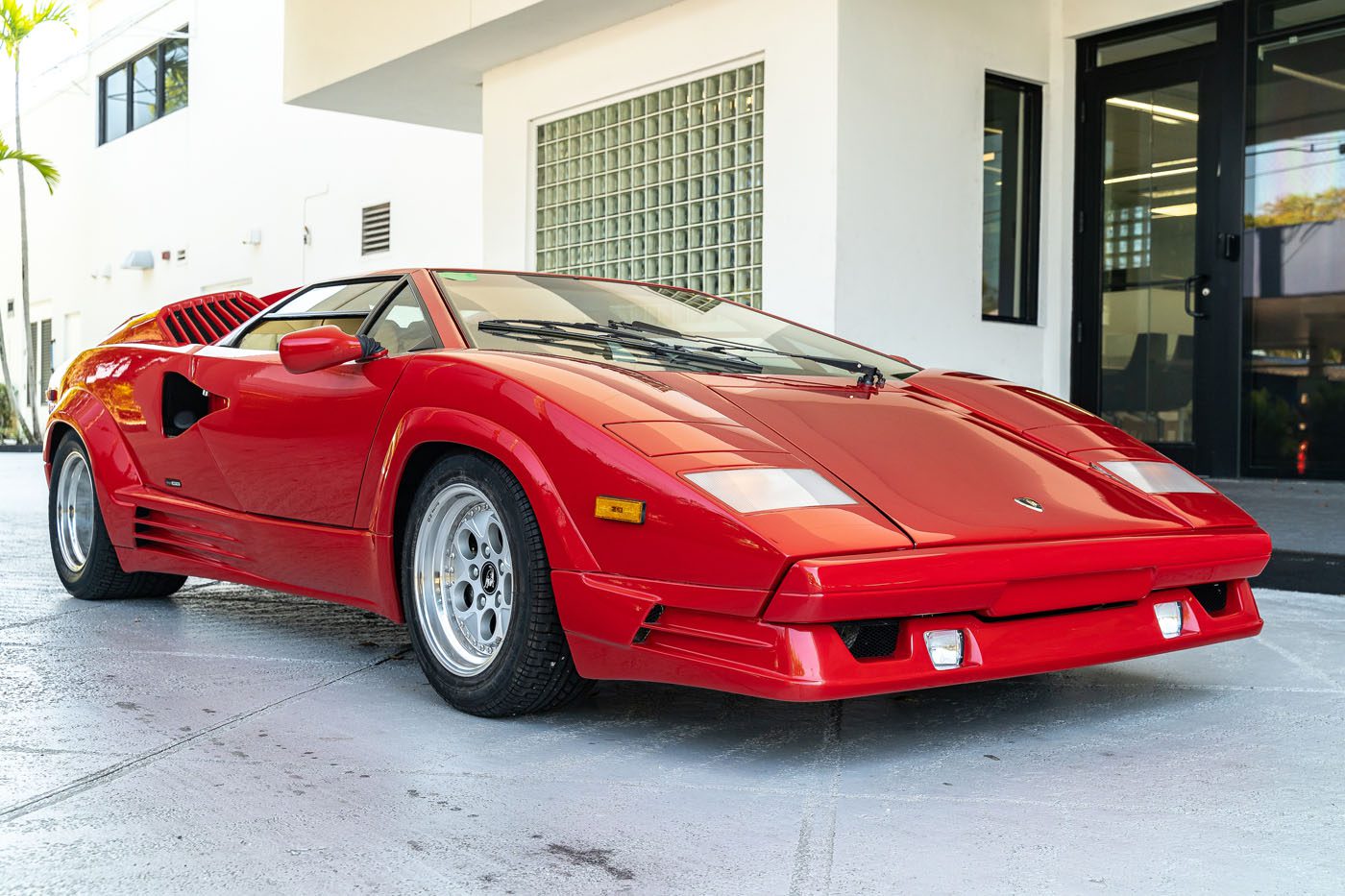
Today, those dreamers are no longer teenagers. They are established collectors, investors, and enthusiasts with the means to pursue the legends of their youth. And in that world, one car now stands apart as the most extraordinary opportunity imaginable: a 1990 Lamborghini 25th Anniversary Countach, preserved in a condition so pristine that it feels as though it rolled straight out of Sant’Agata yesterday.
This example is remarkable not only for what it is, but for what it represents. Purchased new in 1990 and held in continuous single ownership for 35 years, it has accumulated just 117 kilometers — 73 miles — from new. That makes it the lowest-mileage Anniversary Countach known to exist, a true time capsule of one of Lamborghini’s boldest eras. Servicing has been entrusted exclusively to official Lamborghini dealerships, and storage has been nothing short of obsessive: the car has rested in a computerized, purpose-built facility designed to maintain it in showroom-fresh condition, able to withstand a Category Five hurricane!
What truly sets this Countach apart is the level of stewardship behind it. This car has not only been preserved, but protected with a mindset reserved for the most important collector pieces. The original factory plastic seat covers remain in place just as they left Sant Agata. The windshield still displays the original green import shipping label, which confirms the car was never exposed to moisture and never casually handled or prepared for regular road use. Underneath, factory inspection markings and finishes remain visible on the suspension components. Even the factory tape over the cigar lighter is still intact, an authentic detail that would not survive normal delivery or service. This is not simply a low mileage example. It is a car kept in a true time capsule environment, cared for with long term respect and an understanding of its historical significance.
Equally important is its place in history. The last 25th Anniversary Countach Chassis # ZA9CA05A4LLA12085 was completed on July 5th, 1990, and is naturally housed in the Lamborghini Museum.
This 25th Anniversary ZA9CA05A4LLA12076 was one of the last Anniversary Countach ever produced in June 1990— the ultimate expression of a design that had already become legend. Lamborghini engineers refined the original concept with improved aerodynamics, cooling, and drivability, creating a celebratory edition that honored two and a half decades of audacity. For collectors, the “Anniversario” is not simply another Countach; it is the car that carried the model into the modern era while preserving its outrageous DNA.
What elevates this car even further is its cultural resonance. More than a machine, the Countach is shorthand for an entire lifestyle — exclusivity, performance, and the kind of fearless design that makes the world take notice. To acquire the lowest-mileage, last-built Anniversary edition is to secure a piece of rolling art that embodies ambition itself.
Opportunities like this simply do not repeat. As values surge for the best examples of 1980s and 1990s supercars, collectors are increasingly seeking the few untouched specimens that define an era. This Countach is one of those unicorns: impossibly rare, meticulously preserved, and historically unmatched.
Now, this extraordinary Countach will be offered exclusively through Rockstar Car Auction. Qualified bidders have the chance to own more than just a car. They can own the dream itself — the poster on the wall, the legend in the flesh, the Lamborghini that redefined an era. Interested parties must register to bid for the opportunity to secure this untouched legend.. For more information, please call 407-538-0224.
As A Special Tribute To This Extraordinary Masterpiece, NO Buyer’s Commission Will Be Levied. The online bidding ends on January 17th at 10:00 PM.
Our free daily newsletter sends the stories that really matter directly to you, every weekday.
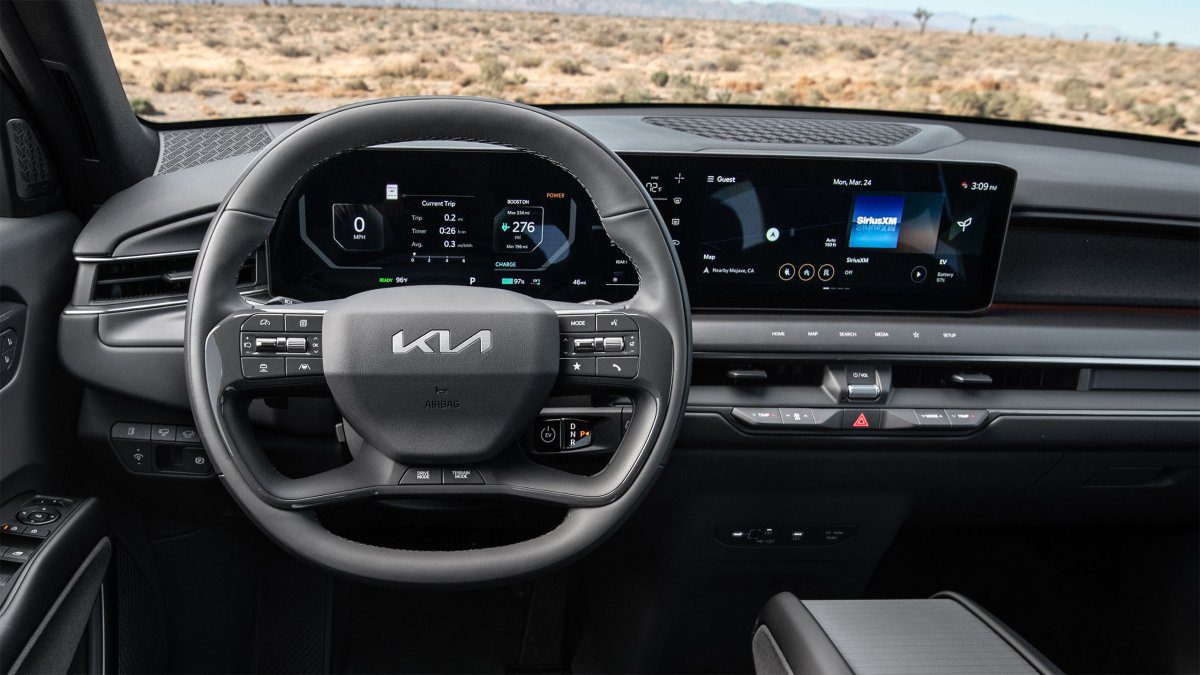
If you’re buying an EV in North America, these days you’d be hard-pressed to find something better equipped for the money than Hyundai and Kia’s latest products. Not only are they just plain good, but they’re also not overly complicated to use, thanks to fairly conventional interiors that retain some physical buttons at a time when those have been vanishing from cars. Even the EV9, for example, uses hard switches for climate and volume, as well as all of the steering wheel’s controls. Fortunately, Kia doesn’t view this as a fad.
When asked by The Drive whether he sees the brand going “full touchscreen” in the future, Tom Kearns, Vice President and Chief Designer at Kia Design Center America, responded with a firm “no.”
“I think consumers, for the things that they use often—which is probably volume control, radio, and temperature—it’s so nice to touch something,” Kearns said, adding that he views the matter of keeping physical controls not simply down to tactility and expectations, but safety as well.
“I think when your eyes are on the road, you can reach down and touch a knob and adjust it without even looking at it. But the same can’t really be said if it’s a touchscreen. You can’t feel it, so you have to look at it. But if you can feel it, you don’t have to take your eyes off the road. You can not even look, and you’re like, ‘Oh, there it is,’” Kearns said.
The 2026 Kia EV9. Kia
A 2020 U.K. study evaluated the behavior of drivers when interacting with Apple CarPlay or Android Auto phone projection systems that typically require the use of a touchscreen. Researchers found, among other things, that “controlling the vehicle’s position in the lane and keeping a consistent speed and headway to the vehicle in front suffered significantly when interacting with either Android Auto or Apple CarPlay, particularly when using touch control,” and that “use of either system via touch control caused drivers to take their eyes off the road for longer than NHTSA recommended guidelines.”
There’s certainly an argument to be made against the safety of capacitive or touchscreen controls with no physical feedback. However, when it comes to consumer preference, Kearns stresses this is a regional matter.
“I think that most consumers in America—I don’t know about other continents, like, Asian countries or Korea or Europe, I’m not sure—but I feel like most American customers like some tactile feel,” Kearns told us. “A few buttons.”
This is something we have heard before from other automotive executives, particularly those in a position to compare the tastes and priorities of the buying public across global markets. Volkswagen’s Ralf Brandstätter notably said last year that “Chinese consumers expect AI-first, connected vehicles, with seamless voice control, and smart cockpits as the norm,” highlighting that the average age of an EV buyer in China was under 35, whereas in Europe, it was 56.
The lifelong level of comfort with computers and software that a younger customer has means everything in this age of selling software-defined vehicles. “These aren’t just preferences,” Brandstätter summed up. “They shape the entire product and UX strategy from day one.”
Perhaps that means we’ll see further differentiation in interface design across continents. At least for North American buyers, though, Kia appears inclined to continue giving them what they want for the foreseeable future.
Chris Teague is a Maine-based automotive journalist who is passionate about the business and technology aspects of the automotive industry. He covers new and used vehicles as well as industry trends, translating sometimes complex concepts into easy-to-digest content. Chris’s work has appeared in Autoblog, Autoweek, InsideEVs, and other publications. He also co-hosts “America on the Road,” a weekly radio show and podcast. When he’s not driving or writing, Chris loves cooking and enjoying the outdoors with his family.
Our free daily newsletter sends the stories that really matter directly to you, every weekday.
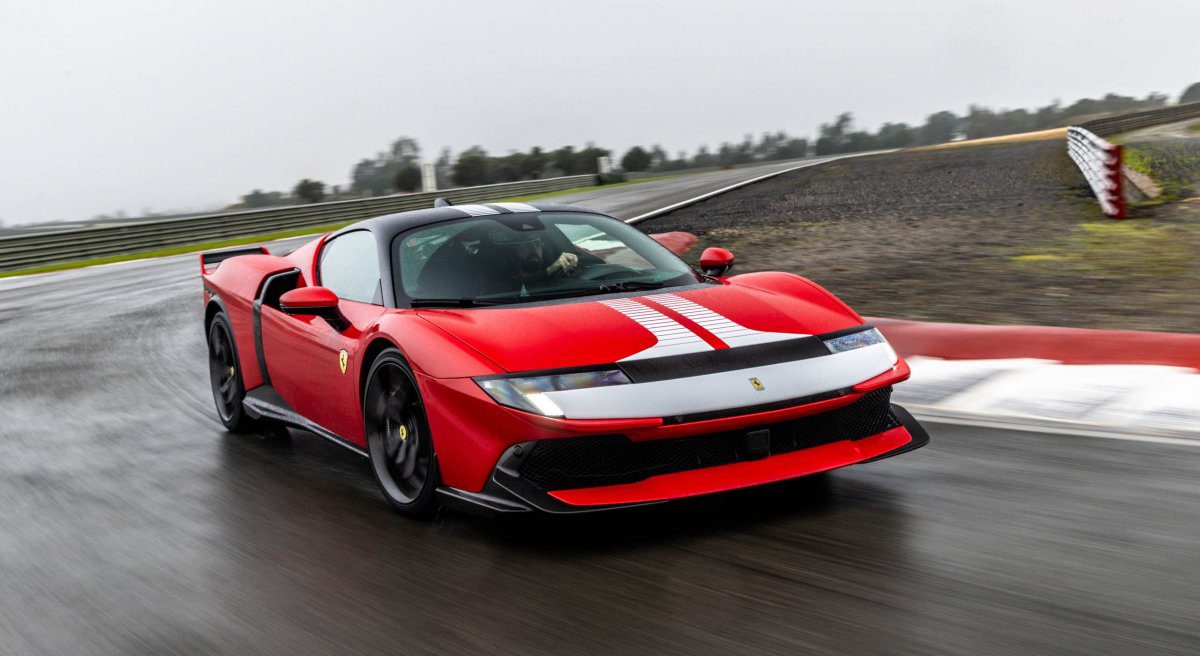
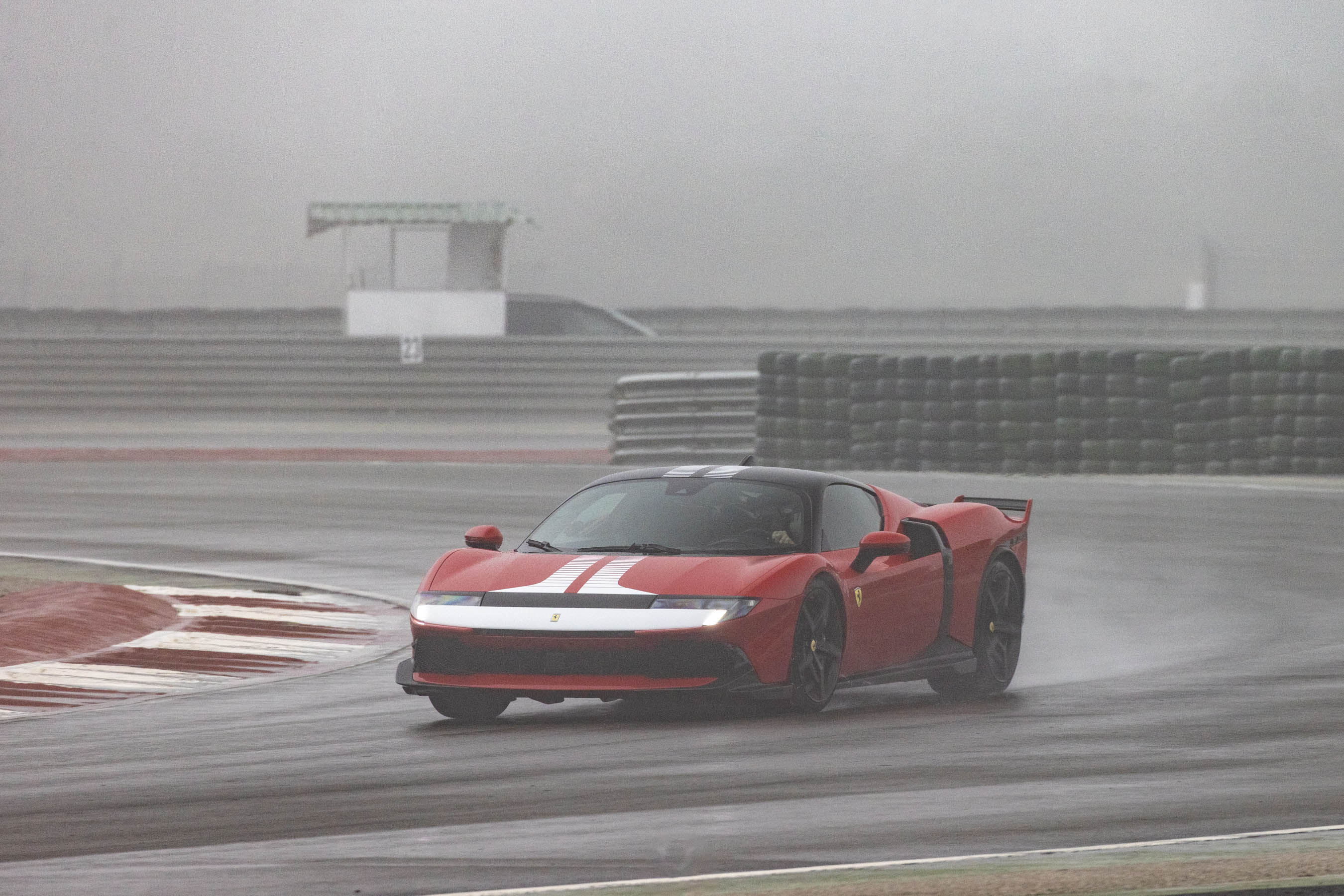
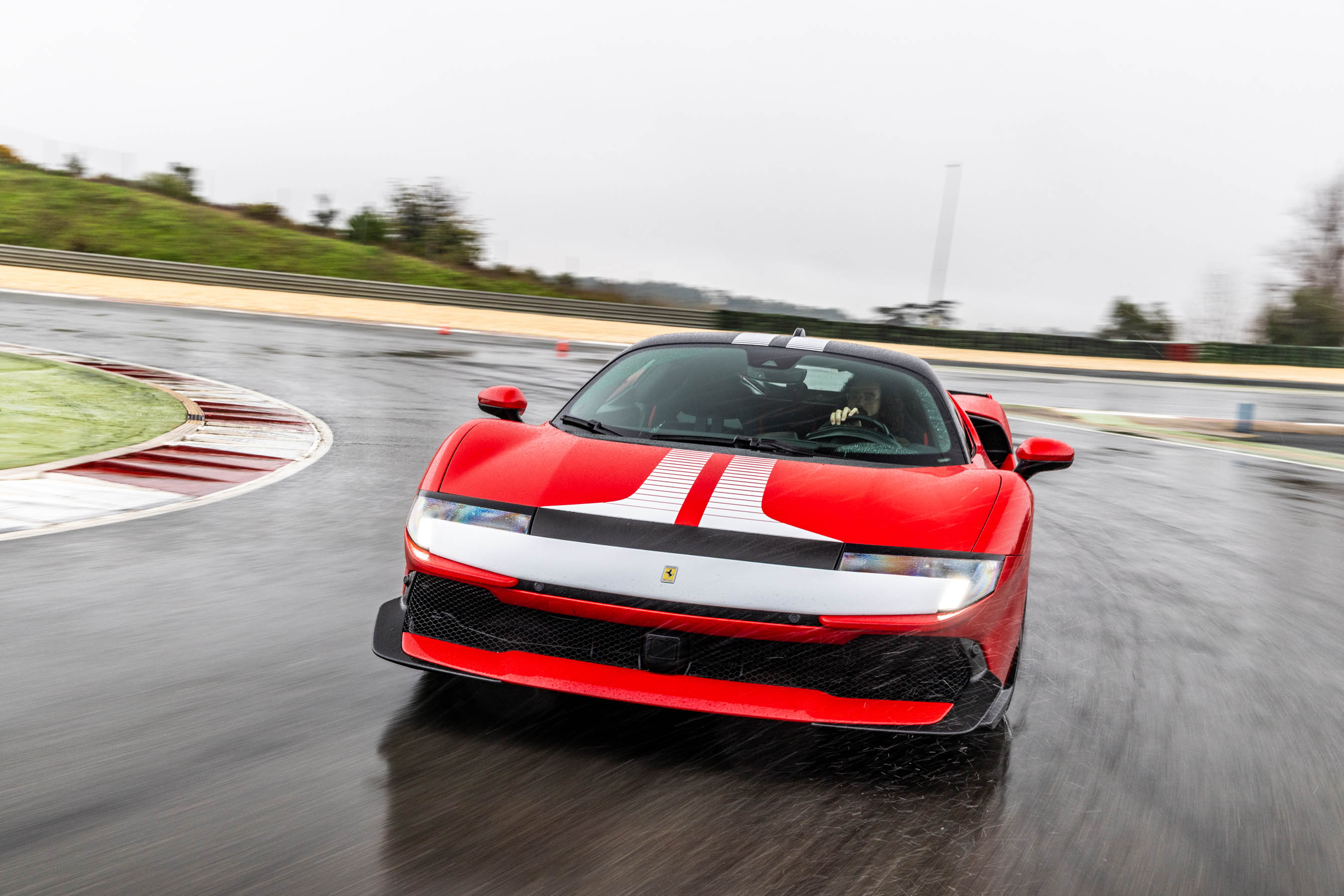
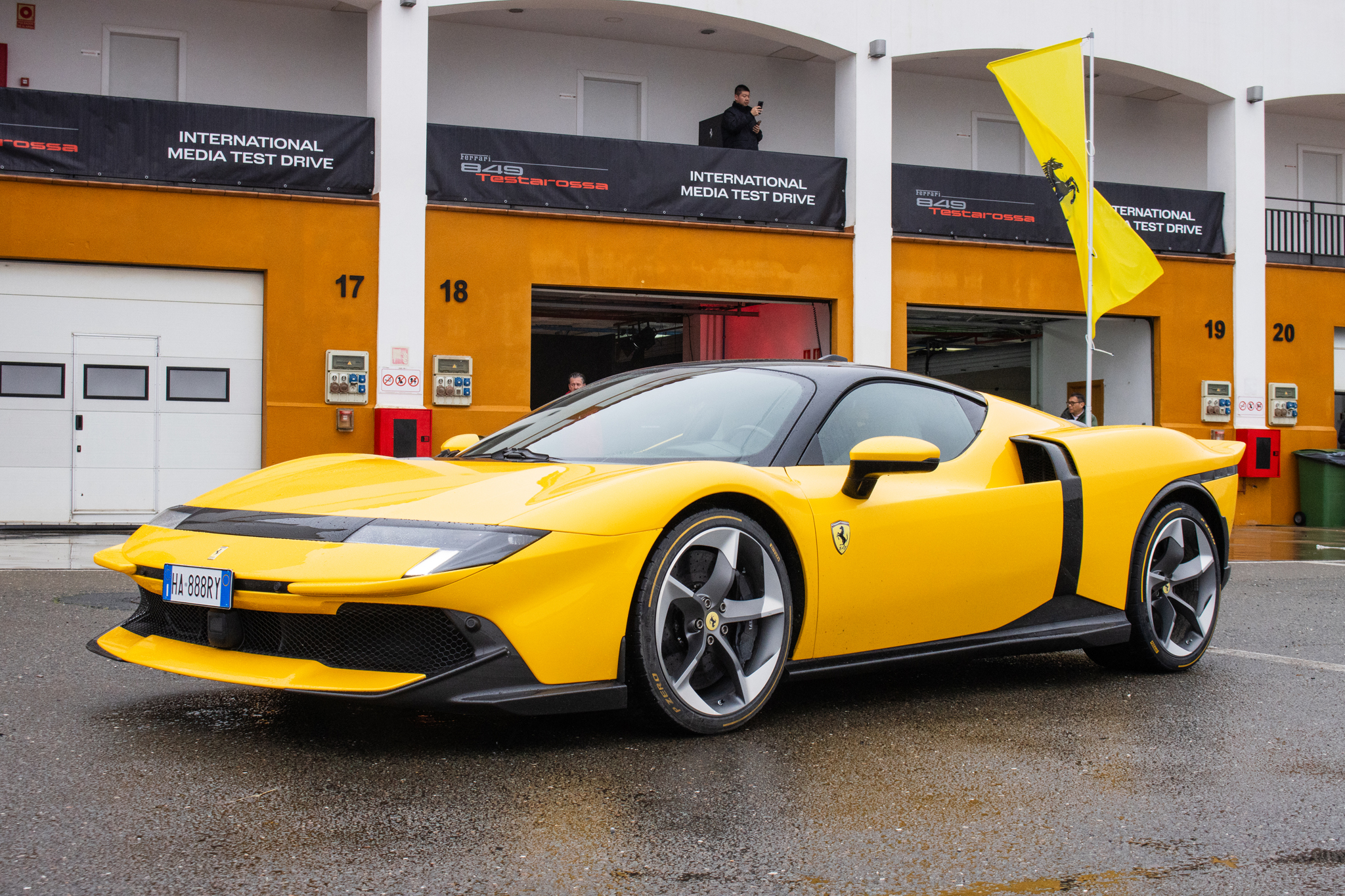
“OK, we’re going to pick it up here,” the Italian-accented voice of one of Ferrari’s lead development drivers crackles over the radio, as cheerful and unbothered as if we were ordering another bottle of wine at dinner the night before. Except, we’re not—we’re easing through the final turn into the front straight of Circuito Monteblanco in Spain, in a rainstorm, in a pair of $600,000 2027 Ferrari 849 Testarossas. I grip the wheel harder and make a stupid face.
Pick it up he does. One second he’s there, a physical form in the vague shape of a car about a hundred feet in front of me. Next, he’s a distant set of taillights twinkling through the roaring wash. I put my foot to the floor, desperate to keep sight of the only thing tethering me to reality. The chassis shimmies for a instant, then surges forward assuredly, the 4.0-liter twin-turbo V8 howling past 8,000 rpm behind my head as the tri-motor hybrid system unleashes 1,036 horsepower in a place where common sense would tell you that’s a bad play. Out of the corner of my eye, I can see the traction control light flashing. But all I’m feeling is unrelenting power.
And then he’s gone. I’m a pilot flying VFR in zero visibility. I do what you’re not supposed to and glance down at the speedometer, not that it matters since all my reference points have vanished, and in that brief moment it leaps from 143 to 151 mph. Still no taillights. Uh-oh.
But—la salvezza! Four thin red lines suddenly pierce through the wall of water as he reaches the braking point, which is… somewhere out there. I try to time my footwork, quickly realize I’ve screwed up, and fully expect the worst as the lead car’s silhouette materializes in front of me and I slam on the left pedal. But the Ferrari’s upgraded ABS Evo system, feeding off a complex digital control system called FIVE to judge the perfect amount of slip in each wheel for maximum braking performance, won’t let that happen. Like I’m Senna in the wet, the car scrubs speed in an impossibly short distance. Next thing I know, I’m moving into the circuit’s first turn again at a placid 35 mph.
Catching my breath, I think back to what one of the car’s engineers said earlier in the day. The Ferrari 849 Testarossa is technologically complex, but it’s not complicated to drive. And how, my Italian friend. And how.
Mauro Ujetto
There are a few things worth saying up front. First, Ferrari as an automaker is no longer the purist brand whose cars prioritize raw, mechanical thrills over everything else, and whining about how the days of hot-and-bothered V12s and gated manuals are over is fruitless. Times have changed, Ferrari has changed. What hasn’t is the essence, even if the expression is completely different.
Second, as an all-wheel-drive, plug-in hybrid, twin-turbo V8 supercar sitting atop the company’s hierarchy of “range” cars—i.e. not super exclusive models—the 849 Testarossa shares almost nothing with its 1980s namesake except for the engine’s red valve covers. No side strakes, no pop-up headlights, no Don Johnson. Instead, it’s part of a new crop of hybridized mid-engine prize fighters with over 1,000 horsepower, replacing the Ferrari SF90 Stradale and going up against the Lamborghini Revuelto and soon the Aston Martin Valhalla. Heady stuff.
And third, as that engineer mentioned, the car is so complex that I could write 10 pages simply describing every little upgrade to hardware and software that Ferrari’s thrown into it before even getting to how it all adds up behind the wheel.
But I won’t, because you can read Ferrari’s extremely detailed press release to learn things like how it worked on the fluid dynamics of the turbocharger’s turbine vanes and borrowed a ceramic ball bearing from the F80 to minimize lag in the biggest unit it’s ever put in one of its “regular” cars. Or the exhaust manifold made from 100% inconel has a new flexible coupling also made from the same superalloy to account for thermal expansion. Or how a redesigned cylinder head with tumble-effect intake ports creates vortices in the combustion chambers that further improve efficiency. Or how all of that, plus more, allowed it to squeeze an astonishing 818 hp from the 4.0L V8 in the SF90 Stradale, and new gearbox control logic for the 8-speed dual-clutch transmission somehow creates sharper, barkier shifts and smoother power delivery.
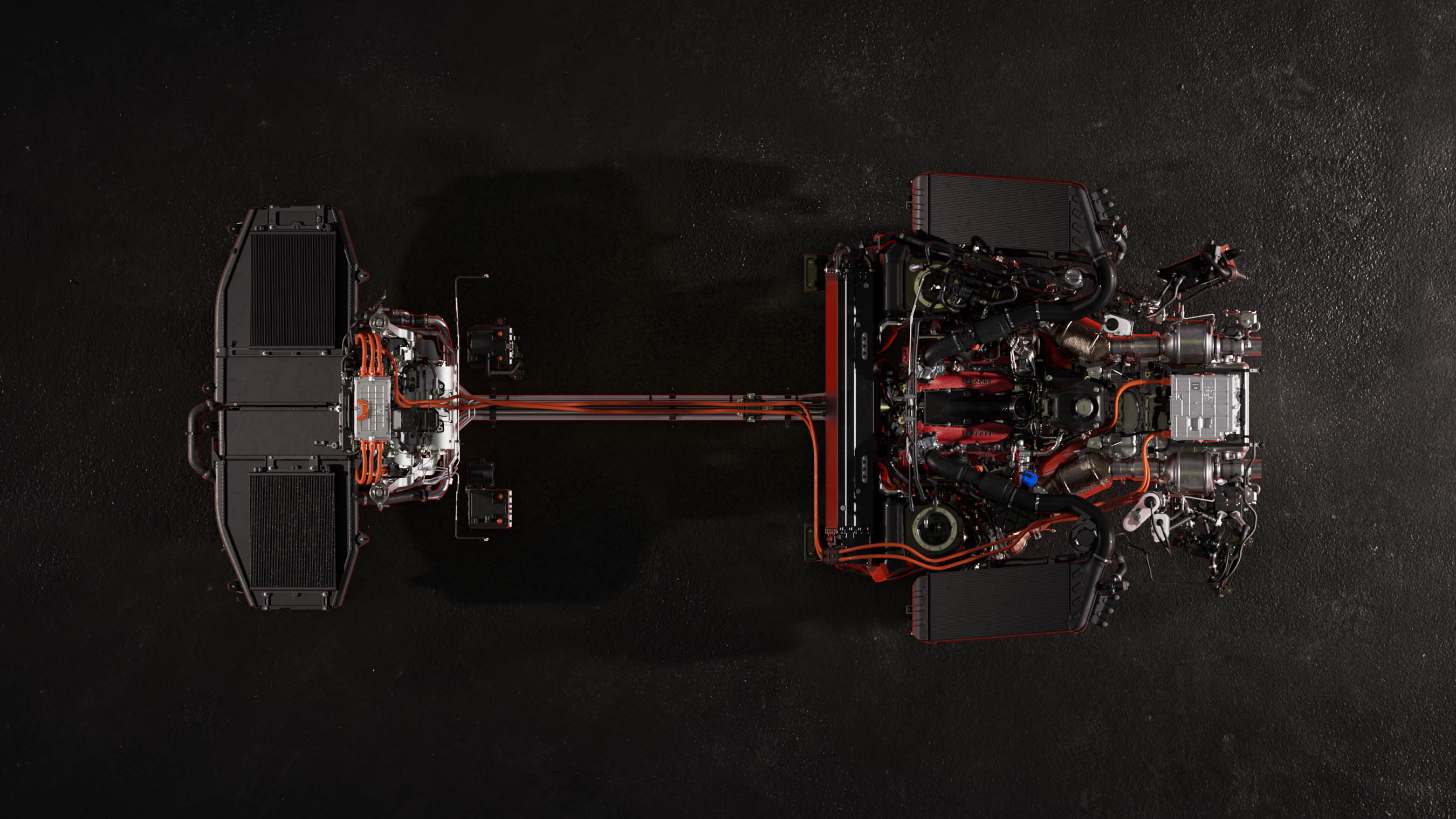
You know what? This is kind of fun. The three-motor hybrid system—two radial flux motors on the front axle, an axial-flux pancake between the engine and transmission, and 7.45-kWh battery delivering 15 miles of electric-only range—is lighter and even more mind-melded with the V8’s power delivery. That makes the handoff between gas and electric power more seamless between low, mid, and high RPMs. The underfloor aero is completely redesigned with a trio of cascading vortex generators for a 20% boost in downforce and 10% decrease in drag compared to the SF90’s bottom. Ferrari somehow found a 15% increase in cooling demanded by the more powerful V8 through larger intakes, asymmetrical radiators, and side intercoolers also pilfered from the F80.
Finally, a redesigned suspension reduces body roll by 10% from the SF90, optimizing the tires’ contact patches and further increasing lateral grip. Semi-active Magneride dampers are standard. Bigger brakes—which are brake-by-wire, by the way—with better cooling and the SF90 XX Stradale’s ABS Evo system join the party. Even the regenerative braking system has been overhauled with “anti-jerk” characteristics in mind to make it feel natural. All that with an aluminum chassis for the same dry weight as the SF90: about 3,500 pounds.
Even if you’re jaded by the Ferrari of today, you have to appreciate the insane, obsessive level of engineering that went into the 849 Testarossa. When I drove the 812 Superfast a few years ago, I wrote that it was incredible to feel Ferrari working the tiny margins that remained to squeeze every drop of performance from a front-engine, rear-drive car. Even as we enter this new hybrid AWD era, the same is true of the mid-engine V8 setup.
In both cases, doing so demands a huge dose of tech, and this is where I’m going to lose some of you. The 849 Testarossa’s nervous system is underpinned by the Ferrari Integrated Vehicle Estimator, a digital dynamic control system that takes in real time data like three-axis acceleration (longitudinal, lateral, and… up and down) and roll, pitch, and yaw. It essentially creates a virtual clone of the what the car is doing in a given moment, does the math to predict what’s about to happen, and tells systems like the traction control, AWD, and ABS Evo how to behave to maximize grip, acceleration, and braking. As a Ferrari spokesman put it to me, it’s basically the sensor of sensors in the car. Sounds like a gimmick, but I can assure you, it is not.
That is joined by more interconnected acronymic aids like Side Slip Control 9.0 (SSC) to dial in your optimum slip angle and Ferrari Driving Enhancer 2.0 (FDE) that complements the eDiff torque vectoring by selectively braking individual wheels in a high-speed corner.
Kyle Cheromcha
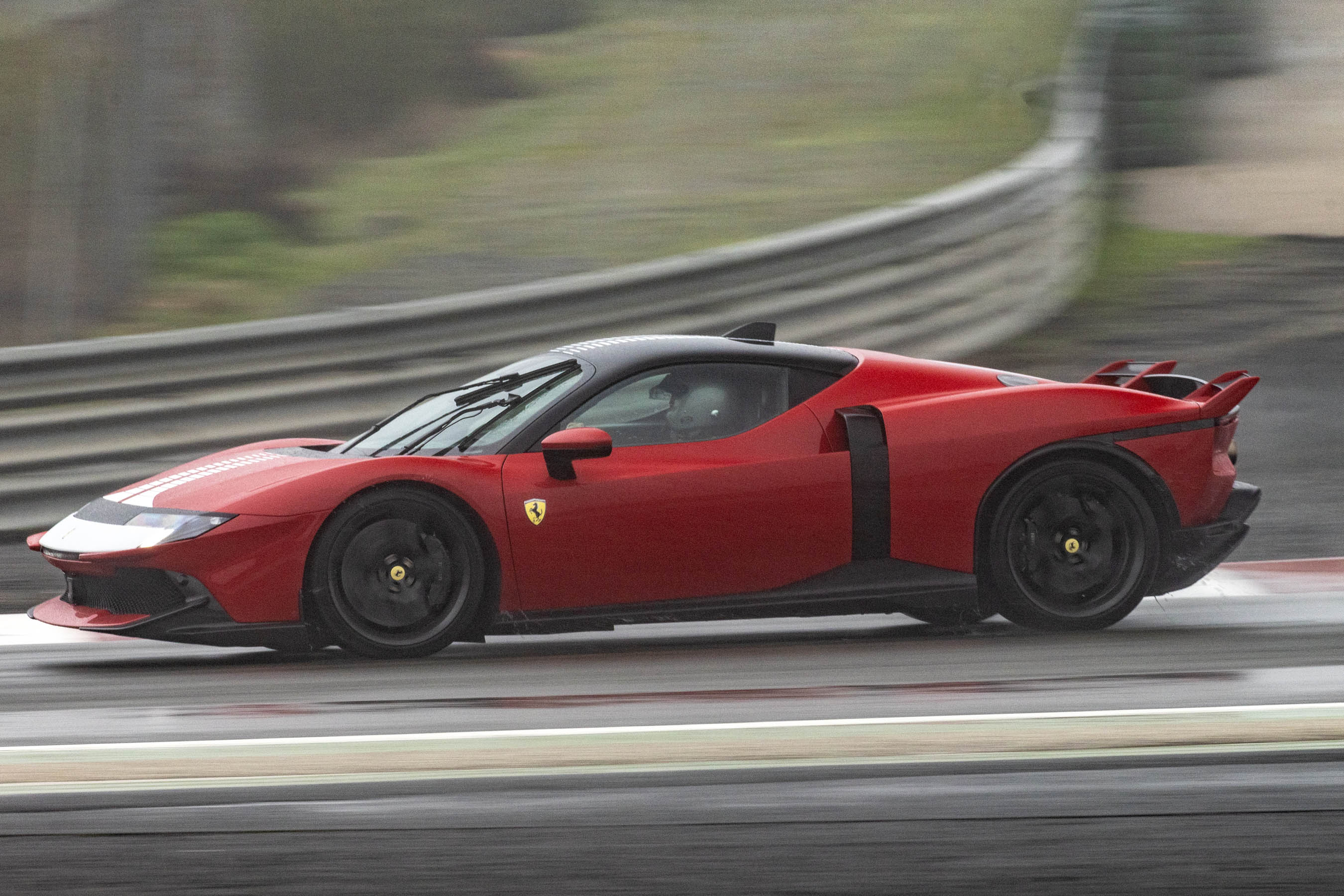
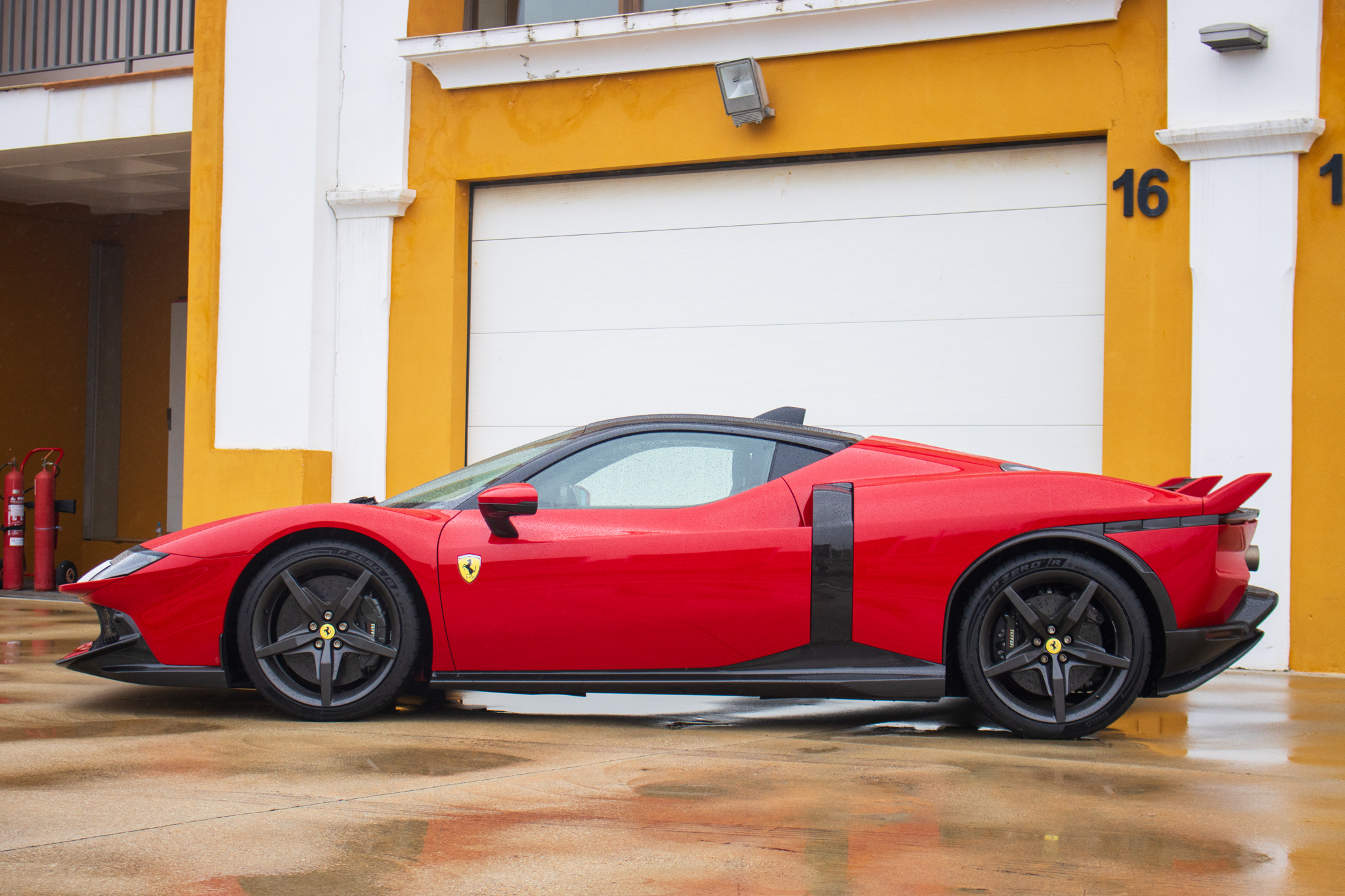
And the way it looks, well, there are few things people agree on less than the direction of Ferrari’s design language. Personally, I think it’s moving in a good direction, and this one in particular would’ve been received more positively if they didn’t call it a Testarossa and expect people not to draw comparisons to the 80s version. I like the retro black bar on the front end, the angled character line tracing from the front bumper all the way up to the twin-tail rear end, and the vertical bar behind the doors that pinches the body like a corset and outlines the side intakes. We should appreciate that the obsession with underbody aero has let Ferrari bring back smoother, softer panels up top. The only miss is the squinty taillights. Give me some circles any day.
Mauro Ujetto
Back to the track. As I mentioned, my day at Circuito Monteblanco was marked by off-and-on downpours, heavy fog, and temperatures in the mid-40s—hardly the ideal conditions for buckling up the four-point harness in an 849 Testarossa equipped with the track-oriented Assetto Fiorano package, which saves about 66 pounds with carbon fiber wheels and lightweight seats, and adds more underfloor aero tricks and twin spoilers out back for even more downforce.
The instructions from Ferrari’s team consisted of leaving the Manettino drive mode dial in Wet mode for the first few laps to get a feel for the car. Meanwhile, the hybrid system has four separate modes itself to manage how the electric power is delivered and recuperated—full electric, Hybrid, Performance, and Qualify—and Performance was best suited for the conditions. Otherwise, just try to keep up.
Wet mode is aptly named: despite the rain and having a thousand horsepower at my command, the 849 simply refused to oversteer, even when I booted the throttle mid-corner just to see what would happen. What I quickly came to realize is that the suite of electronic aids and the hybrid system all act as what Motor Trend’s Angus MacKenzie and I later described as a stupidity sponge—soaking up and smoothing out even the dumbest of inputs.
Only once did an abrupt power cut feel like the traction control system was actively intervening. Otherwise, the 849 Testarossa’s brain makes the driving experience adaptable to conditions and driver skill in an astoundingly natural way. There’s that real-time magic. I’ve never experienced seeing a TC light flashing while burying the accelerator in the carpet in fifth gear and feeling nothing but unbroken acceleration well into triple-digit speeds. It is designed to make you believe like you are right on the edge of control, and it delivered the most visceral track experience I’ve ever had in this job.
There was certainly a lot of understeer, but mainly because there just wasn’t enough grip from the 265/35 R20 tires up front for the torque-vectoring electric motors to do their thing. Wet mode cannot defeat the laws of physics, and at some point you do have to back off. The steering itself was excellent—probably not enough feel for die-hards, but extremely direct and agile. The Assetto Fiorano package uses Multimatic shocks instead of Magneride, though Magneride remains an option, and it felt like the race-derived bit of kit it was, flat through corners and stable over curbs.
After facing my mortality in that first session, the development driver approached me to gently suggest that I was actually still braking too early, and I needed to trust the ABS Evo system more. Hit it late and hard and really lean into trail braking into a curve. That was a tricky ask, not because I didn’t trust it, but because the pedal was quite firm with a short stroke and it was difficult to modulate. The firmness is also adaptive, so it’s challenging to learn on the fly. I found myself wishing for more range to play with. When I did gather the courage to brake later than I thought possible, the 849 Testarossa came through and held the line, apart from more shimmying and shaking than a casual driver would appreciate.
On my last few laps, having learned the course, I switched the Manettino dial from Wet to Sport mode and was immediately greeted with a lot more oversteer, more aggressive intervention from the traction control, and a looser rear end under hard braking. A little more time and I could’ve adapted to it, but I had more business to attend to. The Ferrari team thoughtfully mapped out a two-hour drive through a totally empty, beautifully curvy road through the Spanish countryside to get a feel for the regular 849 Testarossa. Alas, it began to rain even harder, but it gave ample time to judge the car on its everyday usability.
Kyle Cheromcha
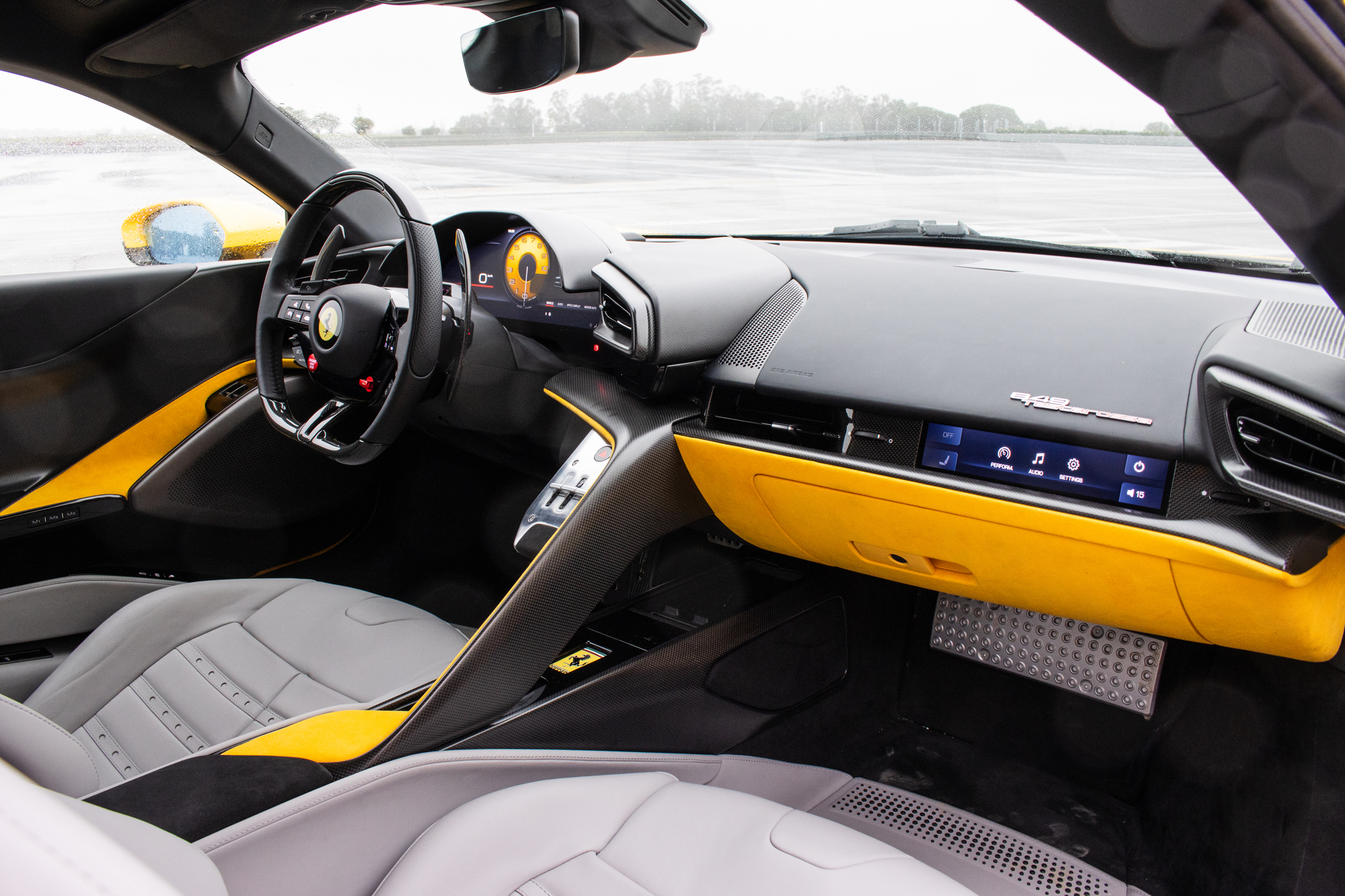
Slipping into the cabin of the street car felt like an immediate upgrade. The powered standard seat is a lot more comfortable, with adjustable bolsters and lumbar, not exactly soft but certainly easy to find a comfortable position. Forward visibility is excellent, with the front fender bulges making it easy to position the corners accurately. Even rear visibility is great because the V8 is mounted so low in the chassis.
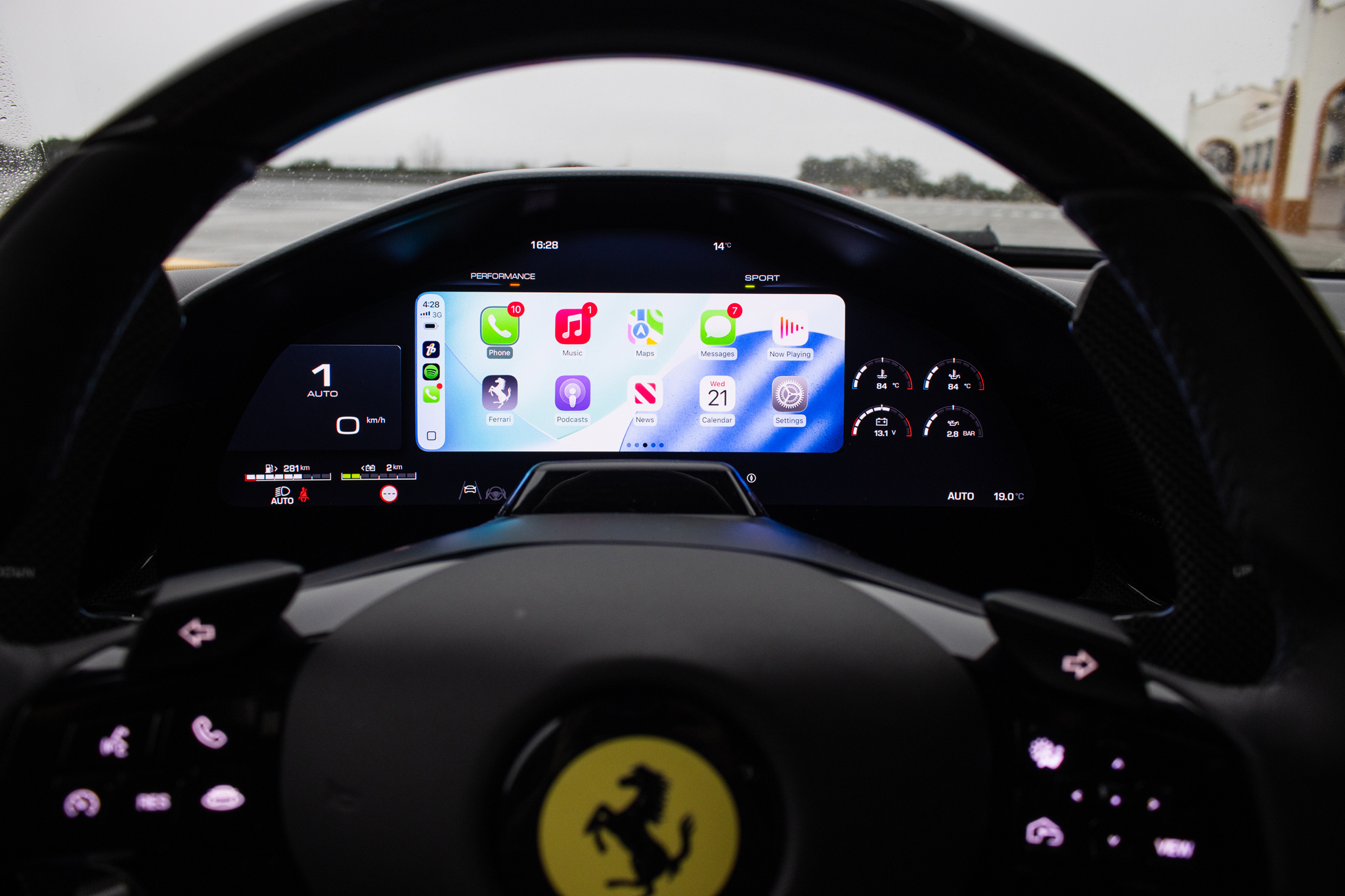
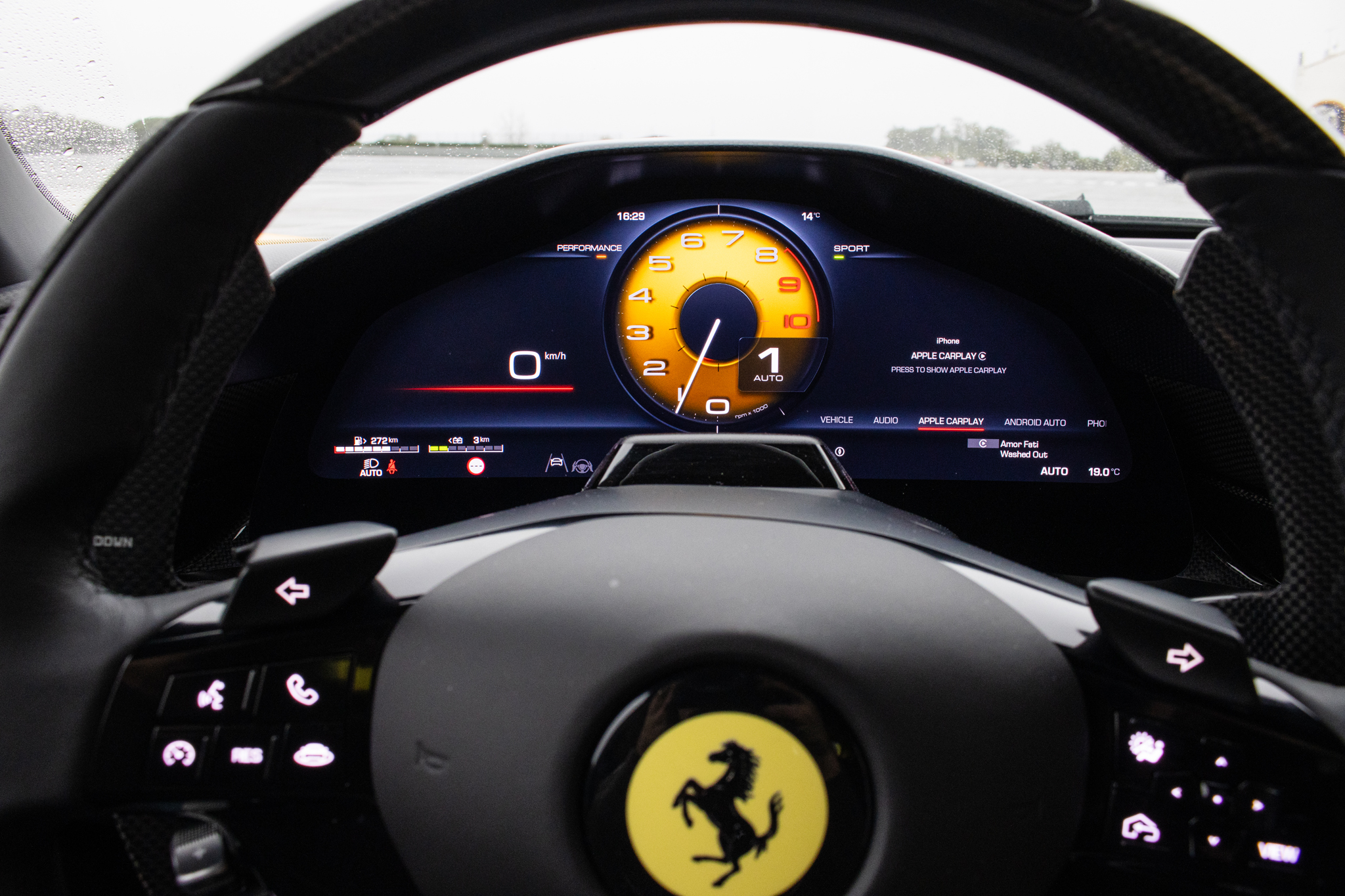
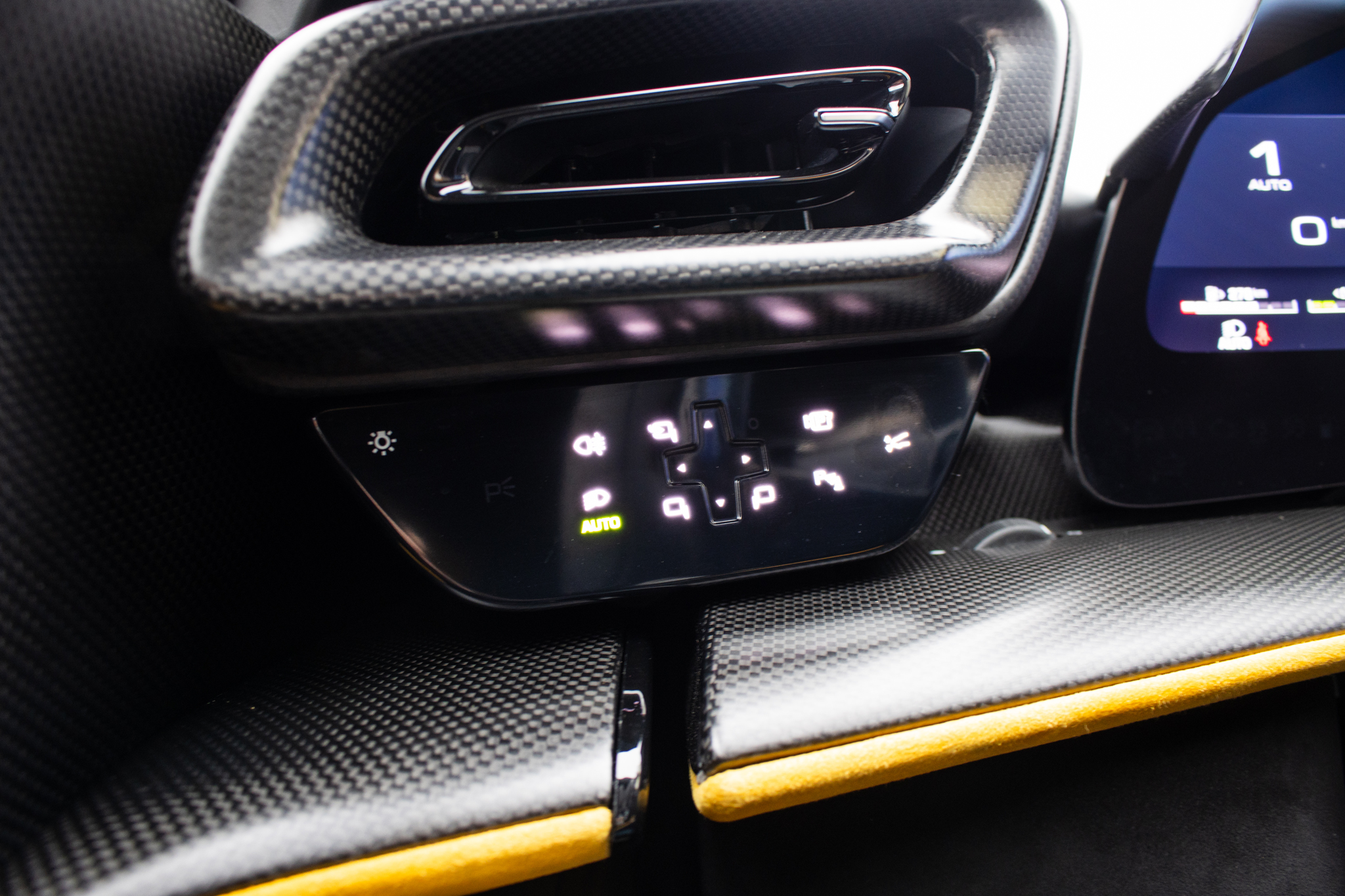
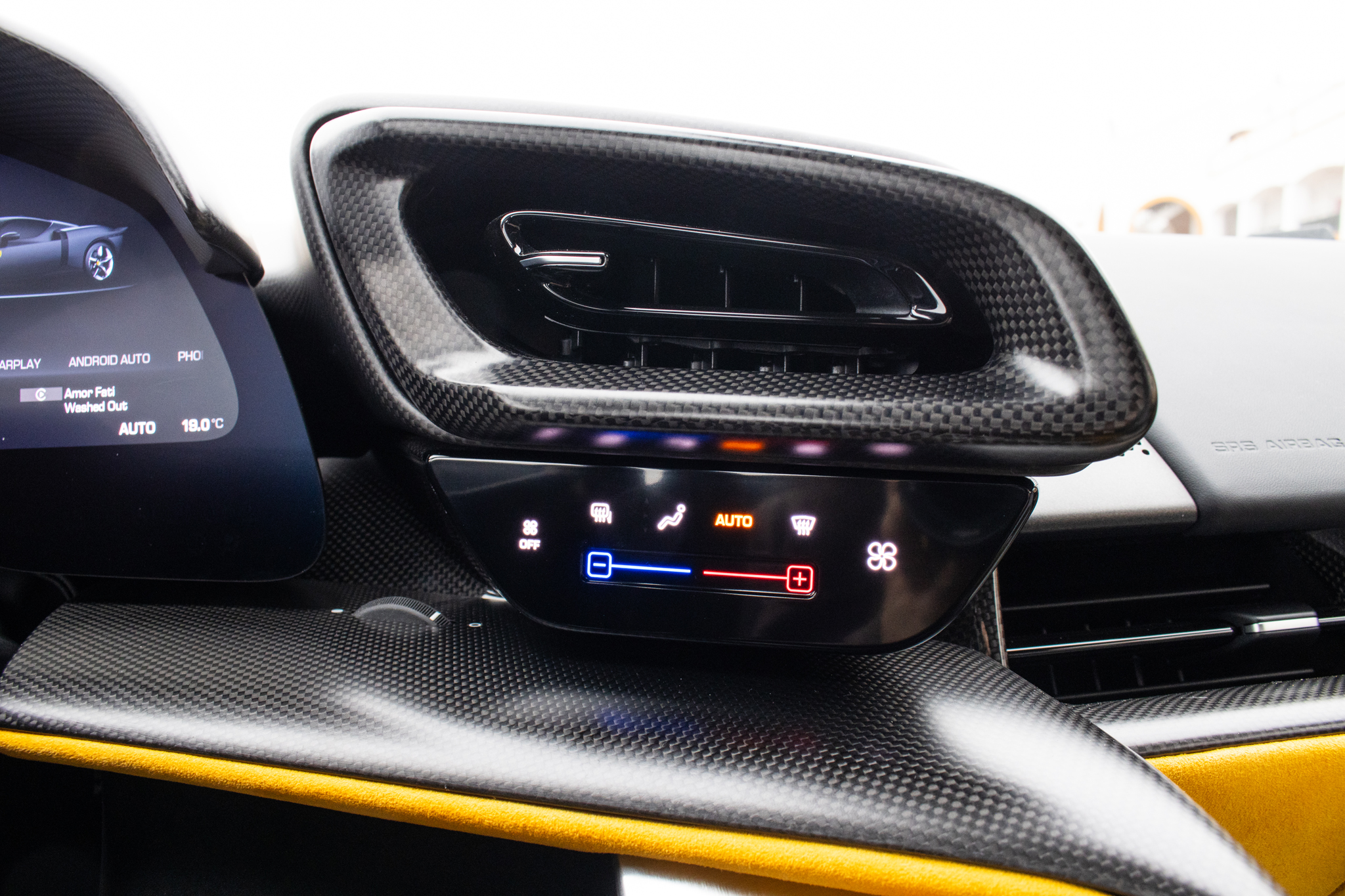
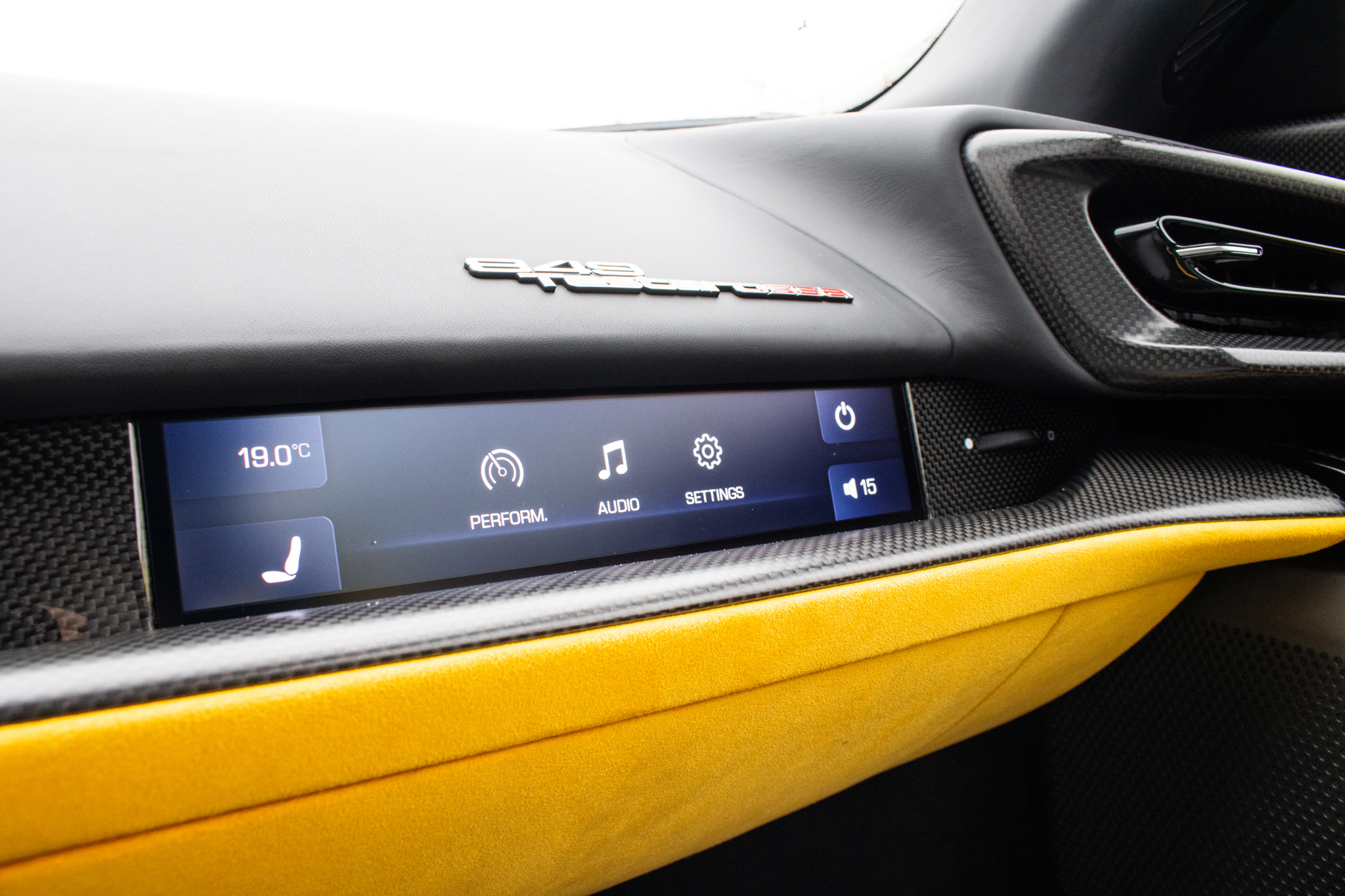
Ferrari is quite proud of the fact that it added real buttons back to the wheel for navigating the single screen containing the gauge cluster and infotainment system, and you know, bonus points for that. The hybrid system selector is still the old touch capacitive nonsense along the bottom of the wheel, though, and only the current selected mode is backlit, so owners will have to get used to memorizing the order and spacing of each option. Otherwise, it frames the screen nicely, flanked by huge and satisfyingly clicky paddle shifters.
Kyle Cheromcha
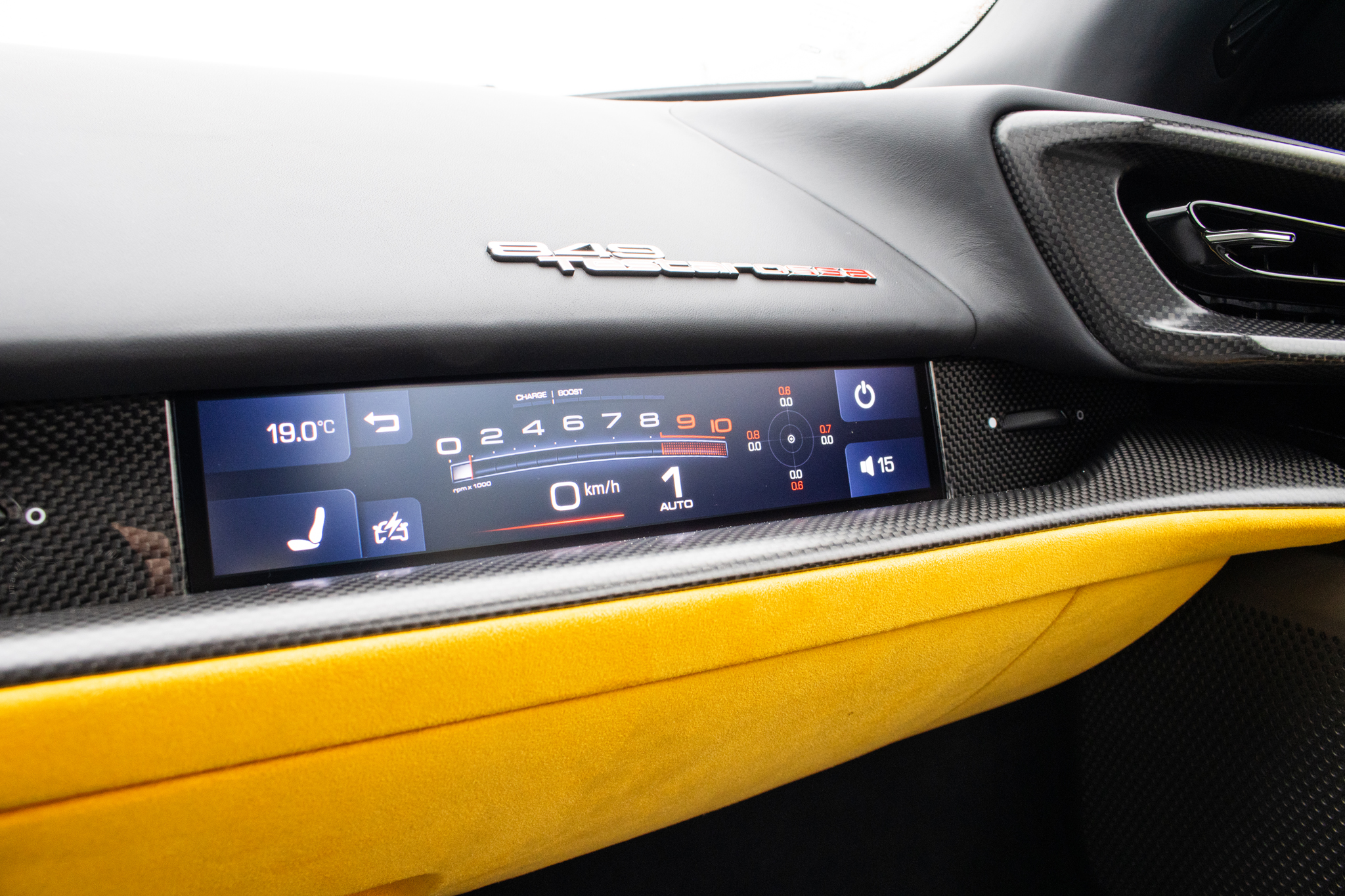
That said, I do have mixed feelings on the single-screen solution (not counting the standard passenger screen, which is useless to the driver). It certainly makes the interior feel more like a proper old-school cockpit, but navigating everything with steering wheel buttons is tricky and sometimes feels as dangerous as reaching over and being distracted by a central touchscreen. Especially when using Apple CarPlay, it just doesn’t feel intuitive. Certain apps “stack” their controls in different ways despite how it looks on the screen, so sometimes pressing the down button actually gets you to the thing you need to click, just below the menu option that’s currently highlighted, and sometimes pressing down actually sends you to the left.
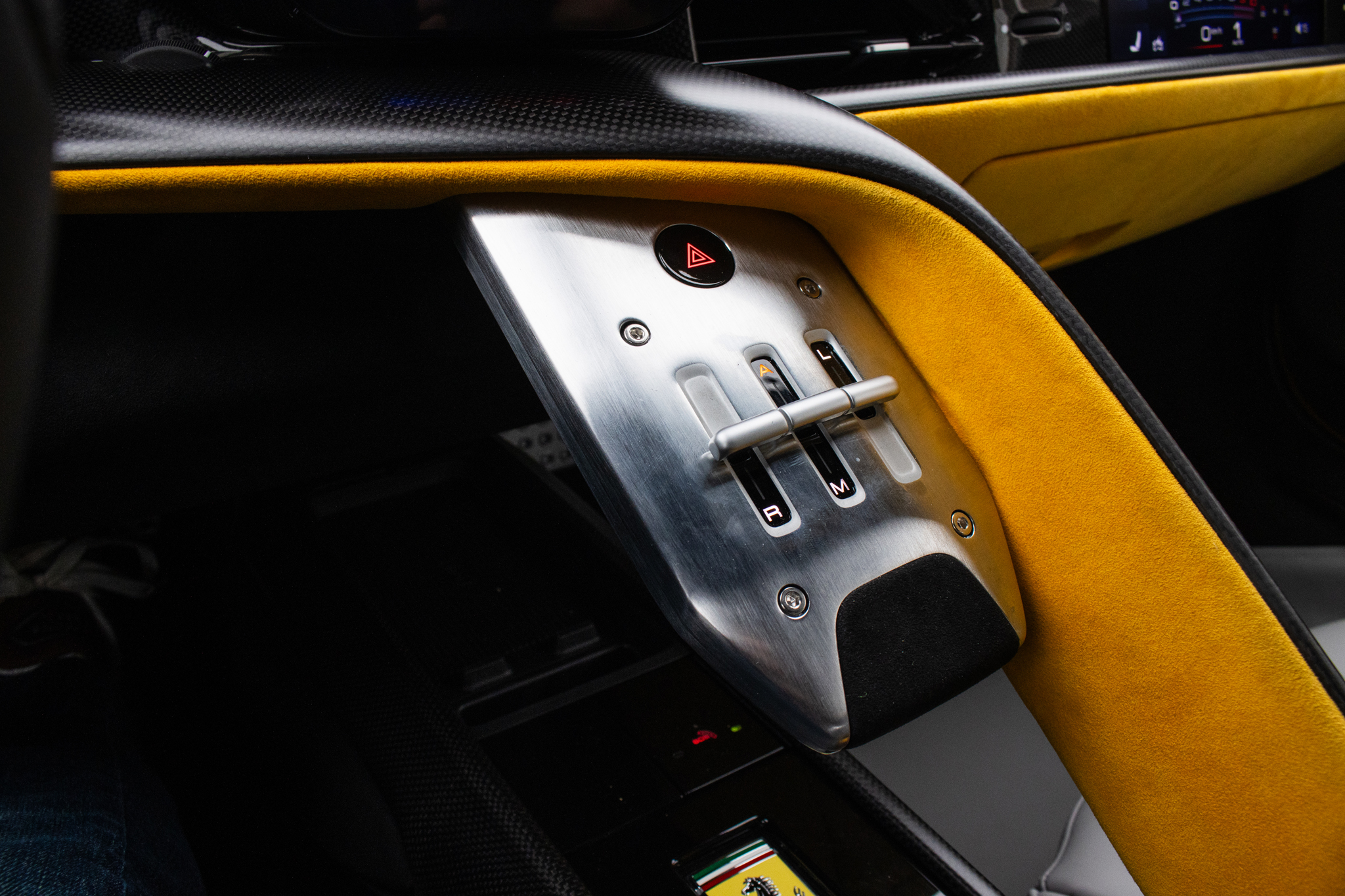
There’s one more thing that’s sure to polarize: there’s no gated manual shifter, but there is a gated manual shifter-looking thing that’s actually the selector for reverse, automatic mode, manual mode, and launch control. I can appreciate what they were going for, but having four options and two blanks on something that’s supposed to look like a six-speed shifter feels inelegant, and the short action on the little levers is weak. If you’re going to visually call back to something people sorely miss, at least try to recreate the experience more.
The blinding rain and guardrail-less road meant any chance to press the 849 Testarossa on the street was out the window, but again, the car never skipped a beat or felt too powerful for how I was using it. It stormed through standing water and muddy wash-overs, never slipped on road markings. The rear was utterly stuck in. The only negative I have to report is that in Sport mode, the transmission is a little too slow to kick down. There’s plenty of torque to surge forward in 5th or 6th gear, but punching the throttle doesn’t bring the drama of a quick drop to 3rd or 2nd like you’d expect.
The Magneride suspension was firm but yielding. Far from plush, but not punishing or over-aggressive, and it had enough ground clearance to never need the front-axle lift over Spain’s many speed bumps. And that brake-by-wire system with its adaptive pedal started to make more sense on the street, where there was less pressure to nail the right amount of force each time.
After a couple of hours of slow-speed fun, I got back on the highway for a half-hour blast back to base camp. The battery was full, having kept itself topped up in Hybrid mode, so I switched into eDrive to experience a silent Ferrari, minus a fair amount of road noise from the tires. The three motors by themselves put out 220 hp, and that certainly felt accurate given the decrease in passing power. Range is… not 15 miles when you’re doing 75 mph. I got about 8 miles before the battery ran out. But hey, it works.
Kyle Cheromcha
Leave your preconceptions at the door, and the 2027 Ferrari 849 Testarossa is an astonishing machine. It is a genuine achievement in the way truly great cars are—surprising, delightful, enthralling, a bit scary, but most of all, fun as hell. If you worry that modern supercars are just way too intense to enjoy, find your way into one of these and see what a company like Ferrari has to say about that.
Because truly great cars are also a statement. In this case, technology can elevate a driving experience from a simulacrum of a more straightforward past into a future that’s truly connected to the things that made the past so special. Just like there’s no world in which screens will disappear from cars, no matter how many buttons we’re able to cajole automakers into bringing back, there’s no world in which modern supercars will ever be like the original Testarossa again.
But we can and should appreciate what Ferrari has done here: using technology to make a 1,000-horsepower plug-in hybrid that engages those same primal pleasure centers in our brains. It scratches that same itch. It has the same magic. The expression is different. But the essence? It’s still there, still intact. Let Ferrari be Ferrari, and great things will happen.
Ferrariprovided The Drive with travel, accommodations, and access to the vehicle for the purpose of writing this review.
GWM has taken the concept of platform sharing to another level, unveiling its ‘ONE’ architecture that will underpin as many as 50 models with hybrid, hydrogen, battery-electric and ICE powertrains planned.
Marketing-approved GWM logic for the system is: “one vehicle, multiple powertrains; one vehicle, multiple categories; one vehicle, multiple configurations; one vehicle, multiple markets”.
Reflecting attempts by global car-makers to reduce development and manufacturing costs across entire product line-ups, GWM appears to have gone further with a one-size-fits-all platform that can be adapted to virtually any vehicle segment or propulsion method.
The platform will have both ladder-frame and monocoque chassis options, and these will be compatible with an array of powertrains ranging from internal combustion to electric and hydrogen fuel cell, with various flavours of hybridisation.
“It may sound dynamic and complex, but in reality they simplify complexity,” said GWM chair Jack Wey.
“Thanks to multiple powertrain options, we have expanded our market reach.
“For example, it can be equipped with large-displacement gasoline engines to meet the demands of the Arab markets.”
An example of these so-called large-displacement engines could be the menacing twin-turbocharged V8 hybrid powertrain GWM revealed at the Shanghai Motor Show and again more recently at CES in Las Vegas.
Whether the force-fed 4.0-litre V8, rumoured to produce 403kW on its own and almost double that when coupled with electric motors, will make it into ONE-based models is yet to be established – but it sounds likely.
GWM’s ONE platform is also reported to use a vision-language-action artificial intelligence model to manage powertrain, dynamics and driver-assistance systems.
These AI systems will be used to predict hazards, adjusting suspension, steering and braking during “emergency avoidance”, meaning a less reactive safety response.
“The GWM ONE platform shatters the traditional boundary between active and passive safety, achieving a deep integration of the two” said GWM chief executive Mu Feng.
“Safety is no longer about reacting to a crash, but about predicting and protecting at every stage.”
More bizarrely, the AI apparently also coordinates the lighting and seats to deliver “romantic” scenario-based experiences…whatever that means.
GWM has so far teased one car – albeit in camouflage form – set to use the new platform, in the form of a large 5.3-metre SUV that will fall under its premium Wey brand in China.
Chinese media reported the model will use a 2.0-litre turbocharged engine with 800-volt plug-in hybrid system, capable of a pure-electric range of around 400km with the ability to recharge at a rate of 200km in just five minutes.
Locally, GWM achieved record sales across 2025 totalling 52,809 vehicles to make it the seventh most popular brand in Australia.